Are you familiar with the railway line known as the "Keiyo Line"? It is a line operated by East Japan Railway Company (JR East), but if you look closely, it is an interesting line full of quirks.
Although it is the Keiyo Line, trains that run exclusively within the line are generally announced as the "Keiyo Line," but for some reason, there are "trains that run entirely on the Keiyo Line yet are announced as if they were traveling on a different line".
An overview of the Keiyo Line
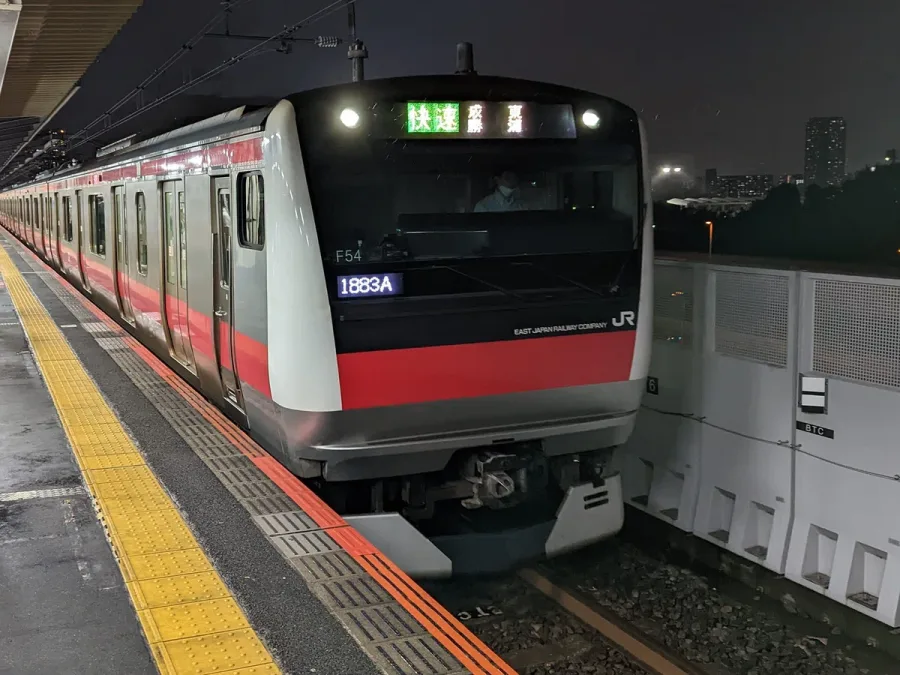
The Keiyo Line is, explaining what kind of line it is, is a quirk in itself. Rather than just name-related quirks like the "actual line name being hidden" or the "actual line name being used as a system name" that I have covered before, the very origin of the line is a quirk. As I will mention later, its quirkiness is also reflected in the fact that the section description of the line differs significantly between the securities report and the "Railway Handbook"" lol
The Keiyo Line was planned as part of the "Tokyo Outer Loop Line," but...As we learn in junior high school social studies class, the "Korean War" broke out in 1950. At that time, Japan supplied materials to the U.S. military, which triggered an escape from the recession that had continued since the end of World War II (Pacific War/Greater East Asia War). This is what is known as the "special procurement boom".
Riding the momentum of the special procurement boom, Japan entered a period of high economic growth called the "High Economic Growth Period" from the late 1950s until just before the oil crisis (oil shock) of the 1970s.
From the special procurement boom to the high economic growth period, Japan's railway freight transport grew significantly. The problem here was the area around Tokyo, or more specifically, the Yamanote Line (freight line) reaching its capacity. Therefore, the then-Japanese National Railways (JNR) launched a project called the "Tokyo Outer Loop Line," which would build a new bypass line for the Yamanote Line about 20 km away from it. The Keiyo Line, which I am covering as a quirk this time, and the Musashino Line, which is intertwined with that quirk, were lines born from this plan.
So, the Keiyo Line at the beginning of the plan was a freight-only line that started at the "Shiohama Marshalling Yard" (Kawasaki Ward, Kawasaki City: current "Kawasaki Freight Station") on the Tokaido Line (freight line), passed through "Nishi-Funabashi Station" (Funabashi City, Chiba Prefecture) and "Chiba Freight Terminal Station" (Mihama Ward, Chiba City), joined the Uchibo Line at Soga Station, and reached "Kisarazu Station" (Kisarazu City, Chiba Prefecture). The reason it passes through Nishi-Funabashi Station is to connect with the Musashino Line.
"Wait, that's different from the current Keiyo Line!" If you thought that, you are sharp. Unlike the Musashino Line, the current Keiyo Line is different from the plan.
The twists and turns of the Keiyo LineLike the Musashino Line, the construction of the Keiyo Line was carried out by the Japan Railway Construction Public Corporation (currently the Japan Railway Construction, Transport and Technology Agency: JRTT). The rough history of the Keiyo Line is as follows.
1967: Construction between Shiohama Marshalling Yard and "Shinagawa Wharf Station" (Shinagawa Ward, Tokyo: tentative name) is approved
1971 : Construction between Nishi-Funabashi and Soga is approved
1973 : The section between Shiohama Freight Terminal and Tokyo Freight Terminal opens
→ This section was treated as an extension of the Tokaido Line (freight line) (and remains so to this day)
→ Tokyo Freight Terminal Station is the official name for 'Shinagawa Wharf Station'1974 : Construction between Tokyo Freight Terminal and Nishi-Funabashi is approved
1975 : Chiba Freight Terminal to Soga opens
→ Operated as a freight-only line at the time
→ Access to Soga Station was temporarily borrowed from a private line built by Kawasaki Steel (now JFE Steel)1978 : Passenger service between Nishi-Funabashi and Soga is approved
1983 :
・Construction between Tokyo Freight Terminal and 'Shin-Kiba Station' (Koto Ward, Tokyo) is frozen
→ A measure taken due to the worsening financial state of the Japanese National Railways and lower-than-expected freight demand
→ This section was later taken over by the 'Tokyo Waterfront Area Rapid Transit' established by the Tokyo Metropolitan Government and repurposed as part of the Rinkai Line (1)
・Construction between 'Tokyo Station' (Chiyoda Ward, Tokyo) and Shin-Kiba Station is approved
→ Built as a passenger-only line following strong requests from Chiba Prefecture
→ The land for the section between Tokyo and 'Etchujima Station' (Koto Ward, Tokyo) was repurposed from land originally secured for the 'Narita Shinkansen,' which had its construction frozen that same year
→ The platform space at Tokyo Station was also land originally secured for the 'Narita Shinkansen'
・Passenger service between Tokyo Freight Terminal and Nishi-Funabashi is approved
→ As mentioned above, since construction between Tokyo Freight Terminal and Shin-Kiba was frozen, the section between Tokyo and Nishi-Funabashi was destined to become a passenger-only line1986 :
・Access tracks at Soga Station completed
→ Ended the borrowing of tracks from Kawasaki Steel
・The section between Nishi-Funabashi and Chiba Freight Terminal extended and opened as a passenger-only line
→Passenger service between Nishi-Funabashi and Soga began
→ Passenger trains were based at a depot (the current Keiyo Rolling Stock Center) built between Shin-Narashino Station (Narashino City, Chiba Prefecture) and Kaihin-Makuhari Station (Mihama Ward, Chiba City)1987: Following the dissolution of the former Japanese National Railways, the entire line was succeeded by JR East
→ Japan Freight Railway Company (JR Freight) continued freight transport on the section between Chiba Freight Terminal and Soga as a Type 2 railway operator1988: The section between Shin-Kiba and Minami-Funabashi and the section between Ichikawa-Shiohama Station (Ichikawa City, Chiba Prefecture) and Nishi-Funabashi opened as passenger-only lines
→ The first fully 'ATS-P' equipped section
in the JR Group→ Through service for Musashino Line 'trains' also began1990: The section between Tokyo and Shin-Kiba opened
→ With this, the Keiyo Line after the plan revision was fully completed-
2000:
・ Chiba Freight Terminal Station was closed
→ With this, all Keiyo Line freight stations disappeared (2)
→ The two Keiyo Rinkai Railway lines (Food North Line and Food South Line) originating from that station were also closed
・ JR Freight changed its Type 2 railway operation section to between Nishi-Funabashi and Soga
→ Operation of through freight trains from the Musashino Line began (3)
→ 'ATS-SN' was re-installed between Nishi-Funabashi and the former Chiba Freight Terminal (4)・ 'Shinko Signal Station' was newly established between Inagekaigan Station (Mihama Ward, Chiba City) and Chiba-Minato Station (Chuo Ward, Chiba City)→ Newly established using a very small portion of the former Chiba Freight Terminal site
→ Installed to allow freight trains to wait for (pass) passenger trains
2015: Ownership of the facilities between the former Chiba Freight Terminal and the former Togawa Signal Station (5) was transferred from JRTT to JR East (transferred free of charge)
-
2023: 'Makuhari-Toyosuna Station' (Mihama Ward, Chiba City) opened between Shin-Narashino and Kaihin-Makuhari→ A station requested by three parties: Aeon Mall, Chiba Prefecture, and Chiba City (6)→ One of the 'strategic new stations' for which JR East also bears part of the project costs (7)
2026: Use of Shinko Signal Station suspended (not closed)
→ Because freight train waiting at the signal station is no longer necessary due to timetable revisions
(1) The section between Shin-Kiba and Tennozu Isle on the 'Rinkai Line' retains remnants of its original construction as the Keiyo Line, such as the 'connecting track at Shin-Kiba Station' and the 'junction between Tokyo Teleport and Tennozu Isle, and the depot beyond it.'
(2) Soga Station is also a freight station, but it is not counted here because it belongs to the Sotobo Line.
(3) In conjunction with this, JR Freight also began Type 2 railway operations on the Musashino Line between Shin-Matsudo and Nishi-Funabashi.
(4) This was a measure taken because the installation of "ATS-PF" (JR Freight-specification ATS-P) for JR Freight locomotives was not progressing at the time. Currently, all locomotives passing through this section are equipped with ATS-PF, so the ATS-SN equipment has been removed.
(5) This was a signal station that existed to enter the private line of Kawasaki Steel; it was abolished in 1986 when the access tracks to Soga Station were improved.
(6) Initially, there were four parties involved, including Narashino City, but the city withdrew midway.
(7) Normally, the principle for petition stations is that they are installed at the "full expense" of the petitioner, but this one was installed with JR East also contributing funds. Other examples include Oda-Sakae Station on the Nambu Line (branch line) in Kawasaki Ward, Kawasaki City, and Ashikaga Flower Park Station on the Ryomo Line in Ashikaga City, Tochigi Prefecture.
Is Tokyo Station the starting point of the Keiyo Line...?
Where is the current starting point and ending point of the Keiyo Line? According to JR East's securities reports, the section between Tokyo and Soga (43.0 km) is treated as the main line, and the section between Ichikawa-Shiohama, Nishi-Funabashi, and Minami-Funabashi (11.3 km) is treated as a branch line. I want you to remember here that even though it is a branch line, the section between Ichikawa-Shiohama, Nishi-Funabashi, and Minami-Funabashi "is also" the Keiyo Line.
The kilometer posts of the Keiyo Line also follow this theory (?) from the securities report, and there is a Keiyo Line end point marker (43km post) between the Uchibo Line outbound platform (Platform 5) and the Keiyo Line platform (Platform 4) at Soga Station.
On the other hand, if you look at the Keiyo Line in the Railway Handbook, it uses a different classification than JR East. The first one listed is not the starting point, but the section between Nishi-Funabashi and Soga, where passenger service first began. And the Tokyo to Ichikawa-Shiohama section and the Ichikawa-Shiohama to Nishi-Funabashi section, which were built later, are "put on the back burner".
The Railway Handbook seems to use a notation that prioritizes the order of opening. However, to repeat, it remains the case that the section between Ichikawa-Shiohama, Nishi-Funabashi, and Minami-Funabashi "is also" the Keiyo Line.
There are two main systems for Keiyo Line "train" schedules
On the Keiyo Line, passenger trains other than limited expresses are operated using a "train schedule" where departure and arrival times are set only at certain stations (excluding some special trains). Keiyo Line "trains" can be broadly divided into the "Keiyo Line" and the "Musashino Line".
"Keiyo Line": Systems that are completed within the Keiyo Line or connect from Soga Station to other linesThe "Keiyo Line," as the name suggests, includes "trains" that are completed within the Keiyo Line, as well as "trains" that enter the Sotobo Line or Uchibo Line from Soga Station (8). For trains entering the Sotobo Line, some trains also enter the Togane Line by splitting or joining along the way.
The trains used on the "Keiyo Line" belong to the Keiyo Rolling Stock Center, and the E233-5000 series, manufactured for the Keiyo Line, is the mainstay, but one set each of the 209-500 series, which was operated on the Chuo-Sobu Line local service (Chuo-Sobu Line local trains), and the "Keihin-Tohoku Line" E233-1000 series are also deployed.
These are basically 10-car trains, but for operations entering the Togane Line, E233-5000 series sets that can be split into "6 cars" and "4 cars" (there are only 4 such sets) are always assigned. The end of the train number is suffixed with "Y" for local trains and "A" for (commuter) rapid trains.
(8) Although they are "trains" on the Keiyo Line, on the lines they enter, they are in principle operated using a "train schedule" where arrival and departure (and some passing) times are determined at each station. However, the method of assigning train numbers follows that of the train schedule.
"Musashino Line": Systems that connect to the Musashino Line (supposedly)The "Musashino Line" is, as the name suggests, a "train" that runs directly onto the Musashino Line (between Fuchu-Hommachi and Nishi-Funabashi). There are systems that enter the Musashino Line at Nishi-Funabashi Station via Tokyo Station and Ichikawa-Shiohama Station, and systems that enter the Musashino Line heading toward Nishi-Funabashi Station from Kaihin-Makuhari Station, Shin-Narashino Station, and Minami-Funabashi Station (there is no service between Kaihin-Makuhari and Soga, or via "Futamata-Shinmachi Station" (Ichikawa City, Chiba Prefecture)).
The rolling stock used for the "Musashino Line" also belongs to the Keiyo Rolling Stock Center, using the E231-0 series and 209-500 series that were used on the Chuo-Sobu Line local service. Both have undergone equipment updates (replacement of major electronic equipment, including the VVVF inverters for motor drive). However, since the 209-500 series has not had its braking system replaced, unlike the updated 0 series cars (9), you can still enjoy the unique air brake sound of the 209 series.
The "Musashino Line" "trains" have the letter "E" at the end of the train number. This does not change whether they are departing from/arriving at Tokyo Station or Minami-Funabashi/Kaihin-Makuhari Station.
However, as those with a keen eye may have noticed, the sections between Ichikawa-Shiohama and Nishi-Funabashi on the Keiyo Line and between Minami-Funabashi and Nishi-Funabashi are both structures that allow direct access to the Musashino Line without reversing (a so-called "delta junction"). Therefore, from the perspective of the Keiyo Line, the train sets departing from/arriving at Tokyo Station and those departing from/arriving at Minami-Funabashi/Kaihin-Makuhari Station run in "opposite directions".
Therefore, "Musashino Line" train sets never enter service between Ichikawa-Shiohama, Futamata-Shinmachi, and Minami-Funabashi. If operations were disrupted, the orientation of the train sets could end up reversed...
(9) After the equipment update, the 0 series updated cars were renumbered to the "2000 series" for those equipped with air-operated doors and the "2100 series" for those with electric doors. For the 500 series, no renumbering was performed due to equipment updates (excluding one-man operation modified cars for the Hachiko Line and Kawagoe Line).
Why is it the "Musashino Line" even though it only runs on the Keiyo Line?
Now that I've written over 5,300 characters just in the introduction, here is the main topic (too long, lol). On the Keiyo Line, there are "trains" departing from/arriving at Nishi-Funabashi that do "not" go directly to the Musashino Line in the morning and evening. Both "Tokyo - Nishi-Funabashi" services and the reverse "Kaihin-Makuhari/Minami-Funabashi - Nishi-Funabashi" services are available, but the latter has more frequent service.
I observed the 19:29 departure from Minami-Funabashi bound for Nishi-Funabashi this time, and there were several "strange" points.
Strange point 1: It's called the "Musashino Line" at the station even though it doesn't go to the Musashino LineAt Minami-Funabashi Station, there is a bulletin board that always displays the next "train" for the Musashino Line. This is because the departure track changes depending on the time of day (and timing), but this bulletin board not only displays "trains" bound for Nishi-Funabashi but also politely displays them as "Musashino Line" bound for Nishi-Funabashi.
As I have said several times before, the track between Nishi-Funabashi and Minami-Funabashi is also a proper Keiyo Line. Therefore, this is strictly speaking, "incorrect" information. It should correctly be from the Keiyo Line, I repeat.
Perhaps to avoid this criticism, the route name is omitted in the automatic in-train announcements for trains bound for Nishi-Funabashi. Even though they usually say things like "This train is the Keiyo Line (direct to Musashino Line)..." or "This train is direct to the Sotobo Line (Uchibo Line)..." (
Strange point 2: The train cars are also called "Musashino Line" even though they don't go to the Musashino Line (with exceptions)As you can see from the information display at Minami-Funabashi Station earlier, Keiyo Line trains bound for Nishi-Funabashi are treated as "Musashino Line" "trains". The train number also ends with the letter "E".
Most of the train cars are also E231-0 series or 209-500 series for the "Musashino Line". These cars display "Musashino Line" and "Nishi-Funabashi" on their destination signs. Even though they don't enter the Musashino Line by even 1mm...
Regarding the cause of the misleading information, while it is true that this is what happens when you set the destination display data for the Musashino Line's E231-0 series or 209-500 series normally, it is also clear that any train labeled 'Musashino Line' will unconditionally go to Nishi-Funabashi Station, so it seems they intentionally chose not to label it 'Keiyo Line' to prioritize clarity.
Furthermore, Keiyo Line trains bound for Nishi-Funabashi are sometimes operated using 'Keiyo Line' rolling stock. In these cases as well, the station information displays and train numbers are treated as 'Musashino Line'. However, when using the E233 series, they display the service type as 'Local' and omit the line name (a side effect of this is that it seems they cannot provide next-station announcements via the destination display). I don't have enough information about the 209-500 series, so I'm not sure.
Summary: It's only one station, but surprisingly, people were riding it.
So, that was the story of the 'trains' that are labeled 'Musashino Line' even though they only run on the Keiyo Line. Setting aside the trains arriving from and departing for Tokyo, I was curious about the passenger numbers for the trains arriving from and departing for Minami-Funabashi, since they only travel for one station, so I went to check it out.
Even though the 'train' only runs for one station, the seats were mostly full, and in some cars, there were even a few standing passengers. Once you get to Nishi-Funabashi Station, you can transfer to the Sobu Line (Local), the Tozai Subway Line, or the Toyo Rapid Railway, and although it's a bit of a walk, you can also get to Keisei-Funabashi Station (in Funabashi City, Chiba Prefecture) on the Keisei Main Line. When you really think about it, there is actually quite a bit of demand even for just one station.
Come to think of it, back home there is a shuttle service between Mishima and Numazu on the Tokaido Main Line, and because it's convenient for transferring between the Tokaido Shinkansen and the Gotemba Line, it actually gets a surprising number of passengers.
Deciding which 'needs' to address is quite a difficult point. In the case of the Keiyo Line, while they have been prioritizing short-distance users recently, I feel like they aren't fully meeting the 'needs' of medium- and long-distance users. But in this world, you can't please everyone, so I suppose it's important to find a balance through steady research and the like.