On September 19, 2025, the use of the My Number health insurance card via smartphone was finally unblocked. However, when actually using it, questions arise one after another.
These questions are often dismissed as 'just the way it's designed,' but in the background, issues of technology, systems, and organizations are intricately intertwined. This article will thoroughly delve into each of them.
1. The Big Picture of NFC Standards: Do Type C and Type F Exist?
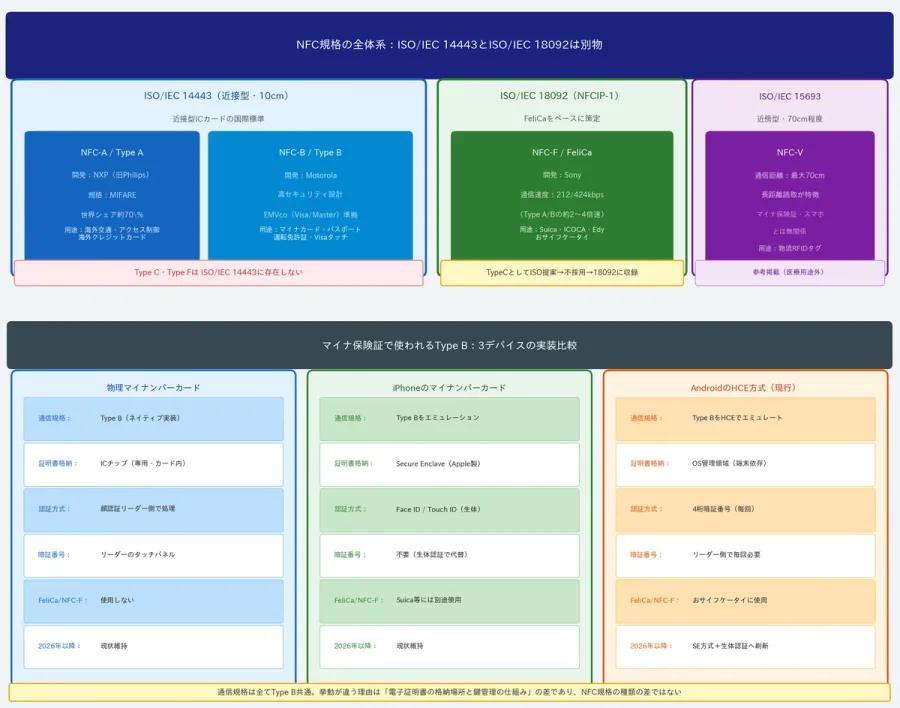
When using a My Number health insurance card on a smartphone, the questions 'Shouldn't both the physical card and the smartphone be NFC Type B?' and 'Aren't there Type C or Type F?' are valid. First, let's accurately organize the big picture of NFC standards.
The NFC standard is not a 'single system'NFC consists of two majordifferent international standard systems. They are easily confused, but they are different things.
ISO/IEC 14443 (proximity type, communication distance of 10cm) is the standard used for My Number health insurance cards, passports, and credit card touch payments, and onlyType A and Type B are defined here. Type A is MIFARE, developed by NXP (formerly Philips) of the Netherlands, which holds about 70% of the global market share, mainly in Europe. Type B was developed by Motorola and is adopted for passports, My Number cards, driver's licenses, and Visa touch payments due to its high-security design.
ISO/IEC 18092 (NFCIP-1) is the standard used for Suica, ICOCA, and Osaifu-Keitai, and was formulated based on FeliCa developed by Sony. The NFC Forum calls thisNFC-F. Its communication speed is about 2 to 4 times faster than Type A/B, making it suitable for a 'touch and go' experience that allows passing through ticket gates in less than 0.2 seconds.
Where are 'Type C' and 'Type F'?Type Cdoes not exist in ISO/IEC 14443. There is a history where Sony proposed FeliCa as 'Type C' for ISO/IEC 14443 international standardization, but it was rejected during deliberation. For this reason, some old documents list FeliCa as 'Type C,' but its current official position is ISO/IEC 18092 (NFC-F).
Type Falso does not exist in ISO/IEC 14443. This notation spread because the NFC Forum called FeliCa NFC-F, but this is an alias referring to ISO/IEC 18092, and it is inaccurate as a standard system to list it alongside Type A or Type B of ISO/IEC 14443.
Note thatNFC-V(ISO/IEC 15693) also exists, but its communication distance is as long as 70cm, and it is mainly used for logistics RFID tags and is unrelated to the My Number health insurance card.
Standard NameStandardDeveloperMain UseNFC-A (TypeA)ISO/IEC,14443-ANXP (formerly Philips)Overseas transport/access controlNFC-B (TypeB)ISO/IEC,14443-BMotorolaMy Number card/passport/Visa touchNFC-F (FeliCa)ISO/IEC,18092SonySuica/e-money/Osaifu-KeitaiNFC-VISO/IEC,15693MultipleLogistics RFID tag (70cm distance)TypeCDoes not exist—FeliCa ISO proposal rejected -> to NFC-FTypeF (within 14443)Does not exist in ISO/IEC,14443—Alias/different system of NFC-F (18092)\beginarrayl \hline \textbfStandard Name & \textbfStandard & \textbfDeveloper & \textbfMain Use \\ \hline \textNFC-A (TypeA) & \textISO/IEC,14443-A & \textNXP (formerly Philips) & \textOverseas transport/access control \\ \hline \textNFC-B (TypeB) & \textISO/IEC,14443-B & \textMotorola & \textMy Number card/passport/Visa touch \\ \hline \textNFC-F (FeliCa) & \textISO/IEC,18092 & \textSony & \textSuica/e-money/Osaifu-Keitai \\ \hline \textNFC-V & \textISO/IEC,15693 & \textMultiple & \textLogistics RFID tag (70cm distance) \\ \hline \textTypeC & \textDoes not exist & \text— & \textFeliCa ISO proposal rejected -> to NFC-F \\ \hline \textTypeF (within 14443) & \textDoes not exist in ISO/IEC,14443 & \text— & \textAlias/different system of NFC-F (18092) \\ \hline \endarray
My Number health insurance card uses only Type BThe My Number card (both physical and smartphone versions) uses only ISO/IEC 14443 Type B. Both iPhone and Android emulate Type B using a different circuit than the 'NFC-F used for Suica.' The facial recognition reader simply accepts devices that communicate via Type B, and the key management behind it is not questioned.
Differences in implementation of 3 devicesTo give the answer first,the communication standard is common to all Type B, but the storage location of the electronic certificate and the key management mechanism differ for each deviceis the essence of the difference in behavior.
The physical My Number cardnatively implements Type B and stores the electronic certificate directly on the IC chip.
The iPhone My Number Card stores the digital certificate in a hardware key management chip called Apple's 'Secure Enclave' and integrates it with Face ID/Touch ID, allowing the process to be completed solely through biometric authentication. While it appears as Type B communication to the reader, there is a robust barrier of biometric authentication inside the iPhone.
The Android HCE (Host Card Emulation) method uses HCE, where the Android OS emulates Type B via software. Because Android devices vary widely across manufacturers and models, and hardware key management specifications equivalent to the Secure Enclave are not standardized, current services are forced to adopt a design that requires the user to enter a 4-digit PIN on the reader side every time.
ItemPhysical My Number CardiPhoneAndroid (Current)Communication StandardType B (Native)Type B EmulationType B simulated via HCECertificate StorageIC Chip (Dedicated)Secure EnclaveOS Managed Area (Device Dependent)Authentication MethodFace Authentication (Reader side)Face ID/Touch ID (Biometric)4-digit PIN (Every time)PIN EntryRequired sometimes on readerNot requiredRequired on reader every timeFeliCa UsageNot usedUsed separately for Suica, etc.Used for Osaifu-KeitaiFrom 2026 onwardsStatus quoStatus quoRefreshed to SE method + Biometrics\beginarrayl \hline \textbfItem & \textbfPhysical My Number Card & \textbfiPhone & \textbfAndroid (Current) \\ \hline \textCommunication Standard & \textType B (Native) & \textType B Emulation & \textType B simulated via HCE \\ \hline \textCertificate Storage & \textIC Chip (Dedicated) & \textSecure Enclave & \textOS Managed Area (Device Dependent) \\ \hline \textAuthentication Method & \textFace Authentication (Reader side) & \textFace ID/Touch ID (Biometric) & \text4-digit PIN (Every time) \\ \hline \textPIN Entry & \textRequired sometimes on reader & \textNot required & \textRequired on reader every time \\ \hline \textFeliCa Usage & \textNot used & \textUsed separately for Suica, etc. & \textUsed for Osaifu-Keitai \\ \hline \textFrom 2026 onwards & \textStatus quo & \textStatus quo & \textRefreshed to SE method + Biometrics \\ \hline \endarray
Planned improvements for Autumn 2026The Digital Agency plans to refresh the 'Android My Number Card' around autumn 2026, realizing biometric authentication integration by utilizing Google Wallet and Android's security foundation (Strongbox Keymaster). The current PIN entry requirement is merely a transitional specification.
2. Why are the operation steps different between Android and iPhone?
Given the technical background in the previous section, the difference in operation is clear.
On iPhone, 'biometric authentication via Secure Enclave' is completed within the smartphone, so authentication is finished just by holding it over the reader. Android requires a two-step process: entering a PIN, then holding it over the reader. Furthermore, adding 'iPhone/Android selection' and 'multiple consent screens' significantly increases the amount of operation compared to the physical card's face authentication (1 step).
3. Are 'presentation every time' and 'consent every time' really necessary?
With traditional insurance cards, checking once a month was sufficient at the same hospital. Why has it become 'every time'?
Official AnswerAccording to the official FAQ of Myna Portal, it is stated that, in principle, presentation of the insurance card is required at every visit according to Article 53 of the Health Insurance Act Enforcement Regulations, and the design is set up to obtain consent for viewing medical and medication information each time.
The reason the 'consent every time' screen appears multiple times is that consent is obtained under the Personal Information Protection Act for each type of information viewed (medical information, medication information, health checkup information, etc.). This results in 2 to 4 consent operations per visit.
However, legally, once a month is sufficientAccording to the Japan Federation of Insurance Medical Associations, as an interpretation of the Ministry of Health, Labour and Welfare, it is permitted to operate such that 'when eligibility is confirmed via the online qualification verification system based on the insured person's number, etc., during the second or subsequent visit within the same month, the card is not required to be presented again.'
While once a month is sufficient by law, the government has a policy intention to 'have it used as much as possible every time' to improve the adoption rate. Criticism has also emerged from the field, stating that 'if we check every time even for follow-up visits, the site will be in chaos.'
4. Why can it only be installed on one smartphone?
Contradiction with Credit CardsEven though only one credit card is issued, it can be registered simultaneously in multiple digital wallets such as Apple Pay and Google Pay. Why can't that be done with the My Number Health Insurance Card?
The reason credit cards can be registered on multiple devices is due to "tokenization," which Visa and Mastercard put into practical use around 2014. A unique token (virtual card number) is issued for each device from a single card, allowing for the invalidation of only that specific token in the event of loss.
Ironically, the tokenization method is more secure.Concentrating everything on one device means that if it is lost, all services are suspended, and re-registration at a municipal office becomes necessary. With the tokenization method, you can immediately invalidate only the relevant device with a single app operation.
The single-device limit for the My Number health insurance card is not a technical necessity, but rather a design choice (a product of avoiding responsibility and reducing development costs)—it is reasonable to view it as such.
Comparison ItemCurrent (Single-Device Limit)Tokenization Method (Credit Card Style)Impact of Loss/TheftAll services suspendedOnly the relevant device invalidatedLocalization of DamageImpossiblePossibleRecovery ProcedureRe-registration at municipal officeImmediate invalidation via appConvenience of Multiple DevicesNoneAvailableRisk ConcentrationHigh (All concentrated on one device)Low (Distributed per device)Private Sector Adoption—Around 2014 (Visa/Mastercard)\beginarrayl \hline \textbfComparison Item & \textbfCurrent (Single-Device Limit) & \textbfTokenization Method (Credit Card Style) \\ \hline \textImpact of Loss/Theft & \textAll services suspended & \textOnly the relevant device invalidated \\ \hline \textLocalization of Damage & \textImpossible & \textPossible \\ \hline \textRecovery Procedure & \textRe-registration at municipal office & \textImmediate invalidation via app \\ \hline \textConvenience of Multiple Devices & \textNone & \textAvailable \\ \hline \textRisk Concentration & \textHigh (All concentrated on one device) & \textLow (Distributed per device) \\ \hline \textPrivate Sector Adoption & \text— & \textAround 2014 (Visa/Mastercard) \\ \hline \endarray
5. Why is medication information reflected with a delay of several months?
One of the biggest selling points of the My Number health insurance card is that you can "reference the history of medications prescribed at multiple medical institutions and pharmacies." However, the reality is quite different.
The medication information referenced by the current My Number health insurance card is based on receipt (medical fee statement) data. Receipts are closed at the end of the month, submitted to the Payment Fund or National Health Insurance Federation the following month, and processed and registered from the 11th to the 14th of the following month or later.
Structurally, only information up to the end of the previous month can be referenced, and at most, information from about two months ago is reflected. "Medications prescribed at another hospital 2–3 days ago" cannot be confirmed with the My Number health insurance card. This is a common specification for all medical institutions nationwide, and in situations involving acute illnesses or emergency prescriptions, it can become a medical safety risk.
The solution is electronic prescriptions, but adoption is lagging.The fundamental solution to this problem is electronic prescriptions. Because information prescribed by a doctor is registered in real-time with the electronic prescription management service, pharmacies can confirm medication information immediately.
However, according to data from the Ministry of Health, Labour and Welfare as of June 22, 2025, the adoption rate for electronic prescriptions remains at 82.5% for pharmacies, 13.4% for hospitals, and 19.6% for clinics. The government had set a goal to "have them adopted by almost all medical institutions and pharmacies" by March 2025, but it became certain that the goal would not be met, and the target was revised in the summer of 2025.
With adoption by the prescribing doctors (hospitals/clinics) at only about 10–20%, patients cannot enjoy the benefits of electronic prescriptions.
MechanismImmediacy of InformationNotesMedication Notebook (Paper/Electronic)Immediate (Recorded on day of visit)Patient must bring itMy Number Health Insurance Card (Receipt-based)Max 1–2 month time lagPrevious month’s data reflected after 11th–14th of next monthElectronic Prescription-Compatible InstitutionImmediate to real-time82.5% of pharmacies, only 13.4% of hospitals\beginarrayl \hline \textbfMechanism & \textbfImmediacy of Information & \textbfNotes \\ \hline \textMedication Notebook (Paper/Electronic) & \textImmediate (Recorded on day of visit) & \textPatient must bring it \\ \hline \textMy Number Health Insurance Card (Receipt-based) & \textMax 1–2 month time lag & \textPrevious month's data reflected after 11th–14th of next month \\ \hline \textElectronic Prescription-Compatible Institution & \textImmediate to real-time & \text82.5\% of pharmacies, only 13.4\% of hospitals \\ \hline \endarray
6. Why am I asked for a medication notebook even though I have a My Number health insurance card?
It is natural to think, "If I can get medication information with my My Number health insurance card, I shouldn't need a medication notebook," but the reality is that a structure where both are necessary has been created.
The "Medication Notebook Penalty" in the Medical Fee SystemThe "dispensing fee" that determines the bill at a pharmacy includes an item called "medication management guidance fee," and the points differ depending on whether or not a medication notebook is presented.
If you bring and present your medication notebook: Medication management guidance fee (1) → 45 points
If you do not bring your medication notebook: Medication management guidance fee (2) → 59 points
Since 1 point = 10 yen, not having the notebook results in a charge that is 14 points = 140 yen higher. For a patient with a 30% co-pay, this results in a difference of approximately 42 yen per visit.
CategoryWith NotebookWithout NotebookMedication Management Fee(1) 45 points(2) 59 points30% Patient Co-payApprox. 135 yenApprox. 177 yenDifference14 points = Approx. 42 yen(Higher without notebook)Additional FeesAllowed (Dispensing Mgmt, etc.)Not allowedPharmacy PenaltyNoneReduced to 13 points if usage rate is 50% or less\beginarrayl \hline \text\bf Category & \text\bf With Notebook & \text\bf Without Notebook \\ \hline \textMedication Management Fee & \text(1) 45 points & \text(2) 59 points \\ \hline \text30\% Patient Co-pay & \textApprox. 135 yen & \textApprox. 177 yen \\ \hline \textDifference & \text14 points = Approx. 42 yen & \text(Higher without notebook) \\ \hline \textAdditional Fees & \textAllowed (Dispensing Mgmt, etc.) & \textNot allowed \\ \hline \textPharmacy Penalty & \textNone & \textReduced to 13 points if usage rate is 50\% or less \\ \hline \endarray
Furthermore, pharmacies where the notebook presentation rate for patients returning within 6 months is 50% or less are deemed 'pharmacies without sufficient evidence of notebook utilization,' and are subject to a restriction where they can only charge a special rate of 13 points instead of the standard medication management guidance fee (45 points). The system is designed to force pharmacies to encourage patients to bring their notebooks.
The essence of the problem: The time lag preserves the significance of the medication notebook.According to data from the Japan Federation of Insurance Medical Associations, the rate of medication information viewing via My Number health insurance cards at pharmacies remains at only 28.5%. The reason is simple: medication information on the My Number card is delayed by up to two months, whereas a medication notebook can record prescriptions from that very day immediately.
This dual structure will not be resolved until electronic prescriptions are widely adopted by medical institutions and the medical fee system is revised to change the status of the medication notebook.
7. Why equipment varies by hospital
When you visit a hospital, you notice that the equipment configuration varies completely depending on the facility.
Card readers with facial recognition are terminals already introduced for physical My Number card support, manufactured by multiple companies such as Fujitsu, Hitachi, and Sony, with slightly different specifications. General-purpose card readers for smartphones are external terminals added later to support smartphones. Because facial recognition readers do not have built-in NFC smartphone reading capabilities, they are placed separately in many hospitals.
The design requires users to move between two devices when using a smartphone, which is the biggest cause of confusion. Furthermore, many medical institutions have not installed smartphone readers, and the Ministry of Health, Labour and Welfare itself urges patients to 'bring their physical card to medical institutions for the first time.'
Device TypePurposeInstallation StatusFacial Recognition ReaderPhysical card reading/consentInstalled in almost all facilitiesSmartphone ReaderSmartphone NFC readingMany facilities lack thisIntegrated Reader (New)Handles both in one unitOnly in some new facilitiesWhy the variationMultiple makers/phased rolloutRetrofitting/budget constraints\beginarray \hline \text\bf Device Type & \text\bf Purpose & \text\bf Installation Status \\ \hline \textFacial Recognition Reader & \textPhysical card reading/consent & \textInstalled in almost all facilities \\ \hline \textSmartphone Reader & \textSmartphone NFC reading & \textMany facilities lack this \\ \hline \textIntegrated Reader (New) & \textHandles both in one unit & \textOnly in some new facilities \\ \hline \textWhy the variation & \textMultiple makers/phased rollout & \textRetrofitting/budget constraints \\ \hline \endarray
8. Is the Digital Agency not a 'group of experts'?
The Digital Agency self-evaluates that 'there are not many organizational forms in the world where civil servants and private-sector experts are mixed as a central government agency,' and it is true that excellent private-sector engineers and PMs have gathered there. The problem is not the quality of the talent, but the structure that prevents their abilities from being utilized.
From the beginning, 20 to 30 bureaucrats became involved in every case, which met with resistance from those from the private sector. There was a significant gap between private companies and the government in terms of tool introduction and decision-making speed.
Four combined problems—bureaucrat-led decision-making, reliance on major system integrators, siloed administrative structures, and difficulty in retaining talent—have created a situation where the national system in 2025 is failing to solve problems that the fintech industry solved in 2014.
Problem AxisSpecific DetailsImpact on My NumberBureaucrat-led decisions20-30 bureaucrats control all casesUX ignored/avoidance of responsibilityReliance on major SIersBulk orders to Fujitsu/NTT DataDeadline priority/obsolete designSiloed administrationDigital Agency/MHLW/MIC dividedFinancial expertise not integratedDifficulty retaining talentFewer national civil service applicantsLoss of top private talent\beginarray \hline \textbfProblem Axis & \textbfSpecific Details & \textbfImpact on My Number \\ \hline \textBureaucrat-led decisions & \text20-30 bureaucrats control all cases & \textUX ignored/avoidance of responsibility \\ \hline \textReliance on major SIers & \textBulk orders to Fujitsu/NTT Data & \textDeadline priority/obsolete design \\ \hline \textSiloed administration & \textDigital Agency/MHLW/MIC divided & \textFinancial expertise not integrated \\ \hline \textDifficulty retaining talent & \textFewer national civil service applicants & \textLoss of top private talent \\ \hline \endarray
9. Conclusion: The Big Picture of the Problem
The 'inconvenience' of the My Number health insurance card is not merely a superficial usability issue, but a structural problem spanning three layers: technology, policy, and organization.
IssueRoot CauseProspects for ImprovementEntering PIN every time on AndroidImplementation gap between HCE and Secure EnclaveScheduled for improvement in Fall 2026Presenting and consenting every timeLegal requirements + policy intent for adoptionUnlikely to change for the time beingOnly one device can be registeredDesign that does not adopt a token-based approachNo plans for improvement at this timeMedication info delayed by up to 2 monthsStructure dependent on receipt dataDepends on the spread of electronic prescriptionsMedication notebook still requiredMedical fee system preserves the notebookCannot be resolved without system revisionInconsistent equipmentRetrofitting and mixed manufacturersGradual standardizationDigital Agency’s design qualityBureaucrat-led, SIer-dependent, siloedDifficult without structural reform\beginarrayl \hline \textbfIssue & \textbfRoot Cause & \textbfProspects for Improvement \\ \hline \textEntering PIN every time on Android & \textImplementation gap between HCE and Secure Enclave & \textScheduled for improvement in Fall 2026 \\ \hline \textPresenting and consenting every time & \textLegal requirements + policy intent for adoption & \textUnlikely to change for the time being \\ \hline \textOnly one device can be registered & \textDesign that does not adopt a token-based approach & \textNo plans for improvement at this time \\ \hline \textMedication info delayed by up to 2 months & \textStructure dependent on receipt data & \textDepends on the spread of electronic prescriptions \\ \hline \textMedication notebook still required & \textMedical fee system preserves the notebook & \textCannot be resolved without system revision \\ \hline \textInconsistent equipment & \textRetrofitting and mixed manufacturers & \textGradual standardization \\ \hline \textDigital Agency's design quality & \textBureaucrat-led, SIer-dependent, siloed & \textDifficult without structural reform \\ \hline \endarray
The Android system refresh in the fall of 2026 could be a turning point, but the issues regarding the status of medication notebooks and the requirement to present the card every time will not be resolved unless laws and systems are reviewed. Creating a system that citizens can use conveniently should be the Digital Agency's fundamental purpose.
Fact Check & References
Digital Agency 'Electronic Certificate Installation Service for Android Smartphones' https://services.digital.go.jp/mynumbercard-android/
Digital Agency 'Service Refresh for Smartphone Electronic Certificates (Scheduled for Fall 2026)' https://www.digital.go.jp/policies/mynumber/
Digital Agency 'FAQ: Using the My Number Card as a Health Insurance Card' https://www.digital.go.jp/policies/mynumber/faq-insurance-card
Myna Portal Official FAQ 'Do I need to present my My Number card every time I visit a doctor?' https://faq.myna.go.jp/faq/show/3652
Japan Federation of Insurance Medical Associations 'Handling of Second and Subsequent Visits Within the Same Month' (October 2024) https://hodanren.doc-net.or.jp/info/news/2024-10-06/
Japan Federation of Insurance Medical Associations 'Medication Information Viewing Rate at Pharmacies is 28.5%' (March 2024) https://hodanren.doc-net.or.jp/info/news/2024-03-02-2
Yoshida Clinic 'My Number Health Insurance Card Information is Still Insufficient Nationwide!' (November 2024) https://yoshidacl-terute.com/information/
EPARK Medication Notebook 'Medication information is not reflected even after linking with Myna Portal' https://okusuritecho.epark.jp/renew/faq/details/588641bbf1ec1eff
Ministry of Health, Labour and Welfare 'Medication Management Guidance Fee (Dispensing Fee Schedule)' Ho-i-hatsu 0305 No. 4 (March 5, 2024) https://www.mhlw.go.jp/content/12400000/001231560.pdf
Yaku-Job 'What is the Medication Management Guidance Fee? Explanation of Points and Calculation Requirements' (January 2026) https://yaku-job.com/column/way_of_working/medication-management-guidance-fee/
Ministry of Health, Labour and Welfare 'Current Status and Challenges of Electronic Prescription Policy' (May 2025) https://www.cas.go.jp/jp/seisaku/digital_gyozaikaikaku/kaizentaiwa3/siryou1.pdf
Ministry of Health, Labour and Welfare 'Regarding Goal Setting for Electronic Prescriptions and Electronic Medical Records' (July 1, 2025) https://www.mhlw.go.jp/content/10808000/001511375.pdf
Nihon Generic Co., Ltd. 'The spread of electronic prescriptions and the promotion of adoption by medical institutions are challenges: Ministry of Health, Labour and Welfare' https://medical.nihon-generic.co.jp/topics/column24/
Cabinet Secretariat 'Requests for Further Realization of Effects of DX in Each Ministry and Agency' (May 2025) https://www.cas.go.jp/jp/seisaku/digital_gyozaikaikaku/kakusyoDX3/kakusyoDX3_siryo2.pdf
#MyNumberHealthInsuranceCard #MyNumberCard #DigitalAgency #MedicationNotebook #ElectronicPrescription #NFC #TypeB #Smartphone #Android #iPhone #MedicationInformation #MedicalDX #MedicalFee #JapanDX #AdministrativeReform