Good morning. Good afternoon. Good evening.
Thank you for visiting today as well.
Regarding the "Justice Devil" in today's title.
To broaden the interpretation a little,
it's something like "colored glasses, assumptions, and one's own absolute sense of justice."
That kind of thing.
Since everyone does this unconsciously,
the people who think, "That doesn't apply to me,"
are the ones who should be the most careful.
Because we believe our own sense of justice is absolute,
trivial daily skirmishes occur,
and I believe that eventually spreads to cause wars.
We want to live in peace, don't we?
Peace.
The "Justice Devil" that appears in Chainsaw Man
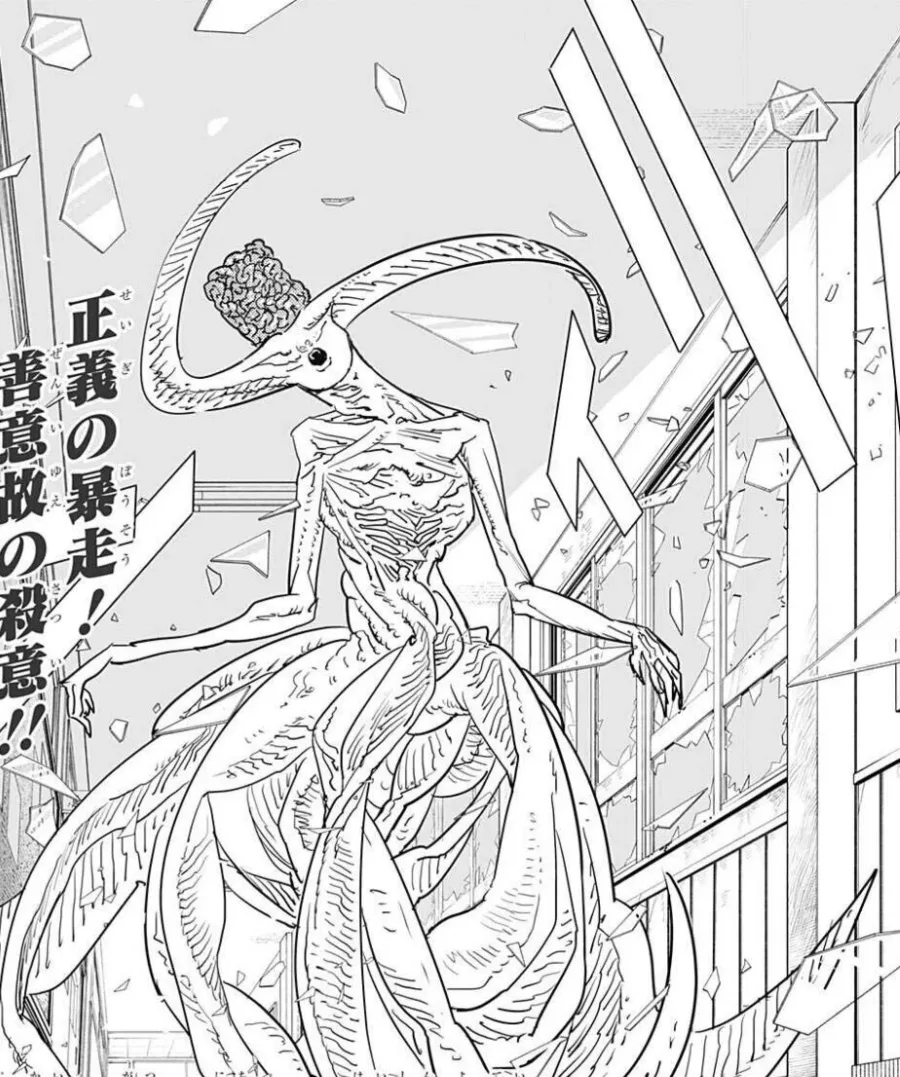
Are you all reading the manga "Chainsaw Man"?
It's incredibly interesting, isn't it? I love it.
Every character is charming, aren't they?
Of course, it's fiction,
and it's a story that couldn't happen in reality,
but I found myself strangely convinced by the concept,
or rather the setting of the "Devils," and I ended up getting hooked.
To briefly introduce the world-building,
it's a story set in a world where "Devils," monsters driven by human fear, naturally exist
and are recognized.
Devils are concepts that humans fear or loathe,
and humans can make contracts with devils to use them or borrow their power in exchange for a price. It's a dark fantasy about the protagonists who hunt them down.
Something like that, I suppose.
Personally, the concept of the devils is excellent,
and it's interesting how they range from things like the Gun Devil, Future Devil, War Devil, and Control Devil,
to the Octopus Devil, Muscle Devil, Fish Devil, and so on.
What personally struck me was the "Justice Devil."
As someone who grew up immersed in the world of good triumphing over evil by watching Kamen Rider and Super Sentai since I was little, I thought, "I can't believe 'Justice' could become a 'Devil'!" Plus, the visual is super scary...
Setting aside the detailed plot,
the message I felt from this story was,
that even a single concept like "justice" has various interpretations and perceptions depending on the person.
Excessive justice becomes something people loathe and an object of fear.
What happens when you stick to "your own sense of justice"
More or less,
I think people act under the belief that "I am right."
That is why communication breakdowns occur.
For example, let's recall a work situation.
I am abstracting an incident that actually happened between colleagues at my company...
There was a task that required coordination between Person A and Person B,
and it was by no means highly difficult,
and both of them had experience with the task, but
a mistake occurred.
Presumably, both A and B
would say, "'I' thought this way."
Originally, to avoid misunderstandings,
they should have confirmed specific matters and details with each other.
Because of the assumption that "as for me, it's better to proceed with this work this way,"
they did not share what should have been shared.
Despite it being the responsibility of both parties due to these factors,
neither wants to admit their own mistake.
Because I have to take responsibility.
Because I don't want to apologize.
Because I believe the other person is in the wrong.
...Regardless of the various factors involved.
The structure of sticking to one's own sense of justice and painting the other person as the villain.
The 'Devil of Justice' created by an excessive sense of self-righteousness
seems to lurk in our daily lives as well.
The examples have become quite abstract, but
don't these kinds of things happen all the time in daily life?
'I never thought the other person would take it that way.
That wasn't my intention.'
Sometimes this comes to light in work where responsibility is involved, but
even if it doesn't surface normally, if your own sense of justice is too intense,
you think the other person is wrong and you are right.
I personally think that these kinds of misunderstandings
are also factors that create discord and friction between people.
Let's have a buffer that says, 'I might be wrong.'
'Believing in yourself' or 'trying to do the right thing' are
feelings that it is perfectly fine to have.
In fact, I think it is only natural to have beliefs and guidelines to lead you.
However, to defeat the devil caused by excessive righteousness,
'I might be wrong'is a kind of buffer, a mental flexibility I would like to keep.
Check with the other person by saying, 'I think this way, but what do you think?'
By communicating,
we create a relationship where we can cooperate comfortably with each other.
For the sake of a win-win for both sides,
I want to incorporate the feeling of
'I might be wrong.'
People with flexibility are cooler, and
that is how I want to be.
The first thing needed to put this into practice is 'not to make assumptions and not to stay silent.'
Don't you feel like you could at least start by talking to the other person
and aligning your interpretations?
The story has been extrapolated significantly from the Justice Devil in Chainsaw Man,
but these days I feel that there is so much to learn from manga as well.
Thank you for reading until the end today.
Let's meet again next time.
See you later.