Introduction
When you start using AI agents in earnest,
it is not just the intelligence of the model that ultimately makes the difference.
Which work procedures,
in which environments,
at what level of granularity,
and how to make them reusable.
This is where it counts.
At the heart of this are Agent Skills.
Whether in Claude Code, Codex, Cursor, or GitHub Copilot-based environments,
“Skills for reliably delegating specific tasks to AI” are becoming increasingly important.
However, there is a major fork in the road here.
Do you treat Skills as mere folders?
Or do you treat them as manageable executable assets?
This difference is quite significant.
Skills are no longer just 'collections of convenient prompts'
If you underestimate Agent Skills, they might look like nothing more than “frequently used instructions compiled into Markdown.” That is certainly fine at the beginning.
For example,
PR review perspectives
Slide creation procedures
Image generation quality standards
Research report structure
Pre-release checks
Log verification procedures
Internal document style rules
Even just compiling these into a SKILL.md file significantly reduces the burden of explaining them in prompts every time.
However, Skills truly start to pay off when they go beyond mere instructions.
You can place reference materials in Skills.
You can bundle scripts.
You can include templates.
You can define how to use external services.
You can also include procedures for connecting with MCP or APIs.
In other words, Skills are gradually becoming
not just manuals describing 'what you want the AI to do',
but connection interfaces that define 'how the AI connects to the execution environment'.
We need to change our perspective here.
Skills are not prompt components.
Skills are operational cells that package the capabilities of an AI agent.
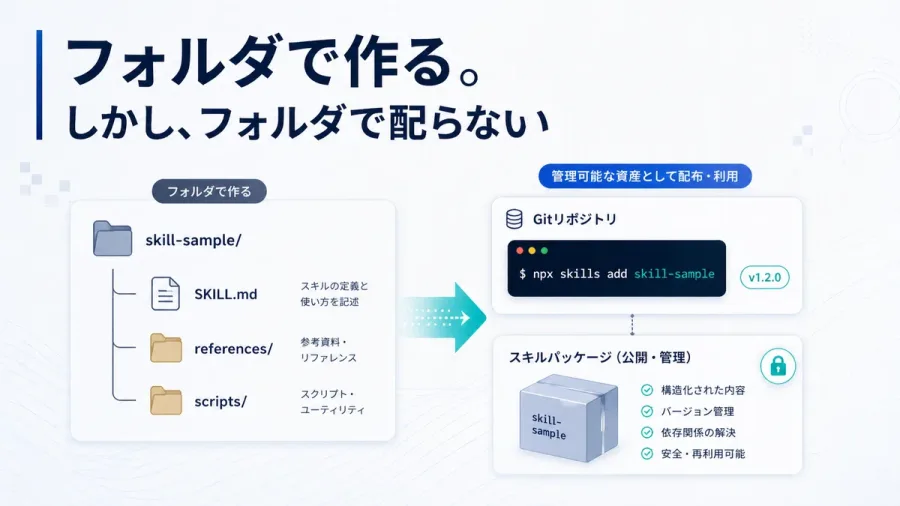
Create them as folders. But do not distribute them as folders.
Agent Skills are folders in terms of structure.
For example, it looks like this.
my-agent-skills/
  skills/
    slide-export/
      SKILL.md
      references/
      scripts/
This is natural.
With 'SKILL.md' at the center,
supplementary materials,
scripts if necessary,
and the context required for execution all bundled together.
The problem is not that they are folders as a unit of creation.
The problem lies in trying to handle distribution, installation, updates, and deletion by manually handing over folders.
'Please extract this ZIP'
'Please place this folder in .claude/skills'
'For Codex, please place it here'
'Please delete the old version'
'The latest version is here'
'Please look at the README and apply it manually'
This works for a small number of people.
However, as the number of Skills increases,
the number of users grows,
the number of supported agents increases,
and the frequency of updates rises, it quickly falls apart.
Folder sharing is a high burden for both the creator and the user.
Furthermore, what is scary is that you lose track of which environments and which versions of a Skill remain after it has been distributed.
Even though you distributed Skills to strengthen the AI agent's capabilities,
old Skills, broken Skills, and Skills of unknown origin remain in the field.
These are not assets.
They are just cluttered components.
What 'npx skills add' changes
This is where the distribution format 'npx skills add' becomes important.
For example, you can install a published Skill repository as follows.
npx skills add owner/repo
If you only want to install a specific Skill, it looks like this.
npx skills add owner/repo --skill slide-export
If you are installing for Claude Code, you can also take this form.
npx skills add owner/repo -g -a claude-code --skill slide-export -y --copy
If it's for Codex, this is how it looks.
npx skills add owner/repo -g -a codex --skill slide-export -y --copy
On the surface, it looks like just another installation command.
But that is not the essence.
npx skills add changes Skills from 'things you pass around as folders' to 'things you can install via command.'
More specifically, it changes
AI agent capabilities from hand-me-down knowledge into manageable assets.
This difference is significant.
What becomes 'manageable'?
When you distribute Skills via CLI, installation becomes stable first.
You don't have to make the recipient wonder, 'Where should I put this?'
You just need to write this at the top of the README.
npx skills add owner/repo
Now the entry point is standardized.
Next, you can explain updates.
npx skills update -g
You can also explain deletion.
npx skills remove slide-export -g
This is where it becomes important.
A Skill is not something you create once and finish.
Models change.
Agent environments change.
CLI specifications change.
Internal company rules change.
You use it and find holes in the procedures.
Standards for output quality are also updated.
In other words, a Skill is not a static document, but an asset that is operated.
Therefore, updates become more important than installation.
The lifecycle becomes more important than distribution.
Trying to do this by sharing folders inevitably becomes difficult.
Skill distribution is a PromptOps issue.
This is not just about a convenient CLI feature.
It is about PromptOps.
PromptOps is the philosophy of treating prompts, Skills, and agent configurations not as one-off craftsmanship, but as assets that can be reused, updated, verified, and operated.
Pasting prompts by hand every time.
Explaining the background to the AI every time.
Writing the same precautions every time.
Recalling quality standards every time.
Re-explaining successful procedures to others every time.
This is common for individual work.
However, it is weak for AI agent operations.
Turn successful work procedures into Skills.
Once it's a Skill, make it distributable.
Once distributed, make it updatable.
If you update it, keep a change history.
If used in an organization, have reviews and permission boundaries.
Only when you include all this does it become PromptOps.
The essence of 'npx skills add' lies in bringing this flow closer to real-world operations.
A Skill becomes an 'ability installation' for an AI agent.
In human work, abilities increase through education.
Reading manuals.
Learning from seniors.
Looking at procedure manuals.
Remembering real-world examples.
Acquiring judgment criteria.
For AI agents, a Skill is something close to that.
However, unlike human education,
Skills can be replicated.
They can be distributed.
They can be updated.
They can be deployed to multiple agent environments.
In this sense, a Skill is not 'AI educational content'.
More accurately, it isa unit for installing capabilities into an AI agent.
For example, suppose someone created a 'high-quality slide generation Skill'.
If you just pass it around in a folder, it ends up as a convenient shared item.
However, if you place it in a GitHub repository, make it installable via 'npx skills add',
and make it so it can be added to Claude Code or Codex, and updated or deleted, the meaning changes.
It is no longer individual work know-how, but a reusable agent capability. This difference is significant.
However, CLI distribution does not automatically guarantee safety.
There is a point of caution here.
'npx skills add' is convenient.
But precisely because it is convenient, there are also dangers.
The fact that a Skill can be installed with a single command means that unverified Skills can also be installed with a single command.
The following types of Skills are particularly dangerous.
Those containing 'scripts/'
Those that assume the execution of shell or bash
Those that handle API keys
Read internal files
Send data to external services
Connect to MCP or DB
Access GitHub, Slack, Google Drive, etc.
Allow automatic fixes and execution
These Skills are not just prompts.
They have an execution surface.
They have side effects.
They touch permission boundaries.
Therefore, just because you can install them via CLI doesn't mean you should install everything.
In fact, it is the opposite.
As Skills become distributable via CLI,
review, provenance, versioning, permissions, and auditing become critical.
'Easy to install' is different from 'safe to use'
It is better to keep these separate.
npx skills add primarily solves the distribution UX.
In other words,
Easy to introduce
Easy to explain
Easy to update
Easy to delete
Easy to deploy across multiple environments
It solves these problems.
However,
Is that Skill safe?
Are there any malicious commands?
Are unnecessary permissions being requested?
Is there any external data transmission?
What does the script actually do?
Is it robust enough for internal corporate use?
These are not automatically guaranteed.
Mixing these up is dangerous.
In other words, the correct way to organize this is as follows.
CLI配布は、Skillを管理しやすくする。
ただし、Skillを安全にするわけではない。

安全性は、レビュー、権限設計、バージョン固定、監査で担保する。
By establishing this premise, the design for Skill operations becomes clear.
Design differs between personal publication and organizational use
If a Skill is published by an individual, priority should first be given to ease of installation.
Write the installation command at the beginning of the README.
Clearly specify the target agent.
Briefly describe what the Skill does.
Clearly state the necessary prerequisites.
Include update and deletion commands as well.
This alone makes it much easier to use.
On the other hand, organizational use is a different story.
If you are using Skills in an organization, you need at least the following perspectives.
誰が作ったSkillか
どのリポジトリから入れるのか
どのバージョンを使うのか
どのエージェント環境へ入れるのか
どのツール実行を許すのか
どのファイルに触れるのか
外部送信はあるのか
更新時に誰がレビューするのか
問題が起きたらどう戻すのか
This is exactly what AI harness is about.
It is not about the convenience of the Skill itself, but rather
in which execution environment the Skill is placed,
with what permissions it runs,
what audit trails are left,
and where it can be stopped.
Unless you design with those factors in mind, AI agent operations will become unstable.
There are still situations where folder sharing remains relevant
What we must not misunderstand here is that
folder sharing does not become completely unnecessary.
Especially in the following situations, folder distribution still has meaning.
In closed environments where it cannot be pushed to GitHub
You want to distribute only internally audited snapshots
Use of external CLIs is restricted
Network connectivity is restricted
You want to place a fixed version only in specific projects
The Skill contains internal-only documents
In these cases, folder distribution is a possibility.
However, it should not be 'sloppy folder sharing'.
It should be distributed as an audited package.
For example, structure it like this.
approved-skill-pack/
  MANIFEST.md
  CHANGELOG.md
  CHECKSUMS.txt
  skills/
    approved-review-skill/
      SKILL.md
      references/
      scripts/
In other words, if you retain folder distribution,
treat it not as a 'hand-me-down' but as a 'fixed release'.
The essence remains the same here as well.
The creation unit may be a folder.
However, the operational unit must be an asset.
Skills require an 'operational contract' that goes beyond a README.
The number of people distributing Skills will increase in the future.
Some will distribute them as appendices to articles.
Some will distribute them as internal templates.
Some will publish them as OSS.
Some will create task-specific Skill packs.
At that point, simply writing installation commands in a README will not be enough.
What is truly needed is an operational contract.
At a minimum, a Skill will require the following information.
このSkillは何をするのか
何をしないのか
対象エージェントは何か
導入コマンドは何か
更新コマンドは何か
削除コマンドは何か
必要な外部サービスは何か
必要な環境変数は何か
触るファイル範囲はどこか
外部送信はあるか
スクリプト実行はあるか
安全に使うための注意点は何か
This is necessary not just to 'make Skills distributable',
but to 'ensure they can be used responsibly'.
Once you reach this point, a Skill is no longer just a prompt.
It is closer to a small software asset.
That is why it makes sense to manage it in a GitHub repository,
maintain an update history, fix installation procedures, and make it reviewable.
Future Skill distribution will be divided into three layers.
Going forward, the distribution of Agent Skills will likely be divided into three layers.
The first is personal Skills.
Skills to speed up your own work.
These include templates for writing, research procedures, image generation steps, and code review perspectives.
These can simply be developed locally.
The second is public Skills.
Place them on GitHub or similar platforms so they can be installed via npx skills add.
Maintain a README and explain how to update or remove them.
These become capability assets that others can use.
The third is organizational management Skills.
Managed in internal repositories, these include reviews, version pinning, permission boundaries, audit trails, and approval flows.
These serve as the infrastructure for AI agent operations.
Mixing these three leads to confusion.
Using personal Skills directly in an organization is dangerous.
Introducing public Skills into a company without review is also risky.
Starting to modify organizational management Skills individually in local folders will lead to failure.
As the scope of Skill usage expands, it moves from PromptOps toward HarnessOps.
npx skills add is a small watershed moment.
npx skills add looks modest on the surface.
It appears to be just an installation command.
However, it represents a major shift.
The capabilities of AI agents move from prompts in a chat window to local folders, and further to distributable repositories.
This change is significant.
This is because the gap in AI utilization shifts from 'whether you can give good instructions on the spot' to 'whether you can save, distribute, and update successful instructions and procedures as assets'.
The gap between those who struggle with prompts every time and those who accumulate them as Skills will widen.
Furthermore, the gap between those who hand over Skills via folders and those who make them installable and updatable via CLI will also widen.
And finally, there will be a difference between those who just distribute Skills and those who manage them including reviews, permissions, and audit trails.
This is where the future of AI agent operations will diverge.
Summary: Skills have become 'distributable capabilities'.
The essence of Agent Skills is not about teaching AI how to perform tasks.
It is about taking successful workflows,
making them reusable,
deployable to other agent environments,
updatable,
deletable,
and auditable when necessary.
In that sense, npx skills add is more than just a convenient command.
It is the gateway to transforming AI agent capabilities
from ad-hoc folders into manageable assets.
For future Skill management, it is better to think this way.
フォルダで作る。
しかし、フォルダで配らない。

コマンドで導入できるようにする。
更新できるようにする。
削除できるようにする。
レビューできるようにする。
権限境界を明示する。
A Skill is not an appendix to a prompt.
It is a small, executable asset for the AI agent era.
And because it is an executable asset, even the method of distribution becomes a design target.
#AIAgent #AgentSkills #ClaudeCode #Codex #PromptOps #AIUtilization #GenerativeAI #AIHarness #DevelopmentEnvironment #OperationalEfficiency