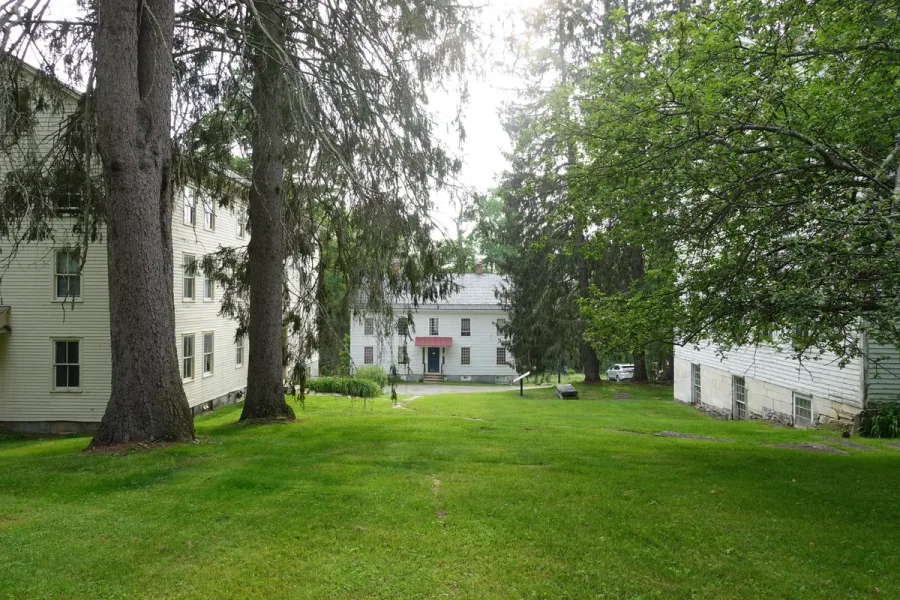
The four fundamental principles of Shaker practice are said to be "confession," "celibacy," "community of goods," and "separation from the world." As a concrete means of practicing these, they decided to separate themselves from the secular world, build their ideal society with their own hands, and live communally there.
This was not the decision of Ann Lee, the first leader of the Shakers, but rather that of Joseph Meacham, the third leader, who was entrusted with the future of the order and its believers after they crossed over to America.
The establishment of the community began in 1787 at Mount Lebanon and Watervliet. Mount Lebanon was the headquarters of the Shaker order, and Watervliet was the first Shaker settlement.
Subsequently, from the 1790s to 1794, nine communities were born, like a wave centered on Mount Lebanon, starting with Hancock, Massachusetts, and reaching as far as Gloucester (Sabbathday Lake), Maine. This can be called the first wave of community construction in the New England region. Most of these were communities formed by converts from the missionary journeys during Ann Lee's lifetime; they were established as communities in response to the policy that those who were already aware of themselves as believers should specifically gather in one place and live together.
The stage for the second wave of community establishment was the American Midwest of Kentucky and Ohio in the early 1800s. The conversion movement known as the Second Great Awakening, which remains in American history, is called the Kentucky Revival. It was not only the Shakers who benefited from this; many Protestant denominations also increased their followers.
By this time, Mount Lebanon already had a wealth of believers, was equipped with various facilities, and had established a stable economy and management system. Following that example, and using Mount Lebanon as a model, communities were created in the Midwest at the same time as converts were being gained.
In the Midwest, the construction of community residential buildings and workplaces was rushed, and by the very early stage of the 1820s, Shaker-like, beautifully maintained settlements were formed. In the Midwest, which was a frontier requiring a harsh life, the Shaker way of life may have been an object of envy. It was not uncommon for people to convert in search of life in a wealthy and stable community.
In particular, Union Village, which became the center of the Midwestern breakthrough, saw such rapid growth that it reached its peak number of believers at the end of the 1810s, and almost all communities reached their golden age in the decades following the 1820s.
The major difference between the first and second waves is that conversion to the Shakers and participation in the community became synonymous. At the time of missionary work in the New England era, a concrete vision of communal life in a community was not presented, and converts participated in a format where they would occasionally attend worship services or gatherings held in the vicinity.
Currently, the locations and names of 25 Shaker communities have been identified, including those that were short-lived. There were movements to create communities in slightly more distant places like Florida and Georgia, where enthusiastic believers emerged. However, after the expansion into the Midwest, when conversion was sought in distant places, given the Shaker way of faith that required a life befitting a believer (communal life in a community), believers had to choose between leaving that place or creating a new community on that land. And building a new community was by no means easy.
With North Union in 1822 as the last, no more communities were born that would take root and last for a long time in that place.
The Shaker community system may look like a large receptacle at first glance, but it was a means chosen by the Shaker people for the practice of their doctrine, and at the same time, it is an expression of the difficulty of Shaker conversion.