On a day I had no plans after a walking trip
I headed to Okazaki, a place I had wanted to visit for a long time
I started becoming interested in Okazaki a year ago
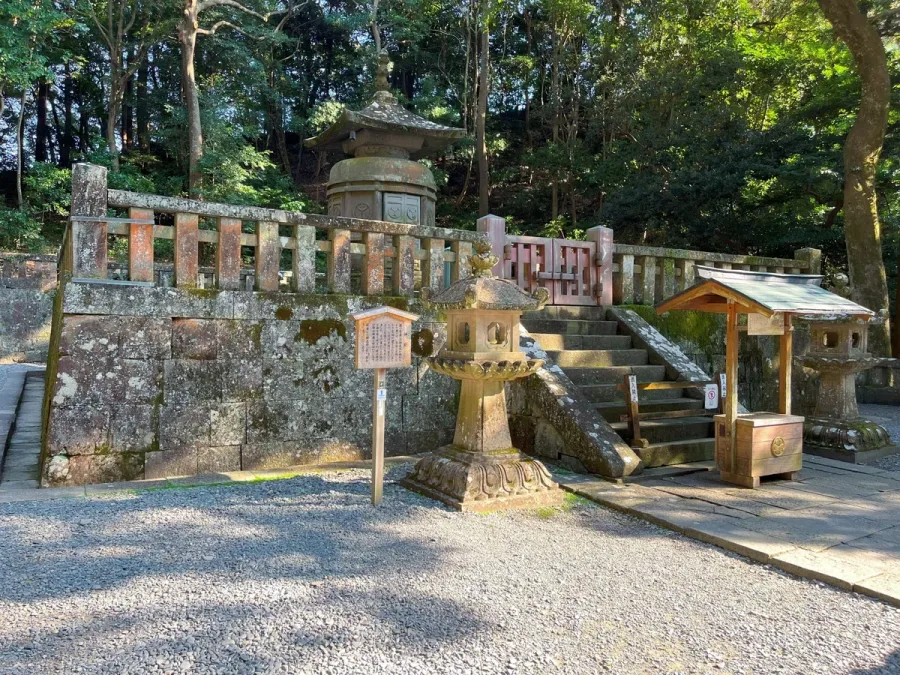
when I visited Kunozan Toshogu Shrine in Shizuoka Prefecture...
This was also a place I had long wished to see, but
I learned what kind of place it was only after being there
Originally Kunozan Castle, built by Takeda Shingen during his invasion of Suruga,
it is the place where Tokugawa Ieyasu instructed in his will
for his remains to be enshrined
Kunozan Toshogu Shrine visit article
His will also stated that the mausoleum should face west, toward his family temple, Daijuji, and
Okazaki Castle, his birthplace, which is when I started to become curious about the area of Okazaki
Places associated with Tokugawa Ieyasu
I used to have a dislike for history, but
as I visited historical sites on my casual travels
and read the local explanations,
it became interesting how things connected like a puzzle,
and I've started to take an interest in it, albeit late in life
In particular, since I went to Kunozan,
I've had more opportunities to visit places associated with Tokugawa Ieyasu,
and following the Sekigahara battlefield ruins and Sunpu Castle ruins,
I was finally able to tour Okazaki this time
I intended to summarize it quickly, but
with Ieyasu's biography, which also serves as my notes,
and Daijuji Temple alone, it became quite long...
so it ended up split into two articles
Daijuji Temple was founded in 1475 by the fourth head of the Matsudaira clan, Chikatada.
In 1641, the third shogun, Iemitsu marked the 17th anniversary of Ieyasu's death by
arranging the temple buildings so that one could look out toward the birthplace of his grandfather from the main hall, through the mountain gate and the main gate, to see Ieyasu's birthplace,
Okazaki Castle
It's a stylish design typical of Iemitsu, who is known for his devotion to his grandfather
Beyond the elementary school playground and the main gate,
the black structure visible in the center is
Okazaki Castle, the birthplace of Ieyasu ✨
This straight line of about 3 km is called the
Vista Line and is designated as a scenic landscape conservation area by city ordinance.
The tall buildings seen here and there
were built to avoid the Vista Line,
so you can tell it's a protected landscape.
It seems walkable if it's a straight distance of about 3 km, but
due to the fatigue from the previous day's walking trip, I headed there by bus.
Get off at the Tonobashi bus stop and
walk west along the Yahagi River
The Okazaki Castle building that came into view was
smaller than I expected,
and I was surprised that it could be seen from 3km away
It is said that it was first built
in the mid-15th century by Saigo Yoritsugu.
In 1531,Matsudaira Kiyoyasu(Ieyasu's grandfather) moved it to its current location, known as Ryuzan.
In 1542, Takechiyo, his childhood name,
who would later becomeTokugawa Ieyasu,was born inside Okazaki Castle.
After that, Ieyasu spent his childhood in other lands as a hostage
of the Oda and Imagawa clans,
but after the Imagawa clan was defeated at the Battle of Okehazama in 1560,
he became independent at age 19 and became the lord of Okazaki Castle.
In 1570, Ieyasu moved his base to Hamamatsu in Totomi
and made his eldest son, Nobuyasu, the lord of the castle.
In 1590, when Ieyasu was moved to the Kanto region by Hideyoshi,
Tanaka Yoshimasa became the lord and established the sogamae (outer defensive perimeter).
You can learn about the prosperity of that time
from the model displayed inside the castle.
The inner enclosure of the castle alone was vast,
and it seems many buildings stood there.
What is now Okazaki Park
is the area even further inside the inner enclosure,
and while it has become smaller compared to the past,
I feel its historical value has increased.
Even though the area has shrunk,
it is still vast and has many highlights to see on foot.
I felt like there were lines on it,
but I didn't realize that was intentional too.
It began in the Kanei era when Tokugawa Ieyasu was enshrined
as the deity of the Toshogu Shrine within the castle keep.
In 1876, the Toshogu Shrine was relocated to the main enclosure of Okazaki Castle,
merged with Eisei Shrine, and became Tatsuki Shrine.
Although the name is different, there is no doubt that Lord Ieyasu is the deity,
and it seems to be one of the many Toshogu shrines located throughout the country.
The current castle keep has almost the same exterior as the old one,
and is a reconstructed keep built in 1959.
Located on the first floor of the keep
is the foundation stone that supported the central pillar of the 1617 keep.
It is believed that the central pillar extended down to below the third-floor floorboards.
Gate doors and wicket doors from inside Okazaki Castle
that were demolished by the 1873 Abolition of Castles Ordinance.
The reconstructed keep has five floors,
where you can learn history through models on the second floor,
feel the vibrancy of the castle town on the third floor,
experience immersion through video on the fourth floor,
and look out over the castle town from the top fifth floor.
Since I could see Okazaki Castle from Daijuji Temple, I assume it's visible from here too, but...
It doesn't stand out like the castle keep,
so I can't tell which one is Daijuji Temple
I thought about exploring the castle grounds more after that, but
I enjoyed the castle keep too much (read too many explanations),
so it was a good time to head to the station
Descending the stairs from the main enclosure,
I crossed the Takechiyo Bridge,
which I believe is named after Ieyasu's childhood name
Even though it was the day after my walking trip,
I walked around as my desires pleased,
so I didn't have the luxury of taking big detours,
but I visited famous spots on the way to the station
I don't plan on walking the entire Tokaido,
but I want to walk the 27 curves of the Okazaki castle town
At that time, I'd like to try searching for the remains of the Okazaki Castle outer fortifications in a 'Buratamori' style
It's a bit far from my destination station,
but I made a detour to a place that defines Okazaki
It seems like I could have done a factory tour,
but I'll save that and other things for next time
I thought about walking along Hatcho-gura Street too,
but I held back and turned around...
or so I thought, but is there something at the corner?
It seems to be a handprint of a cast member from the
2006 NHK serial TV drama
Junjo Kirari, which is set in Okazaki City in the early Showa period
I haven't watched it at all so I'm indifferent,
but I was curious about the handprints of people I know
I came to Okazaki via Meitetsu,
so I'm heading back to Nagoya via the Aikan and JR lines
Related articles: Places associated with Ieyasu
1542 | Born at Okazaki Castle
1585 | Tensho-era castle tower constructed
1607 | Keicho-era castle tower constructed
September 14, 1600 | Battle of Kuise-gawa
September 15, 1600 | Battle of Sekigahara
1616 | Remains moved to Kunozan
1616 | Mortuary tablet moved to Daijuji Temple