Hello.
I'm Pan-chan, a tour conductor with over 25 years of experience.
During your stay in Hawaii, one thing that always causes a headache is food expenses.
If you eat at a restaurant, you have to pay for the food, tax, and then a tip. ABC Stores are convenient, but if you try to buy everything from daily water and breakfast to vegetables, it gets surprisingly expensive.
That's why I found this on the west side of Waikiki:
Food Pantry Eaton Square
Food Pantry Eaton Square
.
When you hear "Food Pantry," it might sound like a facility that distributes food for free, but this is a regular supermarket.
The exterior is a bit plain, but once you step inside, it is well-stocked with vegetables, fruits, meat, eggs, cheese, deli items, sushi, bread, and even desserts.
It was a very easy-to-use supermarket for travelers who want to:
Cook their own meals in the hotel
Keep breakfast costs low
Buy small amounts of ingredients
Eat Spam musubi
Get snacks for drinking in the room
Relax when they don't have the energy to go to a restaurant
Where is Food Pantry Eaton Square?
Food Pantry Eaton Square is located inside Eaton Square on the west side of Waikiki.
The address is:
438 Hobron Lane #110, Honolulu
It is a convenient location for those staying at the Hilton Hawaiian Village or hotels closer to Ala Moana. The currently posted business hours are 6:00 AM to 9:00 PM from Sunday to Thursday, and 6:00 AM to 10:00 PM on Fridays and Saturdays, but these are subject to change.
The store isn't very prominent facing the main street; it's tucked a bit inside the building.
Even I initially thought,
"Is this really a supermarket?"
But inside, it's wider than you'd expect!
It's not a convenience store for tourists, but a proper grocery store that locals can use for their daily needs.
Right when you enter, Hawaiian food is lined up!
The first things I noticed inside were bread, snacks, and Spam musubi.
This is a local food you want to eat at least once during your stay in Hawaii.
Looking at the photos, you can see:
Classic Spam musubi
Musubi that looks like it has egg
Spam musubi with different seasonings
Bread for breakfast
Bread with sausage
and more.
At the time of the photo, prices were mostly in the $3 to $4 range per Spam musubi.
It's definitely not dirt cheap.
However, it's easier than eating breakfast at a restaurant. Each one is surprisingly filling, so for a light breakfast, one Spam musubi and a coffee is enough.
It's also convenient as a portable meal before a tour with an early morning departure or on a day spent traveling by bus.
Great selection of sushi and Asian-style deli items
The refrigerated cases were lined with sushi rolls, nigiri sushi, seaweed salad, and kimchi-style side dishes.
Hawaiian supermarkets have a mix of food cultures from Japan, China, Korea, the Philippines, and more, so even though it's an American supermarket, the selection is somewhat familiar to Japanese people.
What I could confirm in the photos were:
Sushi rolls
Nigiri sushi
Seaweed salad
Kimchi
Side dishes using vermicelli and vegetables
Seafood like shrimp
Meat-based side dishes
and more.
It's convenient to be able to combine a few small side dishes rather than buying one large plate.
For example,
Sushi + seaweed salad + instant miso soup
would be great for dinner on a day when your stomach is tired from eating out.
It doesn't feel as specialized as a poke shop, but it's enough for a simple meal in your hotel room.
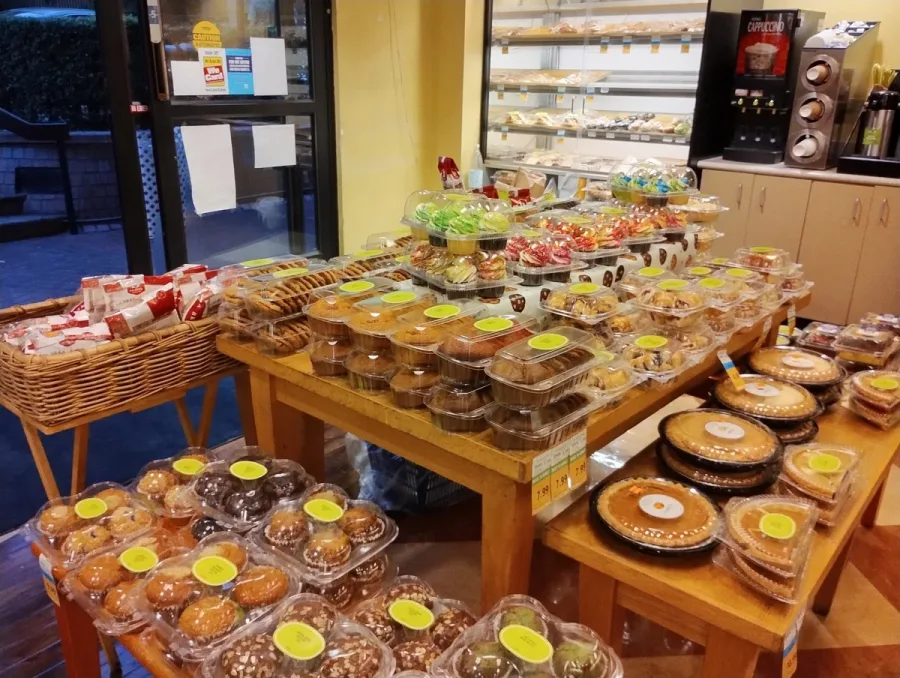
Bread, muffins, and pies are also American-sized!
Around the bakery, there were:
Muffins
Cookies
Donuts
Pies
Cakes
Colorful cupcakes
Sweet breads
all lined up.
It's a voluminous display typical of an American supermarket.
However, a little warning for travelers.
As far as the photos show, many muffins and cookies are sold in multi-packs.
It's a large quantity for someone who just wants to eat one.
It's fine if you can share with roommates or family, but if you're traveling alone, you might not be able to finish them.
Besides, I'm not a big fan of sweets.
For people like that, you can just enjoy how they look and don't feel pressured to buy them.
Pies are also mostly sold as whole pies, so they are better suited for eating with everyone in a hotel room.
Sandwiches and deli items are convenient, but not cheap
In the refrigerated cases, there were:
Sandwiches
Bagel sandwiches
Wrap sandwiches
Salads
Cheese
Ham
Olives and pickles
and more.
At the time of the photo, many sandwiches were around $6 to $10.
When converted to Japanese yen, you might think,
"It's expensive for a supermarket sandwich!"
But in Hawaii, lunch at a restaurant is even more expensive.
If you consider tax and tips, it can sometimes be cheaper to bring deli items or sandwiches back to your room.
However, while it's convenient to buy for one person, if there are two or more people, it might be cheaper to buy bread, cheese, and vegetables separately and make your own.
The variety of cheese and ham is amazing
The cheese section is quite extensive.
Just in the photos, you can identify various types such as:
Gouda
Smoked Gouda
Gruyère
Fontina
Blue cheese
Gorgonzola
Pepper Jack
Provolone
and more.
This section is quite dangerous for wine lovers!
If you buy cheese, ham, olives, and bread, you can have a wonderful drinking session in your hotel room without going to a restaurant.
However, many cheese and ham products are around $7 to $10 per pack.
If you get greedy and want several types, it will quickly become expensive, so my method is to limit it to:
1 type of cheese + 1 type of ham + fruit
Fruits are easy to buy by the piece
What's convenient for travelers is the produce section.
In the photos, there were:
Bananas
Apples
Oranges
Mangoes
Pineapples
Papayas
Dragon fruit
Avocados
Watermelon
and more.
In American supermarkets, fruits and some vegetables are sometimes sold by weight.
Even if the display says,
$XX/lb
it doesn't mean you have to buy a whole pound.
You can take just what you want—like two bananas, one apple, or one avocado—and take it to the register, where it will be priced according to its weight.
This is a blessing for short-term visitors!
Cut fruit is convenient, but it tends to be more expensive because of the processing involved.
If you want to save money, I recommend bananas, oranges, and avocados, which you can eat just by peeling them.
Vegetables can also be bought individually
In the vegetable section, there were:
Cucumbers
Bell peppers
Carrots
Onions
Broccoli
Cabbage
Napa cabbage
Leafy greens
Daikon radish
Mushrooms
and more.
There are pre-bagged items, but you can buy things like cucumbers, bell peppers, and onions individually.
If you are cooking with just a microwave and a heat-resistant bag (like I-Wrap), these seem easy to use:
Broccoli
Napa cabbage
Bell peppers
Mushrooms
Carrots
Onions
If you have kitchen shears, you can cut them without a cutting board.
However, cabbage and Napa cabbage are large if bought whole.
Even if you stay for a week, you might not be able to finish them alone.
If there are small amounts of pre-cut vegetables, choosing those is less wasteful.
There were even small packs of eggs!
In overseas supermarkets, eggs are usually sold in 12-packs, and I used to think,
"I can't finish these during a hotel stay."
However, looking at the photos, there are also 6-packs of eggs here.
This is great for those who cook in their hotel!
If you have eggs, you can use them for:
Microwave scrambled eggs
Oatmeal porridge
Egg soup
Vegetables with egg
Sandwiches
and more.
However, at the time of the photo, I saw 6-packs for over $6, so eggs themselves aren't exactly cheap.
Still, considering the cost of eating breakfast at a hotel once, eggs that can be used for several breakfasts are a saving.
The meat section is also authentic
It's a compact supermarket, but the meat section is quite authentic.
Beef steak
Ground meat
Pork
Chicken
Sausages
and more are lined up.
Steak meat is larger than in Japan.
If you have a condo with a kitchen, it would be fun to buy meat here and grill it.
However,
if you are only cooking with a heat-resistant bag and a microwave,
raw, thick steak meat is difficult to handle.
Since you don't know the output or heating unevenness of a hotel microwave, it's safer and easier to use:
Pre-cooked chicken
Canned tuna
Eggs
Tofu
Deli items
Seafood
etc.
Can you buy in small quantities?
To conclude,
it is quite easy to buy small quantities of fruits and some vegetables.
On the other hand,
muffins, cookies, bread, meat, cheese, and pre-cut salads
can come in packs that are a bit large for travelers.
Not everything comes in small sizes.
What's good for small-quantity shopping at Food Pantry is:
2 bananas
1 avocado
1 cucumber
1 bell pepper
1 onion
6-pack of eggs
1 Spam musubi
1 pack of sushi
1 pack of deli items
1 yogurt
etc.
I recommend not buying a huge amount on your first day, but buying for 2-3 days first and adding more if you run out.
Is Food Pantry cheap?
I'll be honest here.
It's not a super-discount supermarket.
Because of its location around Waikiki, everything feels expensive compared to a Japanese supermarket.
Especially
sandwiches, cheese, ham, eggs, snacks, and pre-cut products
are priced accordingly.
Still, considering the trouble of taking an Uber to a suburban supermarket, the convenience of being able to walk there to shop is significant.
If you spend money on round-trip transportation and waste time just to go to a cheaper store, it might not end up being much of a saving.
It's better to think of this as a store where you can walk from your hotel and buy only what you need, rather than a store to target for the lowest prices.
How to use it differently from ABC Stores
ABC Stores are convenient because they are everywhere in Waikiki.
On the other hand, Food Pantry's strength is its selection of fresh food and deli items.
For ABC Stores:
1 bottle of water
Beer
Souvenirs
Sunscreen
Things you suddenly need
Shopping late at night or while on the move
For Food Pantry:
Vegetables
Fruits
Eggs
Meat
Cheese
Ham
Deli items
Sushi
Ingredients for a multi-day stay
If you are cooking in your hotel for several days, it's efficient to buy ingredients at Food Pantry first and then just replenish what you're missing at an ABC Store.
What would Pan-chan actually buy?
If I were spending a week with just a heat-resistant bag and a microwave, I'd start with this much.
For breakfast:
6-pack of eggs
2-3 bananas
Yogurt
Bread or oatmeal
For lunch/dinner:
Broccoli
Bell pepper
Mushrooms
Avocado
Canned tuna
Sushi or poke-style deli items
Seaweed salad
For a tired day:
Spam musubi
Sandwich
1 pack of deli items
For drinking in the room:
1 type of cheese
1 type of ham or salami
Fruit
Alcohol
Base it on vegetables, eggs, and tuna, and add a few deli items or Hawaiian-style snacks.
This way, you can save money without losing the travel mood.
Points to be careful about
Don't buy too much
American products have more volume than they look.
Especially for bread, snacks, and cheese, think calmly about whether you can finish them.
Check the price tag units
For vegetables, fruits, and meat, there is a mix of:
Price per item
Price per pack
Price per pound
Check for "each," "ea," "lb," "package," etc., next to the price display.
Check the size of the refrigerator
Hotel room refrigerators are sometimes small or lack a freezer section.
Before buying frozen food or a large amount of drinks, check if they will fit.
Follow the hotel's cooking rules
The extent to which cooking is allowed in guest rooms varies by hotel.
Even if there is a microwave, it's safer to avoid cooking that produces odors or smoke.
Pan-chan's conclusion
Food Pantry Eaton Square is not a supermarket that only seeks low prices.
But it is a very convenient supermarket for travelers because:
You can walk there from the west side of Waikiki
It opens early in the morning
You can buy vegetables and fruits
There are small packs of eggs
Sushi and deli items are well-stocked
You can also buy Spam musubi
It has what you need for cooking in your hotel
Especially if you are staying around the Hilton Hawaiian Village or the DoubleTree Alana Waikiki Beach, it's worth a look.
The exterior is a bit plain.
But once you go inside, the selection was richer than I imagined.
Instead of going to a restaurant for every meal, have bananas and eggs for breakfast, Spam musubi for lunch, and deli items and vegetables for dinner.
Use the money you saved to enjoy the poke, steak, and alcohol you really want!
Hawaiian supermarkets were not just places to buy groceries, but also tourist spots where you can enjoy local food culture.
※ Business hours, prices, and products handled are as of the time of the visit. They may change depending on the day of the week, season, or inventory status. Please check the latest information before using.