What kind of article is this?
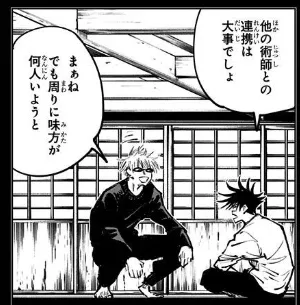
This is an article about Chapter 236 of the manga "Jujutsu Kaisen," currently serialized in Weekly Shonen Jump, titled "Going South."
The chapter in question (hereafter referred to as "Going South") contains a massive amount of information, and with some depictions that appear contradictory at first glance, it seemed necessary to organize the content for better comprehension.
The goal is to summarize what was written in "Going South" and to confirm its position within the work. To that end, I will also attempt to interpret the work itself, so I hope this will be of some help to those who read this article. Also, I will naturally be covering chapters not yet collected in a volume.
What happened in "Going South"?
Below, I will list only what happened in "Going South."
Some might argue that if I really intend to interpret it properly, I should start from the preceding Satoru Gojo vs. Sukuna battle, but as you can see, even a single chapter has a tremendous amount of content, and it would be a hassle for both the writer and the reader, so I will not do that.
My calculation is that since there is a skip in the depiction between "Going South" and the previous chapter, this should be sufficient.
Page 1: Satoru Gojo reunites with Suguru Geto / Gojo dislikes the reunion
Page 2: Gojo explains the reason he disliked the reunion is because he told his students that when you die, you die alone / Gojo wishes this moment were just a delusion / Geto consoles him, saying, "It doesn't matter if it's a delusion or reality" / Gojo praises Sukuna
Page 3: Distant view of the airport / Gojo states he can empathize with Sukuna / Gojo talks about the isolation he feels from the people around him
Pages 4-5: Gojo says he would have been satisfied if Geto had been among his students
Pages 6-7: Gojo is happy about his death / Nanami finds Gojo creepy / Nanami states, "Gojo lived a long life thanks to his way of thinking" / Gojo is a pervert who uses jujutsu only for his own sake
Pages 8-9: Haibara apologizes / Nanami says, "Sometimes curses can also bring people to life"
Page 10: Gojo says, "I don't think there has ever been a sorcerer who died without regrets"
Page 11: Gojo prays that this is not a delusion / An airplane is shown
Pages 12-13: Dead
Pages 14-16: Explanation by Sukuna
Page 17: Sukuna says, "Bravo"
Pages 18-19: The one deployed is the God of Lightning, Hajime Kashimo
Writing it all out, there is a lot of information. Or rather, even taking each line of dialogue individually, it is difficult because it builds upon past chapters.
The line 'When you die, you'll be alone' on page 2 is from chapter 58. In context, it means '(Even if you have many allies around you, when a jujutsu sorcerer loses and) dies, they die alone,' but for some reason, the first half is omitted.
The line 'There is no such thing as a death without regrets for a jujutsu sorcerer' on page 10 is from chapter 3, and it is preceded by the excuse, 'It is difficult to imagine the psychology of someone at the moment of death.'
In short, it seems safe to interpret both as quotes meaning that, contrary to prior expectations, the scenery seen at the moment of death was not bad.
Now that I have deciphered the quotes from past dialogue, questions still remain regarding the depiction. Some people might be dying to know the contents of pages 14-16 and 18-19, but the questions of most readers likely boil down to two points regarding the contents of pages 1-13: 'Is this scenery really just a delusion, as Gojo says?' and 'Who does Gojo think he is, talking down to everyone from such a high horse?' I would like to focus primarily on these two points this time.
Is Satoru Gojo seeing a delusional landscape?
First, as a general rule, please keep in mind that if a manga contains a line asking, 'Is this really A or B?', it means the author wants the reader to think about whether it is A or B. Furthermore, in 'To the South,' there are two lines that touch upon 'delusion or fact.' This must mean they want us to think about it 2.5 times more than usual.
Therefore, from here on, I will not discard the possibility of either fact or delusion, and will examine the two theories in order.
・Fact Theory: Satoru Gojo's soul is crossing over to the other side. His friends from his time at the technical college are there to welcome him.A theory based on the premise that a shonen manga-style afterlife exists. It is the view that his friends appeared at Gojo's final moment to praise his efforts. The fact that Haibara remembers his final exchange with Nanami serves as evidence.
・Delusion Theory: The friends from the technical college are something Gojo invented. Everything is nothing more than Gojo's fantasy.As Gojo thought while he was alive, death is something that happens to the individual alone. All the characters who appeared at the airport in 'To the South' are things Gojo imagined, and Haibara's dialogue just happened to coincide with Nanami's thoughts.
Compared to the fact theory, which has the evidence of Haibara's dialogue, the delusion theory seems thin at first glance. However, it is quite tricky. This is because, both before and after Satoru Gojo's death, there are frequent depictions that deny dialogue with the dead.
For example, during the Shibuya Incident, there were multiple scenes that appeared to be the resurrection of the dead, but
they were all said to be reflections or copies.
Wait, didn't the medium resurrect what they call 'soul information'?
Well, maybe it's not a resurrection...
Come to think of it, Yuta's episode was based on the mechanism that it wasn't derived from the dead, but rather that the survivor wanted to hear the voice of the deceased.
Honestly, it's not certain if what appeared in Volume 0 was Rika herself (according to Kenjaku, what Yuta was doing was 'soul detention'), but in the main story's timeline, they even went out of their way to clarify that the current Rika is a copy of the cursed spirit Rika. People interpret this in their own ways, but I see this as a minor adjustment to fit the development of the main story.
So, regarding what had been hinting at something for a long time,
Kusakabe finally said it outright. It's a declaration to 'give up on talking to the deceased themselves.' Since there have been so many mentions of this, whether direct or indirect, it seems safe to say that the standard in this work is that 'you cannot converse with the dead.'
So what does that mean?To state the conclusion, this line from Geto is likely not a clumsy evasion or anything of the sort, but rather the model answer itself.
At the moment of death, the deceased might return from the other side to praise how you lived your life. But whether that miracle happens or not doesn't really matter. It has nothing to do with you while you're alive, and those who witness a miracle take the truth of the afterlife to the grave—that is how I summarize it.
To paraphrase Yuji's line, since we don't know what happens after death, the characters live so they won't have regrets. The point is that the reality line of this manga is drawn in such places.
Who does Gojo think he is, talking from such a high horse?
Satoru Gojo denied reuniting with the dead while he was alive, but since reuniting with Geto, he has been saying whatever he wants, like 'I wanted Geto to push me forward' or 'I empathized with Sukuna.' When Kenjaku appeared in Geto's form, he denied the resurrection, so perhaps he was suppressing his feelings until the very end.
Why does Satoru Gojo open his heart to Geto and Sukuna while lamenting his estrangement from the current technical college group? To answer that, we first need to consider what the airport and the gathered members actually are.
Visions of the end that occurred in the pastIn thinking about the true nature of the airport, I would like to consider the visions of the end that have occurred frequently until now. Let's list their contents below.
・Shikigami user:Vision seen just before being killed by Geto. He clearly calls it a 'panoramic view of his life,' but for some reason, only the dog he kept appears.
・Jogo: He has visions of Hanami and Dagon, who have already been exorcised. For some reason, Sukuna stepped into his vision.
・Nanami: Following the vision of Kuantan, he has a vision of Haibara, who is deceased.
・Nobara: Setting aside the fact that her status as dead or alive is still uncertain, she has a vision of her classmates from Jujutsu High who were alive at that point, and Fumi-chan.
・Maki: She had a vision of the disappearance of Mai, with whom she shared cursed energy.
・Panda (specifically the Gorilla and Triceratops cores inside him): Two of his three souls have vanished.
What can we learn by lining these up? First, the visions that appear at the end of life are not necessarily limited to the deceased. There are cases where those who are dying long for those left behind, such as the Jujutsu High students for Nobara, or the Panda core for the Gorilla/Triceratops cores.
Among these, Nobara's vision is particularly noteworthy. The seats lined up are said to be the seats of her life, but (even taking into account the practical need to avoid introducing unknown characters suddenly) there is no one there other than her classmates from her high school days and Fumi-chan. Apparently, she thought everyone from her hometown was crazy.
Nobara's prejudice against her hometown is especially important.
Jujutsu Kaisen is a work sensitive to the distinction between 'inside' and 'outside.' It is lenient to those inside and harsh to those outside. It frequently touches upon the attitudes that such people naturally adopt.
In particular, jujutsu sorcerers are positioned as a ruthless group that helps those on the inside while eliminating external enemies.
Jujutsu sorcerers possess sensibilities beyond those of ordinary people, allowing them to kill cursed spirits, but
The boundary between curses and humans seems prone to blurring. That's no good! In fact, in the battle against Eso and Kechizu, they killed people thinking they were curses, leaving them with a bitter aftertaste.
Mahito is also furious at the arbitrariness of distinguishing between one's own side and external enemies, and at Yuji's lack of self-awareness, and
Yuko Ozawa is also reflecting on her actions. It is a flavor of this work that a high school girl and the boss of a long-running series arrive at the same conclusion (the difference being whether they fall into self-loathing or become defiant). This is likely part of the depiction that Mahito is still a child.
In terms of the distinction between inside and outside, it seems safe to interpret terminal visions as a kind of life-flashing-before-your-eyes experience that recalls those who were particularly close and intimate. Sukuna is an exception, but talking about him at length gets confusing, so I will save that for later.
What was Gojo thinking?Now, as for the distinction between inside and outside for Satoru Gojo...
Immediately after his resurrection, his resistance to killing is thin. His judgment on the value of human life seems close to Mahito's.
Well, by becoming the strongest, Gojo strayed from the path of humanity and went to a distant place, but he still listened to Geto's words on morality.
It is not just Gojo; Inotaku says this as well. It must be something like an occupational hazard for jujutsu sorcerers.
It seems he wants him to stop because it is unhealthy for an educator.
Returning to Gojo, his dependence on Geto continues even after Geto himself turns into a curse user. While Gojo closes his ears to the current Geto's claims, he begins to live by relying on the guideline of 'protecting non-sorcerers' that the former Geto had shown.
At the same time, he reflects on Geto's isolation and begins to focus on nurturing the next generation.
Regarding Gojo himself, he was confident even when his opinions on saving the weak clashed with Geto's,
but it seems he truly took it to heart once they actually parted ways.
Let's organize what we know so far. Jujutsu sorcerers make their living by eliminating external threats, and they must distinguish between the 'inside' that needs protecting and the 'outside,' but that boundary is ambiguous. Among them, Satoru Gojo recognized jujutsu sorcerers as his own kin, but he relied on Geto to determine whether or not to protect non-sorcerers. After obtaining strength isolated from others, this tendency worsened, and he himself ceased to find meaning in human life.
If that is the case, even if he started training the next generation after Geto's departure, the situation did not change, and it seems that only those he felt were his kin before his resurrection appeared in his final vision. ...That turned out to be a rather dull conclusion. It is only natural, as I have only been following the consistency of the depictions within the work.
In other words, the peace in the story brought about by Gojo (who was actually functioning quite effectively as a deterrent) could be said to be due to the curse that the jujutsu sorcerer Geto placed on Gojo to protect people. The two of them, who denied the assimilation of Riko Amanai and tried to keep her human, ironically became gears driven by grand causes and curses, losing their own human color. Looking back, it seems that was the kind of episode 'Hidden Inventory' was.
Regarding Satoru Gojo's death: From Sukuna's perspectiveFrom here on, I would like to touch upon the context surrounding Gojo's death. First, regarding Sukuna, the theory Sukuna states after defeating Gojo is unique. It is revealed in the two chapters immediately following 'To the South'.
To put it briefly, his argument seems to be that 'the strong are emotionally fulfilled by being defeated by someone stronger' and 'it is impure for the strong to try to be fulfilled in any other way.' I don't get it.
To repeat, when talking about the inside and outside, Sukuna praises not belonging to an organization and having no kin, and instead treats the hostile relationships between external enemies as communication. It means that even external enemies that Mahito would forget as soon as he finished eliminating them can become unforgettable arch-enemies to Sukuna (depending on the opponent).
In fact, Jogo, who was acknowledged by Sukuna, was crying. Sukuna's reaction to this was, 'I don't know about that,' and considering his later remarks, 'that' likely refers to 'being fulfilled by others.'
Sukuna applies this self-righteous view to Gojo as well, but Gojo has no way of knowing. Furthermore, even if he had thoughts about his own defeat after giving it his all, Gojo's true desire was ultimately to fight alongside Geto and his camp.
Even though Sukuna offered words of praise, Gojo was never within Sukuna's scale to begin with. It is too modest to say he got a strike in, but it seems there was a truth that only Gojo knew.
Regarding Satoru Gojo's death: A proper deathBesides the scale Sukuna possesses, there is another scale that can be used to decipher 'To the South.' It is the impressive line from Chapter 1: 'You are strong, so help people' and 'You should die surrounded by people.'
Needless to say, this is the polar opposite of Gojo's statement, 'When you die, you'll be alone.' Satoru Gojo may have been outside the scope of being human, and he may not have thought about the gratitude of those he saved. He doesn't seem to have any lingering attachments to the students he left behind either.
Even so, at the moment of his death, Gojo was able to remember his connections with those around him as a human and die immersed in a feeling of happiness. It is a paradoxical ending where, no matter how it looked from the outside, it was a good death surrounded by people for Gojo alone.
Summary
Is the airport reality or a delusion?In the first place, it is not emphasized that much in the story at this point, and I have to say it doesn't matter which it is. For reference, in the story, with the exception of Yuta's curse on Rika, the possibility of interference with the deceased is consistently denied.
Who does Satoru Gojo think he is?Jujutsu sorcerers make their living by eliminating external threats, and they must distinguish between the 'inside' that must be protected and the 'outside,' but that boundary is ambiguous. Among them, Satoru Gojo recognized other sorcerers as his own kin, but he relied on Geto to determine whether non-sorcerers should be protected. After obtaining strength that isolated him from others, this tendency worsened, and he himself ceased to find meaning in human life. Even after he began training the next generation following Geto's departure, the situation did not change, and only those he felt were his kin before his resurrection appeared in his final vision.
Furthermore, because this final vision diverged from his life, it was not something known to Sukuna or the students at the technical college, nor did it fit Sukuna's self-righteous view of humanity.
...In particular, the conclusion of the former might be settled one way or the other depending on future developments, but naturally, I am only thinking within the scope of what can be read, so I won't care about it when that time comes. Please forgive me.
Aside: Why does Sukuna intervene in the vision after death?
This is an aside and I am not that confident about it, so I will keep it brief, but it is already known that a similar phenomenon exists. It is the 'false memories' seen by Todo and Choso. Since an outsider is barging into an individual's fantasy, one has to say that it looks similar on the surface.
To give another example, there is a scene in Sendai where Kenjaku declares the start of the Culling Game. This scene is worth noting because it properly touches on the principles.
If someone else enters your mental world, it is the work of jujutsu. In the near-death experiences of Maki and Panda, there are clearly Mai, the Gorilla Core, and the Triceratops Core, which are not NPCs but have substance, and it seems that this happens because they share cursed energy with each other. When the false memories occurred in succession, some predicted it was Yuji's cursed technique, but it seems that cursed energy itself has that property.