1. Basic Specs of the 3 Ollama Cloud Plans
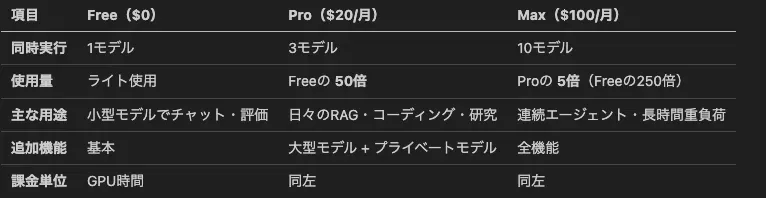
Free: Approx. 5 million tokens per week
Pro: Equivalent to 250 million tokens per week
Max: Over 1.25 billion tokens
In other words, with Pro or higher, it feels virtually unlimited for daily individual use.
2. Main LLMs available on Ollama Cloud (as of May 2026)
The strength of Ollama Cloud is that cutting-edge open-source large models are immediately available. Here are some particularly popular high-performance models excerpted from the official list of cloud-supported models.
Flagship Class (Comfortable on Pro / Max)Many of the models listed here are ultra-large MoE (Mixture of Experts) models with total parameters in the hundreds of B to 1T range. The greatest value of Ollama Cloud is that you can easily try out models in a class that cannot be run in a local environment in the cloud.
kimi-k2.6: Total approx. 1T (MoE, active approx. 32B). Top-class in multimodal, long-horizon coding, and agentic / swarm capabilities
deepseek-v4-flash / deepseek-v4-pro: Total approx. 685B (MoE, active approx. 37B). 1M context / High-efficiency inference
glm-5.1 / glm-5: Total approx. 400-500B (MoE, active approx. 32B). Agentic engineering / SOTA-class coding
minimax-m2.7 / m2.5: Total approx. 456B (MoE, active approx. 46B). Coding, productivity, and agentic workflows
qwen3.5: Wide range of sizes, top tier is 235B class (MoE). Multimodal / High-performance overall
gemma4 (26b / 31b, etc.): 26B-31B (Dense). Google-based, reasoning, coding, multimodal. Local execution is feasible at this scale
These are guidelines to help you decide, "Can this model I'm interested in run on my machine?" (assuming Q4 quantization).
In short, the division is "30B class is realistic for local, 70B for high-end configurations, and anything above that is cloud-only". Ollama Cloud is optimized precisely for the use case of offloading only those super-large models that cannot be run locally to the cloud.
Other powerful modelsqwen3-coder-next, nemotron-3-super (NVIDIA), ministral-3, devstral-small-2, gpt-oss series, etc. Some (like gemma4:31b-cloud) are available even in the Free tier, but large models like kimi or deepseek will quickly hit limits.
Common featuresTool calling support makes it strong for agent workflows
Fast with native weights + latest optimizations (e.g., NVFP4)
Prompts are not logged or used for training (privacy-focused)
Seamless switching with the same CLI / API as local Ollama
# クラウドモデルもローカルと同じ感覚で起動
ollama run kimi-k2.6
ollama run deepseek-v4-pro
ollama run glm-5.1
3. Real User Reviews on X and Reddit (Latest as of April-May 2026)
Here, we summarize the raw voices of real users shared on Reddit (especially r/ollama) and X.
Reddit (Mainly r/ollama)Positive feedback accounts for the vast majority.
“Pro $20 is plenty even if you use hundreds of millions of tokens a week”
“Free is enough for daily use”
“Productivity increased 2.7x to 4x after switching from Claude $200 Max to Pro”
“DeepSeek / GLM-5.1 is the best for agent workflows”
“A hidden gem”
Reports of actual usage are also specific.
Even working all day, only 40-50% consumed with the 5-hour reset
Weekly reset is also easy, only at 79% after using 300M+ tokens
Comments about it being “impossible to use up” stand out.
X (Twitter)“Running OpenClaw with GLM-5.1 > Kimi K2.6”
"For $20, DeepSeek V4 Pro is as good as Claude"
"Upgrading to Max brought my agents back to lightning speed"
Privacy + the best open models is a combination that receives much praise.
Complaints are also prominentOn the other hand, complaints regarding stability and consistency of speed cannot be ignored.
Extremely slow during peak times (TTFT latency, decreased token generation speed)
Responses cut off mid-stream, and there are moments when the model "becomes stupid"
Reports that usage limits suddenly became stricter on Pro (a 30-35% reduction in exchange for speed improvements?)
Comments on GitHub issues such as "95% failure rate even on Pro" and "unstable even on Max"
"Not production-ready", "no SLA"
User base evaluation: Light to medium users very satisfied, heavy agent users acceptable level, production / SLA required difficult at present
While the cost-performance is exceptionally good, stability and speed consistency need improvement — this is the general assessment as of April–May 2026.
4. Pros and Cons of Using Pro / Max
This is a summary of the pros and cons of Pro / Max based on the latest community feedback.
ProsBest cost-performance: $20 for Claude Pro-level, $100 for exceeding Claude Max ($200) usage + concurrency
Freedom of model selection: Use the best open models like DeepSeek / GLM / Kimi / MiniMax instantly at blazing speeds
Perfect privacy: Prompts are never logged or used for training
Seamless with local: Switch between local ↔ cloud using the same CLI / API
Sufficient for heavy users: Strong for parallel agents, long-duration RAG, and large-scale codebase tasks
Overage purchase prospects: A mechanism to buy additional capacity cheaply when limits are exceeded has been announced
Hard to predict due to GPU time billing: Consumption varies significantly based on model size and query length
Speed fluctuations: Delays and instability during peak times (Western time zones)
Occasional quality drops: Reports of disconnections, cut-offs, and response degradation
Risk of limit adjustments: Past instances where Pro limits were suddenly tightened
Unsuitable for production: No SLA, wait times occur due to sudden capacity shortages
The perceived difference between Free and Pro is extreme: With large models, Free hits a wall immediately
5. Comparison with other companies' subscriptions (May 2026)
Cost-performance conclusionIn the $20 class, Ollama Cloud Pro is the strongest candidate. Especially for those who want to freely use the best open models, there is no substitute. For heavy users, the $100 Max is also quite excellent, and I often see comments saying it has higher satisfaction than the Claude $200 plan.
6. Conclusion — Worth trying Pro right now
Recommendations by planPro $20 → For individuals and developers, this is enough for most. There is a rapid increase in people switching from Claude / ChatGPT
Max $100 → For those who seriously run continuous agents or multiple parallel tasks. Many say, "I still have headroom." If you prioritize stability, a local + cloud hybrid is recommended
People who do coding, RAG, and agent tasks every day
People dissatisfied with Claude / ChatGPT limits
Privacy-conscious people who want to use the best open LLMs
People who already use local Ollama and want to offload only heavy-duty models to the cloud
Usage is based on GPU time (consumption varies significantly by model size)
Expect latency and instability during peak times
Free is strictly for testing, the standard workflow is to try it out with Free first and upgrade to Pro immediately.
For production / SLA-required use cases, it is currently not recommended
Summary
The Ollama dual-wielding approach—local unlimited plus cloud supplementation—is undoubtedly one of the strongest options in 2026.
Free: For testing and small models.
Pro $20: Best value for money; sufficient for most individual developers.
Max $100: For continuous agents / heavy business use; better value than the Claude $200 plan.
The standard workflow is to try it out with Free first, then upgrade to Pro if it's not enough. I don't think you'll get lost if you follow this order: only those who find Pro insufficient should consider Max.
Official Pricing: https://ollama.com/pricing Cloud model list: https://ollama.com/search?c=cloud
Which model or plan are you interested in? Let me know in the comments, such as "I want to hear how you use kimi-k2.6" or "I want to know specific examples of integration with Claude Code." I'll use them as topics for my next article.
(Information is current as of May 9, 2026. Since plan details and supported models are updated frequently, please check the official website for the latest information.)