"World Person" refers to "a person who transcends the boundaries of their own country and is interested in and involved with the world." Anyone, from children to adults, who is interested in the world and takes action is a "World Person." For a detailed explanation of this blog, please read here.
This time, our World Person, Eriko Nagata, is energetically promoting the charms of the Northern Spain region, which is not yet widely known within Spain. How did Nagata, who was initially drawn to Italy when she first became interested in overseas, end up becoming captivated by Northern Spain?
Turning "likes" into a career. Walking with Northern Spain today
Sakai (hereinafter, --): Ms. Nagata, please tell us about your current work.
Nagata: I have two main jobs. One is work related to Spain, which I started at age 25. As a Spanish interpreter and translator, I mainly support events for the Basque Government Tourism Board aimed at Japan and South Korea, and provide PR support for the Basque Culinary Center, a four-year university specializing in food science and cooking located in the suburbs of San Sebastian, Spain. Also, personally, I have been sharing information about the food and life of Northern Spain on my blog and social media under the name "Green Spain Plus" for about 15 years.
The four provinces of Northern Spain—Basque Country, Cantabria, Asturias, and Galicia—are regions characterized by being blessed with lush green pastures and nature. Because they differ from other parts of Spain, they are affectionately known as España Verde (Green Spain). I named my blog "Green Spain Plus" because I wanted to share information specialized in the northern regions I visited and grew to love. I don't earn an income from this information sharing, but it has led people to discover me, which has resulted in jobs like Spanish interpretation and translation.
Another thing I do is hold online Spanish classes. I used to work in wine importing, and I started these classes after teaching Spanish to people at Spanish restaurants I met through that job. The classes have gradually expanded, and I have taught over 200 people so far.
I aimed for Italy, but my life-changing encounter with Northern Spain
--This time, I would like to ask mainly about your work related to Northern Spain, but could you tell us the story of how you got to where you are today?
Perhaps because my father was a cook, I have loved cooking since I was old enough to remember. Since my parents both worked, I often ate meals at my grandparents' house with my twin brother. The simple dishes my grandparents, who had experienced the war, made for us, and the snacks they created from their post-war memories of making do with limited ingredients due to poverty, are deeply etched in my childhood heart. Because of that influence, I am still strongly drawn to traditional home cooking made by bringing out the best in ingredients, regardless of whether it is domestic or international. Since I was little, I also looked forward to getting a cookbook every birthday.
When I was in my third year of high school, for some reason, the feeling that "it would be a waste of time to just go to university aimlessly" sprouted, and I decided not to pursue higher education but to enter the world of food and beverage. When I looked up potential employers at school, the only options were Japanese, Chinese, French, or Italian cuisine. Based on my personal image, I felt "Japanese cuisine seems to have a scary atmosphere" and "French cuisine seems to have strict training," so I removed them from my candidates. After wavering between Chinese and Italian, I chose Italian cuisine because of the impression that it was "bright and stylish."
At that time, I remembered my father's words: "Those who train in the authentic place and get credentials are strong." If I was going to learn Italian cuisine, I wanted to learn the real thing locally someday—that thought naturally grew stronger.
In the end, I graduated from high school without getting a job, and I hopped between part-time jobs in the food and beverage industry to save money for studying abroad. While working at hotel banquet halls and restaurants, I had opportunities to interact with Japanese cuisine chefs and French cooks, but they were all very warm and kind people. I reflected on the fact that I had chosen my career path based only on images.
I didn't get a job, declaring, "I'll save money and study abroad in Italy," but the money I earned from part-time jobs disappeared into clothes, bags, and social expenses, so I wasn't saving money as planned.
Even so, I was gathering information, such as requesting brochures for studying abroad in Italy, but when I thought about actually going overseas, my fear became stronger, and days passed where I couldn't take action.
After that, I worked at an Italian restaurant in Nihonbashi, where I was in charge of bread, pasta, and desserts. It was a blessed environment surrounded by a chef who had returned from Italy and talented seniors, but I felt it was difficult to continue due to the working conditions, so I resigned after two years. After that, I wanted to learn bread making, so I worked at a bakery. The bread-making job was very fun, but the hourly wage was low here too, and there were times when I had to work a side job at a pachinko parlor at night to earn living expenses.
While vaguely thinking, 'I want to be independent in a job I love by the time I'm 25,' the days of groping in the dark continued. At that time, I had an opportunity to hear stories from an acquaintance who was studying abroad in Spain. That person said to me, 'If you're so afraid of going abroad, why don't you try coming to Spain where I am? Spain and Italy are close, so you might be able to meet Italians,' and pushed by those words, I decided to visit Spain first.
--So, even though you were interested in Italian cuisine, your destination was Spain!
That's right. At first, it was a country I had absolutely no interest in, to the point where I didn't even know where it was. Even so, I made the decision thinking it was 'for the sake of studying in Italy.' It was my first solo trip outside of family vacations. I was so nervous that I couldn't stop feeling nauseous on the way to Narita Airport. An acquaintance studying abroad came to pick me up at Madrid Airport, and he took me by car about 300 kilometers north to Burgos, a city in northern Spain where he was staying.
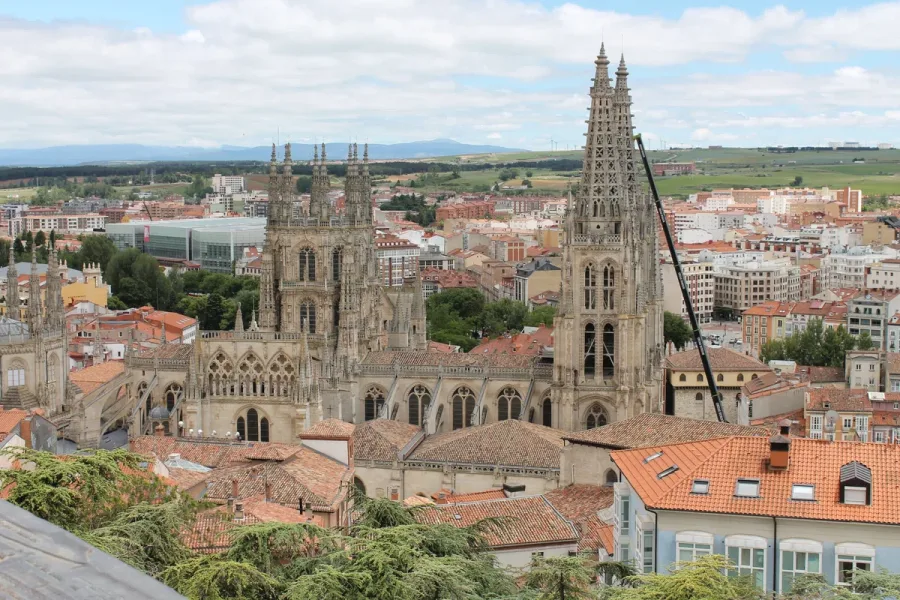
Exhausted from the long-haul flight, I fell asleep in the car, and when he woke me up, it was in front of the Burgos Cathedral, one of the three great cathedrals of Spain and a World Heritage site. The moment I saw the majestic cathedral standing divinely illuminated by the moonlight, I couldn't help but shed tears at its sheer beauty.
During my stay, my acquaintance was busy with work, so a Spanish couple who were his friends offered to show me around instead. The two of them could only speak Spanish, and I had no interest in Spain. Thinking about it now, I'm surprised they agreed to do it. However, the scenery of Northern Spain that these two showed me changed my life thereafter.
In particular, in a village called Frias, about 80km northeast of Burgos by car, I was so moved that my body trembled at the sight of an old castle beautifully towering on a steep cliff.
I wanted to tell the two who guided me, 'I will never forget this scenery, this experience. Thank you so much,' and I felt that strongly, but at the time, I could only speak a little Italian and no Spanish at all, so I couldn't properly convey my feelings just by pointing at a dictionary. By the time I returned to Japan, I had the feeling that 'someday I will definitely convey my gratitude to them in Spanish.'
Although my days were spent communicating with gestures while holding a small Spanish dictionary, I touched the warmth of the local people, tasted the wonderful scenery and the deliciousness of simple, unadorned food, and I had completely fallen in love with Northern Spain.
Days in Burgos where I studied Spanish with passion
--That is a wonderful connection, as if you were led to Northern Spain. That is truly the case. For the six months after returning to Japan, I worked about 16 hours a day to save money and set off for Burgos again. In Spain at that time, if you had a certificate of attending a language school, you could stay for six months without a visa, so I studied at a local language school until the very last minute. Since Burgos was an environment where only Spanish was spoken, it became a time when I naturally immersed myself in Spanish.
My language school teacher advised me, 'To learn daily conversation, don't shop at the supermarket, but shop at the market and interact with the local people.' So I went to the market, and when I asked about vegetables I had never seen before, people around me gathered one after another, teaching me the names of the vegetables and how to eat them, and even showing me rarer vegetables, treating me very warmly.
People in northern Spain may be reserved and many are shy. However, when I tried talking to them, many were very kind and gentle, and I was truly grateful for that warmth.
I had quit all my jobs in Japan and come to Spain with my back to the wall, so I was desperate to learn Spanish. After the three-month halfway point passed, I had nightmares every night that 'I hadn't studied anything yet, but before I knew it, I had returned to Japan.' I think it was the time I studied most seriously in my life. Perhaps Spanish suited me. I was able to learn enough to speak to a certain extent in six months.
The 'next step' I chose to make use of Spanish
--What kind of work did you do after returning to Japan?
I was 25 when I returned from studying abroad. I looked for a job that would make use of my Spanish, but with only a high school diploma, a history of part-time work, and a gap in my resume, I couldn't find anything. Since both my father and grandfather were self-employed, I had always wanted to work for myself someday, so I started a business as a sales agent for Spanish wine and food products. It was rewarding work, but it was a business heavily influenced by the economy, and because it required a stable, long-term supply of large quantities of wine, managing it was by no means easy.
I worked hard for five years, but I felt there was a limit to what I could do on my own, so I decided to change my business model. I signed a service contract with an importer that primarily sourced Spanish wine and took charge of wine sales. The person who invited me to work with them at that company was someone who had signed a wine purchase contract with me shortly after I started my business, and I am still deeply grateful to them today. After that, my career in wine importing came to an end after about 12 years.
Although I left the wine industry, the experience I gained during that time has become an important foundation that shapes who I am today. Through my work with wine, I was able to meet people involved in Spanish food all over Japan, and those connections led to the information dissemination I started in 2011 with Green Spain Plus.
Since 2010, I have visited Northern Spain at least once every two years to broaden my horizons. I wrote about the knowledge and memories I gained through my travels on Green Spain Plus, and the Spanish Tourist Office found it, which led to me receiving work from the Basque Government. Recently, I have been able to handle tourism promotion events for the Basque Country held not only in Japan but also in South Korea. I feel happy to be able to use my knowledge of the culture and food of Northern Spain, including the Basque region, in my work as an interpreter, translator, and PR supporter.
Sharing the charm of the Northern Spain I fell in love with, with as many people as possible
――Ms. Nagata, what do you think is the charm of Northern Spain?
I think one of the charms is the sense of immersion, as if you have wandered into the set of a medieval movie. Like Japan, tourism in Spain tends to be concentrated in large cities, but in the small towns and villages of Northern Spain, there are few tourists, and you can see up close how modern life breathes within beautiful, long-standing townscapes. I also feel that the climate is humid and mild, which suits the Japanese constitution.
And above all, the food is wonderful. Northern Spain is so rich in ingredients that it is called a 'food pantry,' with thriving fishing, agriculture, dairy, and livestock industries, and the restaurants loved by the locals are all very delicious.
When I was a child, I loved watching my grandmother make miso, fruit liqueur, and pickled plums, and Northern Spain also has a variety of preserved food cultures. Finding commonalities with Japanese food culture might be one of its charms.
Furthermore, I am surprised at how safe and kind people are, especially in small towns. Once, when I was trying on clothes at a souvenir shop in a rural town in Asturias, I lost one of my earrings. Later, when I entered a shop on the other side of town, someone called out to me, 'Are you Japanese? Didn't you lose an earring at the shop where you bought clothes earlier?' The souvenir shop owner had been contacting various shops that tourists might visit. This one episode alone should give you a sense of the kindness and warmth of the people in Northern Spain.
Spain is currently focusing on 'sustainable tourism.' Like Japan, overtourism, where tourists are concentrated only in popular tourist destinations, has become a social issue. Sustainable tourism refers to a form of tourism where travelers, tourism businesses, local communities, and the natural environment can all maintain a good relationship over the long term.
Since I fell in love with Northern Spain in Burgos, which I visited for the first time by chance, I have been sharing information about it like a fan because I wanted people in Japan to know about the Northern Spain I love so much. In recognition of these activities, the international conference event 'Spain Talks 2026,' hosted by the Spanish Tourist Office, awarded me the Best Content Award in the Ambassador Award: Tourism Content Creator category for contributing to sustainable tourism. It is an unexpected honor, but I would like to continue to spread the charm of Northern Spain even further.
What lay beyond finding what I 'love'
――Do you have any advice for those who haven't found something they 'love' like your passion for Northern Spain?
I believe that if you haven't found what you 'love,' it's simply because you haven't encountered it yet. By trying new things you've never touched before or broadening your perspective outside the world you are currently connected to, you might find hints that lead you to what you 'love'.
Even if you don't find what you 'love' right away, accumulating a lot of material will steadily increase the chances of finding it. I hope you will gather plenty of material first, without rushing or forcing yourself.
--Through your involvement with the world, have you noticed anything or felt that you have changed?
Since I started engaging with the world, I've realized how much I love Japan, and that things I took for granted could be considered completely absurd in different places. When I was attending a language school in Spain, there were times when I laughed when people around me made mistakes or mispronounced words. In Japan, I think there is a tendency to laugh off one's own slips of the tongue or to laugh at others' mistakes to lighten the mood, but I was the only one laughing in that situation, and I felt very embarrassed. I also feel bad for the other person.
Also, I felt culture shock when communication didn't go smoothly in various situations, such as email and phone exchanges or local meetings, but from that experience, I learned that while politeness is important, clarity and expressing one's intentions—starting with the conclusion—are indispensable.
Furthermore, when I go abroad, I often receive many questions from people interested in Japan, and I sometimes realize that I didn't know as much about Japan as I thought. Since I am a 'representative of Japan' to them, the responsibility is significant. I have started researching Japanese things and customs again and thinking about how to explain them clearly in Spanish, which has led to various learnings and realizations.
--Is there anything you would like to try in the future, Ms. Nagata?
All the work I am involved in is very enjoyable, and at this point, I am not thinking about making any major changes. I just want to continue the work I have now with great care.
I have been entrusted with work by the Basque Government and received an award from the Spanish Tourism Board, and before I knew it, I found myself in a place I never imagined. I feel that my mother, who has supported me ever since I was drifting between part-time jobs after graduating from high school, is also happy with my current situation.
Actually, I am aiming to publish a book based on what I have learned so far, focusing on the history and culture of Spanish food, what I have absorbed in my own way, and the background of how each dish was born. The content I have been writing little by little is now about 80% complete.
I intend to think carefully about the form of publication, but since the content has become quite substantial, I am sure it will be a book that you will enjoy.
--After listening to you for so long, I've become quite hungry (laughs). Finally, could you tell me one of your favorite Spanish dishes?
May I name two? (laughs). One is the 'tortilla de patata,' a potato omelet that is a national dish loved all over Spain. It is a dish that can be eaten at bars, restaurants, and at home, and despite its simplicity—using only eggs, potatoes, salt, and oil—it has diverse variations depending on the region and household, making it a very profound dish. If you go to Spain, I hope you will enjoy comparing them.
The other is lentil stew. This is a home-cooked meal with a comforting taste that is eaten when you have a cold. It is also a dish that has been cherished locally since the long, impoverished post-war era. Although not well known, Spain has a very rich variety of bean dishes, all of which are deeply flavorful and attractive. I hope you will try them at least once.
Eriko Nagata's Global Citizen Points
● When I was anxious about going abroad, I was able to ask people around me for help. ● Once my mind was made up, I did not hesitate to take action. ● I have the strength to keep cherishing the feeling of 'love.' ● I can talk about Japan.
Interview Postscript
During the interview, Ms. Nagata shared some tips for finding what you love. Among them, the phrase, "Perhaps you haven't found what you love simply because you haven't encountered it yet?" left a strong impression on me. I felt it was a warm sentiment that encourages us to keep searching for the "loves" we have yet to discover.
Furthermore, I felt there was deep meaning in her story about how she was too afraid to go to Italy, where she had originally intended to study abroad. Ms. Nagata's experience seemed to teach us that by being honest with our hearts, there are moments when we can encounter the places and people destined for us.
Recently, she says she has been receiving more inquiries from students asking about working at Spanish restaurants or wanting to learn about Spanish culture. She mentioned that she finds it very enjoyable to introduce them to chefs or explain things herself.
I hope that for those who have read this article, the circle of people interested in the rich charm of Spain, starting with the Northern Spain that Ms. Nagata shares, will continue to expand.
Interviewer/Article Writer: Yukiko Sakai
Editorial Cooperation: Megumi Tomizawa, Mizuho Akaogi
Click here for the Green Spain Plus website
Click here for the Green Spain Plus Instagram
Click here for the previous World Person #27 article featuring Hikaru Iwama