On September 10, 2026, the European Central Bank (ECB) decided at its Governing Council meeting in Berlin to raise its policy rates by 0.25%, setting the deposit facility rate at 2.50%. This is the second rate hike since the start of the military conflict in the Middle East, following a pause in July and the initial hike in June, which was the first in about three years. The backdrop is the persistent high prices of crude oil and natural gas due to turmoil in the Strait of Hormuz, which accelerated the Eurozone's inflation rate to 3.3% in August. What is the ECB wary of with this decision, and how far will it continue to tighten? This article organizes the details of the decision, the reality of inflation, the new economic outlook and three scenarios, market interpretations, and the implications for Japanese investors and business professionals, step by step.
1. What was decided: All three policy rates raised by 0.25%
First, let's confirm the details of the decision. The ECB has three policy rates, and all of them were raised by 0.25% this time.
Deposit facility rate: 2.25% → 2.50%
Main refinancing operations rate: 2.40% → 2.65%
Marginal lending facility rate: 2.65% → 2.90%
The new interest rates will apply from September 16, 2026. Among these, the market pays the most attention to the deposit facility rate as the "ECB policy rate." This is because the Eurozone continues to have excess liquidity in the banking system, and the rate at which banks deposit their surplus funds with the ECB functions as the de facto floor for short-term money market rates.
This Governing Council meeting was an "off-site" meeting, held annually outside the Frankfurt headquarters, and was hosted by the Deutsche Bundesbank in Berlin. The podium at the press conference displayed the text "ECB GOVERNING COUNCIL MEETING Berlin 2026," where President Lagarde explained the reasons for the decision.
The key points of the monetary policy statement released by the ECB can be summarized in the following three points.
The first point is the recognition that the conflict in the Middle East continues to generate inflationary pressure, and inflation is expected to remain significantly above the 2% target for a long period. The second point is the expression of determination to ensure that inflation stabilizes at 2% over the medium term. And the third point is the stance of continuing to make "data-dependent, meeting-by-meeting" decisions without pre-committing to a future interest rate path.
At the press conference, President Lagarde described this decision as a "no-brainer." On the other hand, regarding which direction they would move at the next meeting, she repeatedly stated that she had "no outlook" and "cannot predict the next move," avoiding any promise of further rate hikes. She also explained that the Governing Council's discussion focused on the decision itself and did not discuss the future interest rate path.
Market expectations beforehand were also largely in agreement. In a Reuters survey of economists conducted in early September, almost all respondents expected this 0.25% rate hike. In other words, the rate hike itself was not a surprise, and it can be said that the focus had shifted to "what happens next" and the new economic outlook released at the same time.
2. Why raise rates now: The energy shock from the Middle East
To understand this rate hike, it is necessary to look back at the course of the energy shock that has shaken the Eurozone economy in 2026.
It began at the end of February. The United States and Israel launched attacks on Iran, and the situation in the Middle East became tense all at once. Shipping through the Strait of Hormuz, through which about 20% of the world's crude oil and about 20% of the world's liquefied natural gas (LNG) are said to pass, was significantly disrupted, causing energy prices to soar. The ECB's economic outlook document clearly describes this situation as a "blockade of the Strait of Hormuz."
The Eurozone relies on imports from outside the region for much of its energy. Having experienced inflation rates exceeding 10% due to the surge in energy prices during Russia's invasion of Ukraine in 2022, it is a region with a strong sense of caution regarding energy shocks.
Crude oil back to the $100 rangeBrent crude futures, the benchmark for European oil prices, topped $100 a barrel again in September. On September 9, it closed at over $101, the highest level since May. The direct trigger was the further escalation of tensions surrounding maritime transport, such as the U.S. military attacking Iran-linked tankers and the Houthi rebels, a pro-Iranian armed group in Yemen, attacking Saudi Arabia. On the day of the ECB Governing Council meeting, there were moments when crude oil prices exceeded $102.
Natural gas at its highest since December 2022Natural gas may be more serious. The Dutch TTF, the benchmark for European natural gas prices, rose above 80 euros per megawatt-hour on September 10, reaching its highest level since December 2022. Since much of the LNG heading to Europe from Qatar passes through the Strait of Hormuz, the turmoil in the Middle East directly hits Europe's gas supply and demand. Compounded by maintenance of gas facilities in Norway and reduced supply from Algeria, European gas inventories remain below average levels.
The 'injection season' for topping up gas storage facilities during the summer is coming to an end, and we are heading into a winter where heating demand will rise while inventories remain insufficient. Concerns over gas shortages are intensifying ahead of winter, which could push gas prices even higher. In its statement, the ECB also pointed out that gas prices are particularly vulnerable to supply disruptions and an 'unusually cold winter'.
The 'Amplifiers': Refining Margins and Electricity PricesThis energy shock has factors that push up consumer prices more than the price of crude oil itself. The first is the expansion of refining margins for petroleum products such as gasoline and diesel. Because the turmoil in the Middle East has reduced the global supply of petroleum products, prices for these products are difficult to lower even when crude oil prices fall. The second is electricity prices. In Europe, the cost of natural gas-fired power generation tends to dictate wholesale electricity prices, so high gas prices directly spill over into electricity bills.
In the ECB's outlook, the assumption for wholesale electricity prices in the third quarter of 2026 has been revised upward by approximately 50% since June. If you only look at crude oil price movements, you will misjudge the true weight of energy inflation in the Eurozone.
3. How has Eurozone inflation moved?
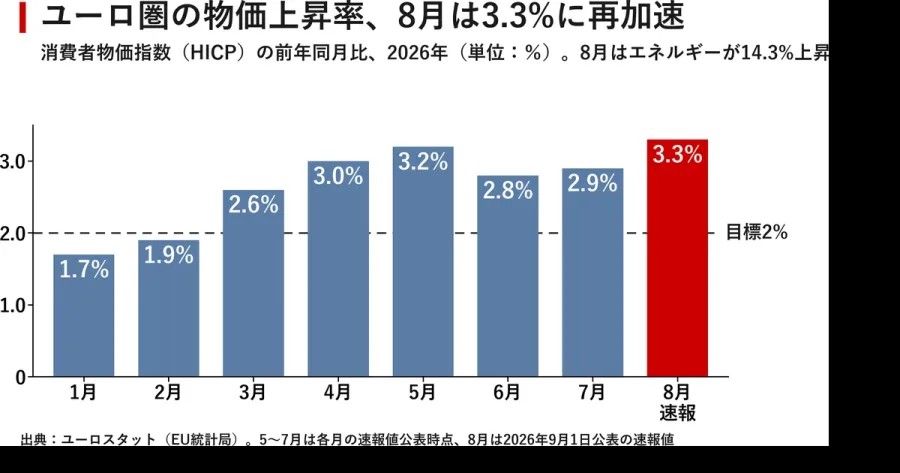
The surge in energy prices is clearly reflected in Eurozone consumer prices. Using data from the European Union's statistical office (Eurostat), we can trace the monthly inflation rate (HICP, year-on-year) for 2026.
January: 1.7%
February: 1.9%
March: 2.6%
April: 3.0%
May: 3.2%
June: 2.8%
July: 2.9%
August: 3.3% (flash estimate)
At the beginning of the year, it was hovering slightly below the 2% target. However, it jumped to 2.6% in March, immediately after the conflict in the Middle East began, reaching 3.0% in April and 3.2% in May. It slowed down to 2.8% in June, but accelerated again toward the summer, with the August flash estimate reaching 3.3%, the highest level since September 2023.
Energy is the protagonist, while core inflation remains calmLooking at the components, the characteristics of this inflation are clear. In August, the inflation rate by item shows energy standing out at 14.3% (compared to 10.3% in July). Meanwhile, services remained at 3.0% (3.3% in July), non-energy industrial goods at 1.2%, and food, alcohol, and tobacco at 1.2%. The core inflation rate, excluding energy and food, was 2.4%, actually a slight decline from 2.5% in July.
The energy inflation rate surged from 5.1% in March to 10.9% in April, and reached 14.3% in August, the highest level since January 2023. In other words, the current acceleration in inflation can be explained almost entirely by energy prices. It is not a resurgence of 'domestically generated inflation' led by service prices or wages.
This is where the difficulty of this interest rate hike lies. Monetary policy cannot lower energy prices themselves. Crude oil and gas prices are determined by the situation in the Middle East and global supply and demand, and raising interest rates in the Eurozone will not make ships in the Strait of Hormuz start moving. Why, then, did the ECB decide to raise rates? We will consider this point in detail in Chapter 6.
4. The trajectory of interest rates: From a phase of rate cuts to a reversal toward tightening again
ECB monetary policy has fluctuated significantly over the past few years. Looking back at the trajectory of the central bank deposit rate, the positioning of this latest rate hike becomes clear.
2022–2023: The fastest rate hikes in historyFollowing Russia's invasion of Ukraine, the Eurozone inflation rate hit a record high of 10.6% in October 2022 since statistics began. The ECB ended its negative interest rate policy in July 2022 and proceeded to raise rates for 10 consecutive meetings until September 2023, bringing the central bank deposit rate to a record high of 4.00%.
2024–2025: Eight rate cuts to 2.00%As inflation settled, the ECB shifted to rate cuts starting in June 2024, implementing eight cuts totaling 2.00% over the approximately one year leading up to June 2025. The central bank deposit rate fell to 2.00% and remained at that level for nearly a year thereafter. The average annual inflation rate for 2025 was 2.1%, nearly reaching the target.
2026: Another rate hike due to energy shockWhat disrupted this 'target achieved' state was the conflict in the Middle East. The ECB decided on a 0.25% rate hike at its June meeting, bringing the central bank deposit rate to 2.25%. This was the first rate hike in about three years since September 2023. While it held steady in July to observe the situation, the prolonged confusion in the Middle East and the re-acceleration of inflation led to a second rate hike in September.
Compared to the 2022–2023 rate hike phase, this time the pace and magnitude are much more moderate. Back then, there were massive 0.75% hikes at once, but this time it is 0.25% at a time, with a meeting skipped in between. It is evident that the ECB is trying to carefully balance 'nipping inflation in the bud' with 'not cooling the economy too much.'
Differences from the 2022 energy crisisEven though it is the same energy shock, the starting point is vastly different between 2022 and 2026.
The first difference is the starting point of interest rates. In 2022, the ECB was in the midst of a negative interest rate policy, with the central bank deposit rate at -0.50%. With quantitative easing still purchasing government bonds, monetary policy was in an extremely accommodative state when energy prices began to rise. In contrast, in 2026, the central bank deposit rate is at 2.00%, near the neutral rate, and the ECB is in the process of reducing its holdings of government bonds by not reinvesting maturing ones. The holdings under the ECB's Asset Purchase Programme (APP) and Pandemic Emergency Purchase Programme (PEPP) are stated in this latest statement to be declining at a gradual and predictable pace.
The second is the spread of inflation. In 2022, inflation spread rapidly across a wide range of items due to the sharp recovery in demand from the economic reopening after the pandemic, global supply chain disruptions, and high energy prices. So far this time, core inflation is at 2.4% and services at 3.0%, which are relatively calm, with the main cause of acceleration concentrated in energy.
The third is the speed of the central bank's response. In 2022, the ECB viewed inflation as transitory and was slower to start raising rates than the U.S., resulting in being forced to raise rates at the fastest pace in history. This time, it is moving to raise rates early while the inflation rate is around 3%. The idea is that moving early and in small increments is better than moving late and in large increments to minimize the damage to the economy.
Given these differences, it is unlikely that this rate hike phase will be as rapid and significant as the one in 2022–2023. The additional rate hikes priced in by the market are also at a moderate pace of a few 0.25% increments. However, this assumes that the Middle East situation does not deteriorate further; if a severe scenario becomes reality, the story will change.
Real interest rates are still negativeAnother point to keep in mind is real interest rates. Subtracting the August inflation rate of 3.3% from the central bank deposit rate of 2.50% results in a real interest rate of approximately -0.8%. Looking at the core inflation rate of 2.4%, which excludes energy and food, the real interest rate is nearly zero.
In other words, even now after two rate hikes, the ECB's monetary policy is not at a level that 'strongly cools the economy.' Many in the market view the neutral rate, which neither overheats nor cools the economy, as being around 2%, and 2.50% has just entered the 'slightly tightening' territory, slightly above the neutral rate. President Lagarde herself stated in the press conference that the neutral rate is a very conceptual thing and not of great importance, but it serves as a benchmark for the market to consider future room for rate hikes.
5. Reading the new economic outlook: Inflation is 'higher for longer'
The ECB publishes its economic and price outlook four times a year: in March, June, September, and December. The September outlook was prepared by ECB staff and served as the foundation for this rate hike decision. Compared to the June outlook, it is as follows.
The inflation rate (HICP) is projected to be 3.0% in 2026 (same as in June), 2.5% in 2027 (2.3% in June), and 2.1% in 2028 (2.0% in June). While the 2026 forecast remained unchanged, the forecasts for 2027 and 2028 were revised upward by 0.2 percentage points and 0.1 percentage points, respectively.
Core inflation, excluding energy and food, is projected at 2.5% for 2026 (same as in June), 2.6% for 2027 (up from 2.5%), and 2.3% for 2028 (up from 2.2%). These figures for 2027 and 2028 have also been revised upward.
Real GDP growth is projected at 0.9% for 2026 (up from 0.8% in June), 1.4% for 2027 (up from 1.2%), and 1.5% for 2028 (unchanged). The economic outlook has been revised upward.
Inflation is expected to peak at 3.6% in the October-December quarter of 2026.Looking at the quarterly outlook, inflation is expected to peak at 3.6% in the October-December quarter of 2026. Thereafter, as the impact of soaring energy prices drops out of year-on-year calculations, it is expected to fall to 2.5% in the April-June quarter of 2027 and hover around 2% thereafter.
What is noteworthy is the significant difference in the speed at which shocks transmit to energy versus other items. Because energy prices are passed on to consumer prices quickly, if oil and gas prices fall as assumed, the energy inflation rate is expected to decline rapidly and turn negative during 2027. It will return to positive territory in 2028 due to the introduction of the EU's new Emissions Trading System (ETS2).
In contrast, the ripple effect on non-energy items proceeds slowly. This is because rising transportation and utility costs are passed on to food and service prices over time. Core inflation is expected to continue rising until early 2027 and only begin to settle in 2028. It is precisely this "delayed inflation" that the ECB is wary of.
The economy is more resilient than expectedOne of the reasons for the upward revision in the inflation outlook is the resilience of the economy. Eurozone growth in the April-June quarter of 2026 exceeded expectations, with broad-based growth across countries and sectors. The unemployment rate in July was at a historic low of 6.4% and is expected to reach new record lows during the forecast period.
There are three pillars supporting the economy. The first is the expansion of defense spending and infrastructure investment, centered on Germany. Fiscal policy is expected to move in an expansionary direction by 0.5 percentage points of GDP in 2026. The second is investment related to artificial intelligence (AI) and the export of digital services. The third is personal consumption, supported by stable employment. President Lagarde also acknowledged in her press conference that she was surprised by the resilience of the economy, noting that data released after the forecast deadline suggested even higher growth for 2026.
A resilient economy is good news in itself. However, from the perspective of monetary policy, in an economy with strong demand, companies find it easier to pass on cost increases to prices, and workers find it easier to demand wage hikes. In other words, the structure is that "because the economy is strong, high energy prices are more likely to spread to prices as a whole." The logic of this forecast is reflected in the fact that the upward revision of the economic outlook is directly leading to an upward revision of the core inflation outlook.
The oil price assumptions underlying the forecast are already lower than realityAnother point that cannot be overlooked is the assumptions behind the forecast. The ECB's outlook is based on market futures prices for energy price assumptions. In the current assumptions, Brent crude oil is expected to decline gradually, averaging $89.5 per barrel in 2026, $78.0 in 2027, and $73.6 in 2028. The average for the July-September quarter of 2026 is set at $88, nearly 15% lower than the June forecast.
However, the deadline for finalizing the energy price assumptions was August 19. Since then, in September, oil prices have again exceeded $100. In other words, it is highly likely that the September forecast is based on more optimistic assumptions about oil prices than reality. President Lagarde's comment at the press conference that current inflation was lower than expected but "more prolonged" can be read as an acknowledgment of this gap between assumptions and reality.
Meanwhile, the natural gas assumptions were set at an average of 51.0 euros per megawatt-hour for 2026, 43.3 euros for 2027, and 30.3 euros for 2028, a significant upward revision from June. The assumption for the July-September quarter of 2026 is double the level of the forecast from December 2025. Even so, the TTF price on September 10 was in the 80-euro range, far exceeding the 2026 assumption. If prices continue to exceed the forecast assumptions for both oil and gas, the inflation outlook may be revised upward further.
6. What the "severe case" looks like in the three scenarios
Given the extremely high uncertainty surrounding the situation in the Middle East, the ECB has presented three alternative scenarios in addition to the baseline scenario. This is an update to what was first presented in the June outlook.
Optimistic scenario: Energy prices normalize faster than in the baseline scenario
Pessimistic scenario: Energy price increases are larger and last longer, and uncertainty rises while secondary ripple effects intensify
Severe scenario: An energy shock occurs that is stronger and longer than in the pessimistic scenario, and wages and non-energy prices also react strongly
In each of these scenarios, the inflation outlook changes significantly.
In the optimistic scenario, inflation rates will be 2.9% in 2026, 1.9% in 2027, and 1.8% in 2028, actually falling below the target. The baseline scenario is 3.0% in 2026, 2.5% in 2027, and 2.1% in 2028. In the pessimistic scenario, inflation actually accelerates in 2027, reaching 3.1% in 2026, 3.2% in 2027, and 2.3% in 2028.
The most shocking is the severe scenario. Inflation rates are 3.3% in 2026, 5.4% in 2027, and 3.2% in 2028, exceeding 5% in 2027 and remaining significantly above target even in 2028. Core inflation also remains high at 3.5% in 2027 and 3.2% in 2028. Meanwhile, the growth rate drops to 0.4% in 2027. This is a state close to so-called stagflation, where inflation and economic stagnation occur simultaneously.
The ECB's outlook document explains that the severe scenario assumes a 'non-linear' reaction consistent with past experiences when facing major energy shocks. This likely reflects lessons learned from 2021-2022. At that time, many central banks viewed high energy prices as 'transitory' and were slow to respond, after which inflation spread to wages and a wide range of goods, forcing rapid interest rate hikes.
What can be read from this scenario analysis is that the ECB views risks asymmetrically. If the optimistic scenario is realized, inflation will only fall slightly below the target, but if the severe scenario is realized, inflation will jump to more than double the target. Considering the cost of being wrong in either direction, the decision to raise rates early, even while being prepared for some negative impact on the economy, is rational.
7. Is 'raising rates for supply shocks' correct?
Here, I will consider the fundamental issues surrounding this interest rate hike.
Textbook principle: 'Look through supply shocks'In financial policy textbooks, it is generally held that central banks should 'look through' supply shocks, such as rising energy prices. There are two reasons for this. One is that raising interest rates does not lower energy prices themselves. The other is that high energy prices themselves reduce household real income and have the effect of cooling the economy, so adding interest rate hikes on top of that could excessively worsen the economy.
President Lagarde herself admitted at the press conference that this shock is 'primarily a supply shock.' Even so, the reason they proceeded with the rate hike is that there is an important exception to the principle. That is when a supply shock lasts for a long time and begins to spread to corporate pricing, wage negotiations, and people's inflation expectations. When this happens, 'second-round effects' are created where inflation, which should have been temporary, continues in a self-propagating manner, and if left unchecked, larger rate hikes will be required later.
Three transmission channels the ECB is watchingSo, to what extent are second-round effects appearing in the Eurozone? From the ECB's statement, we can read the current status of three channels.
The first is wages. The growth rate of compensation per employee slowed to 3.3% in the April-June quarter of 2026 from 3.5% in the January-March quarter. The ECB assessed in its statement that at this stage, wages have not shown a notable reaction to the energy shock. However, the ECB's wage tracker expects the growth rate of agreed wages to rise slightly to 2.7% in the first half of 2027, and the possibility remains that moves to seek inflation compensation in future wage negotiations will strengthen.
The second is corporate profits. The growth rate of unit labor costs slowed from 3.5% to 2.6%, but on the other hand, the growth rate of unit profits expanded from 0.3% to 2.2%. This suggests that companies may be raising prices by more than the increase in costs. When the economy is solid, it becomes easier for companies to pass on price increases.
The third is inflation expectations. Most long-term inflation expectations are stable at around 2%, which is a reassuring factor for the ECB. However, short-term inflation expectations remain at a high level. If households and companies begin to think that 'prices will continue to rise for a while,' there is a risk that this will push up actual inflation through panic buying, price hikes, and wage demands.
Looking at it this way, the second-round effects are at a stage where they 'have not yet fully materialized, but there are signs.' The ECB's rate hike is positioned not so much as a response to inflation that has already occurred, but as a 'preemptive rate hike' to prevent the spread of inflation that could occur from now on.
There are also concerns about rate hikesOf course, it is not that there are no concerns about this rate hike. High energy prices are already putting pressure on household real income, and if rising interest rates are added to that, the burden on households with mortgages and companies with high debt will increase. According to the ECB's statement, bank lending rates for companies rose to 3.8% in June-July from 3.6% in May. The cost of funding through corporate bonds is also at a high level of 4.0% in July. The growth rate of mortgages slowed to 3.0% in July.
Furthermore, the Eurozone shares one monetary policy among 21 countries with different economic conditions, with Bulgaria joining in January 2026. The impact of the same interest rate hike differs between Germany, where the economy is being boosted by defense spending and infrastructure investment, and Southern European countries with less fiscal leeway. If long-term interest rates rise, the interest payment burden of highly indebted countries will also increase. The fact that President Lagarde stated at the press conference that she is carefully watching the movements of the bond market, especially long-term interest rates, is likely because she is conscious of these risks.
Even so, now that the economy is more solid than expected, it is also a timing where it is easier to absorb the blow to the economy from rate hikes. Mark Wall, an economist at Deutsche Bank, has expressed the view that the European economy is more solid than expected and that the risks created by tightening are small. It can be said that there is a certain rationality to the judgment of taking preemptive measures while the economy is strong.
8. Market reaction and the next move
Short-term interest rates reach highest level in about three yearsHow did the market receive this decision? The yield on Germany's two-year government bond, which most sensitively reflects the outlook for monetary policy, rose by 0.12% at one point after the decision to reach 3.19%, marking its highest level in about three years. The 10-year yield was also in the 3.3% range before the board meeting, a high level not seen in about 15 years, and selling spread across European bond markets.
However, some point out that it is difficult to distinguish whether this rise in yields is due to the ECB's decision or the rise in oil prices, which have exceeded $102 per barrel. This is because rising energy prices push up interest rates through both inflation expectations and expectations of additional rate hikes.
The euro actually fell slightlyOn the other hand, the euro fell slightly in the foreign exchange market. The euro briefly fell below $1.16 against the dollar, trading in the $1.158 to $1.165 range. The currency fell despite the rate hike because President Lagarde did not promise further rate hikes, and the statement mentioned downside risks to the economy, leading the market to perceive it as less hawkish than some had anticipated.
Market prices in additional rate hikesEven so, interest rate futures and swap markets have priced in a significant amount of additional rate hikes. According to Bloomberg, the swap market after the decision fully priced in three more 0.25% rate hikes by mid-2027, and the probability of a rate hike at the next meeting in October rose to over 50%. If three rate hikes are realized, the central bank deposit rate will reach 3.25%.
Economists' views are also leaning toward additional rate hikes. Mr. Wall of Deutsche Bank, mentioned earlier, expects a high probability of a rate hike in December as well. Italy's major financial institution UniCredit also changed its forecast to make December the "last rate hike." As the turmoil in the Middle East drags on, more market participants are increasing their forecasts for the number of rate hikes.
Nevertheless, as President Lagarde emphasized, future decisions will depend entirely on the data. If the situation in the Middle East improves and energy prices fall, additional rate hikes may become unnecessary. Reports also suggest that Iran claims an agreement with Oman regarding the Strait of Hormuz is near. The President's statement that "uncertainty can change the situation overnight" applies in both directions.
Data to be released before the next meetingThe next ECB Governing Council meeting will be held in late October. By then, data that will serve as material for the decision will be released one after another. First, in early October, the flash estimate for September consumer prices will be released. The ECB's outlook is for inflation to peak at 3.6% in the October-December quarter, and whether the September figure rises in line with this forecast or exceeds it will be the first litmus test.
Next, the flash estimate for GDP for the July-September quarter will be released around the end of October. As President Lagarde suggested at the press conference, if growth continues to exceed expectations, the reason to hold off on rate hikes out of consideration for the economy will diminish. On the other hand, if there are signs that consumption is stalling due to high energy prices, the ECB will likely become cautious.
Furthermore, the ECB's quarterly bank lending survey and surveys on corporate and household inflation expectations will also be materials to gauge the spread of secondary effects. Along with trends in energy prices, whether these indicators all trend upward will likely determine whether there is a rate hike in October.
At the December meeting, a new economic outlook will be released. The forecast period will be extended to 2029, and it will be shown again whether the inflation rate will return to 2% in the medium term. The view in the market that "December is the last rate hike" exists because if a return to 2% can be confirmed in this outlook, a basis for ending rate hikes will be obtained.
9. How are the world's central banks moving?
Where does the ECB's decision stand among the world's central banks? Let's compare the policy interest rates of major central banks (based on levels as of the end of August, with the ECB reflecting this decision).
US Federal Reserve (FRB): 3.50-3.75%. Held steady in July. At the September 16 meeting, the probability of a 0.25% rate hike is seen at about 60%.
Bank of England (BOE): 3.75%. Held steady in July. The view that it will also hold steady at the September 17 meeting is dominant.
ECB: 2.50% (central bank deposit rate, from September 16).
Bank of Japan: 1.00%. Raised in June. At the September meeting, the possibility of a rate hike to 1.25% is being considered.
The energy shock originating from the Middle East is a global phenomenon, and many central banks are shifting their stances from "rate cuts to rate hikes" or from "holding steady to rate hikes." A notable feature of September is the divergence in responses, with the Reserve Bank of New Zealand, the ECB, and the Bank of Japan leaning toward rate hikes, while the Bank of Canada and the Bank of England lean toward holding steady.
In terms of levels, the ECB's 2.50% is more than 1% lower than that of the United States or the United Kingdom. This is because the ECB cut rates earlier and more aggressively than other central banks in 2024–2025. Given the lower starting point, it can be said that the ECB has relatively more room for rate hikes.
Trends in the United States are also important for the ECB. If the Fed moves to raise rates, the dollar is likely to strengthen against the euro, which increases the import price of oil traded in dollars and pushes up inflation in the eurozone. The current outlook already incorporates the assumption that the euro has fallen 1.0% against the dollar since June. The ECB's future decisions will be influenced not only by the situation in the Middle East but also by the actions of the Fed.
10. Implications for Japanese Investors and Business Professionals
The eurozone's rate hikes are not just a distant European affair. Here are the key points for Japanese readers to keep in mind.
Foreign Exchange: The Future of the Euro-Yen Depends on the Interest Rate Differential Between Japan and EuropeECB rate hikes are generally a factor for a stronger euro. However, this time, the euro's reaction was limited because the hike was already priced in and President Lagarde did not promise additional hikes. Since the Bank of Japan is also exploring rate hikes, what will determine the direction of the euro-yen is the "change in interest rate differential" based on how far both the ECB and the Bank of Japan proceed with their hikes. The tug-of-war over the pace of rate hikes between Japan and Europe is likely to be the focus of the foreign exchange market going forward.
Bonds: European Yields at Approximately 15-Year HighsThe rise in German government bond yields to levels not seen in about 15 years means that the investment appeal of European bonds is increasing for Japanese institutional investors. However, when investing with currency hedging, one must judge based on the real yield after deducting hedging costs, and if yields rise further due to future additional rate hikes, existing bond prices will fall. Attention should also be paid to the movement of the yield spread between Germany and Southern European countries.
Equities: Winners and Losers Vary by SectorIn European stocks, rising interest rates have different impacts on different sectors. Generally, banks are considered a sector that benefits from rising interest rates as their margins tend to expand with higher lending rates. On the other hand, sectors with high borrowing such as real estate and utilities, as well as high-tech stocks valued for high growth expectations, tend to face headwinds from rising interest rates. Defense and infrastructure-related sectors are receiving a different tailwind in the form of expanded fiscal spending.
Business: Costs and Demand in European OperationsFor Japanese companies operating in Europe, it is necessary to keep an eye on both the rising cost of local funding and the decline in consumer purchasing power due to high energy prices. In energy-intensive manufacturing industries in particular, rising electricity and gas costs could squeeze profits. On the other hand, the fact that the unemployment rate is at a historical low and that investment in defense, infrastructure, and AI is active indicates the resilience of the European market.
Household Perspective: European Travel and ImportsOn a more personal level, the movement of the euro is reflected in the prices of European travel and imported goods. Imported goods traded in euros, such as wine, cheese, luxury brand items, and European cars, tend to rise in price if the euro strengthens and the yen weakens, and conversely, they tend to fall if the euro weakens and the yen strengthens. This time, the euro fell slightly despite the ECB's rate hike, but if the ECB's rate hikes proceed at a faster pace than the Bank of Japan's in the future, the euro-yen is likely to rise. For those planning European travel or businesses dealing in imports from Europe, it would be useful to keep an eye on the meeting schedules of the central banks of Japan and Europe.
Furthermore, high energy prices in Europe are not someone else's problem for Japan either. Europe and Asia compete for LNG procurement, and if Europe rushes to secure LNG for the winter, it will also push up LNG prices for Asia. This could have a delayed impact on electricity and gas bills in Japan.
Implications for Japan: Two Responses to the Same Energy ShockJapan is also a country that relies on imports for most of its energy and is strongly affected by high energy prices originating from the Middle East. The fact that the ECB responded to the supply shock with preemptive rate hikes is a useful reference for considering the decisions of the Bank of Japan, which faces the same problem. The issues of how to evaluate inflation expectations and the spillover to wages, and whether to take action while the economy is still resilient, apply directly to Japan as well.
11. Five Points to Watch Going Forward
Finally, here are five points to watch in order to predict the ECB's next move.
The first factor is the price of crude oil and natural gas. The ECB's outlook is based on the assumption that Brent crude oil will gradually decline from an average of $89.5 in 2026 and that gas prices will also stabilize. If crude oil remains above $100 or if gas shortages worsen in the winter, the inflation outlook will be revised upward, increasing the likelihood of further rate hikes.
The second factor is monthly price statistics. Of particular note are the movements in core inflation, excluding energy, and service prices. In August, core inflation was 2.4% and services were 3.0%, both of which were stable, but if these begin to trend upward, it will be a sign that secondary effects are taking hold.
The third factor is wage trends. At present, wages have not shown a significant reaction to the energy shock, but if the push for inflation compensation intensifies during wage negotiations from autumn through winter, the ECB's vigilance will increase further.
The fourth factor is the direction of the situation in the Middle East. If negotiations regarding the Strait of Hormuz progress and navigation is normalized, energy prices could drop significantly, potentially leading to a scenario close to the ECB's optimistic outlook. Conversely, if attacks on maritime transport intensify further, pessimistic or severe scenarios will become more realistic.
The fifth factor is the actions of other central banks, such as the Federal Reserve and the Bank of Japan. From mid-to-late September, meetings of the Fed, the Bank of England, and the Bank of Japan will take place in succession. Since each country's decisions influence one another through exchange rates, these cannot be ignored when considering the ECB's next move.
Conclusion: A War of Attrition Against 'High and Long' Inflation
The ECB's current rate hike is a preventive measure to ensure that the energy shock originating in the Middle East does not end as a 'temporary price increase' but instead turns into 'prolonged inflation.' Most of the current inflation is due to energy prices, and the spillover into wages and corporate pricing remains limited. However, with the economy remaining firm and short-term inflation expectations staying high, the current environment is one where high energy costs can easily spread to prices as a whole.
For the ECB, which experienced the mistake of misjudging inflation as 'transitory' in 2021-2022, it is more important than anything not to repeat the same error. On the other hand, if they raise rates too quickly, it will place an additional burden on households and businesses already weakened by high energy costs. The current pace of raising rates by 0.25% while skipping one meeting reflects the ECB's struggle to balance these two risks.
$100 oil, winter gas shortages, and energy prices exceeding the assumptions of their outlook. The ECB's 'war of attrition against inflation' has only just begun. The next Governing Council meeting in October and the new projections to be released at the December meeting will be major milestones in predicting the outcome.
References and Sources
Nikkei, 'ECB Decides on 0.25% Rate Hike, Responding to Prolonged Inflation Driven by High Resource Prices' (September 10, 2026)
European Central Bank, Monetary policy decisions, 10 September 2026
https://www.ecb.europa.eu/press/pr/date/2026/html/ecb.mp260910~314e508016.en.htmlEuropean Central Bank, Monetary policy statement, 10 September 2026
https://www.ecb.europa.eu/press/press_conference/monetary-policy-statement/2026/html/ecb.is260910~6a45359cfc.en.htmlEuropean Central Bank, ECB staff macroeconomic projections for the euro area, September 2026
https://www.ecb.europa.eu/pub/pdf/other/ecb.projections202609_ecbstaff~8e340fc69d.en.pdfEuropean Central Bank, Monetary policy decisions, 11 June 2026
https://www.ecb.europa.eu/press/pr/date/2026/html/ecb.mp260611~4d41bd5e83.en.htmlEurostat, Euro area annual inflation up to 3.3% (September 1, 2026)
https://ec.europa.eu/eurostat/web/products-euro-indicators/w/2-01092026-apEurostat, Euro area annual inflation up to 2.9% (July 31, 2026)
https://ec.europa.eu/eurostat/web/products-euro-indicators/w/2-31072026-apEurostat, Euro area annual inflation down to 2.8% (July 1, 2026)
https://ec.europa.eu/eurostat/web/products-euro-indicators/w/2-01072026-apEurostat, Euro area annual inflation up to 3.2% (June 2, 2026)
https://ec.europa.eu/eurostat/web/products-euro-indicators/w/2-02062026-apEurostat, Annual inflation up to 3.0% in the euro area (May 20, 2026)
https://ec.europa.eu/eurostat/web/products-euro-indicators/w/2-20052026-apEurostat, Euro area annual inflation up to 3.0% (April 30, 2026)
https://ec.europa.eu/eurostat/web/products-euro-indicators/w/2-30042026-apEurostat, Annual inflation up to 2.6% in the euro area (April 16, 2026)
https://ec.europa.eu/eurostat/web/products-euro-indicators/w/2-16042026-apEurostat, Annual inflation up to 1.9% in the euro area (March 18, 2026)
https://ec.europa.eu/eurostat/web/products-euro-indicators/w/2-18032026-apEurostat, Euro area annual inflation down to 1.7% (February 4, 2026)
https://ec.europa.eu/eurostat/web/products-euro-indicators/w/2-04022026-apBloomberg, Lagarde Calls ECB Hike 'No Brainer' as Markets Bet on More Ahead (September 10, 2026)
https://www.bloomberg.com/news/articles/2026-09-10/ecb-lifts-rates-for-second-time-as-iran-war-drives-inflationBloomberg, ECB Flags Inflation Threat, European Bond Yields Hit Multi-Year Highs (September 10, 2026)
https://www.bloomberg.com/news/articles/2026-09-10/european-bond-selloff-deepens-as-ecb-flags-inflationary-risksFXStreet, Lagarde speech: Can't anticipate what will be the next move (September 10, 2026)
https://www.fxstreet.com/news/lagarde-speech-cant-anticipate-what-will-be-the-next-move-202609101314FXStreet, Lagarde speech: Surprised by economic resilience (September 10, 2026)
https://www.fxstreet.com/news/lagarde-speech-surprised-by-economic-resilience-202609101324FXStreet, ECB won't commit to future hikes, which weighs on the Euro (September 10, 2026)
https://www.fxstreet.com/analysis/ecb-wont-commit-to-future-hikes-which-weighs-on-the-euro-202609101321FXStreet, Economists agree: ECB to hike rates on September 10 – Reuters poll (September 3, 2026)
https://www.fxstreet.com/news/economists-agree-ecb-to-hike-rates-on-september-10-reuters-poll-202609031128Investing.com, Euro yields push higher with crude near $100 and ECB hike imminent
https://www.investing.com/news/forex-news/euro-yields-push-higher-with-crude-near-100-and-ecb-hike-imminent-4890937CNBC, An ECB rate hike is 'all but certain', but investors divided on what comes next (September 10, 2026)
https://www.cnbc.com/2026/09/10/ecb-interest-rate-hike-lagarde-iran.htmlCNN Business, Global oil prices hit $101 per barrel as Middle East conflict roils markets (September 9, 2026)
https://www.cnn.com/2026/09/09/economy/oil-price-iran-warThe Washington Times, Brent crude hits $100 a barrel as Iran war escalates (September 9, 2026)
https://www.washingtontimes.com/news/2026/sep/9/brent-crude-hits-100-barrel-iran-war-escalates/Trading Economics, EU Natural Gas
https://tradingeconomics.com/commodity/eu-natural-gasEuronews, European gas prices hit highest point since March, worse may follow (August 20, 2026)
https://www.euronews.com/business/2026/08/20/europes-gas-prices-have-doubled-with-the-worst-yet-to-cometastyfx, Central Bank Watchlist: September 2026 Meeting Expectations
https://www.tastyfx.com/news/central-bank-watchlist-september-2026-meeting-expectations/Bloomberg (Video), Iran Says Hormuz Deal With Oman Close, Brent Oil Nears $100 (September 8, 2026)
https://www.bloomberg.com/news/videos/2026-09-08/daybreak-europe-9-08-2026-video