It is often explained in massage and foot reflexology that 'massaging flushes out waste products and lactic acid.' However, experimental results show the opposite: while massaging, blood flow to the muscles is actually hindered, and the removal of lactic acid is delayed. What is actually happening in the body is quite different from the common theory.
There are two widely believed theories about foot reflexology and massage. One is that you should 'drink water after the session to flush out toxins.' The other is that a spot that hurts when pressed is a 'sign of a bad organ.' To put it simply, drinking water does not promote the excretion of toxins, and a painful spot does not signify a specific organ. However, hydration and pain do have meanings different from the common theories.
'Flushing out toxins with water' does not hold up
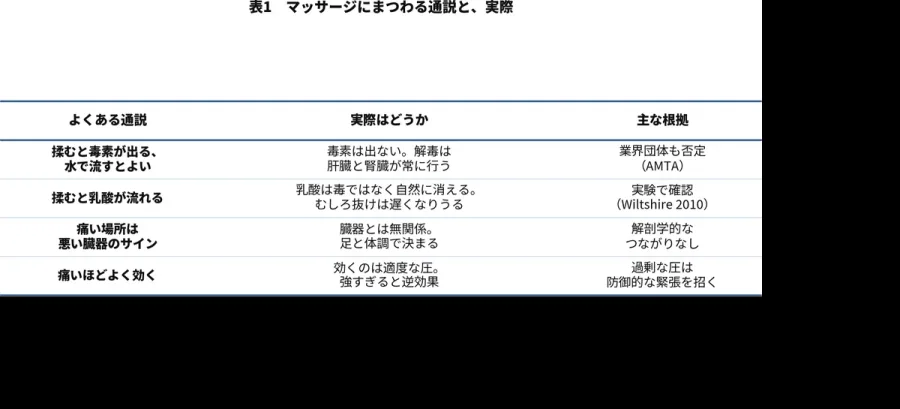
First, let's talk about toxins. There is no evidence that massage flushes toxins from the body. To begin with, what 'toxins' refers to is vague, and the body's detoxification is normally carried out by the liver and kidneys. The contents of what are called 'toxins' vary, including caffeine, food additives, and lactic acid produced by exercise, but none of these have been confirmed to follow a path where they are squeezed into the blood by massage and flushed out through urine. A session does not strengthen detoxification functions, nor does it place an extra burden on the kidneys. Since there is no increase in what needs to be flushed out, the logic of flushing it out with water does not hold up. The massage industry's own organizations state that there is no scientific basis for the idea that toxins are squeezed out by pressure.
The idea that 'lactic acid is flushed out' is also often heard, but this is also off the mark. Lactic acid is not a toxin in the first place; it is a normal metabolite produced during high-intensity exercise, and it returns to baseline levels within 30 to 60 minutes even if left alone. Moreover, massage does not speed up the removal of lactic acid. In experiments comparing recovery after exercise, active recovery involving light movement was the fastest, while massage was no different from or worse than resting. Other studies have shown that pressure during a session temporarily hinders blood flow to the muscles, delaying the removal of lactic acid. Massage is useful for recovery, but not because it flushes out lactic acid; it works through a different mechanism. Studies examining muscle tissue taken after exercise have shown that in massaged muscles, signals related to inflammation were suppressed and the mechanism for producing energy became more active. On the other hand, there was no difference in the levels of lactic acid or glycogen. It is effective, but the reason lies elsewhere than in the common theory.
The meaning of drinking water
Drinking water is not meaningless. However, the reason is different.
When muscles are massaged, body fluids move, and it is easy to feel the urge to urinate after a session. Drinking water to compensate for that is reasonable. As for the amount to drink, you can just follow your thirst; there is no need to force yourself to drink large quantities. Maintaining hydration on a daily basis is related to muscle function, tissue suppleness, and recovery from exercise. However, this is about daily hydration, not about flushing something out through a session. In short, drinking is good, but it is not to 'flush out toxins,' but rather normal hydration.
Furthermore, there is a real connection between hydration and pain that is different from the common theory. Multiple studies have shown that when the body is dehydrated, pain is felt more intensely. When healthy people were mildly dehydrated and their pain was measured, the intensity and unpleasantness of the pain increased by about 10%, and the time they could endure the pain decreased. Brain imaging also showed that activity related to pain was stronger during dehydration.
Although the effect is small and varies by individual, the direction is clear. There is a basis for drinking water properly before and after foot reflexology, not because it 'flushes out toxins,' but because it 'makes pain less likely to be felt intensely.'
Water becomes medically necessary only in rare cases where muscles are damaged by overly strong treatment. This is an accident that should be avoided and almost never happens with foot reflexology, which involves small muscle mass. Pressure strong enough to require water is, in the first place, overdoing it.
It is not organs that determine the intensity of pain
Even when the same spot is pressed, some people feel pain while others are fine. Even for the same person, it can be excruciating one day and pleasant the next. Explaining this as 'dysfunction of the corresponding organ' is a mistake. What determines the intensity of pain is not the organs, but three factors.
The first is individual and site-specific differences in pain sensitivity. The intensity felt when pressing varies from person to person, and even within the foot, it varies by location. For example, even with the same pressure, the instep and arch are more sensitive to pain than the heel. Sensitivity is related to constitution and other pains the person may have. There are reports that women are slightly more sensitive on average, but there is debate about that difference, and at least in the feet, the difference in location is much greater than gender.
The second is the local condition of the foot. If there is a 'core of stiffness' in the foot muscles, it will hurt intensely when pressed. In many cases, this core does not usually hurt when pressed. However, when it becomes hypersensitive due to standing work, fatigue, or stress, the pain spreads not only to that spot but also to areas slightly further away, and what is usually fine becomes excruciating that day. This is the main reason why the sensation of the same spot changes from day to day. After walking all day, the entire foot becomes sensitive.
The third is the state of mind and body at that time. Pain is not transmitted exactly as the pressure intensity; the brain determines it by increasing or suppressing the signal. When touched gently at a moderate speed, nerves that convey comfort are activated, suppressing pain, and trust in and peace of mind toward the practitioner also support that suppression. Conversely, if you are tense or bracing yourself, the same pressure will hurt. This is why the same massage can feel different from day to day.
And there is no evidence in modern medicine that painful spots are connected to specific organs. There is no anatomical path between a point on the foot and an internal organ that transmits pain. It is more accurate to think that intense pain is a sign of the foot itself and the physical condition, not organ dysfunction. What foot pain tells you is a problem with the foot itself, such as plantar inflammation or calluses, not the state of a distant organ.
The true nature of 'painful but pleasant'
There is also a reason for the 'it hurts but it feels good' sensation. Strong pressure blocks pain signals at the spinal cord level through thick nerves and encourages the secretion of endorphins, the body's internal painkillers. Furthermore, the painful stimulus itself temporarily activates the brain's mechanism for suppressing pain. An experiment conducted on healthy people in 2025 also confirmed that the pressure of a painful technique temporarily dulls the perception of pain afterward. It feels good even though it hurts because these factors overlap. Even spots that hurt intensely often get used to it within a few minutes of continuous pressure, moving from excruciating pain to dull pain, and then to a feeling of lightness. However, this is a temporary change observed in healthy people; it does not mean that damaged tissue is healing, nor does it mean that the more it hurts, the more effective it is.
However, it does not mean that the more it hurts, the more effective it is. What is effective is moderate pressure within a range the body can accept; overly strong pain actually makes the body tense, hardens the muscles, and has the opposite effect. Stopping at 'painful but pleasant' is the most reasonable approach.
Why have these two things been believed?
There are reasons why people want to believe these two common myths. The reason you need to use the restroom more often after a massage is that the manipulation causes body fluids to shift, but this can feel as if "toxins are being flushed out." The word "detox" also gives people a sense that they have done something good for their health. The myth about pain is the same. When a painful area feels lighter after a treatment, it seems as if you have identified and cured a dysfunction in the organ located there. A reflexology map makes that story easy to visualize. Both make sense as experiences. It is just that they are different from what is actually happening.
Summary
Pain is not a report card for your organs, but a sign of your feet, your physical condition, and your mood that day. And you should drink water to prevent pain from increasing due to dehydration. It is not to flush out toxins. If you grasp these two points, foot reflexology will become a more relaxed and useful habit.
Reference Information
Paul Ingraham. Why Drink Water After Massage? (Verification of the toxin/lactic acid myth). https://www.painscience.com/articles/drinking-water-after-massage.php
AMTA. Myths in Massage Research (Denial of "flushing out toxins" by industry organizations). https://www.amtamassage.org/publications/massage-therapy-journal/myths-in-massage-research/
Physical TheraPT. Water After Massage: Latest Review (2025). https://www.physicaltherapt.com/field-research-blog/2025/12/18/drinking-water-after-massage
Wiltshire EV, et al. Massage impairs postexercise muscle blood flow and "lactic acid" removal. Med Sci Sports Exerc. 2010. https://journals.lww.com/10.1249/MSS.0b013e3181c9214f
Comparison of active recovery and massage for lactic acid removal (Research on post-exercise recovery). https://pubmed.ncbi.nlm.nih.gov/16558481/
Crane JD, et al. Massage therapy attenuates inflammatory signaling after exercise-induced muscle damage. Sci Transl Med. 2012. (Recovery mechanism is the regulation of inflammatory signaling, not lactic acid)
Case of rhabdomyolysis due to overly deep massage (CHEST 2020). https://journal.chestnet.org/article/S0012-3692(20)32866-X/fulltext
Bear T, et al. A preliminary study on how hypohydration affects pain perception. Psychophysiology. 2016. https://pubmed.ncbi.nlm.nih.gov/26785699/
Hypohydration and pain perception in healthy women. J Appl Physiol. 2021. (Pain tolerance -8%, intensity +13%, discomfort +12%). https://journals.physiology.org/doi/full/10.1152/japplphysiol.00402.2021
Dehydration Enhances Pain-Evoked Activation in the Human Brain (fMRI). Anesth Analg. 2014. https://journals.lww.com/anesthesia-analgesia/abstract/2014/06000/dehydration_enhances_pain_evoked_activation_in_the.23.aspx
Pressure pain sensitivity map of the entire foot (Study on regional differences, 2024). https://www.researchgate.net/publication/383874356_Pressure_pain_threshold_of_the_whole_foot_Protocol_and_dense_3D_sensitivity_map
Chesterton LS, et al. Gender differences in pressure pain threshold in healthy humans. PAIN. 2003. https://pubmed.ncbi.nlm.nih.gov/12583868/
Mechanisms of Myofascial Pain (Trigger points and referred pain). https://www.ncbi.nlm.nih.gov/pmc/articles/PMC4285362/
Trigger Points: Diagnosis and Management. American Family Physician. https://www.aafp.org/afp/2002/0215/p653
Excelsior Integrative. Deep tissue massage: pain physiology (introducing 2025 research on peripheral/central sensitization and descending inhibition via painful pressure). https://excelsiorintegrative.com/main-blog/understanding-deep-tissue-massage-why-the-deepest-pressure-isnt-always-best/
Acibadem. Foot Pressure Points: What Evidence Really Shows (no connection between foot points and organs has been confirmed, 2025). https://acibademinternational.com/health-library/foot-pressure-points-explained-by-medical-evidence-not-myths/
Descending Modulation: Why Massage Therapy Alleviates Pain (descending pain modulation). https://massagefitnessmag.com/massage/descending-modulation-why-massage-therapy-alleviates-pain/
#Massage #FootReflexology #Health #Healthcare #SelfCare #Evidence #Pain #Hydration #Pseudoscience