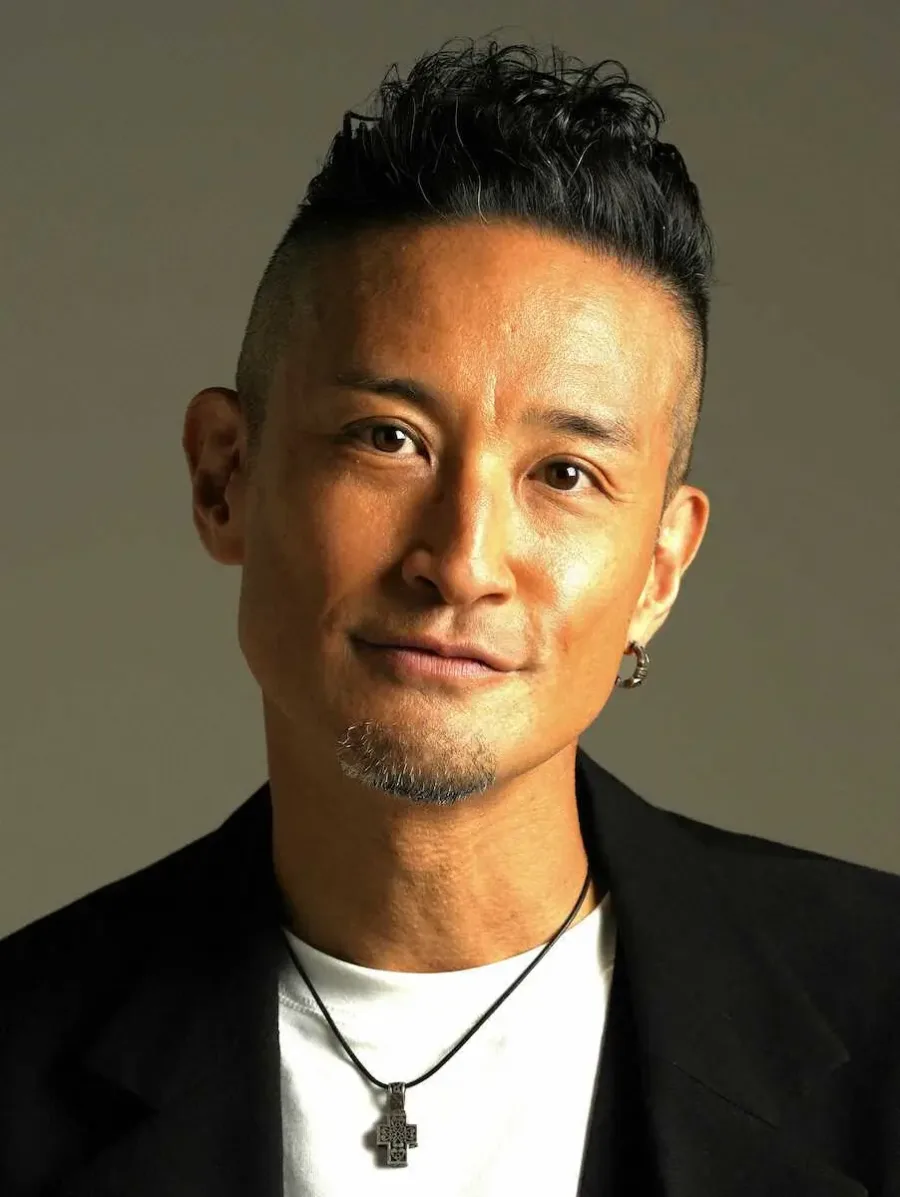
Hello, I'm Mitsuteru Ichinomiya.
In the previous 7th installment (Fuyu no Hana) episode, I talked about Hiroji Miyamoto's 'lower' = pelvic floor muscles. The idea that the reason his voice doesn't collapse even when he moves or bends over is because his foundation is tightly locked.
This time is the second part of the Hiroji Miyamoto series.
The song I'll be covering is the Elephant Kashimashi signature song 'Oretachi no Ashita' (ap bank fes take).
And the theme I want to focus on this time is the 'upper' part.
For those of you who worry that 'I don't know what he's singing' or 'the lyrics don't reach me,' this is probably the most effective episode for you.
'The lyrics pierce' — This is the fundamental premise of J-ROCK
There is something I always think about when talking with Elephant Kashimashi fans.
This is also the fundamental premise of the J-ROCK genre.
In rock vocals, vocals where you don't know what is being sung are
already a failure at that point.
More than the melody, more than the tone of the voice, 'the lyrics piercing' comes first.
So then, where in Hiroji Miyamoto's body is his voice actually resonating?
When ordinary people try to imitate the 'downward pressing support,' it usually ends up
muffled, and you can't tell what they are singing. However, while Miyamoto pushes down that much,
only the words clearly fly forward.
Herein lies another one of Hiroji Miyamoto's hidden weapons.
What kind of song is 'Oretachi no Ashita'?
'Oretachi no Ashita' is a signature cheering song released by Elephant Kashimashi in 2008.
(Please refer to the original song for the lyrics)
This ap bank fes take is a performance of incredible intensity where Miyamoto-san
grabs the mic, hunches over, runs around, and screams while singing.
At first, I watched this as just 'rock music by a passionate guy.'
But as I listened to it over and over, I realized something.
Standard vocalization vs. Hiroji Miyamoto's vocalization
When teaching 'good vocalization' in voice training, it is often said:
That is the image.
The moment you produce sound, the space inside your mouth expands
evenly front-to-back and top-to-bottom. This is the model for '
well-balanced vocalization.'
However, Hiroji Miyamoto does not sing according to this model.
Observing Miyamoto-san's vocalization —
- The downward pressure is consistently strong
- A posture that seems to keep pressing downwards - The area below the neck is
widely stretched -
Shout-style overtones are mixed in
In terms of the image of producing sound, it is a way of resonating that drops it down with a thud.
But Miyamoto-san's voice reaches us. In fact, it is crisp and clear. This is the mystery here.
There are three patterns for where the sound resonates
Voice position (the place where the voice actually resonates and sounds) is largely divided into three types depending on the singer.
| ① Back (back of the pharynx) | Keisuke Kuwata, etc. | Mellow, glossy, muffled, flavorful sound |
|
② Directly above (above the soft palate) | The position considered the 'model' | Beautiful, well-ordered, rising sound ||
③ Near the front teeth (outside the oral cavity) | Hiroji Miyamoto | Crisp, piercing, words fly forward |
Miyamoto-san is the type who resonates at ③ near the front teeth.
This is the key point.
“If the position of the mouth is here, a little further forward
—the place where the sound resonates is a bit in front of the front teeth.”
It is a voice position with that long-distance throwing feel.
This is the true nature of why the lyrics fly forward.
The 'two movements' that make Hiroji Miyamoto's voice possible
To summarize, Hiroji Miyamoto's vocalization involves two movements occurring simultaneously.
With just ①, the voice ends up muffled downward. With just ②, the voice becomes light and thin.
Because he does these two things simultaneously
- Weight and sorrow (the lower sound)
- Clarity and sharpness (the forward sound)
both coexist in a single note.
This is the first installment of the basic principles I have been talking about —
is the most extreme and purest implementation of that.
The back of the throat is kept as a 'wide tube'
There is something I want you to be careful about here.
When you hear “resonate near the front teeth,” you might think he is singing only with the front of his mouth, but that is
wrong.
In Hiroji Miyamoto's case, the back of the throat remains a wide tube, open the whole time.
This is not the commonly mentioned “yawn shape” where you feel the soft palate, but an approach that
keeps the pharyngeal cavity below that (the lower space of the throat) wide
.
Trying to raise the soft palate involves pushing up from under the tongue, which is difficult for beginners. However, with an approach that
widens the pharyngeal cavity = the bottom, you can do it more intuitively.
For example, the sensation of ha-hi-fu-he-ho while opening the back of the throat downward. It is the exact same direction as being taught in choir to “
open your mouth vertically.”
Miyamoto-san,
This combination of 'wide in the back, far at the exit' creates that resonant, unified sound.
Singing 'O' as if swallowing it
The pronunciations by Hiroji Miyamoto that move me the most are the vowels
'O' and 'Ha'.
Usually, the 'O' vowel is produced by shifting with the upper lip(narrowing the mouth). But Miyamoto-san's 'O' is sung
as if swallowing it. A sensation of swallowing downward.
'Ha' is the same.
Even though it rings in the upper jaw as 'Ha-Ha-Ha', the resonance also reaches the nasal cavity.
This is a phenomenon that occurs because he pronounces it while keeping the back vertically wide without narrowing his mouth.
He opens his mouth vertically and keeps his lower jaw down the entire time, sending only the tone color to the front of his mouth.
This is Hiroji Miyamoto's basic posture. Whether in the A-melody or the chorus,
the distance between his lower jaw and neck is always close (= the lower jaw is dropped). That is why, no matter how high the vocal range goes,
the tension in his thoracic cage does not break.
He looks like he's going wild, but his foundation is rock-solid
What is the reason he can keep singing while thrashing about, crouching, and running around like this?
When I looked into it, I found this fact.
In other words, as a child, the foundations of choral singing were thoroughly drilled into him.
Choral instruction is simple.
- Open your mouth vertically
- Open it downwards
- Project your voice far away
This is exactly the vocalization of Hiroji Miyamoto, whom I talked about this time.
This is what I wanted to convey the most.
The more an artist appears to be singing freely, the more solid their foundations are.
Without a 'foundation,' you cannot even 'break' it.
This is an important truth that Hiroji Miyamoto embodies.
Possessing the two extremes of 'being solid' and 'being wild'
Having watched Hiroji Miyamoto for a long time, what I think is,
is what it means.
Usually, people lean toward one or the other. People who are all about 'I have to do it right.' People who are all about 'I want to be free.'
But people who are active as artists for a long time can go back and forth between the two extremes.
They have serious foundations, and they can break them at their own will.
Hiroji Miyamoto is a person who possesses both pure seriousness and the art of how to break that. That is why, even after decades,
I never get tired of wanting to see the 'next Hiroji Miyamoto'.
Viewing through the lenses of anatomy, psychology, and quantum mechanics
I will organize what I have discussed so far using 'three lenses'.
[Anatomy]
Hiroji Miyamoto creates a structure where he opens the pharyngeal cavity (the space at the bottom of the throat) as a vertically long cylinder, and places the exit outside the oral cavity near the front teeth
. By continuing to puff out his chest (the front of the rib cage),
the diaphragm does not pull up, and pressure continues to be applied in a downward direction
. Because the downward pressure continues, the resonance at the exit near the front teeth does not waver
. This is the true identity of the anatomically 'voice that strikes with lyrics'.
[Psychology]
I believe that "personality shows in one's singing".
To use astrology as an analogy,
- Sun sign = The social face seen from the outside (= the everyday Hiroji Miyamoto)
- Moon sign = The true self known only to close friends (= Hiroji Miyamoto in his songs)
What appears in singing is the Moon sign. That is why people who seem cheerful in public can suddenly become introspective when they sing.
Hiroji Miyamoto is someone whose pure sincerity at his core leaks out through his voice. That is why his lyrics reach us. Because his
voice is not lying.
[Quantum Mechanics]
"Words" are vibrations with specific frequencies. Each vowel—"a," "i," "u," "e," "o"—has a
unique combination of frequencies (= formants).
By Hiroji Miyamoto sounding them near his front teeth, the
formants fly straight forward without being disturbed. Because of this, they are accurately decoded as "words" by the listener's ears
as "words".
There is a proper scientific reason for it.
The one thing you can start doing today
This has become long. Once again, I will introduce just one practice.
Expanding the pharyngeal cavity with "Ha-Hi-Fu-He-Ho"Before raising the soft palate, first expand the tongue.
1. Open your mouth vertically in front of a mirror (enough to fit two fingers vertically) 2.
Lower your lower jaw as if bringing it closer to your neck 3. Vocalize "
Ha, Hi, Fu, He, Ho" in that state 4. Find the sensation of the back of your throat becoming a
vertically long tube
When you produce sound, have the consciousness of sounding it in front of your mouth, not inside it.
1. Imagine a microphone floating
just in front of your lips (about 1-2 fingers away) 2. Aim your words at that microphone
3. Try it with your favorite words, such as "Arigato" or "Konbanwa"
This is the key point for today.
We will do the pelvic floor muscle tightening discussed in the 7th installment and
the resonance near the front teeth from this installment at the same time.
This is the complete form of 'support from the back, resonance in the front'.
As you get used to it,
will emerge. This is the gateway to what Hiroji Miyamoto is doing.
Next Episode Preview
In the next installment, the 9th, we will change the atmosphere a bit and
feature Kozo Murashita's 'Odoriko'.
The theme is — 'Why do gentle voices sound gentle?'. The keyword is '
pulling sound'.
If Hiroji Miyamoto uses sounds pushed forward, then Kozo Murashita uses
sounds that are pulled back and resonated. Even among singers who 'make the lyrics heard,' I will show you that there are
completely opposite approaches
.
Singing is not just for people with special talent.
By understanding how the body works and making it your ally,
anyone can learn to sing more freely than they do now.
In this series, let's cultivate your 'singing body' together.
See you next time.
Mitsuteru Ichinomiya
Uta Lab (5.3 million total YouTube views)
Notice
▼ Uta Lab YouTube Channel
Mitsuteru Ichinomiya / Adult Uta Lab
▼ Mitsuteru Ichinomiya Vocal Lesson
Trial Lesson | TrueHappieness
https://www.youtube.com/channel/UCtPy07oTpyqghznZaHsj6oQ/join
▼ Mitsuteru Ichinomiya Official Goods
▼ Seeking support for YouTube video production
Mitsuteru Ichinomiya Live Information
I believe that hearing me sing live is the best way to convey the 'singing body'.
If you are nearby, please come and see me.
| June 6 | Osaka Umeda Always (Southern Tribute Band SkipBeats Live) |
| June 19 | TwitCasting Paid Stream / Approx. 20 acoustic songs (Mitsuteru Ichinomiya Solo) |
| July 20 | Osaka Honmachi Mother Popcorn (Southern Tribute Band SkipBeats Live) |
| August 15 | Kobe Chicken George (Southern Tribute Band SkipBeats Live) |
I believe that hearing me sing live is the best way to convey the 'singing body'.
If you are nearby, please come and see me.
Inquiries
Please feel free to contact me for lessons, live performances, booking requests, interviews, etc.
info@truehappinesschool.com
(You can also apply for lessons via the school website in the description box)