One of Japan's largest audiobook distribution services, "audiobook.jp," broadcasts a radio program called "Radio NIKKEI 'Money no Karakuri'," which delivers tips that business people can use tomorrow to help spread the "learning by ear" style!
The program's personality is Wataru Ueda, founder of OTOBANK. Every month, we invite guests to discuss various themes over four weeks, including trending business topics, work styles, human resource development, and money.
This time, we welcome as our guest Norihiko Kamioka, who served as editor-in-chief of the public relations magazine "Hanatsubaki" and general manager of the public relations department at Shiseido, held positions as vice chairman of the Public Relations Society of Japan and director of the Public Relations Society of Japan, and is currently the executive officer and general manager of the Corporate Division at Ebara Foods Industry, where he led the launch of "Ebaradio."
On the program, we asked Mr. Kamioka about various topics, including what he values in his public relations work, why internal communication is considered important, and "Ebaradio," the internal radio program at Ebara Foods Industry that contributed to the penetration of corporate philosophy and the enhancement of internal communication.
We will introduce some of that content here on note!
"Ebaradio," which played an active role in instilling corporate philosophy and internal communication during the COVID-19 pandemic
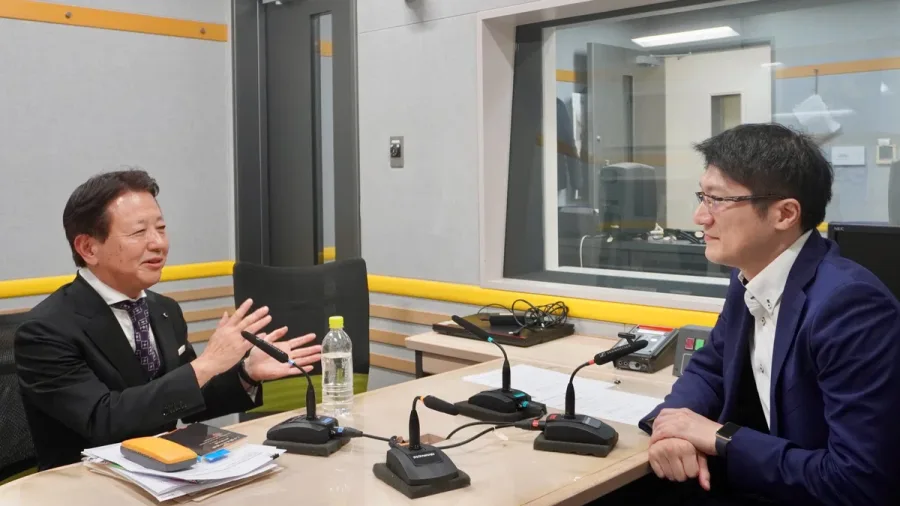
Ueda: I would like to ask in detail about "Ebaradio," the internal media that was implemented at Ebara Foods Industry from 2021 to 2024.
I assume it is called "Ebaradio" because it is "Ebara"'s "radio," but I would be happy if you could tell me about the program content and the background of how you started this initiative.
Kamioka: As you said, it is an internal radio program that only employees can listen to. It was distributed from November 2021 to April 2024, and we distributed a total of about 39 episodes.
The main content was cross-talk where two or three employees appeared each time to discuss a single theme.
There were seasons 1 through 3, and in addition to our company president appearing in every season, all directors and outside directors also appeared, and we tried to produce and distribute it so that everyone would be as committed as possible.
Ueda: How did the employees and the management side who appeared react to the president and directors appearing on the show?
Kamioka: The reactions were varied, but it was well-received that people could hear the human and charming sides of the directors that are rarely seen or heard in daily life.
Since it is a program of about 20 to 30 minutes, people could listen to it during lunch breaks, while traveling, on their commute, or even with their families on their days off. In addition to computers, it could also be listened to on mobile phones.
Ueda: That's "ear gap time." Our company's audiobooks are also listened to during gap time.
When it comes to internal public relations, I think there are various patterns, such as those who create websites on an intranet or those who create newspapers in paper media, but what was the reason you chose radio as a medium among them?
Kamioka: We previously had an internal newsletter in PDF format called "Ebara Tsushin."
However, when we formulated our "vision for 10 years from now" in the previous year, 2020, it didn't seem to resonate much with the employees.
Therefore, we talked about conducting new internal communication to help employees understand and take root in the "vision for 10 years from now."
It was during the COVID-19 pandemic, so there was a situation where it was difficult for employees to come to the office.
Also, communication was fragmented, and there was a state of wanting the warmth of human voices.
So, we thought of "radio" as a medium that could use the power of digital technology to deliver the voices of people in the company to employees all over the country, even if they were at home.
Ueda: What was the actual response within the company?
Kamioka: We conduct an internal survey called the "Ebalove Degree Survey" to measure how several internal communication media, including "Ebaradio," are functioning. According to that, 40% to 50% of employees listen to "Ebaradio."
It is said that the independent viewership rate for internal media is generally about 20%, so we consider this a better situation.
Also, new communication across departments was occurring between the performers, and between those who appeared and those who listened, so I think that was also good.
Internal communication is important to instill management philosophy in today's employees
Ueda: It is fantastic that people look forward to listening to an internal communication medium every time, isn't it?
In recent years, we have been hearing the term "internal communication" more often, but what is the importance of internal communication in a company?
Kamioka: This might get a bit technical, but it is said that public relations originally has five functions.
The first is receiving information from outside the company. This means receiving information about how the environment surrounding the company will change in the future and how the world will change.
The second is delivering the received information to the necessary people within the company, starting with the management team.
The third is receiving "internal information," such as what is happening within the company.
The fourth is feeding back the content received in the third step to the necessary people, including the management team.
And only in the fifth step does so-called external public relations or media relations come into play. Therefore, the primary target of public relations activities should essentially be internal.
The reason it is attracting attention recently is, I believe, because employees are the stakeholders that many companies are prioritizing the most right now.
I think today's employees truly have diverse facets. They might be doing community association work on weekends, acting as a representative of an NPO, or being a shareholder. And above all, they are entities that can become sources of information about their own company by making full use of social media.
Even among such diverse employees, I think values are diversifying within each individual as well.
On the other hand, in this era of social media, no matter how good a message a company sends out, if the actual actions of the company's employees do not match it, it will be heavily criticized, right?
Therefore, based on that, it is very important for all employees to agree with and empathize with the company's purpose and management philosophy, and to put them into practice in their daily work.
I believe that is why internal communication is being valued more than ever before.
Ueda: So, in terms of the flow of the times, internal communication is essential.
(Excerpted from the program content of the 1st week broadcast on December 6th to the 4th week broadcast on December 27th)
Please be sure to listen to the full episode on podcasts and other platforms.
"Money no Karakuri" can also be heard on podcasts!・Apple Podcasts
・Spotify
[Norihiko Kamioka Profile]
Joined Shiseido in 1987. Began working in public relations in 1995, served as editor-in-chief of the public relations magazine "Hanatsubaki," and became General Manager of the Public Relations Department in 2015. Served as Vice Chairman of the Public Relations Society of Japan and Director of the Public Relations Society of Japan. In 2020, received the "Corporate Public Relations Award for Distinguished Service and Encouragement" from the Japan Corporate Communications Center. In 2021, became an Executive Officer at Ebara Foods Industry, Inc., and as General Manager of the Communication Division, is in charge of public relations, IR, ESG, and the Customer Consultation Office. Has also served as a part-time lecturer at the Gakushuin Women's College Graduate School since 2022.
[Money no Karakuri Program Information]
Program Name: Radio NIKKEI "Money no Karakuri"
Broadcast Date and Time: Every Friday 7:30–7:45 (Rebroadcast: Every Wednesday 12:15–12:30)
Broadcast Media: Radio NIKKEI 1, radiko, podcast
*Available for listening for one week after broadcast via radiko time-free
Production: Radio NIKKEI, OTOBANK
Personality: Wataru Ueda (Chairman and Representative Director, OTOBANK Inc.)
Program Website:https://www.radionikkei.jp/karakuri/