Introduction
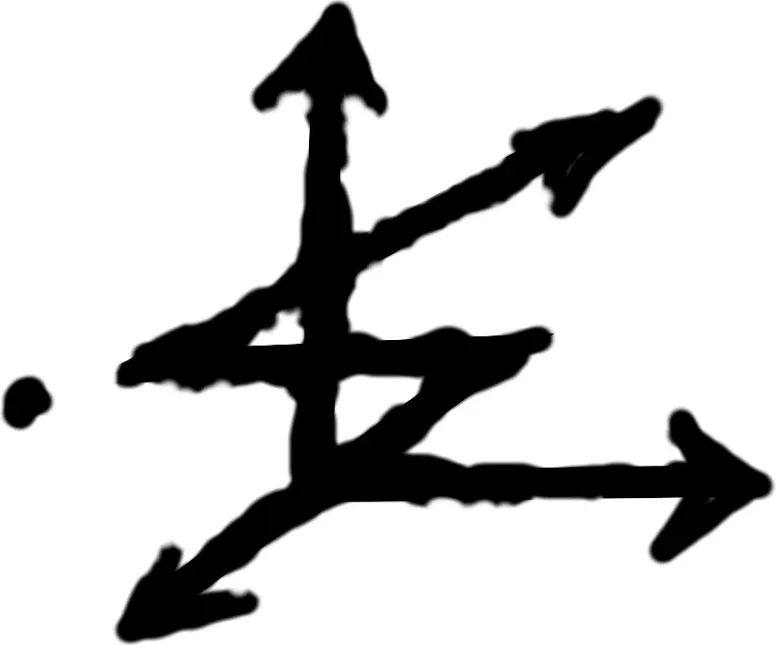
This paper is an attempt to reboot, from a contemporary perspective, DKMU (Domus Kaotica / Marauder Underground), an art-magick experimental collective that was active in the late 2000s and saw its activity decline around 2011–2012.
1. From Chaos Magick to Art = Magick
The movement generally known as "Chaos Magick" had its theoretical foundations formed in the 1970s and 80s, and reached its maturity as a technique in the 1990s. Chaos Magick of this era developed practical techniques such as sigils, servitors, and gnosis, establishing them as magical methods.
However, entering the 2000s, this framework reached a turning point. Magick was no longer just about "arcane mysteries" or "internal manipulation"; it expanded into cultural and urban experiments, linking up with movements in art, street art, networking, video, music, and urban artistic intervention.
2. The DKMU Experiment
DKMU was born within this context. It began around 2004 with the Linking Sigil (Ellis) as its starting point, reached its peak between 2007 and 2010, and operated under the banner of "Assault on Reality." For DKMU, magick was not a technique for wish fulfillment, nor was it a belief system or an organized religion. Rather, for DKMU, magick was a device where the act of art itself acted upon reality—that is, Artist Magick. Sigils, video, urban artistic intervention, and linguistic experiments were merely tools for that purpose.
DKMU was by no means a singular phenomenon. There were already several cultural movements that attempted to act upon reality through art, music, and media, such as the collective sigils and network magick seen in the 1980s TOPY (Thee Temple ov Psychick Youth), or The KLF, who were inspired by Robert Anton Wilson's "Cosmic Trigger" and used pop culture itself as a magical intervention. DKMU can be seen as a 2000s instance that reorganized these within the context of the internet and urban culture.
3. The Urban Core of the Doombringer (663)
One of the core symbols of DKMU was the Doombringer (663). This was not a traditional religious "god," but an artificially designed god-form, a shamanic entity operating within the urban environment. The Doombringer was a symbol presiding over "destruction and creation, chaos and invention, and the transgression of boundaries." It was not a shaman living in nature, but a model of the "urban shaman" that the Unknown Sorcerer (Le Sorcier Inconnu) had always sought.
4. Ellis ➜ Eris — Raising the Level of Abstraction
Ellis in DKMU was a temporary mask that appeared in the era of the 2000s. In this re-excavation, there is no need to revive Ellis. Instead, we adopt Eris (the goddess of discord and chaos) as the underlying abstract principle. This is Discordian, and at the same time, an extremely practical choice.
5. The Concept of Class/Instance
In this project, we treat DKMU and the Doombringer as a "class" or a "historical instance." This is a metaphor borrowed from software engineering, which the author of this paper, the "Unknown Sorcerer," is working with. It is a mental model for explaining the mechanisms of inheritance and re-implementation.
Simply put, we generate a copy of the original so as not to affect the original deity. This allows us to engage with it as a new entity, inheriting only its properties without being influenced by the actions experienced by the Doombringer used in the past DKMU.
6. Conclusion — The Banner of Art = Magick
Art is not expression. Art is action. Magick is not belief. Magick is practice. The peak of DKMU may have ended. However, the question has not ended. This paper is a manifesto written to speak of "Art = Magick" in Japan once again, to reboot the Doombringer, and to make this the banner led by the Japanese Discordian Association. Hail Eris! Hail All Discordia!
And so—
EVERYTHING IS TRUE NOTHING IS PERMITTED!
The arrival of an era
Once, the phrase "Nothing is true, everything is permitted" was a tool for questioning fixed truths and dogmas. However, it was often used as an indulgence, implying that "anything goes." DKMU prepared a different phrase.
Everything is true; nothing is permitted.
The world is full of meaning. That is precisely why actions must not be taken lightly. This overlaps with Discordian values. You may start art as a joke.
But that joke holds meaning in reality. Therefore, take responsibility for your actions. That is the meaning embedded within it.