↓↓↓ Click here for the YouTube video ↓↓↓
↓↓↓ Click here for the explanation slides ↓↓↓
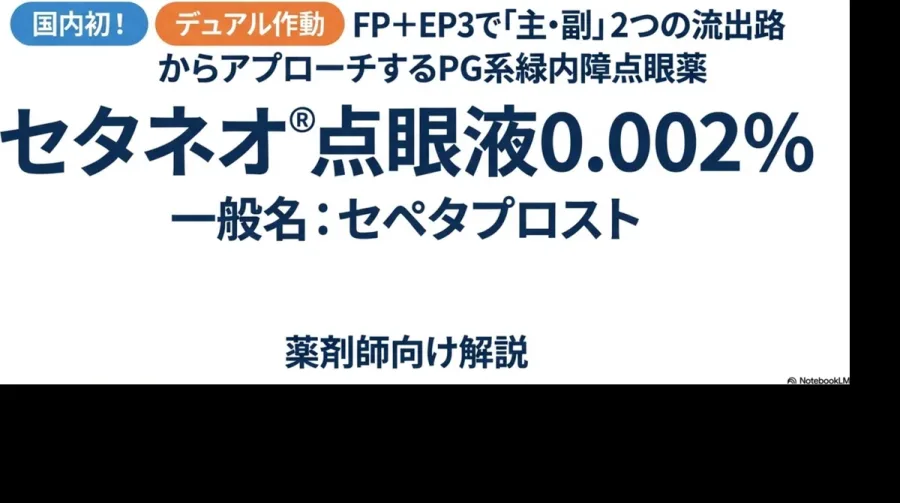
As the first in Japan to use a dual-action (FP+EP3) mechanism to approach both primary and secondary outflow pathways, this time I will be explaining Setaneo Ophthalmic Solution 0.002% (generic name: sepetaprost), so thank you for watching until the end.
Now, for the basic information. The brand name is Setaneo Ophthalmic Solution 0.002%, and the generic name is sepetaprost. In terms of pharmacological classification, it is a bicyclic prostaglandin derivative and is a therapeutic agent for glaucoma and ocular hypertension. It is manufactured and sold by Santen Pharmaceutical Co., Ltd. It is a new drug that was born quite recently, on October 23, 2025.
First, regarding the three greatest benefits that Setaneo brings: the first is its status as the first dual-action mechanism in Japan. While conventional drugs were mostly FP receptor agonists alone, this is the first in Japan to be a dual agonist for both FP and EP3 receptors. I will explain thoroughly later what this brings about.
Next is the expectation for sustained intraocular pressure reduction. By acting on the primary outflow pathway, it improves the sustainability of the intraocular pressure-lowering effect and levels out diurnal fluctuations. As mentioned in the dual-action mechanism section earlier, the second benefit is that this drug also acts reliably on the primary outflow pathway.
Thirdly, it offers stable efficacy during long-term administration. Even with 52 weeks of long-term administration, a significant and sustained reduction in intraocular pressure was observed at all observation points from 2 weeks after the start of administration. These are the three clinical benefits. I will explain each of these in detail later.
Regarding the origin of the name and pharmacological classification: the name is derived from the 'Se' and 'ta' of sepetaprost, plus 'neo', which means new in Greek, resulting in the name Setaneo. The pharmacological classification is a bicyclic prostaglandin derivative, and it is considered a therapeutic agent for glaucoma and ocular hypertension, which is a condition where intraocular pressure is high even though there are no problems with the visual field.
Now, regarding the indications and effects: it is for glaucoma and ocular hypertension, which is basically the same as previous prostaglandin preparations. It is considered effective for various types of glaucoma in clinical trials, but please note that there is no experience using it in patients with angle-closure glaucoma, so it should be administered with caution.
Regarding the mechanism of action: it is a drug that promotes drainage from the primary outflow pathway in addition to the conventional secondary outflow pathway. Previous prostaglandin-related drugs, such as latanoprost, were drugs that only stimulated the FP receptor. This lowers intraocular pressure by increasing the drainage of aqueous humor from the uveoscleral outflow pathway, which is a secondary outflow pathway.
On the other hand, as I explained at the beginning, Setaneo is a drug with a dual mechanism, so it has the characteristic of stimulating the EP3 receptor, which performs outflow from the primary outflow pathway (the trabecular meshwork and Schlemm's canal), while also stimulating the FP receptor that increases drainage from the secondary outflow pathway. Therefore, it promotes the outflow of aqueous humor from both the primary and secondary pathways, and this dual mechanism is a first in Japan. There have been drugs that act on the EP2 receptor before, such as Avelis, but the novelty of Setaneo lies in the fact that this target is the EP3 receptor.
Now, a column. I researched what exactly this EP3 receptor is, so I have included it on the slide. There is a research result that verified this by administering an EP3 receptor antagonist into the anterior chamber using normal-eye monkeys. This experiment was conducted to see what changes occur when the EP3 receptor is antagonized while Setaneo is already being applied, and this verified what the EP3 receptor is actually doing.
As a result, although there was no difference in intraocular pressure reduction at 8 or 24 hours after instillation, the results confirmed that the intraocular pressure-lowering effect of Setaneo was attenuated at 26 hours. In other words, because the EP3 receptor was antagonized, a difference appeared only at 26 hours, suggesting that the activation of this EP3 receptor may contribute to the sustainability of Setaneo's intraocular pressure-lowering effect, specifically in the period beyond 26 hours.
Now, here is a slide for patient explanation. I think it is best to tell them, 'This is a medicine that lowers intraocular pressure by widening another drainage pathway in the eye.' As for the explanation, I think it is good to say, 'Inside the eye, there is a fluid called aqueous humor that flows to transport nutrients. This medicine, Setaneo, is a drug that lowers the hardness of the eye, or intraocular pressure, by widening the drainage pathways for this fluid. While previous medicines widened one drainage pathway, this medicine works to allow the fluid to escape to the outside more smoothly by opening another drainage pathway as well.'
Regarding dosage and administration, it is to be instilled once a day, one drop at a time. Also, there are no specific regulations for dosage adjustment or cautious administration regarding renal function, hepatic function, or the elderly. However, since clinical trials have not been conducted for children, etc., safety has not been established, and for pregnant women, it should only be used if the therapeutic benefit outweighs the risk.
Regarding contraindications, warnings, and precautions: Contraindications are limited to patients with a history of hypersensitivity. There are no specific warnings or precautions set. Regarding patients who require caution in practice and the reasons for this, caution is advised for patients with aphakia or those with intraocular lens implants due to the risk of decreased visual acuity caused by macular edema. Also, for patients with endophthalmitis, caution is advised with Setaneo as well, because there have been reports of increased intraocular pressure with other FP receptor agonists.
Regarding side effect monitoring: I will state at the beginning that these are not unique to Setaneo. In other words, please note that this is a slide about the side effect monitoring generally required for prostaglandin preparations. Common side effects include conjunctival hyperemia, abnormalities of the eyelashes, and hypertrichosis of the eyelids. As pharmacists, I think it is good to instruct patients to thoroughly wipe or wash their faces after instillation. Although rare, a serious side effect is iris pigmentation; since this may follow an irreversible course, regular ophthalmological examinations are necessary. Also, note that corneal disorders such as punctate superficial keratitis are a concern. If symptoms such as stinging, itching, or eye pain persist, patients should see a doctor immediately. Since the eye drops themselves have a pH close to neutral, they should not fundamentally cause stinging, so it is good to tell patients to see a doctor immediately if they experience these symptoms.
Regarding points for medication guidance: First, if stinging, itching, or eye pain persists after instillation, please see a doctor immediately. To prevent darkening around the eyes or the growth of eyelashes, please wipe well or wash your face immediately after instillation. Also, as many of you often say regarding eye drops, after instillation, close your eyes for 1 to 5 minutes and lightly press the inner corner of the eye to prevent side effects and improve therapeutic efficacy. These are the three main points.
There is nothing special that you must say just because it is Setaneo, but it is good to mention that this is a long-acting medicine. For example, with previous prostaglandin preparations, intraocular pressure was well-controlled while visiting the hospital or immediately after instillation, but there were many cases where intraocular pressure increased at night, leading to the progression of visual field constriction. Since Setaneo is expected to improve that to some extent, I think it is fine to convey that as well.
Summary: As the first dual agonist in Japan, it is a medicine that stimulates two receptors: the FP receptor, which was often stimulated by previous prostaglandin preparations, and the EP3 receptor. It is characterized as a new mechanism prostaglandin eye drop that promotes aqueous humor outflow from two drainage pathways: the main outflow pathway and the accessory outflow pathway. Also, it provides stable effects with long-term administration, as the effect is maintained even with 52 weeks of long-term use. Furthermore, guidance on external changes is essential; to prevent side effects such as iris pigmentation and eyelash abnormalities, thorough wiping and face washing after instillation are required. I think there are some who do not provide this guidance, so it would be good to convey it again.
Regarding this medicine, I have explained various things, but it seems to be a drug positioned as having proven non-inferiority to latanoprost in terms of efficacy. However, as I explained earlier, it is attracting some attention because it is expected to lower nighttime intraocular pressure to some extent. Still, because there is a 14-day prescription limit and information on side effects has not yet been sufficiently accumulated, my impression is that many ophthalmologists have a policy of using it only for specific patients for the time being.
So, this time I explained Setaneo Ophthalmic Solution, a new treatment for glaucoma. Recently, when I mentioned that I was the only one giving myself high ratings, people started giving me high ratings, which makes me extremely happy. I used to hear people say in videos, 'It encourages me if you give me a high rating,' and I wondered if that was really true, but it is incredibly encouraging. If you would like, I would appreciate your continued support. Also, if there are any other medicines you would like me to explain, I would be happy to do so for basically any medicine handled in a pharmacy, so please leave a comment. Thank you for watching until the end.
↓↓↓ Click here for the YouTube video ↓↓↓
#DrugExplanation
#Pharmacist
#DispensingPharmacy
#NewDrug