Claude Sonnet 5 has been released, but for those of us using Opus 4.8, it might be hard to see exactly where to switch over. Claude Sonnet 5 is a Sonnet-series model released on June 30, 2026 (US time) that makes it easier to autonomously execute multi-step tasks while using tools like browsers and terminals.
On the day of its release, I used it with Cursor agent and Claude Code to handle everything from landing pages and games to CLI tools and slide generation. By the end of this, I aim to help you distinguish between situations where you should try Sonnet 5 on high or xhigh, and those where you should stick with Opus 4.8.
First impressions of Sonnet 5 and a one-line definition
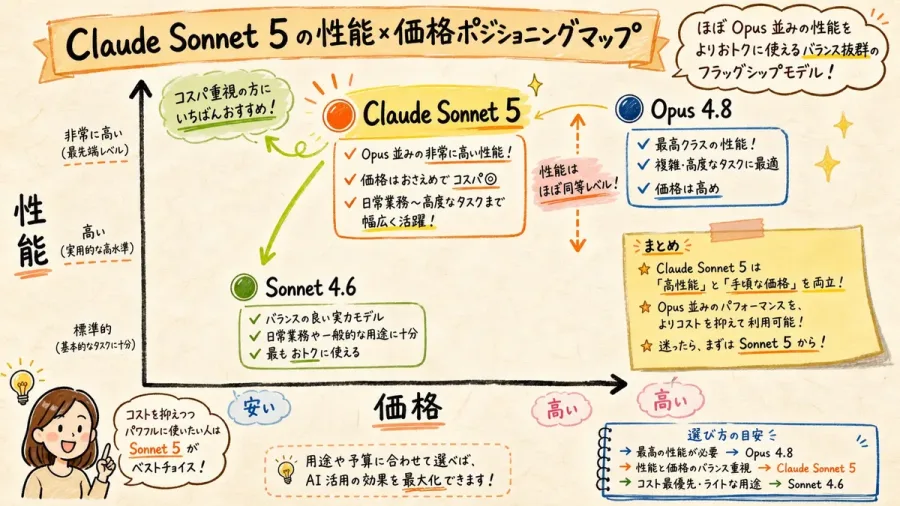
Claude Sonnet 5 is the model Anthropic has launched with the promise of "Opus-level intelligence at Sonnet pricing." Being agentic means that the AI doesn't just answer prompts, but also possesses the nature of advancing multiple tasks on its own while calling tools. My first impression after using it was that while it is indeed close to Opus 4.8, the stability for work-related tasks comes before any flashy surprises.
Personally, with the memory of Fable 5 still fresh, the excitement in the community seemed a bit subdued. It's not the type of model where flaws stand out, and when running landing pages or tool usage, it has a touch similar to Opus 4.8. However, from the perspective of someone using Opus 4.8 every day, this is a model where you choose "which tasks to delegate" rather than assuming you will "replace everything."
I will clarify the sources here. The release date, pricing, tokenizer, and some of the benchmarks are from the official Claude Sonnet 5 announcement and the System Card. The landing pages, games, CLI tools, and the feel of the speed are from my own primary verification conducted on the day of release. Please read the evaluation that "the impact is thin" as my assessment, not as a fact.
Capabilities seen in benchmarks and the difference from Opus 4.8
Looking at the benchmarks, Sonnet 5 clearly outperforms Sonnet 4.6. SWE-bench Pro is a coding evaluation that handles actual software fixes, Terminal-Bench 2.1 is an evaluation of terminal tasks, HLE is for broad knowledge questions, OSWorld is for PC operation, and GDPval-AA v2 is geared toward knowledge work. How to read the numbers: "Overall, it exceeds 4.6, but there is still room for Opus 4.8 in the most difficult coding tasks."
Before getting into the table, I will narrow down how to read the numbers to three points.
In coding, SWE-bench Pro has grown to 63.2% and Terminal-Bench 2.1 to 80.4%. The difference from Sonnet 4.6 is +5.1 points and +13.4 points, respectively (my calculation).
GDPval-AA v2 is 1618, slightly exceeding Opus 4.8's 1615. It is dangerous to read this broadly as "the model exceeds Opus overall"; it is safer to accept that it performed strongly in knowledge work evaluations.
HLE and OSWorld also outperform 4.6. HLE is 57.4% with tools and OSWorld is 81.2%, so these numbers seem to align well with improvements in agentic multi-step tasks.
※ For the Opus 4.8 column, the only value with a reliable source is GDPval-AA v2 (1615). The others have not been verified on my end, so I have marked them as "unconfirmed" and have not fabricated any numbers. My reading, including my own experience, is that there is still a gap for Opus 4.8 in the most difficult coding tasks.
The differences I felt in implementation tasks also generally align with this table. If you want to entrust difficult code decisions to the end, Opus 4.8 provides peace of mind. On the other hand, for tasks like organizing materials, drafting UIs, and creating and using CLI tools, there are situations where Sonnet 5 is easier to try, including the cost.
It is a trap if the effort level is medium
Effort level is a setting where you choose how deeply you want the same model to think, from low, medium, high, xhigh, to max. The higher you go to the right, the easier it is to improve accuracy, but speed and cost become heavier. The first thing that is easy to get wrong with Sonnet 5 is starting to use it with medium.
Combining Anthropic's chart with my own experience, the priorities are quite clear. If you want to see the strengths of Sonnet 5 in daily development, please choose high or xhigh first. If you compare it while staying on medium, there are items that fall short of Sonnet 4.6's medium, and you won't see much of a difference despite using a new model.
Max is suitable for verification or difficult one-shot attempts. It is a candidate for slide structures where you want to decide the output in one go, fixing broken CLI tools, or checking designs across long contexts. However, it is a setting that dulls your sense of cost if used regularly. Low and medium can be used for light text organization or simple assistance, but they are not settings for seeing what makes Sonnet 5 special.
For me, the first week will be "high as default, xhigh if I get stuck, and max only for critical moments." If you don't do this, what will happen is that you will misjudge the model. Judging it as "no different from 4.6" after only touching medium means you are closing the book without seeing the best range of Sonnet 5.
Speed and Price — The Tokenizer Trap
I compared the speeds while watching the TPS on the Cursor agent. TPS stands for tokens per second, which is a metric for how many generated tokens can be produced per second. In code generation, Sonnet 5 tends to be faster than Opus 4.8 at xhigh or medium settings, and it feels lighter than Gemini or Composer 2.5.
However, this reverses depending on the use case. In generating technical explanation articles, there were cases where Composer or Gemini Flash were faster. Therefore, I cannot write that 'Sonnet 5 is always the fastest.' The takeaway is that it tends to be faster in multi-step tasks involving code or tool operation, while other models may win in long-distance runs like text generation.
The pricing is based on Anthropic's official announcement: until August 31, 2026, it is $2 per million tokens for input and $10 for output. The standard price thereafter is $3 for input and $15 for output. The tokenizer is a mechanism that breaks text into small units that the AI can handle, and it is explained that with the new tokenizer in Sonnet 5, the same text will result in approximately 1.0 to 1.35 times the number of tokens.
Introductory price: $2 input / $10 output, until August 31, 2026
Standard price: $3 input / $15 output
New tokenizer: Approximately 1.0 to 1.35 times the token count for the same text
Context window: 1M tokens
It is dangerous to simply read this price as 'it became cheaper than 4.6.' Anthropic explains that the introductory price was adjusted to balance the total cost because the number of tokens increases. When estimating, you need to look at both the unit price and how much your input text will expand.
Conclusion: When to use Sonnet 5 vs. Opus 4.8
Choose Sonnet 5 when you want to handle daily development and mass production while keeping an eye on cost and speed. Choose Opus 4.8 for difficult problems requiring maximum accuracy, design decisions with high failure costs, or uses requiring relaxed cyber capabilities. If you look at third-party benchmark aggregations, Artificial Analysis can also be a verification guide, but in a work setting, it is faster to judge by trying it out on a small scale with your own tasks.
I will also touch briefly on safety. In the System Card, misaligned behavior is organized as 2.53 for Sonnet 5, 2.89 for Sonnet 4.6, and 2.10 for Opus 4.8. Since a lower number is a safer indicator, this reads as an improvement from 4.6, though it does not reach Opus. In Firefox exploit development, both Sonnet 5 and 4.6 have a 0.0% working exploit rate, showing a design that does not lean toward attack purposes.
If you are trying it out today, small steps are sufficient.
Switch the model to Claude Sonnet 5 in your current environment. If you cannot select it, it is fine to wait with Opus 4.8 until it appears in your supported environment.
Set the effort level to high. If you feel the output is shallow, raise it to xhigh.
For the first task, choose a mass-production type where speed is effective. Code generation, first drafts of slides, or small CLI tool creation are suitable.
If you get stuck on a difficult problem, switch back to Opus 4.8. Do not consider the decision to switch back a defeat; use them differently for each task.
Personally, I have a strong tendency to solve things with Opus or Fable unless they are heavy-duty tasks. Even so, for those who want to optimize cost-performance, Sonnet 5 is worth trying. Especially in operations like specifying models for skills, it is quite realistic to shift only mass-production tasks to Sonnet 5.
Sonnet 5 is not a model that replaces Opus 4.8 as dramatically as the official wording suggests. However, when running daily tasks at high or xhigh, there are situations where you can proceed with agent-like work while keeping costs down. The first judgment is whether you need maximum accuracy or prioritize mass production and speed. This check will significantly reduce your hesitation.
For those who want to dig deeper
When you throw real tasks at high or xhigh, differences appear that you can't see in benchmarks alone. In my note membership, I continue to share notes on how to use Claude Code and Codex, harness engineering, and verify agent skills. If you want to follow my daily verification process with the same level of intensity, you can check the content at View Membership.
When choosing AI tools in 2026, you can reduce failures simply by looking at official figures and your own tasks separately. If you follow Masao, it will be easier to keep up with reviews of new AI tools after I've actually tried them. If you found this helpful, I'd appreciate it if you could share it.