(Author: Shu Chiba)
■ Purpose of this article
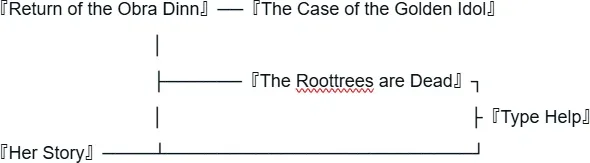
In this article, I will classify and catalog games under the influence of 'Return of the Obra Dinn' ('Obra Dinn').
As sub-classifications, I will also list games influenced by 'The Case of the Golden Idol' ('Golden Idol'), 'The Roottrees are Dead' ('Roottrees'), and 'Type Help'. Incidentally, I will also include works that contain elements of 'Her Story', which, while not directly influenced by 'Obra Dinn', is often related in one way or another.
Most of these are works released in the last year or two. Since 'Roottrees' and 'Type Help' were released in 2025 (the predecessor to 'Roottrees' was in 2023), it makes sense that their followers would be recent... though, isn't there a bit too many of them? While no works of such massive scale have appeared yet, they might just be coming in droves... perhaps.
This article is a supplement, or perhaps an extra, to my previous piece, 'Three Bells Ring for the Correct Answer: On Mechanics That Turn Players into Master Detectives.' Originally, I planned to dash this off in a few thousand words a week after the main article, but as I checked the mechanics of individual works (and new ones kept appearing at an incredible pace), it became long in many ways. It's a common occurrence. It's always like this.
So, please refer to that (↑) for a detailed history of the development of major mechanics from 'Obra Dinn' to 'Type Help.' Consequently, I have not put forward any cohesive arguments in this article. However, I believe there are truths that can be seen just by lining things up and surveying them. We, too, are detectives.
■ Common Q&A
Q. What is a 'game like Obra Dinn'?
A. It refers to followers of 'Return of the Obra Dinn' and the followers of those followers. Basically, I judge them by looking at the mechanics for deduction constructed within the game. Given the current situation where everyone is too quick to blurt out 'It's basically Obra Dinn!' on a whim, I intend to draw the line a bit strictly. If you have any idea what I'm talking about, please reflect on it.
Watching the changes over three to four generations, you can see the flow of how indie games are inherited and developed. By the time you get to the grandchild generation, it's amusing to see things that are 'mentally like Obra Dinn, but mechanically completely different.'
By the way, when I say 'Obra Dinn-like' in this article, I am referring to direct Obra Dinn followers (children, not grandchildren). Also, the notation fluctuates between Obra Dinn and Obra Dinn depending on my mood.
However,the follower-followee relationship in this genre is not necessarily a one-to-one correspondence; in fact, it's the minority,and usually, they are vaguely influenced by multiple works, such as 'Inspired by Obra Dinn, Roottrees, and Her Story!' And in reality, the game mechanics themselves are made up of combinations of various things. The children of Obra Dinn are constantly searching for their own ideal Obra Dinn, so if you call it Obra Dinn-like, everything is Obra Dinn-like, isn't it?
Q. So, what's the point of classifying them?
A. When they are classified... I feel happy! That's the emotion that arises. In me.
Q. Which ones are interesting?
A.This is not a 'list of games I want to recommend.'
Let me say it again. This is not a 'list of games I want to recommend.'
Let me say it one more time. This is not a 'list of games I want to recommend.'
Oh, the high school for games I don't want to recommend~ (School anthem for the high school for games I don't want to recommend)
With that in mind, if I were to say, first play the'original' Big 5: 'Return of the Obra Dinn', 'The Case of the Golden Idol', 'Her Story', 'The Roottrees are Dead', and 'Type Help'.
If you feel like you want to play more works with the feel of these games, play games on Steam that have hundreds of reviews or more and are rated 'Very Positive' or higher. Relatively accessible ones with Japanese versions (including mods) might be 'Unheard', 'Duck Detective', and 'Welcome to the Guild Explorers!'. These types of games suffer from a triple whammy of having a lot of text, being systemically difficult to localize (especially the story fill-in-the-blank problems), and having low demand, so there are seriously no Japanese versions.
If you want to see important works in terms of mechanics in this genre even after overcoming the language barrier, then 'The Red Pearls of Borneo'. However, I think it might be difficult to understand its importance unless you have gone through the Big 5.
For free games distributed on itch.io or demos of unreleased games, it might be better not to expect too much, with some exceptions like 'The Archives of Trevosa'.
Q. How can I find games like Obra Dinn on my own?
A. 1. Play games like Obra Dinn on Steam to train the algorithm and hope they appear in your personal calendar or 'New and Trending' section.These types of games usually state on their Steam store page, 'Homage to Return of the Obra Dinn!' Sometimes it's a lie. Furthermore, if it's a 'serious' game, they might have obtained and posted recommendation comments from Lucas Pope (developer of 'Obra Dinn') or Evil Trout (developer of 'Roottrees'). Pope, in particular, is everywhere. He writes as many cover comments as Soji Shimada or Hideo Kojima.
2. Google it.Capturing them one by one is fine, but if you want to cast a wide net, look for blogs by enthusiasts or game developers. Gamers are creatures who are particular about their favorite genres. Big names in the text adventure world likeAndrew Plotkinoften post game reviews (he must be nearly 60, but it's amazing how energetically he plays new works), and he consciously attempts to categorize Obra Dinn followers.
3. Find a community.This might be the shortest path. An easy one is the site for the puzzle game communityThinky Games. It's also good to find threads where enthusiasts gather onReddit or othergame-related message boards.
Recently, Discord has also become a powerful route; in the 'detective-games' channel of Thinky Games, discussions about these types of games involving game developers are held day and night, and enthusiasts exchange information about 'similar games' on the Discord servers of the game studios introduced in this article.
4. Find development studios.Studios that have made one game like Obra Dinn are highly likely to have made two or three similar ones. This is a similar trend to how point-and-click adventure studios are clustered in modern times. Developers based onitch.io especially have a strong tendency toward this. Perhaps because it's a genre where it's easy to release prototypes? Other than the Big 5,jamwitch andbushmonkey are releasing games with relatively good feel.
5. Look for game jams.Mystery-themed game jams naturally tend to attract mystery games. Representative examples include theMystery Game Jam hosted by Mystery Gamedev and the Thinky Game Jam hosted by Thinky Games (especiallyThe Case of the Thinky Game Jam, which is themed around mechanics-focused mystery games). However, game jam works are naturally small and rough around the edges, so don't have excessive expectations. Finding studios from here is also a strategy.
Q. Are games in this genre selling well?
A. It is a relatively small genre.
Gamalytic's estimates (limited to Steam) suggest that besides 'Obra Dinn' selling about 1 million copies, 'Golden Idol', 'Her Story', and 'Roottrees' are in the range of 400,000 to 600,000 copies each. 'Type Help' is unknown, partly because it's free. When it comes to follower works, if they get 500 reviews on Steam (estimated sales of about 10,000 copies), they are doing quite well, and the majority have double-digit reviews. In the first place, there are many works released for free onitch.io as well.
Only 'Unheard' from China is an exception, apparently a big hit with 1.5 to 2 million copies. I hear 'Red Pearls of Borneo' and 'Type Help' are also very popular in the Chinese-speaking world, so perhaps the future of Thinky games lies on the continent.
Q. Have you cleared all the games on this list?
A. I haven't, but I have played as many as I could get my hands on. So, I might occasionally say something off-base regarding the game content or difficulty.
Q. If a game deviates even a millimeter from the definitions set forth here, does it cease to be an Obra Dinn-like/Idol-like/Her Story-like/Roottrees-like/Type Help-like game?
A. Honest answer: Yes, it does???
Official stance: The requirements for each '◯◯-like' in this article are for convenience, based on the concept of a planetary gear mechanism that 'views games by focusing on mechanics,' in order to grasp the development of Obra Dinn followers as a single flow; they are not the sole, absolute definitions. As I mentioned earlier, 'games like Obra Dinn' pick and choose elements from multiple lineages, so perhaps it would be more appropriate to present a map of affinities in terms of prototype theory. In other words, The Obra Dinn-like that you think is an Obra Dinn-like is an Obra Dinn-like.
Now, let's begin.
■ The Big 5 Family Tree
-
If we look at the flow of Obra Dinn → Golden Idol (Her Story) → Roottrees, the history of 'games like Obra Dinn' boils down to lowering the hurdle for making an Obra Dinn and the genericization of Obra Dinn, but if you ask what 'genericization of Obra Dinn' means, it lies in the shift from 3D to 2D in 'Obra Dinn → Golden Idol,' and the shift from visual-priority to text-priority in 'Golden Idol (Her Story) → Roottrees.'
-
The text-only Type Help is positioned at the downstream end of that flow, and it is interesting to compare Obra Dinn and Type Help based on that 'from visual to text' flow. As games that were technically complex or high-cost are simplified, the number of followers increases, which in turn leads to the richness of the 'games like Obra Dinn' domain.
And it is also interesting that the 'next' step after 'Type Help' is a swing back toward visualization, such as 'The Case of the Gally House' and 'Red Pearls of Borneo.' In particular, 'The Red Pearls of Borneo' shows a posture of having dismantled 'Type Help' and reassembled it, arriving at a different branch than 'Obra Dinn'.
-
■ 'Return of the Obra Dinn' lineage
◆ Features A. Centered on character deduction
A1. Check answers for every three (multiple) correct identifications
B. Includes action deduction (e.g., guessing 'who killed the person in question')
C. Explore multiple sections connected as a single map of still images
C1. 3D first-person perspective
' Return of the Obra Dinn' (Lucas Pope, 2018) (Japanese version available)
Unravel the mysterious fate of the dozens of crew and passengers who were on the 'Obra Dinn,' a ship that returned unmanned on the ocean in the early 19th century.
For a given corpse, you must guess three things: the 'name of the person killed,' the 'name of the person who killed them,' and the 'cause of death.' Furthermore, these complete answers are checked every three people and fixed as confirmed information.
-
Currently, there are almost no followers that completely replicate Obra Dinn.
-
The (somewhat complicated) investigation process, where you recall the 'death scene' for each corpse and then jump to another flashback from a corpse within that scene, has also not been imitated by anyone yet.
Incidentally, another mechanic that isn't often imitated is the 'deduction difficulty display for each character'.
It feels like a pure walking simulator in that interactions other than the time-rewind gimmick are almost entirely stripped away in the exploration parts, but there are zero examples that have inherited even that much.
Also, simply put, games that explore 3D space must be able to withstand observation from every angle, so it costs a lot to build them... as the creator of 'Golden Idol' said.
-
The element of Obra Dinn most adopted by followers might be the 'psychic detective'. It's convenient for justifying the game system within the story. However, examples where they try to expand on that and incorporate supernatural phenomena into the main story, only to make it unnecessarily complicated, are also frequently seen.
Even so, there are several games that have tried their best to become 'Obra Dinn' in their own way.
Works released since 2022 often refer to 'Golden Idol' in some form as well.
“Utter a Name” (evillabert, 2025) A (A1), B, C
You approach the mystery within a mansion where all the guests met a mysterious, sudden death during an event. The psychic detective-like protagonist peeks into fragmented flashbacks and examines items in the mansion to decipher what happened.
Character identification is by full name only, and you must guess the person who was killed and the person who killed them.
Compared to Obra Dinn, it is quite small, with a clear time of about 1.5 to 5 hours.
There is a complex gimmick in the story that complicates the deduction, which might be a point of contention.
"Conscience" (Bowker Studios, 2024)
B, C (C1)
A detective (the player) receives a request letter from a mother who lost her son. Her son supposedly committed suicide, but she seems to suspect something about his death. The detective sneaks into the apartment where the dead son lived to uncover the truth.
Investigate the apartment (about two rooms) from a 3D first-person perspective. It is quite short, with a volume of about a few tens of minutes.
Having to fill in the blanks to guess the story at the end leans towards being Obra Dinn-like.
"Unheard" (NEXT Studios, 2019) (Japanese version available)
A, B
Match audio recordings, which even include the location of the sound, with a map to solve questions about the people in the map. A rare type of mystery game centered on audio.
Operate the player character within a top-down 2D map to eavesdrop on past conversations. It is non-Obra Dinn-like in that NPCs move—meaning it is not an investigation of static images—but the play feel is Obra Dinn-esque.
-
The questions are in a Q&A format: "Who did such-and-such?"
Many experts do not classify this as Obra Dinn-like. I think it is indeed a very subtle line.
-
This game has many followers or games that pay respect to it, and "Type Help" also lists it as a source of inspiration. When you play both, they are certainly different, yet similar.
By the way, the author also lists the immersive theater "Sleep No More" as a source of respect, and the feeling of "following characters around" is indeed very similar.
Items unreleased as of the end of June 2026. Many have demos available. However, since these are not the main game itself, please take this with a grain of salt.
"Funeral for the Sun" (Funeral for the Sun, scheduled for 2026)
A(A1), B, C
-
Naira, a woman with the power to see visions of the past and things not of this world, visits Hacienda, a city that was destroyed overnight by a fire 60 years ago, and explores its ruins. It is a work from Costa Rica that ambitiously incorporates Latin American magical realism, and is a highly anticipated title in the mystery game world for 2026.
There are multiple layers in a single scene, and the era shown changes through Naira's visions. You explore these scenes, picking up portraits and names (full names).
It is basically text-driven. Exploration points are clearly indicated in the exploration parts, showing a strong influence from 'Golden Idol'. I feel like this combination of 'exploration parts like Golden Idol and deduction parts like Obra Dinn (focused on identifying people)' is something that hasn't really been done before.
The main focus is on identifying people, but it also includes elements like deducing relationships between characters and identifying characters who appear in scenes from different eras as the same person, making it surprisingly busy.
There are also some point-and-click elements, such as using items to open paths.
All in all, for now, it is a work that sits right in the middle of 'Obra Dinn' and 'Golden Idol' in terms of mechanics... while also possessing a high level of originality.
There is also a short spin-off, 'Shadows in Sanluca' (2026). It was just released at the end of June, and the mechanics are mostly the same as the demo version of 'Funeral for the Sun'.
"Locator: The Search for Abigail Lidari" (Empty Exhibit)
A (A1. However, location identification), C.
An 'Obra Dinn'-like game in the style of 'GeoGuessr'. Using given 3D photos and a journal that serves as a hint, you pin the location on a map where the photo is thought to have been taken.
It's fresh that you are identifying a location rather than a person.
"Death at Sycamore Hall" (Hesperus Games)
・(No demo version)
It seems to be a story where you follow a case in a fantasy world with a magical medical operation feel... It's the new work from the developer of 'A Case of the Crabs'. Details are unknown.
Judging by the stills, it gives the impression of 2D idle-like exploration plus something extra, combined with the strong Obra Dinn-esque element of character deduction.
-
As the author, I believe the core of an Obra Dinn-like game lies in the three points (A, B, and C) I mentioned earlier, but it seems there are creators who believe that "exploring a static space from a 3D first-person perspective is the true hardcore essence of Obra Dinn!" Even if the overall game system doesn't resemble Obra Dinn, they still claim it as an Obra Dinn homage based solely on that 3D first-person static space exploration aspect. I can understand the sentiment. So, I will list some examples here.
-
That said, if you incorporate these elements without restraint, it raises the question of what to make of scene-replay systems like "Tacoma" or "Ethernal Threads", making it a difficult balance to strike.
However, among scene-replay systems, I feel like something like "Once Upon A Crime In The West" could be considered an Obra Dinn-like game.
Needless to say, this faction shares the same weakness as Obra Dinn—it is easy to get motion sickness while playing.
-
"MIND DIVER" (Indoor Sunglasses, 2025) (Japanese version available)
A so-called psycho-dive game where you submerge into human memories to find the truth. It seems to be heavily influenced by 'Return of the Obra Dinn,' featuring homages within the game and a blurb of praise from Lucas Pope on its store page.
The main mechanics involve "exploring in a 3D first-person perspective and filling in gaps in memory by finding items related to those parts," so the Obra Dinn-like/idle-like elements emphasized in this article are somewhat thin. However, it does possess the sensation of observing and following details through 3D first-person static space exploration, so I think it is suitable for those who like Obra Dinn. The feeling of play is also an important condition for the genre.
"Mr Investigator" (Haoning Wu, 2026)
This is another example that aims for the Obra Dinn-style 3D first-person static space exploration, but adopts a different system. The creator pays homage to Obra Dinn and Idols.
The content involves receiving a request from a woman to "find the truth about the death of my father who passed away when I was a child," and exploring a space that recreates the past. It is divided into several levels (scenes), and for each level, a written question-and-answer problem is presented. Once you clear that, you move on to the next level... and so on. The actual incident being handled is essentially one.
Could it be that Obra Dinn followers tend not to adopt character identification directly?
■ "The Case of the Golden Idol" style
◆ FeaturesA. Focus on story identification via fill-in-the-blank question format (sometimes including character identification)
B. If the number of mistakes in the fill-in-the-blank questions is x or less / more than x, the player is notified (near-miss feature)
C. Explore a single still image (or a level connecting multiple) depicting a frozen scene
C1. Levels are continuous and weave one large story
D. Collect keywords to use in fill-in-the-blank questions during exploration
E. 2D third-person perspective.
E1. There is no player character (as a viewpoint character) within the game.
"The Case of the Golden Idol" (Color Gray Games, 2022) (Japanese version available)
"The Rise of the Golden Idol" (Color Gray Games, 2024) (Japanese version available)
A saga surrounding the mysterious idol "Golden Idol".
-
Solve the mystery of the presented scene by answering long-form fill-in-the-blank questions.
-
In practice, the majority of the mysteries are Obra Dinn-like, such as "Who killed whom, and how?", but because it is in a format close to prose, mysteries other than murder can be embedded, making it easier to tell a wider range of stories.
When playing in a language other than Japanese (mainly English), reading comprehension of the text problems is required, so the longer the text, the higher the difficulty for non-native speakers.
Applying the "check and fix with three correct answers" invented by Obra Dinn, it adopts a system where "if there are two or fewer incorrect answers in the subdivided fill-in-the-blank part, the player is notified of that fact". This is its greatest invention.
-
-
The changes in characters and settings due to the passage of time between levels (episodes) are also interesting.
Come to think of it, in investigative mystery games, it is generally rare to see examples where the in-game time passes continuously over a period of years. Because the levels are divided,it is easier to perform chronological storytelling in Idol-likes. On the other hand, this method is difficult to adopt in Obra Dinn-likes, where levels tend to correspond directly to the whole.
When picking up keywords, the screen displays 'the maximum number of keywords that can be picked up in that level and the number already acquired' (around the bottom right of the screenshot above). Although there are some follower works that do not adopt this, the difficulty, or rather the frustration during play, changes significantly depending on whether it is present or not. Some works even further subdivide the range in which the keyword acquisition rate is shown.
“Murder at the Birch Tree Theater” (Crucible Juice Games, 2026)
A, B, C (C1), D, E (E1). However, B is not 'displayed when there are two or fewer wrong answers', but 'when there are three or fewer'.
A saga of love, hate, and conspiracy spanning several decades, set in a local community theater in the countryside. Except for some parts (changes to the near-miss function), it is quite faithful to Idol.
It skillfully incorporates into its narrative the method of character changes due to the passage of time between levels (episodes), which was also present in Idol. It also works well that the setting of the incidents does not jump around too much between levels.
In the original Idol, the near-miss function, which 'displays that fact when there are two or fewer mistakes', has been changed to 'when there are three or fewer mistakes', and this is tricky. It makes it harder to cheat using the near-miss function that was possible in Idol.
This is actually a rare work among Idol-likes that is conscious of drawing a single thick storyline throughout the entire game.
“Little Problems: A Cozy Detective Game” (Posh Cat Studios, 2025)
A, B, C (C1), D, E
A cozy Idol-like featuring a girl who has just entered university as the protagonist. No gruesome incidents like murders occur.
Since the story part is in the format of 'the protagonist's diary', a situation arises where 'the player must fill in information that the protagonist should already know (such as people's names)', which becomes noise.
The puzzles themselves are quite carefully crafted, and although you don't know what's going on at first glance, if you think about it slowly and carefully, the situation gradually unravels... it understands the essence of an Idol-like.
The art is pop and cute. The American university life culture component is strong.
"The Case of the Worst Day Ever" (Hero Games, 2025) A, B, C (C1), D, E
An idol-like game where you uncover the truth behind various troubles that befall a family. While it could be said to resemble 'Little Problems' in terms of being a slice-of-life game, this one is characterized by a cynical humor that focuses on the dark side of daily life, such as strained relationships with relatives and multi-level marketing schemes among friends.
As an idol-like game, it has a relatively large amount of text. Perhaps because of that, the hint system is quite extensive.
In addition to features seen elsewhere, such as 'telling you when there are XX or fewer mistakes' and 'getting hint sentences from the game itself,' the hint system for fill-in-the-blanks also includes 'highlighting the incorrect parts directly if you ask.'
The 'near-miss' feature is two-tiered, with '3 or fewer mistakes' and '2 or fewer mistakes.'
Contrary to its simple art style that reminds one of a children's picture book, the puzzle-solving is somewhat on the hard side.
"Top Secret Murder Case" (BRANE, Lorenzo Boni, 2026) (Japanese version △) A, B, C (C1), D
An orthodox idol-like game. A story about chasing a conspiracy hidden behind a series of seemingly unrelated death cases.
During investigations (keyword acquisition), there is no indicator like 'you should check here' that is common in idol-like games. It is hard to understand.
The keyword acquisition rate is displayed not only for the entire level but also more specifically by window (see the screenshot above). It is easy to understand.
The near-miss feature is variable, just like in 'The Case of the Worst Day Ever.' However, this one is set to 'display that fact when there are 2 or fewer mistakes' and 'display that fact when there is only 1 mistake.'
-
The Japanese translation is terrible. The word order in the fill-in-the-blank questions, in particular, is a mess.Although the official side has promised improvements...
The poor quality of official Japanese localization is also true for the original 'Golden Idol' (it has improved slightly now), and one reason is that the word order in the sentences during fill-in-the-blanks is swapped between English and Japanese... but in many cases, it feels like a problem beyond that, or rather, that the act of translation itself is fundamentally neglected.
Somehow, games that are half-translated like this are the most discouraging to play, more so than untranslated games...
There is also a short prototype-like work of this title called 'We Suspect Foul Play' (2023).
There is also a spin-off called 'Let Sleeping Dogs Lie' (2025). While it shares the same flavor, it incorporates several unique mechanics, and the 'idle-like' feel is toned down.
"Mini Murder Mysteries" (BUNKWORKS, 2026) A, D
As a detective, you pick up keywords from evidence days and witness testimonies to complete the truth of the case using a fill-in-the-blank format.
-
There is no 'near-miss' system for the fill-in-the-blank questions. Instead, you can view the model answers at any time.
I think this is an example of what happens when you do an 'idle-like' game with the most primitive system.
"Mysteries of Old Tokyo" (Bolerosoft, 2026) A,B,D,E
An ADV where a foreign detective who came to Japan for a secret society mission rides the train, visits famous spots in Tokyo, and saves the souls of wandering ghosts.
For some reason, you have to guess the history of Tokyo's famous spots using a fill-in-the-blank format, but it's closer to filling in text from Wikipedia or a tourist brochure than solving a mystery, so the 'idle' feel is quite thin.
There is also a part where you are made to search for train routes in Tokyo during the Taisho era, making it unique in various ways.
Despite looking like this, there is no Japanese version.
Games made by foreigners who have lived in Japan for a long time or immigrated, based on their memories, are surprisingly common on itch.io. This one also has a strong sense of that, with the author having taken the photos in the game themselves. It has a certain 'flavor' to it, doesn't it?
"Detectopia" (Nightwell Games, 2026)
C, E(E1)
Explore one still image per level and fill in the blanks for each character using pre-provided keywords or pictures. It is highly symbolic and not a word problem. The content required for the blanks varies by level.
At the start of the game, you can choose between two difficulty levels: Easy and Difficult. In Easy, the answer check is performed for each character, while in Difficult, it is performed only after answering for all characters in the level. In the latter case, there is no intermediate checking, so the difficulty is indeed higher.
That said, it claims an "Age Rating: 8 and up," so the difficulty of the game itself is on the easier side.
Many of the "Idol-likes" on itch.io are short works created as prototypes for game jams. Some go on to be developed into full-length games.
"Quid Pro Quo" (mausimus, 2025)
A, C, D, E (E1)
An Idol-like that follows the truth of a certain incident through three scenes. It was born from a game jam for making MS-DOS-style games, and the visual style and sound also conform to an MS-DOS-like aesthetic.
Aside from the near-miss system in the fill-in-the-blanks, you can imagine it as being generally like "Golden Idol."
"Wrongly Accused (Demo Version)" (elomelo games, 2025)
A, C, D, E
A short work about searching for the true culprit behind the assassination of a deputy mayor in Rome, Italy, in 1978. It is set against the backdrop of the political tensions in Italy at the time, such as the Red Brigades.
The part where you visit and explore scenes largely follows "Golden Idol," but instead of keywords, you acquire items. It has a unique system where your "clarification level" gradually increases as you apply the correct items to each question.
At the end, you take on several multiple-choice questions, and the ending changes slightly depending on the overall degree of consistency in your answers.
Since it's set in Italy, you might think it's an Italian game... but surprisingly, the studio is based in Bangladesh.It is apparently planned to be 3D in the full version. What is currently playable is likely closer to a prototype than a demo.
"The Yearbook" (thistlestudios, 2026)
A, E
-
Identify the bodies found after a fire at an elite high school (the characters have a vibe like an American version of Danganronpa). A silver prize winner at Mystery Game Jam 2026.
At first, you guess names from documents (this part feels like a 2D Obra Dinn-like). Finally, you identify what happened by filling in the blanks (keywords are provided on the sheet).
The characters are mostly annoying American high schoolers. Part of the charm of 'Obra Dinn-like' games is the impermanence of life, where both good and bad people die equally (which fits horror particularly well), but the satisfaction of seeing cocky brats get what's coming to them like in a slasher film might be a different direction for differentiation.
I've touched what I could via demos and such, but since it's still in development, things might change.
"City of Voices" (Kini Games)
A, B, C (C1), D, E (E1)
-
A work from the studio of Will Ackerman, who was on the writing team for 'The Rise of the Golden Idol'. The feel of the demo version is quite close to the original Idol series.
The creators of the 'Golden Idol' series are the Grochowski brothers, and when they were making the sequel 'The Rise of...', they hired mystery game and podcast creators for their writing team. Ackerman appears to be one of them.
It seems to be structured to follow a person's half-life over a long span, and it's promising, as if they really know how to handle Idol-like storytelling. According to the official announcement, the playthrough will be a relatively short size of 4 to 6 hours.
"Inkblood" (Hey Bird!, scheduled for 2026) (Japanese version planned)
A work that feels like an even more stylish version of 'Golden Idol'. The visuals are weird and stand out as the best. Along with 'City of Voices', it is a highly anticipated title among orthodox Idol-likes.
Within the scope of the limited-time demo, it was too easy, and I forgot to check if it adopts the 'tells you if you have X or fewer mistakes' feature.
There are several titles that attempt to differentiate themselves from 'The Case of the Golden Idol' by refining their visuals. It's an idea that stems from the uniqueness of 'The Case of the Golden Idol' itself, and it also brings to mind the trend that emerged when followers of 'Slay the Spire' started appearing. Even just changing the visuals makes a big difference.
That said, this game seems to introduce various gimmicks as you progress, which is something I'm looking forward to.
"The Fleming Mansion Murder Case" (SUPERTHUMb, scheduled for 2026) (Japanese version planned)
A, B, C (C1), D, E
A story where you act as a forensic scientist investigating a mysterious incident that occurs at a mansion in London in 1959. The developer, SUPERTHUMb, is a studio based in South Korea.
Although the base is 'Idol-like,' the inclusion of forensic parts is unique. You write death certificates, have coroners analyze injuries on bodies, and so on... While it's still easy within the scope of the demo version, I do have a concern that if the incidents and elements become more complex in the latter half, it might become overwhelming for the player.
"Crimson Seer" (Meridian Malice)
A, B, C, D, E(E1?)
As a Seer who can see into the past and future, you envision various locations in a dark fantasy world filled with red seas and grasp the events occurring there.
The structure is orthodox 'Idol-like.' You explore scenes, pick up keywords to use for filling in the blanks, and solve questions. The questions aren't all laid out in parallel from the start; they are gradually unlocked based on the progress of exploration and puzzle-solving. Many 'Idol-like' games use this method, but in the case of 'Crimson Seer,' the unlocking is done in small increments. Filling in the blanks of the story comes at the very end.
The graphics are good, aren't they?
"Surradia: An Art Retrospective" (Nightwell Games)
A, E (E1)
A new work from the developer of 'Detectopia.' Based on articles and paintings stored in a museum, you reconstruct the story of a (fictional) female artist movement that existed in 1930. It is said to be based on a short story.
Rare for an 'Idol-like' game, there is voice-over narration for each document.
It doesn't have a 'near-miss' system; instead, a hint button appears after you make a few mistakes (?).
"Cold Case: The Red Dress Murder" (Nessie Games)
A, B, D
You access police databases (vehicle registrations and criminal records) from a retro PC, pick up keywords from documents, and fill in the blanks of the story surrounding the case. It is effectively a text-heavy idle-like game, but it is heavily influenced by 'The Roottrees are Dead' and 'Her Story'.
"When Eyes Close" (Escapismogames)
-
It looks like a game where you control a character on a 2D side-scrolling screen while picking up keywords to complete the story by filling in the blanks, but since it's horror, it's too scary for me to play the demo version.
I occasionally see mystery games where you explore on a 2D side-scrolling screen, but as for 'games like Obra Dinn,' only 'Utter a Name' comes to mind; there is nothing else like it. Especially among idle-like followers, this might be the only one.
-
While having strong idle-like elements, these are games where the player character acts as a detective to conduct interviews and gather evidence. In short, there is interaction between characters.
If there is investigation, interviews, conversation, and characters... well, the playfeel becomes similar to traditional detective games. It's a throwback.
There seem to be two types: 'existing mystery games with idle-like fill-in-the-blank puzzles attached' and 'games that tried to add originality to idle-likes or Dinn-likes and ended up feeling like existing mystery games.' The latter is 'Duck Detective'.
▲ Third-person point-and-click style
Visually, these are idle-like games that look like 1990s point-and-click games from Sierra Online or LucasArts, where you control a player character on a map from a third-person perspective to interact with other characters and objects. A representative example is the 'Duck Detective' series.
"Duck Detective: The Secret Salami" (Happy Broccoli Games, 2024) (Japanese MOD available) "
Duck Detective: The Ghost of Glamping" (Happy Broccoli Games, 2025) (Japanese MOD available) " A, B, D, E
Strong characterization, pop art style, plenty of gags, and suitable for everyone. The difficulty of the puzzles themselves is also low.
According to the developers, they "wanted to make a casual version of the serious and difficult 'Golden Idol'." In other words, you could say it's an even more casual version of 'Golden Idol,' which is already a casual version of 'Obra Dinn.' That said, since the animations are more complex, I think the production costs are higher than Idol.
Although it was originally a third-person perspective like 'Golden Idol,' they pivoted to a design where you directly control the protagonist and interact with unique sub-characters because of the focus on character.
The playfeel is close to existing mystery adventures, but the path it took, being derived from Obra Dinn/Idol, is unique.
There is almost no concept of an inventory, which is important in point-and-click adventures, and that is the fundamental difference from point-and-click itself.
"Feline Forensics and the Meowseum Mystery" (Nobody Crown, 2026) "
A, B, D
A film noir-flavored story set in Philadelphia where a hard-boiled cat detective tracks down a jewel that suddenly disappeared from a museum.
Including the hard-boiled parody vibe, it's not much different from 'Duck Detective,' but the detailed investigation gimmicks and exploration, other than filling in the story blanks, are a bit more point-and-click oriented.
You can rotate the camera on the field 360 degrees, and the objects you can interact with change depending on that perspective.
▲ A fusion with subjective perspective point-and-click
Going around various places from a subjective perspective to ask questions. At this point, it starts to have a flavor like an 80s mystery adventure that just doesn't have commands.
"Who Summoned It?" (Crooked Foot, 2026)
A
A comedic point-and-click adventure set in a fantasy RPG world. It uses a 2D first-person perspective and pre-defined keywords.
I haven't finished it yet, but it is highly regarded in the field. Gwen C. Katz of Nightwell Games has praised it as "one of the best games of 2026 (as of May 2026), alongside 'The Ratline' and 'Red Pearls of Borneo'."
"The Murder of Ava Monroe" (BUNKWORKS, unreleased)
Details unknown: A, D?
The next project from the studio behind "Mini Murder Mysteries." It is a 2D first-person style point-and-click game where you conduct investigations such as interviews. A noir-ish mystery game set in the 1940s. You fill in the blanks for answers, but otherwise, it is mostly a point-and-click mystery adventure.
The creator has publicly stated the influence of "Golden Idol".
"Emma Riley: Dream Detective" (Star Fort Games, unreleased)
Details unknown: A, D?
A 2D first-person style point-and-click game where you conduct investigations such as interviews. It is said to include parts where you explore dreams.
■ "Her Story" style
◆ FeaturesThe core mechanic is non-linear storytelling via a "text-input database search system (text parser)."
-
Because the nature of the game becomes non-linear if you focus too much on it, it seems difficult to adopt directly in mystery-solving games, and outside of Sam Barlow's original works, it is oftencombined with other mechanics. Please think of it like ramen.
After all, trying to imitate live-action footage (full-motion video) can be costly.
Games like 'Hymer 2000' and 'The Roottrees are Dead' shift the search target to text. That changes the strategy of the presentation in its own way.
In 'Her Story'-like search systems, even if there are many matches, the search results screen often displays only a limited number. This is where the 'prevention of brute-forcing' in 'Her Story'-likes lies.
For some reason, a retro PC desktop UI, like Windows 95, is often adopted.
-
In the original, you aren't given a clear mystery-style resolution or confirmation of answers (though there is an ending). However, since that tends to be disliked, follower/homage works often provide a clear resolution.
You could say that is thanks to games like 'Roottrees'.
Sam Barlow works:
"Her Story" (Sam Barlow, 2015) (Japanese version available)
You search through a database using keyword searches to find interrogation footage of a woman (dozens of files, each split into segments of a few dozen seconds). If the keyword you enter matches a word spoken in the video, the corresponding video appears in the search results.
"Telling Lies" (Sam Barlow, Half Mermaid, Furious Bee Limited, 2019) (Japanese version available)
The mechanics are basically the same as 'Her Story'. In this work, the search targets span multiple people.
It is often considered a failure among Sam Barlow's works, but personally, I don't dislike it that much.
"Immortality" (Sam Barlow, Half Mermaid, 2022) (Japanese version available)
Explore three films and their behind-the-scenes footage. Instead of keyword searches, this game uses an intuitive system where you click directly on objects or people in the video to jump to them like hyperlinks.
In a sense, you could say that Sam Barlow has been continuously developing these mechanics on his own.
"Lost Wiki: Kozlovka" (yattytheman, 2026)
- 'Her Story' x 'Golden Idol'
Follow the mystery (and witch legends!) surrounding Kozlovka, a small village in Eastern Europe. It features an interface with an early Macintosh aesthetic, where you access Wikipedia and other sources connected via hyperlinks.
Use the keywords you pick up in various articles to solve fill-in-the-blank questions presented each chapter.
Personally, if you ask me if it's super interesting, I'd say it's pretty good... but it has gathered over 1,000 reviews on Steam and is rated 'Overwhelmingly Positive.' It's definitely true that the Macintosh-style texture is great.
"Hymer 2000" (doBell, 2025) (Japanese version available)
- 'Her Story' x Adventure
An adventure game set in an abandoned orphanage. You perform 'Her Story'-style keyword searches and explore 2D top-down screens from a retro PC desktop UI.
In the search part, you look through written conversation logs. You could say it's a casual version of the original 'Her Story,' which used live-action footage.
It has a strong homage to a certain sci-fi work by a certain Nobel Prize-winning author (which has also been adapted into a film), or rather, the setting is almost entirely borrowed. That's not a surprise, and knowing it shouldn't ruin the play experience... probably.
"Curse of Shunned Wolf" (allpoland, 2025)
- 'Her Story' x Adventure
A detective uncovers a tragedy that struck a town in the American frontier era using a phonograph that can hear voices from the past. This is the gold medal winner of the Mystery Game Jam 2025.
Scenes (conversations) unfold in an adventure-style text log. Keywords that can be used for searching are highlighted in blue, making them quite easy to understand.
-
Searching is not full-text search, but a system where specific scenes corresponding one-to-one with keywords are played. Even with the same word, the scene played varies depending on where the player is.
Although it is prototypical, the idea of combining keyword search with a 'movement' action is a concept that rarely appears.
“CaseCracker” (Zhen Tan) (BlackRobe, 2022)
・Her Story × Criminal Investigation Mystery
Set in a fictional Chinese city called 'Akagi', you solve the mystery of a case using a specific investigation UI. It has been turned into a series, with three titles released so far.
-
The process of copying and pasting words found in investigation materials into a search bar to discover new text documents or evidence looks like 'Roottrees', but since this game was released before 'Roottrees' (including its prototype version), it is not a follower. According to a developer interview, they were apparently conscious of 'Her Story'.
In this game, keywords and materials have a one-to-one correspondence, and since you don't hit based on the text content within the materials, the 'Her Story' feel is thin.
-
Checking the answers for each case is done in a Q&A format. You apply the materials picked up through searches during the investigation to the answer fields. It has a light 'Golden Idol' feel. Since it was released two months after 'The Case of the Golden Idol' (with a two-year production period), it is likely not an Idol follower either.
By the way, when it was released, it was often said to be very similar to Osmotic Studios' 'Orwell', but I don't think it's similar at all.
In terms of its origin, it's an interesting game that feels like a twin of 'Roottrees', but completely different!.
According to English-language reviews, the translation into English is quite unnatural. I was just mindlessly copying and pasting sentences into a translator, so I didn't notice...
'RD no Enkaku Suiri' (Zakuzaku Games, unreleased) (Japanese title)
・Her Story × Sound Novel?
A game written and supervised by Takemaru Abiko, who is both an authentic mystery novelist and the scenario writer for 'Kamaitachi no Yoru'.
-
Based on watching the demo at the exhibition, the beginning includes a sound novel part like 'Kamaitachi no Yoru', followed by an investigation part that makes full use of internet searches within the game world. It follows a cycle of picking up new keywords from articles hit by keyword searches (via a pull-down selection menu) and then searching with those keywords again. Time passes in the game as you surf the internet. It seems there is a time limit.
Presumably, if you exceed the time limit or fail to reach the truth, you get a bad ending.
Currently, there is no playable demo online, and details are unknown.
■ 'The Roottrees are Dead' style
◆ Features A. Focus on character identification
A1. Photos for character identification are picked up while searching through documents
B. Document search system via text input (text parser)
C. First-person perspective (the player=protagonist is often given a fixed name and role)
D. Checking answers by identifying three (or multiple) people
'The Roottrees are Dead' (Evil Trout, 2025)
On the UI of a retro 1990s PC desktop, you mainly use a Yahoo!-like search engine to gather information and identify the names of people on a family tree.
-
The point of identifying characters is heavily influenced by 'Return of the Obra Dinn', and the point of centering on keyword searches is heavily influenced by 'Her Story'.
What differs from 'Her Story' in keyword searching is that the input keyword and the search results that hit correspond one-to-one. It may seem like a trivial difference, but it significantly affects the play feel.
Although there is no keyword picking like in Idol-likes, if there are 'clues that lead to the next clue' left within specific documents, the remaining count is displayed (the 'Intuition System'). While not a core feature, it has been adopted by several follower works, including 'Type Help'.
The original game is free to play on itch.io. The core parts were mostly completed at that time, and some media consider this free version the main release for 2023.
-
Among the Big 5, it is the only one not localized into Japanese, so its popularity is relatively low. However, since you can copy and paste the text in the game directly into translation software, you can play it without losing immersion compared to other text-heavy games, even with the translation process in between.
Is 'A Case of Fraud' the only one currently following this example?
There are very few Japanese-localized works that are direct followers of Roottrees. This is because the original 'Roottrees' itself has not been translated, and also because the amount of text as a game is larger compared to Obra Dinn-likes or Idol-likes.
"The Archives of Trevosa" (jamwitch, 2026) A, B, C, D
A short game that is a direct descendant of Rootrees in terms of "creating a family tree." You restore a royal family tree from ancient documents of a fictional nation. You have to guess the name and epithet of each person.
It uses the "Her Story" method, where searching for a single keyword displays multiple results (up to the top three).
Although the ancient documents are in English, they contain original words, and deciphering them from context is the key to gameplay. It can be said to include language deciphering elements similar to "Chants of Sennaar" or "Heaven's Vault." That said, it's not that hard.
"Leaftaker" (K-Ramstack, 2026) A, B, C
A short game where you solve the mystery of an unidentified corpse found in a cemetery. You gather necessary materials by making full use of searches and phone calls, and finally solve a light fill-in-the-blank puzzle. Contains mild horror elements.
If anything, it places more weight on exploring the internet space and documents rather than identifying individuals. There are many followers with this stance.
"A Case Fraud" (Hesperus Games, 2025) A(A1), C, D
To close in on the disappearance of the CEO of a venture company developing a pet translation app, you fill in the company's organizational chart based on the clues (documents) provided. A short game that takes a few hours to play through.
-
Although it lacks database search mechanics, as written in the official store description, it is a family tree-filling puzzle strongly influenced by "Rootrees."
In particular, the way person estimation is effectively divided by group (families in "Rootrees," but departments in this game) feels very similar.
Clues are provided in batches at several stages of the person identification process.
A unique point is that the pets owned by the employees are also included in the organizational chart, which can also be used as leverage for deduction.
At the end, there is a fill-in-the-blank question-and-answer session regarding the "truth of the incident." It includes a "near-miss" feature that tells you if you have two or fewer mistakes.
"The Ratline" (Owlskip Games, 2026)
A(A1), B, C, D? (In the first place, the number of people to identify per level is almost always 3 or fewer)
Set in 1971, you travel the world hunting down remnants of the Nazis. A work by Owlskip, a veteran (though established in 2020) of mechanic-driven, thinky deduction games.
Instead of being given a blank slate for dozens of people all at once, it uses a level (chapter) system like "Golden Idol." For each level, you estimate the names and faces of two or three targets.
There are also fill-in-the-blank questions.
-
The feature is the sheer number of mechanics. It pays respect to works like "Obra Dinn," "Golden Idol," "Rootrees," and "Type Help" (with many Easter eggs hidden inside), and mechanics homaging those works are added as you progress. The more of a nerd you are for this type of game, the happier you will be.
By the way, the official Steam store page features recommendation comments from the creators of the four works mentioned above.
However, it cannot be denied that the gameplay becomes cumbersome due to those piled-on mechanics.
There are also scenes where you need to refer to evidence across levels (cases), making it even more cumbersome.
Owlskip has this... how should I put it, the ideas are good, but the way they are presented doesn't seem very refined, right?
You can pet the dog.
"Kinophobia" (Bruno Dias, 2025)
A, B (you could say that)
A deduction horror game where you visit a ruined film studio and identify the names, years of death, and causes of death of 24 dead spirits.
In terms of genre, it is a command-input text adventure. However, it pays respect to "Obra Dinn," "Roottrees," and "Immortality," and indeed, digging through documents with a text parser feels like "Roottrees," while the feel of exploration, identifying people, and guessing causes of death feels like "Obra Dinn."
Although it has the inaccessibility peculiar to text adventures (especially in the beginning), there are considerations such as a hint function.
Like "Type Help," it seems to be made with Twine, and the download version can be translated directly with Google Translate. The browser version cannot, but you can copy and paste the text.
In terms of being a text adventure derived from "Roottrees," it might be like a twin to "Type Help."
The author, Bruno Dias, is someone who has been involved as a member of the writing team for story-driven games such as "Neo Cab" and "Where the Water Tastes Like Wine." This game also has great text (in the same sense that one might say a character design has a "great face" in illustration).
“Gumshoe Detective Agency: The First Case” (Birdy Interactive, 2025)
B
In 1995, as a detective hired to find a missing heiress of a wealthy family, you conduct an investigation by browsing various websites from a Windows 95-style PC desktop. A short story.
While it does express respect for "Roottrees," it isn't that similar aside from the internet-style database searching. If the concept is simply searching on a retro PC desktop screen, it's already becoming a staple, starting with "Hypnospace Outlaw" (2019). Categorizing these is a tricky matter.
At the end, you fill in the blanks of the story using a pull-down menu.
“Tessa Blackwood’s Crime Time” (thistlestudios, 2026)
A(A1) (though character identification is not mandatory), B, C
From the same developer as "The Yearbook." To help with the show hosted by sisters who run a popular crime podcast, you investigate a mysterious double death that occurred at a farm 60 years ago (searching newspaper articles, making phone calls, searching epitaphs, etc.).
-
Although there is a part where you create a correlation diagram, filling in the characters is not mandatory; the main goal is to create a story (for the podcast) by filling in the blanks. That said, due to the structure, it is still difficult to proceed without filling in the characters.
In creating the correlation diagram, you also have to guess the relationships between the characters (e.g., "A was blackmailing B," "C is D's successor").
“Another Night Archive” (KorbohneD, 2024) C
As a new employee at a mysterious document archive, you work hard to answer mysterious inquiries from mysterious people in this SCP-flavored creepy work-life mystery.
It is a somewhat rare type of Roottrees follower with an irregular search system. When you want to look something up, you first go to the index card repository and look at the card corresponding to the first letter of the keyword you want to search for among the shelves arranged in alphabetical order. The cards also contain short pieces of information, but sometimes a number is also written on the card, and if you enter that into a mysterious machine, more detailed documents are output... that kind of mechanism.
The index cards are not completely filled with text for every heading; only the headings necessary for the game are written. Thank goodness.
The final questions are in a Q&A format.
It is also rare in that it was made before the Steam version of "Roottrees" was released.
■ "Type Help" series
◆ Features-
There are axes for segmented time (vertical) and segmented space (horizontal), and you collect scenes (conversations) by figuring out 'where each of the unnamed individuals was at what time'.
-
'Type Help' uses a unique input method: '(Time Period)-(First two letters of location)-(Number of the person present)'. For example, if the situation is 'In the second time period, at the entrance, people 1, 6, 7, and 10 were present,' it would be '02-EN-1-6-7-10'. If even one part is missing or incorrect, you cannot reach the scene.
As for locations, naturally, you cannot input a place the player doesn't know, so you have no choice but to pick up new explorable locations from conversations, which effectively becomes the act of collecting keywords.
This input format seems attractive in terms of storytelling, so everyone wants to use it, but justifying it within the story is quite difficult if left as is. It even feels like everyone is just doubling down by saying, 'You saw it in Type Help!'
'Type Help' has a certain event that occurs periodically as time progresses, which helps with deduction. It is quite a specialized mechanic, but since it's useful, many follower works have adopted it.
-
Although there is an element of guessing people's names (you can assign temporary names or symbols to people who were initially only assigned numbers), the original game does not include a system to confirm the correct answer. Some follower works do include this.
It basically tends to be driven by deaths (though I don't think death is necessarily required as a system), so the stories often end up being grim.
' Type Help' (William Raus, 2025) (Japanese version available)
One night in 1936, 'you' from decades later uncover the mystery of a suspicious death that occurred at a mansion called Galley House from a PC interface...
-
Basic gameplay feels like: 'Read a conversation in a scene -> Infer where each person was in the time periods before and after based on the conversation -> Discover a conversation in another scene'.
For each scene, the 'number of hints leading to other scenes' is displayed. This is borrowed from the 'Intuition System' in 'Roottrees are Dead'.
-
Searching for the core 'all conversations (including monologues) that took place at Galley House' falls within the scope of interest for a standard mystery game, but to reach the 'truth' from there, one must navigate through layers of complex, specialized settings.
-
Obra Dinn and its followers often rely, to a greater or lesser extent, on supernatural phenomena or specialized settings. When introducing gimmicks into a genre based on the reality of mystery, such elements are often required as a reason to provide explanations within the story world. This is the uniqueness of mystery games as a genre; the mechanics are defined by the mystery, and at the same time, the mechanics define the mystery. That is precisely the part that is not often found in mysteries in other media.
Admittedly, mysteries that use sci-fi or specialized settings are often criticized for the arbitrariness of their rules, and I am curious to know the average sentiment regarding this, especially in video games where players are forced to participate in the deduction.
-
Since you have to create something like an alibi chart in the process of organizing each character's actions, many players create one in Excel.
It is composed entirely of text, and no graphics appear at all (ASCII art does appear). Since the game engine, Twine, is itself software for creating text adventures, the feel is close to a text adventure, including the command input system.
'The Incident at Galley House' (Evil Trout, 2026 unreleased) (Japanese version planned)
This work is a remake of the text adventure 'Type Help' with visuals and voice added. The remake was handled by Evil Trout of 'Roottrees are Dead'.
The full picture is not yet known, but the store page mentions 'newly added content, puzzles, and exploration routes,' so it is assumed there will be some additional elements.
It will be released on July 14th. That's soon.
'The Case of the Dungeon Descent' (jamwitch, 2025)
Set in a fantasy RPG-like world, you play as a fortune teller commissioned by the King to track down the whereabouts of a princess who disappeared deep within a dungeon.
What the player deduces is 'Who used what spell or technique, and where?' 'Who (character)' and 'Where (location in the dungeon)' are symbolized.
There is also an 'Obra Dinn'-like part where you fill in the blanks of the fate each character followed.
Although it is a short work, it is fun and includes unexpected developments. It can be called an exemplary short piece for this type of game.
"What happened to the crew?" (bushmonkey, 2025)
-
You uncover the strange events that occurred on a space station by piecing together the records left behind. It is a surprisingly rare, orthodox 'Type Help' follower.
That said, you can already see bushmonkey's approach of 'trying to improve Type Help to make it easier to play' from this point on.
Basically, it follows the mechanics of 'Type Help' quite faithfully. However, person tracking is done by the initials of their names rather than numbers.
There are also some small mini-game-like puzzles.
I think it might be a habit of this author to place quite a lot of weight on romantic feelings within a small circle (and specifically, one-sided, creepy infatuation from a man).
"The Red Pearls of Borneo" (bushmonkey, 2026)
A work by the creator of 'What happened to the crew?'. Set on the eve of the Japanese military landing in Borneo in 1940, a psychic detective investigates a disturbance that occurs overnight at a farm owned by a British family.
Simply put, it is 'Type Help' with significantly enhanced visuals.
-
Beyond the visuals, many improvements have been made to make it easier to play. As a hint feature, you can pick up fragments of scenes you've heard by interacting with 'objects that were there,' which serve as clues to reconstruct the complete scene.
In addition to the hint system, there are also robust features like a global timeline for each character and a function that tells you if no one is present in that scene at that time.
itch.ioWhen it was first released on , I don't think there were even 100 players including myself, but after it was released on Steam and a Chinese version was added, the number of players increased more than 20-fold. It is now a popular game with over 3,000 Steam reviews. In response to this, they decided to make the sequel, 'Green Mist Over Portland', a paid title, and brought on Hong Kong's Sunfire.Games as a publisher. Sunfire also published 'Top Secret Murder Case' and seems to be focusing on these types of mystery games in recent years.
"Hell's Princess with Ghosts" (Kittypool, 2025) (Japanese title)
Domestic title number one. A work that appeared quite early as a follower of 'Return of the Obra Dinn'. The author is Kittypool of "Shoelace Story".
While it features a unique and one-of-a-kind worldview and characters, the logic of the story and puzzles is quite idiosyncratic, so it may be a niche choice for players. A walkthrough guide by the author is also available.
"Welcome to the Guild Investigation Team!" (Parusoni Kobo, 2026) (Japanese title)
Domestic title number two. In a Narou-fantasy (Wizardry-style) world, you must identify the faces, names, and affiliated parties of nearly 80 members of an adventurer's guild that has reached its 1000th day of operation.
-
You retrieve interviews and news articles as data using a search system, but the search method uses a bit of encoding rather than plain text, which feels like a combination of 'Root Letter' and 'Return of the Obra Dinn'.
It also adopts an <Intuition System>.
Games like 'Obra Dinn' always have the justification for 'why the player/protagonist is there and conducting the investigation' as a critical point, and everyone tends to avoid that, but this work tries to face it head-on.
Parusoni Kobo is a rare type of developer in Japan who is trying to pursue the Obra Dinn-esque sensibility. The card game mystery "Majority of Mirrors" (2024) and "Lily Disappeared and the Cursed Mansion" (2023) also have that tendency, and they are good.
"That Name Sleeps in the Mansion" (Marucchi, 2026) (Japanese title)
-
The third domestic title. You deduce the identities of middle school students who were wiped out inside a mansion during a school trip. It claims to be an ARG game influenced by 'Type Help' and 'Obra Dinn'. The character deduction aspect of guessing names and causes of death is like 'Obra Dinn', while collecting scenes of conversations between characters is more like 'Type Help'.
The way exploration is conducted via database searches (where keywords and scenes have a one-to-one correspondence) feels like 'Roottrees' or 'Her Story', even though they aren't listed as homages.
■ Relatives of 'games like Obra Dinn'
Some relatives of Obra Dinn that Obra Dinn zombies end up at in search of more Obra Dinn.
“My Friends the Monster Trainers” (jamwitch, 2025)
In a Pokémon-like world, you fill out a Pokémon-like encyclopedia by filling in the attributes, habitats, and moves corresponding to monster species. You check your answers by completing all three types. As you progress, new hints (the contents of letter exchanges) arrive.
-
Since the document exploration part is omitted, it feels somewhat simpler than other 'games like Obra Dinn'.
If you have already learned about attribute compatibility in Pokémon, you can solve it quite quickly. I don't know how it would be for someone who has never played Pokémon.
-
Postmortem states that, other than database searches like in 'Roottrees', to obtain clues (in the context of idol-likes, this refers to the words used to fill in the blanks) for deduction by filling in the blanks, there are three types as mentioned above:
1. Have all necessary clues ready from the start, like in '[Classified] of 2015'.
2. As Owlskip works often do, make all the blank answer fields accessible from the start, and unlock clues in batches according to the stage.
3. Prepare separate fill-in-the-blank problems and clues for each level, like in 'Golden Idol'.
-
The developer mentioned they attempted method 2 for this game. From this perspective, 'Obra Dinn' might be the reverse of 2, in that all the clues themselves are prepared from the start, and the fill-in-the-blank problems are unlocked through progression involving movement.
In short, it seems to boil down to whether you unlock the keys or the locks as you progress.
A work nominated in the free game category of the Thinky Game Awards. The winner in that category that year was 'Type Help'. It was a tough opponent, to be fair.
'[Classified] of 2015' (ricky cruz, 2023)
You search for the truth about a certain group photo from a graduation album.
You choose photos that match the names in the album from the various materials and rosters provided. It's a fairly simple character-guessing game. As mentioned earlier, all clues are accessible from the start.
-
The same goes for 'Funeral for the Sun', but games that are positioned exquisitely between 'Obra Dinn' and 'Golden Idol' like this are hard to categorize. It is the defeat of the nerd.
If anything, it's closer to 'Obra Dinn'.
"Chants of Sennaar" (Rundisc, 2023)
A game about deciphering unknown languages. This is a genre in itself, including titles like "7 days to end with you" (Lizardry, 2022) and "The Heaven’s Vault" (inke, 2019), and the trial-and-error gameplay feel of all these is popular among players hungry for Obra Dinn.
In particular, "Sennaar" adopts a three-lock-in mechanic for language guessing (once you get three correct, the answer check begins and the accuracy of your deduction is confirmed), which has a bit of an Obra Dinn follower vibe.
"Strange Horticulture" (Bad Viking, 2022)
You deduce which strange plants your customers want based on the vague orders they give when they visit your strange herb shop, and then sell them to them.
The creator themselves stated that it was "influenced more by "Papers, Please"", and it certainly feels more like "Papers, Please" x "Va-11 Hall-A" than Obra Dinn. Although the scope of exploration is a bit wider. By the way, "Papers, Please" has so many followers that it could have an article all to itself.
A sequel called "Strange Antique" (2025) has also been released.
"Mystery of the Malign" (Gameplay Supremacy, 2025)
A low-poly style 3D first-person mystery adventure. It has some fill-in-the-blank puzzles, but otherwise, it has the feel of a traditional point-and-click mystery adventure, with interviews, puzzle-solving, and multiple endings.
"Once Upon A Crime In The West" (National Insecurities, 2019)
Often described as Tarantino's "The Hateful Eight" meets "Obra Dinn." Using a mysterious camera, you play back scenes from the dozen or so days at the mountain cabin that serves as the setting, all while solving the mystery of the deaths.
Although it involves playing back video rather than static images, the play feel is close to "Obra Dinn," but since the creator hasn't publicly stated any inspiration, it just barely misses being an Obra Dinn-like.
"18 Days of Silence" (tboneturner, 2025)
A bronze prize winner at Mystery Game Jam 2025. As the navigation AI system of a spaceship that has been offline for 18 days, you close in on the truth behind the chaotic tragedy that occurred on board in this short story.
Exploring static 2D scenes feels like "Golden Idol," and starting from character deduction feels like "Obra Dinn," but this creator seems most inclined toward point-and-click. Their 2024 short story "Lambkin" also introduces Dinn/Idol-like answer mechanics, but it is still ultimately a point-and-click game.
"A Storied Life: Tabitha" (Lab42, 2026)
-
Entrusted with organizing the belongings of a deceased person, you perform backpack-style inventory puzzles within the room, and use keywords obtained during the puzzles to fill in the blanks of the story about the room's owner. While this feels Idol-like, there is no single correct answer for the story.
-
If you view Idol-like fill-in-the-blanks not as a quiz, but as a means of storytelling, then perhaps fill-in-the-blanks without a correct answer is also a valid approach.
I feel like I've seen this kind of storytelling mechanic somewhere before.
-
"TR-49" (Inkle, 2026)
A code-breaking adventure from Inkle, a giant of indie adventure games, which they say is "inspired by 'The Roottrees are Dead', 'The Return of the Obra Dinn', 'Type Help', and 'Her Story'."
The mechanics are unique, or rather, while the basics involve collecting documents, each document is assigned a specific number, and you explore those to jump to other documents. It feels a bit like 'Her Story', and you could say it feels like 'Type Help' as well.
Inkle is a long-standing studio that has been leading and achieving success in indie adventure games since 2011, yet they are releasing a new title vividly inspired by sudden hits like 'Roottrees' and 'Type Help'. That kind of openness is what makes this community great.
"Book of Death: The King Must Die" (sponky games, 2026)
A story about finding the names of people to kill a king using a book where writing someone's name causes them to die. It is said to be influenced not only by Obra Dinn and Idol, but also by 'Death Note'.
"The Vanishing of Ethan Carter" (The Astronauts, 2014)
-
Classified as a walking simulator with puzzle-solving elements. Because of mechanics like a detective wandering through ruins and jumping into flashback scenes related to items left behind, it was often whispered to be the source material for 'Obra Dinn', but Lucas Pope himself denied this, stating he "had not played it."
Nevertheless, when you play it, you can understand why one would want to say it "feels similar" in terms of gameplay.
OthersOwlskip GamesandInkleGeneral
-
The two giants who have long been making mechanics-driven mystery games in the indie scene. While maintaining an exquisite distance from the Obra Dinn crowd, they are still influenced by them in titles like 'The Ratline' and 'TR-49'.
My impression is that Inkle is about classic literature themes, while Owlskip is about music themes.
'Outer Wilds', 'Unsolved Case', 'The Witness', 'Botany Manor', 'Shadows of Doubt', 'Neurocracy', and the like are... well, I suppose they're fine.
'Outer Wilds' is said to have been the inspiration for the 'Intuition System' in 'Roottrees'.
[Added recommendations from the comments section (Thank You!)]
' Observer of the Undetermined Case' (DigitalCats, 2026) (Japanese title)
-
You mainly follow the timeline of Twitter (called 'Pallotter' in the game) to identify the real names, public accounts, and secret accounts (plus their occupations later) of the characters. At the end, you fill in the blanks in a Q&A format using words (hashtags) picked up from the timeline.
The focus on identifying people is 'Obra Dinn'-esque, while the parts where you use words picked up during exploration for fill-in-the-blank questions, the division into levels within one large story, and the feature that tells you if you have two or fewer mistakes are 'Golden Idol'-esque. If anything, it leans slightly more toward 'Golden Idol'. It offers a unique taste that differs from those two works in that the exploration is text-driven.
Reading a considerable amount of text while web surfing... is somewhat like 'Roottrees' (there is also a command-input keyword full-text search system), but it's a fine line as to whether it's actually influenced by it. The act of following a Twitter-like SNS timeline itself is relatively common, as seen in 'Urban Legend Dismantling Center' (Hakaba Bunko, 2025).
-
Among 'games like Obra Dinn,' this title is quite user-friendly in terms of both difficulty and UI.
The 'feature that allows you to display only unidentified accounts' is particularly convenient.
"From Ruins" (DigiTales Interactive, scheduled for 2027)
A new title from DigiTales Interactive, known for their dedication to 2D side-scrolling pixel art adventures like 'Lacuna' and 'Between Horizons'.
-
It looks like a standard adventure game at first glance. However, the trailer hints at the presence of mechanics such as filling in narrative gaps, deducing names and locations, and picking up keywords from testimonies. The store description also claims it 'follows in the lineage of modern masterpieces like The Case of the Golden Idol and Return of the Obra Dinn, blending pure detective gameplay with a moving story set in an atmospheric post-apocalyptic world.' It appears they are trying to combine 'games like Obra Dinn' with existing 2D side-scrolling adventures.
The description 'a linear single-player adventure with multiple endings' is concerning, though... since 'games like Obra Dinn' are basically linear. But since they also call it 'linear,' does 'multiple endings' here refer to a type that has many bad endings prepared?
'❌ No need to search for clues pixel by pixel, ❌ no need to combine items in unnatural ways, and ❌ no reflexes or manual dexterity required at all.' → It's funny how it half-denies point-and-click games.
The previous two titles had Japanese versions, but since this one doesn't have a publisher (yet), it doesn't seem to be planned at the moment.
■ Conclusion
How was it?
I am always waiting for information like 'You missed this!' or 'This one is good!'
I wish you all a good Obra Dinn-like life... an Obra Dinn life!
About the author
Shu Chiba
I like things that move. I also like things that have stopped moving.
Blog: Meiba de areba uma no uchi
Profile
X: Shu
bluesky: Shu Chiba
Notice
'Planetary Gear Mechanism' is a doujinshi project that guides/critiques games with experimental attempts. We focus on the possibilities of stories that expand through game-specific mechanisms such as mechanics, UI, scenario branching, random numbers, and reward design.
At the 43rd Literature Flea Market Tokyo on November 8, 2026, we plan to distribute a critique magazine compiling these articles + α under the title 'Planetary: Narrative Games (Tentative).' Mail order is also planned. Please look forward to further updates.