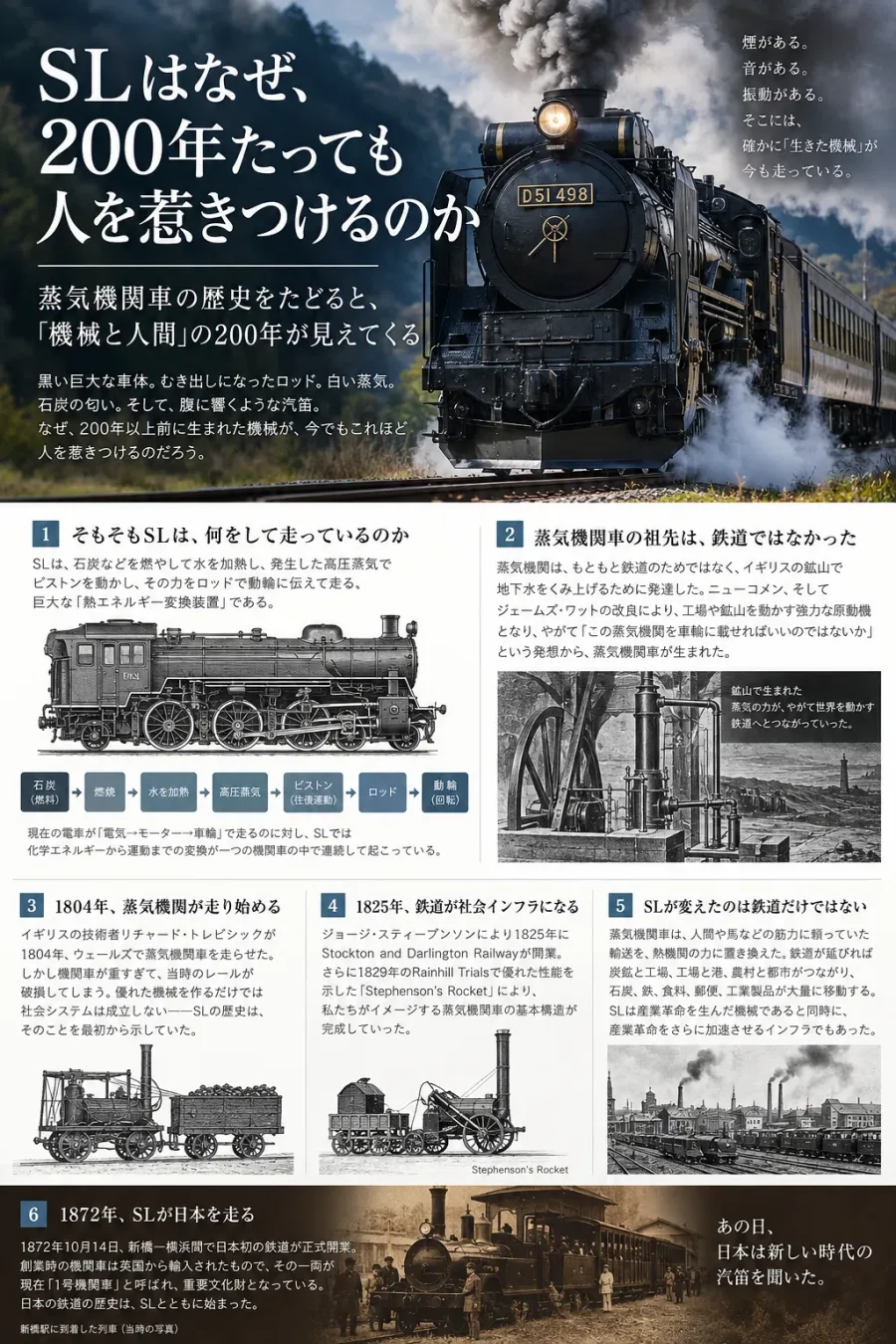
Why do steam locomotives still fascinate people after 200 years?
Tracing the history of steam locomotives reveals 200 years of 'machines and humans'
Seeing a steam locomotive up close gives you a strange feeling.
The massive black body.
The exposed rods.
The white steam.
The smell of coal.
And the whistle that resonates in your gut.
Compared to modern trains, it is clearly an old technology.
Yet, when a steam locomotive runs, many people gather.
It is not just children.
Adults also ready their cameras and turn around when the whistle blows.
Why does a machine born over 200 years ago still attract people so much today?
When you look into the history of steam locomotives, it turns out this was not just a story about 'old trains'.
The steam locomotive was a machine that symbolized humanity's transition from a 'civilization powered by muscle' to a 'civilization powered by heat engines'.
1. To begin with, what makes a steam locomotive run?
SL stands for Steam Locomotive.
To simplify the mechanism greatly,
Fuel such as coal
↓
Combustion
↓
Heating water
↓
High-pressure steam
↓
Cylinder
↓
Reciprocating motion of the piston
↓
Rod
↓
Rotation of the driving wheels
↓
Train runs
is how it works.
Modern trains run through a relatively direct conversion:
Electricity → Motor → Wheels
However, in a steam locomotive,
Energy conversion occurs continuously within a single locomotive:
Chemical energy → Thermal energy → Steam pressure → Reciprocating motion → Rotational motion
The Kyoto Railway Museum also introduces the basic principle of burning coal to turn water into steam, using that steam to move pistons, and rotating the driving wheels connected to those pistons.
In other words, a steam locomotive is a machine that is essentially a giant 'thermal energy conversion device' running on tracks.
2. The ancestor of the steam locomotive was not the railway
Tracing the history of the steam locomotive reveals that the steam engine was not invented to run on railways from the start.
What was important were mines.
In 17th and 18th century England, as coal mines became deeper, how to drain groundwater became a major problem.
Thus, drainage engines utilizing the power of steam were developed.
Through Newcomen's steam engine and improvements by James Watt and others, the steam engine became a powerful prime mover for factories and mines.
However, the initial steam engines had a major characteristic.
They did not move.
They were 'stationary engines' where the massive machine was fixed inside a building or similar structure to perform work there.
From there, a very bold idea was born.
'Wouldn't it be better to put this steam engine itself on wheels?'
This is where the history of the steam locomotive begins.
This is where the history of the steam locomotive begins.
3. 1804, the steam engine begins to run
An important figure in the early history of steam locomotives is the British engineer Richard Trevithick.
Trevithick developed high-pressure steam engines and, in 1804, ran a steam locomotive in Wales.
This is considered one of the important starting points in the history of steam locomotives.
However, it is interesting.
He succeeded in building a steam locomotive.
But then,
the tracks could not withstand the locomotive.
The locomotive was heavy, and the rails of the time were damaged.
This also applies to modern technological development.
A social system cannot be established just by building one excellent machine.
To establish a railway,
locomotives, tracks, bridges, stations, signals, water supply facilities, maintenance facilities, and operational management
must all be established simultaneously.
It can be said that the history of steam locomotives showed from the beginning the importance of 'viewing technology as a system rather than as individual units'.
4. 1825, railways become social infrastructure
The next important figure to appear is George Stephenson.
In 1825, the Stockton and Darlington Railway opened in England.
From this point on, steam locomotives developed from mere experimental machines into full-scale public transportation and logistics infrastructure.
Furthermore, in 1829, the famous Rainhill Trials were held.
The one that demonstrated superior performance there was
Stephenson's Rocket
.
The Rocket incorporated important technologies that would lead to subsequent steam locomotives, such as a multi-tubular boiler and a blast pipe.
In the first half of the 19th century, the basic structure of the 'steam locomotive' that we imagine was rapidly completed.
5. It was not just the railways that steam locomotives changed
From here, railways spread throughout the world.
Before that, land transportation relied heavily on the muscle power of humans and horses.
Naturally, there were limits.
Horses get tired.
They also require feed.
To transport large quantities of cargo, many horses are needed.
Then the steam locomotive appeared.
If you supply coal and water, a massive machine will continue to run, pulling large numbers of people and cargo.
This is not merely the invention of a 'fast vehicle'.
If viewed on the scale of human history,
it was a transition from a civilization that transported goods with muscle to one that transports goods with heat engines
.
As railways expanded,
coal mines and factories became connected.
Factories and ports are connected.
Rural villages and cities are connected.
Not only people, but also coal, iron, food, mail, and industrial products are transported in large quantities.
The steam locomotive was a machine born from the Industrial Revolution, and at the same time, it was an infrastructure that further accelerated the Industrial Revolution.
6. In 1872, steam locomotives run in Japan
And so, railways arrived in Japan as well.
October 14, 1872.
Japan's first railway officially opened between Shimbashi and Yokohama.
The steam locomotives at the time of the founding were imported from the UK.
One of those is the vehicle now called 'Locomotive No. 1'.
According to documents from the Agency for Cultural Affairs, it is a locomotive manufactured by Vulcan Foundry in the UK in 1871 and was used when railways first opened in Japan.
It is now designated as an Important Cultural Property.
In other words,
The history of Japanese railways began with the steam locomotive.
7. For the Japanese people of that time, steam locomotives were not 'nostalgic'
This is interesting because the perception is reversed when viewed from the modern day.
Nowadays, when we see a steam locomotive, we think of it as:
'A vehicle from the past'
'Retro'
'Nostalgic'
I feel that.
However, for the people of 1872, the steam locomotive was the exact opposite.
It was a machine of the future.
A massive lump of iron,
spewing smoke,
venting steam,
and roaring loudly,
running without the use of horses.
From the perspective of Japanese society at that time, it must have been an incredible sight.
In fact, many nishiki-e (woodblock prints) depicting steam locomotives and railways remain from around the time the railway opened.
It might have been close to the feeling modern people have when seeing the latest rockets or humanoid robots.
8. Japan changed from a country that buys steam locomotives to a country that builds them
During the dawn of Japan's railways, many locomotives were imported from countries such as the United Kingdom, the United States, and Germany.
In Hokkaido, American-made steam locomotives like the "Yoshitsune" and "Benkei" were also used.
However, Japan did not just end up continuing to buy locomotives from overseas.
While absorbing foreign technology and expanding the domestic railway network, it proceeded with domestic production and standardization.
Before long,
the 8620 class,
the 9600 class,
the C51 class,
the C57 class,
the D51 class,
the C62 class,
and other uniquely Japanese steam locomotives appeared one after another.
Looking at it as the history of Japanese industry,
The process of changing from a 'country that imports finished products' to an 'industrial nation that designs and manufactures its own'
is also directly reflected in the history of steam locomotives.
9. Why is the 'Degoichi' so famous?
The representative Japanese steam locomotive is the D51 class, commonly known as the 'Degoichi'.
Manufactured starting in 1936, it was primarily used for freight transport.
When looking at steam locomotive classifications,
C57
C62
D51
and others, they start with an alphabet letter.
For Japanese National Railways steam locomotives, this letter indicates the number of driving wheel axles.
C means 3 driving axles.
D means 4 driving axles.
The D-class was easy to secure with a large adhesive weight, making it suitable for freight transport that required high tractive force.
The D51 became a symbolic presence not just because it looked cool.
It continued to transport massive amounts of goods during the turbulent periods of pre-war, wartime, and post-war Japanese society.
Coal.
Lumber.
Ore.
Food.
Industrial products.
In an era when the importance of railway freight was incomparably greater than current truck logistics, the D51 was one of the machines that literally pulled Japan's industry forward.
10. The steam locomotive was a 'giant heat engine controlled by humans'
This was the part I personally found most interesting while researching steam locomotives.
In a steam locomotive, the distance between human and machine is extremely close.
The fireman shovels coal into the firebox.
However, it is not simply a matter of throwing in a large amount of coal.
The condition of the fire bed.
Steam pressure.
Current speed.
The gradient ahead.
Train weight.
The output required in the future.
It is necessary to maintain the combustion state while considering all of these factors.
The engineer also operates the locomotive while reading the steam pressure, speed, track conditions, and wheel adhesion.
In other words, the steam locomotive was a
Human-Machine System where humans read and control the state of a giant heat engine in real time.
It was.
There was a very large part that was supplemented by human perception, experience, and judgment, which is now handled by sensors, computers, and automatic control.
That is precisely why operating a steam locomotive required highly advanced skills.
11. Why did such an amazing steam locomotive disappear?
The reason is simple.
This is because more efficient methods appeared.
It takes time and effort for a steam locomotive to even start running.
Ignite the fire.
Heat the water.
Build up steam pressure.
Only then can it be operated.
Even while running, it consumes large amounts of coal and water.
Furthermore,
coaling,
watering,
ash disposal,
firebox cleaning,
lubrication,
boiler maintenance,
periodic inspections
and many other maintenance tasks are required.
In other words,
while a steam locomotive looks powerful when running, the entire operational system is extremely labor-intensive.
12. Electrification was a revolution that moved energy equipment outside the vehicle.
Comparing electric railways with steam locomotives here is interesting.
A steam locomotive has
fuel + combustion equipment + boiler + prime mover
on the vehicle itself.
On the other hand, electric trains do not carry power generation equipment on board.
Power plant
↓
Power grid
↓
Substation equipment
↓
Overhead lines/third rail
↓
Vehicle
↓
Motor
This disperses and externalizes the energy supply function to a massive infrastructure side.
In a sense, a steam locomotive is
a system that runs by carrying a small heat source and prime mover in each car.
An electric train is
a system where the energy supply equipment is offloaded to the social infrastructure side.
It is not merely a 'replacement of vehicles from steam locomotives to electric trains'.
The architecture of the railway system itself has changed.
13. In the 1970s, steam locomotives rapidly disappeared from Japan
After the war, the Japanese National Railways promoted 'motive power modernization'.
Major lines were electrified.
Non-electrified sections were converted to diesel.
As a result, steam locomotives rapidly disappeared.
December 14, 1975.
The C57 135 pulled a regular passenger train on the Muroran Main Line.
This marked the end of regular passenger trains pulled by steam locomotives on the Japanese National Railways.
Furthermore, in 1976, the steam locomotives used for shunting at Oiwake Station also had their fires extinguished.
The era of the steam locomotive, which had supported Japanese railways for about 100 years, reached a milestone.
14. However, steam locomotives began to run again
For an ordinary machine, history would end here.
Old machines are replaced by new ones.
But steam locomotives were different.
They have been preserved in various places, and some have even begun to run again.
Here, the role of the steam locomotive has changed significantly.
What was once required of steam locomotives was...
to transport large numbers of people and goods efficiently.
However, with today's steam locomotives,
the act of riding the steam locomotive itself becomes the purpose.
In other words,
what was once a
means of transportation
has changed into an
experiential value.
I think this is a very interesting change.
15. Why are steam locomotives still so popular in this day and age?
Compared to modern trains, steam locomotives are overwhelmingly inefficient.
They are slow.
Maintenance is difficult.
They are labor-intensive.
They emit smoke.
They also require large amounts of water.
If you think only in terms of rationality, there is almost no reason to use a steam locomotive.
And yet, when a steam locomotive runs, many people gather.
Why is that?
I think one big reason is that
you can see the moment energy turns into work.
It is.
There is fire.
Smoke comes out.
Steam gushes out.
The piston moves.
The rod moves.
The massive driving wheels rotate.
The train body begins to move.
In that,
combustion → heat → steam → pressure → motion
the physical phenomenon is visible just as it is.
With modern electric trains, even though the result of 'running' is the same, what is happening inside is almost invisible to humans.
It is different with steam locomotives.
'This massive lump of iron is truly moving by the power of steam'
is something you can understand with your eyes, ears, and body.
16. Even the whistle sounds with 'real energy'
The steam locomotive's whistle is also symbolic.
It is not playing a recorded sound through a speaker.
High-pressure steam is sent into the whistle, actually creating vibrations to produce the sound.
In other words, even the whistle is
Fuel
↓
Combustion
↓
Heat
↓
Steam
↓
Pressure
↓
Sound
an extension of energy conversion.
That is why you know a steam locomotive is approaching before you even see it.
You hear the whistle from afar.
You see the smoke.
Vibrations are transmitted from the rails.
And then a massive locomotive appears.
A steam locomotive as a machine conveys its presence to humans not just through sight, but also through
sound, vibration, heat, and even smell.
This 'physicality' is quite different from modern machines.
17. When you line up 200 years of history, the meaning of the steam locomotive has changed.
Around 1804.
The steam locomotive was an 'experiment'.
↓
1820s-1830s.
The steam locomotive became 'cutting-edge technology'.
↓
The 19th century.
Steam locomotives became the infrastructure supporting the Industrial Revolution.
↓
1872.
Steam locomotives became a symbol of Japan's modernization.
↓
The first half of the 20th century.
Steam locomotives became a part of daily transportation and logistics.
↓
The 1950s to 1970s.
They yielded their leading role to electric and diesel power.
↓
The 1970s.
Steam locomotives became 'old technology'.
↓
And now.
Steam locomotives have become
'machines that people go out of their way to ride'
.
Even though it is the same machine, its value has changed completely due to changes in society.
18. "Inefficient does not necessarily mean valueless"
This was what I found most interesting while researching the history of steam locomotives.
Technology usually evolves in the direction of:
Faster.
Cheaper.
Safer.
With fewer personnel.
More efficiently.
In that sense, it was natural for steam locomotives to be replaced by electric trains and diesel vehicles.
However, the value that humans seek in machines is not just "efficiency."
In fact, in the modern era,
Emitting smoke.
Making loud noises.
Humans shoveling coal.
Huge rods moving.
Whistles echoing into the distance.
These aspects, which would normally be evaluated as "inefficient," have become the very source of their appeal.
I think this is quite important when considering technology.
This is what I think is quite important when considering technology.
19. 200 years ago, the steam locomotive was the "future"
200 years ago.
The steam locomotive was the future.
50 years ago.
The steam locomotive became obsolete.
And now.
The steam locomotive has become a cultural asset.
Even though it is the same machine,
cutting-edge technology
→ social infrastructure
→ outdated technology
→ cultural asset/tourism resource
its meaning has changed.
The value of technology is not determined simply by performance alone.
It changes depending on its relationship with society.
20. I think the steam locomotive is a "living industrial heritage"
Modern machines are becoming quieter and quieter.
They are being automated.
They are being digitized.
They are being turned into software.
What is happening inside is becoming invisible to humans.
On the other hand, the steam locomotive is the exact opposite.
You can see the fire.
You can see the smoke.
You can see the steam.
You can hear the sound.
It vibrates.
The rods move.
The wheels turn.
In other words,
humans can physically understand the phenomenon of energy being converted into work.
That is why I believe steam locomotives are more than just old vehicles.
It was an era when humanity first harnessed massive thermal energy at will, shifting transportation that had previously relied on human or animal muscle power over to machines.
That revolution,
is a machine that still reproduces it right before our eyes, even after more than 200 years.
I believe that is what a steam locomotive is.
Perhaps the reason so many people turn around the moment a whistle blows is not simply because it is an unusual train.
Within it,
the power of an era when humans first acquired massive machines as their own strength still remains.
That is why I believe steam locomotives still fascinate people in this day and age.
Reference Materials
・Agency for Cultural Affairs, "Database of National Cultural Properties: Locomotive No. 1"
・Agency for Cultural Affairs, "Cultural Heritage Online: Locomotive No. 1"
・Kyoto Railway Museum, "How does an SL work?"
・East Japan Railway Culture Foundation, "Former Shimbashi Station Railway History Exhibition Room" related materials
・The Railway Museum, "50 Years Since Saying Goodbye to the SL" related materials
・National Museum of Nature and Science, Center of the History of Japanese Industrial Technology, Railway Vehicle Related Materials Digitization