The large language model "DeepSeek V3" was released at the end of 2024. It made headlines for being touted as equivalent to GPT-4, despite being trained in just a few months for a few million dollars.
Entering 2025, its successor, "DeepSeek R1," has newly emerged. It incorporates large-scale reinforcement learning (RL) to achieve deep reasoning capabilities, aiming for performance that rivals OpenAI's o1 model in areas like mathematics, logical reasoning, and code generation. In this article, we will explain DeepSeek R1.
1. Overview of DeepSeek R1
Total parameter count: Same as V3 671 billion (about 37 billion activated during inference)
Deep reasoning capability: Acquired a "thinking" process through large-scale reinforcement learning + additional fine-tuning (SFT/Distillation)
Open source (MIT license) released, with API also provided
Performance: Rivals OpenAI's o1 model in benchmarks for mathematics, logical reasoning, and code generation
Price: Compared to OpenAI and Anthropic, overwhelmingly cheaper
Introduction of large-scale reinforcement learning: Enhanced inference accuracy and logical steps
Activation of autonomous thinking processes: Enables error correction and self-verification through the use of Chain-of-Thought
Multi-stage fine-tuning: Improved accuracy in practical operation through SFT and Distillation
Conventional LLMs generated responses to user input (prompts) in a pattern-matching manner. On the other hand, "reasoning-type" models like R1 internally execute the following processes.
Understanding the task (grasping questions and commands meta-cognitively)
Considering means (considering reasoning and tool usage through internal Chain-of-Thought)
Hypothesis verification (evaluating and correcting generated results on its own)
Final answer (re-attempting if necessary)
The fact that these are optimized through reinforcement learning is what makes it a "reasoning-type" model.
2. Why are "reasoning-type" LLMs attracting attention?
2-1. Differences from conventional LLMsMany existing LLMs, such as ChatGPT and Claude, are trained on large-scale data and are powerful. However, they have also had the following issues.
Difficulty with long-form reasoning: Logic tends to break down midway
Weakness in self-referential feedback: Once output is generated, it is difficult to correct automatically
"Reasoning-type" LLMs are expected to resolve these issues by going through logical steps internally.
2-2. Performance improvement in code, mathematics, and reasoning tasksSignificant performance improvements are particularly noticeable in tasks that require multiple steps, such as code generation and mathematical problems. While code generation used to be a single-shot process, "reasoning-type" LLMs can now internally cycle through processes like test execution and correction.
3. OpenAI-o1 level performance? DeepSeek R1 as seen in benchmarks
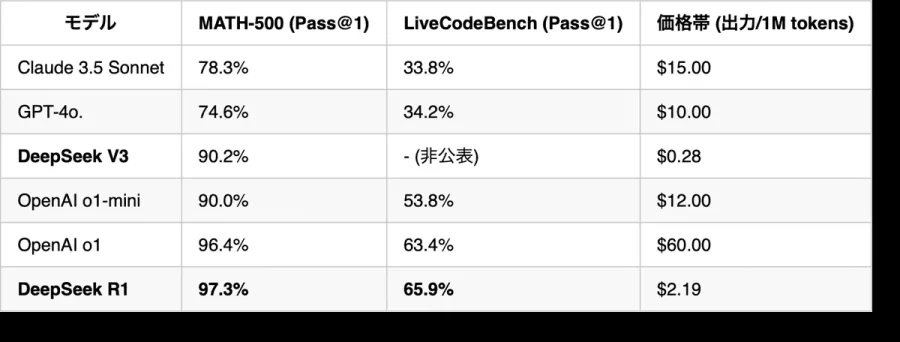
Scores that match or exceed OpenAI-o1 have been reported in major benchmarks such as mathematics, coding, and reading comprehension. For example:
MATH-500 (Pass@1): Over 90% accuracy on university-level math problems
LiveCodeBench (Pass@1): Achieved a high score of 65.9%
Price: $2.19 per output token (per 1M tokens). Cheaper than o1 or 4o
High performance combined with reasonable pricing is the reason for the industry's attention.
4. The mechanism of large-scale reinforcement learning + SFT + distillation models
4-1. Flow of the learning methodIn general LLM development,
Pre-training (next-token prediction on a large-scale corpus)
Supervised Fine-Tuning (SFT) (tuning with human-created QA data)
RLHF (reinforcement learning using human feedback)
These are the steps taken. A key feature of DeepSeek R1 is that it applied reinforcement learning, especially in step 3, on a large scale. Furthermore, they tested an approach like "DeepSeek-R1-Zero," which applies RL before SFT, enhancing self-verification and logical development.
4-2. Why reasoning capabilities were acquired through RL aloneUsually, it was common to provide human labels for Chain-of-Thought via SFT. However, it is said that DeepSeek-R1-Zero was able to acquire reasoning capabilities even when performing RL without SFT.
However, since there were issues such as the output text becoming somewhat difficult to read if SFT was completely omitted, the model that added SFT afterward was completed as DeepSeek R1.
DeepSeek distills the obtained reasoning patterns into smaller models (such as 1.5B to 70B) and releases them. Usually, performance drops significantly when models are downsized, but they claim that relatively high performance can be maintained through distillation using excellent reasoning data.
For example, they report that even a 32B model approaches the performance of OpenAI-o1-mini, highlighting the ability to try advanced reasoning on home GPUs.
5. Usage fees and license: Is it really cheap?
5-1. New pricing plan (as of January 2025)Item Price Input tokens (cache hit) $0.14 / 1M tokens Input tokens (cache miss) $0.55 / 1M tokens Output tokens $2.19 / 1M tokens Maximum context length 128K tokens
Significantly cheaper on cache hits
Higher than DeepSeek V3's $0.28, but still cheaper compared to o1 and 4o
Commercial use allowed, free to modify and redistribute
Reuse of distilled data is also possible
However, if other companies' base models like Qwen or Llama are incorporated, they may be subject to the original license restrictions
Even if it is more expensive than V3, it often costs less than OpenAI GPT-o1.
R1 is a strong candidate, especially in the following scenarios.
When complex reasoning or long-form analysis is required
Leveraging the large 128K context capacity
Wanting to self-host on your own cloud (MIT license)
6. Application to LLM workflows: Prompt Chaining and Parallelization
DeepSeek R1 can basically be used just like other LLMs.
Prompt Chaining: Breaking down tasks and repeatedly referencing outputs step-by-step
Parallelization: Running multiple prompts simultaneously and aggregating the results
Evaluator-Optimizer loop: Utilizing the model's own evaluations or feedback from other models
R1's strengths: Multi-step reasoning, mathematics, complex code generation, and long document processing
V3's strengths: Simple summarization/classification, daily conversation, and high-volume batch processing
For example, in a customer support chatbot, you could configure it so that V3 handles initial responses, and more difficult inquiries are routed to R1. This allows for high-level support while keeping costs down.
Application to AI AgentsThere is a growing trend of building "AI agents" that execute autonomous tasks by using frameworks like LangChain to integrate tools and combine multiple models. Because R1 has a large context and high reasoning capability, it is likely well-suited for flexible and advanced agent design.
7. Points to note when using DeepSeek R1
7-1. Security and PrivacyHigher-performance models carry higher risks of misuse, including concerns about confidential information leakage. While the MIT license offers high flexibility, users must properly establish their own policies and guardrails.
7-2. Future OutlookR1 can be called a "first-generation reasoning model." In the future,
visualization and control of reasoning steps will advance
multimodal (image and audio) support will be added
Continuous learning (online learning)
and other advancements are progressing, and even more sophisticated agentification is expected.
8. Industry Impact: The Changes Brought by R1
8-1. Collaboration with Other ModelsLeveraging the strengths of open source, coexistence and distillation with other models like Llama and Gemini are also easy.
Companies using existing LLMs can utilize R1 distillation models
Combining Gemini's high-speed response capabilities with R1's reasoning power
, and other forms of interoperability are expected.
R1's thought process boosts the development of AI agents that automate tools and workflows. For example,
Customer Support: Searching across internal databases to propose solutions
Software Development: Automatically repeating code fixes and testing
Research and Development: Autonomously proposing everything from paper analysis to new ideas
An era where advanced work can be done with little human intervention is approaching.
9. Summary: Key Points for Utilizing DeepSeek R1
9-1. How to Keep Costs Down While Leveraging High PerformanceAssign basic tasks to V3 and complex tasks to R1
Utilize the cache function to lower costs for identical prompts
Minimize API billing by deploying small distilled models locally
Possibilities: Easily test advanced logical reasoning and autonomous task processing
Challenge: Because the thought process is complex, risk management for runaway behavior and misuse becomes even more important
DeepSeek R1 is a new era LLM that promotes both "thinking" and "performance." For advanced tasks such as long-form analysis and code generation, the key will be to utilize it while balancing cost and performance.
Now that AI agent integration is advancing, the introduction of R1 could have a major impact on business. If you are interested, please give it a try.
Thank you for reading this far!
I am continuously sharing the latest information and usage methods in the AI field on X (formerly Twitter) and YouTube. If you are even slightly interested, please follow me or subscribe to my channel.
X (formerly Twitter): @AI_masaou
YouTube: @ai_masaou
Let's catch the latest information and build the next era together!