Until now, height, weight, and the BMI derived from them have been the mainstream indicators for evaluating body type. However, in recent years, the idea of evaluating one's health and body type by looking at body composition—the components that make up the body—has become increasingly widespread.
There are several ways to measure body composition, but using a device that employs Bioelectrical Impedance Analysis (BIA) to measure muscle mass, body fat percentage, and other metrics is becoming one of the most common methods. BIA devices are efficient in every respect, including short measurement times, the speed at which results are produced, convenience, and accuracy.
However, the cost of purchasing a BIA device varies from model to model.
BIA devices work by sending a weak electrical current through the human body and measuring the electrical resistance (impedance) that occurs as the current flows through body water. Based on the measured impedance, body water volume is calculated, and body composition such as muscle mass and body fat mass is determined; this measurement principle is the same for all BIA devices.
If they use the same method, why is there such a wide range in the price of BIA devices?
In this article, we will explain the important points you should check when purchasing a BIA device.
Check the frequencies
BIA devices use at least one type of frequency current (alternating current) to measure body composition. When BIA devices were first commercialized, they used a single-frequency current of 50 kHz, and some BIA devices still perform measurements using a single frequency as a remnant of this.
However, it is difficult to accurately measure body water volume—the foundation for determining each body composition component—with only a single 50 kHz frequency, so statistical corrections began to be used to compensate for accuracy.
In other words, statistical correction is an average value of trends. For example, it incorporates general trends into the formula for determining body composition, such as the fact that muscle mass decreases with age or that women generally have more body fat than men.
As a result, errors occur in individuals who do not fit these general trends, such as elderly people with high muscle mass or women with low body fat.
Furthermore, because the statistical values used differ depending on the subject—such as healthy individuals, the elderly, children, gender, and medical history—it was considered problematic that they could not be applied to everyone.
Many researchers began to recognize the view that "to overcome this problem, it is necessary to use multiple frequencies rather than a single frequency," and in 1996, InBody succeeded in developing the first BIA device equipped with technology capable of multi-frequency measurement.
When considering the purchase of a BIA device, please check the number of frequencies used. There is no doubt that a BIA device using multiple frequencies is more accurate than one using a single frequency.
Why multi-frequency measurement is accurate
We explained the measurement principle that BIA devices can measure electrical resistance (impedance) by passing a current through the human body. In other words, a BIA device calculates body water volume before anything else from the measured impedance.
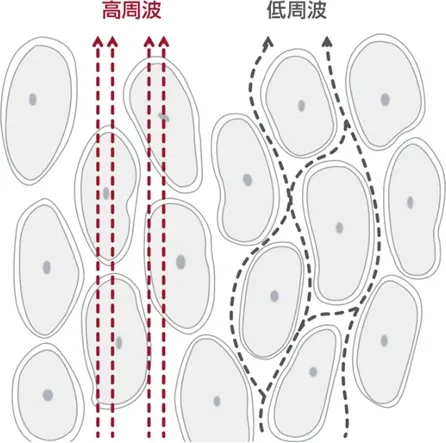
Low-frequency currents do not have enough energy to pass through cell membranes, so they have the property of flowing around the cells. On the other hand, high-frequency currents pass through cell membranes well, so they have the property of flowing through the entire body water, regardless of whether it is inside or outside the cells.
By utilizing the difference in the degree to which currents pass through cell membranes at each frequency, and by passing currents of various frequencies through the human body, it becomes possible to more accurately calculate "extracellular water," "intracellular water," "extracellular water ratio (ECW/TBW)," and "total body water."
Only after accurately measuring this water information can body composition such as muscle mass and body fat mass be accurately calculated.
The point to check regarding whether body composition is being measured accurately is whether the fundamental body water volume is being measured accurately.
In other words, multi-frequency measurement, which uses various frequencies, holds the key to accuracy.
Check the measurement result items
The measurement result items provided by BIA devices vary depending on the device.
Some provide only body fat percentage, while others provide more than 40 comprehensive result items.
Body fat percentage is certainly one of the easier indicators to use for evaluating health status and body type. Many BIA devices available for general home use can display body fat percentage, but in reality, body fat percentage is a volatile item, so relying solely on it is dangerous.
The reason why body fat percentage is prone to fluctuation lies in the measurement principle of BIA devices.
Because BIA devices measure body water, parts where current does not flow (such as clothing or food consumed just before) are calculated as body fat.
Here are three representative items that can be used in addition to body fat percentage. Please check if these items are provided by the BIA device you are considering.
▶Skeletal Muscle Mass
Among muscle mass, this refers only to muscles that can be moved by one's own will and have striations due to muscle fibers. While limb muscles consist only of skeletal muscle, trunk muscles also contain visceral and cardiac muscles. Therefore, this item is also a value obtained by subtracting the estimated amount of visceral and cardiac muscles from the total body muscle mass.
In recent years, the Skeletal Muscle Index (SMI) has been frequently used for sarcopenia evaluation, so you can easily check whether your muscle mass is sufficient and whether you have sarcopenia or sarcopenic obesity.
※ SMI is the value obtained by dividing the skeletal muscle mass of the limbs by the square of height (m). The Asian Working Group for Sarcopenia (AWGS) defines the diagnostic criteria for sarcopenia as less than 7.0 kg/m² for men and less than 5.7 kg/m² for women.
▶Body Water Balance
Higher-precision BIA devices provide detailed water information through multi-frequency measurement, so you can check not only the total body water volume but also the balance of intracellular and extracellular water. InBody allows you to check whether your water balance is appropriate through an item called the extracellular water ratio (ECW/TBW).
The ratio of extracellular water (ECW) to total body water (TBW) in a healthy body maintains a constant value of around 0.380. However, if there is a disease accompanied by edema (such as renal failure, heart failure, cirrhosis, or diabetes), this value increases mainly due to an increase in extracellular water, and if nutritional status deteriorates due to aging or sarcopenia, this value increases due to a decrease in intracellular water (ICW).
While ECW/TBW is an indicator of edema, it is widely used as an indicator of nutritional status and disease severity, and generally, a value exceeding 0.400 is evaluated as high, indicating that the water balance is disrupted.
▶Phase Angle
The phase angle is the phase difference between the resistance that occurs when current flows along body water and the reactance that occurs when it passes through cell membranes. In other words, the phase angle reflects the health of cell membranes and the structural stability of cells.
There is no standard value set for the phase angle, but since a phase angle of 0° means cell destruction, a lower phase angle means that the health and function of the cells are declining.
Since the phase angle is proportional to physique, the values differ by gender and race, and because it tends to decrease with age, it also differs by age group. A study that evaluated the nutritional status of dialysis patients using phase angle reported that 4° or less indicated malnutrition, while 5° or more indicated good nutrition 1).
Check what information is required at the time of measurement
For all BIA devices, the minimum information required at the time of measurement is "weight." Even if the BIA device does not have a weight measurement function, the person being measured must manually enter their weight. If you measure weight on a scale separate from the BIA device, be careful not to make any input errors.
The further the actual weight is from the entered value, the further each body composition value will be from the actual value, but the body fat mass, which is calculated as weight minus fat-free mass, will be particularly affected. Therefore, when entering weight manually, do not use values measured several days ago or estimated weights; use the weight measured immediately before the body composition measurement.
Height is also essential information common to all BIA devices. To calculate body water content from the impedance measured in each body segment, the length of each part of the body is required. Since this length is estimated and used based on a proportional formula relative to height, entering the wrong height will affect all measurement values.
Weight and height are not predictive variables used to adjust results through statistical correction, but rather an important framework for understanding body composition, just like impedance.
Many BIA devices also require input for "age" and "gender".
This is to adjust the actual measured values based on statistical data, such as the fact that people in their 30s have more muscle mass than those in their 80s, or that men generally have a lower body fat percentage than women. The problem with BIA devices that use statistical correction, as explained in the "Check the frequency" section earlier, Check the frequency is that they cannot be applied to everyone.
If you are using such a BIA device, elderly people who exercise or women who go to the gym may have their muscle mass underestimated due to the effects of statistical correction.
To check if a device uses statistical correction, try entering the opposite gender to your own when taking a measurement. If the muscle mass and body fat percentage change significantly compared to the results measured with your actual gender, the device uses statistical correction.
Check what is measured and what is not
BIA devices can only measure the impedance of the parts through which the current flows. In other words, the remaining parts of the body where the current does not flow are calculated by estimation.
Many general home-use BIA devices use the impedance flowing between both feet (the upper body is estimated) or the impedance flowing between both arms (the trunk and lower body are estimated).
Such BIA devices assume that the balance of the physique between the upper and lower body is not disrupted. If a soccer player with very well-developed lower limbs uses a BIA device that only measures between both arms, their lower limb and overall muscle mass will be underestimated.
There are also BIA devices that attach electrodes to the back of the right hand and the back of the right foot to pass a current along one side of the body. In this case, the side of the body without electrodes becomes an estimated value, and it is assumed that the left-right balance is not disrupted.
It becomes difficult to examine the degree of development in a tennis player's dominant arm or the left-right difference in the shunt limb versus the non-shunt limb of a dialysis patient.
However, you should not feel at ease just because it is a whole-body measurement BIA device. This is because there are BIA devices that measure the whole body as a single cylinder, and devices that measure by dividing it into five parts: right arm, left arm, trunk, right leg, and left leg. Even with the same whole-body measurement, the accuracy of the measurement results varies depending on whether or not each part is measured individually.
*For details such as the advantages of segmental measurement, please refer to the "Segmental Measurement Guide" in the InBody topics.
Conclusion
Since InBody is a device that uses Direct Segmental Multi-frequency Bioelectrical Impedance Analysis (DSM-BIA), it can satisfy all the confirmation items mentioned above.
The results are programmed to be analyzed by measuring each of the five parts—both arms, the trunk, and both legs—individually, without performing statistical correction using statistical values.
Because multiple frequencies are passed through each part individually, the measurement time takes from about 15 seconds to about 100 seconds, but the measurement results are almost identical to the DEXA method, which is said to be the most accurate.
If you are going to purchase a BIA device, please be sure to check these points.
So that you do not regret your purchase after the fact because you judged the BIA device solely on price.
References
1. A Study on Phase Angle for Nutritional Assessment of Chronic Maintenance Dialysis Patients, Masuda et al., Journal of the Japanese Society of Clinical Engineering (2019) 65