It was so good!!!!!!!!!!
I got exactly what I was looking for!!!!!
The new characters are cute too!!!!!!!!
The best!!!!!!!!!!!!!!!
Spoiler Warning
To write a thorough review, this article will introduce the synopsis of the entire scenario in several thousand characters. After that, I will write a very long review. Major spoilers ahead.
Since the official source has already issued something like a spoiler warning, I will leave plenty of line breaks. Also, I'll fill it with text just in case so the content doesn't show up in search summaries.
Hom
Hom
Hom
Hom
Hom
Hom
Hom
Hom
Hom
Hom
Hom
HOM
Hom
Hom
Hom
Hom
Hom
Hom
Chiwa
Hom
Homu
Mu...
I think that's enough,
so let's start with some general impressions.
At first glance, I felt that this work turned out to have a very different vibe from what we've seen before!
No, the elements that make it up were still completely Madoka Magica, but it felt like the level of intensity was different...
In other words, while it is a legitimate sequel to the previous work, its flavor as a piece of art is different.
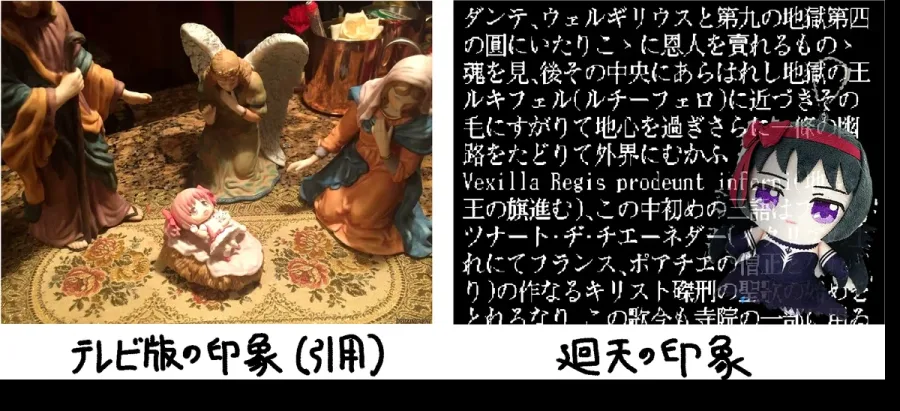
The TV version of Madoka Magica unfolded with a focus on the relationships between human characters (like "MadoHomu") while having a mythological and sci-fi structure.
Rebellion, while centered on the religious element of rebellion against God, gave us elements like a doujinshi where everyone becomes like a Sunday morning magical girl, and a time-loop mystery like Urusei Yatsura 2.
In contrast, this work has few such easily understood elements.
It was a straightforward mythological work where Homura, who has transcended the human realm, constantly deals with beings that are not human.
I was truly happy that Madoka Magica finally reached this point!!!
I had imagined that it would turn into this kind of development, but it's the best that such an otaku-like story was actually told!
Also, a sci-fi-like setting regarding "how information is retained and manifested?" is suddenly added.
I apologize for the creepy way of writing that sounds like "This is irresistible for a maniac like me," but I was moved by the fact that they made such a maniacal work...!
Regardless of the maniacal nature, I feel there are various problems with it as a movie, but I enjoyed it the whole time I was watching it!
Also, as an otaku who likes things like the Bible, I would like to interpret it as a myth, but since it got long, I made it into a separate article like an expansion pack. If you have understood the scenario, I think it's fine to read from here, or read only that.
Table of Contents
Overview and Interpretation of the Story Structure
Like the previous work, Rebellion, this work features Homura as the protagonist.
The main axis is Homura dealing with three newly introduced magical girls.
However, the collapse of the space Homura rules happens quite easily (or rather, a mysterious character is boldly invading and starting the collapse at the beginning).
The length and focus of this work are not on that battle, but on the development of gradually finding out who the entity trying to invade and cause the collapse of the space is and what kind of existence it is.
What is revealed there, which is particularly important, is the "origin of witches" and the "witch generation system," and
this is something that concerns the foundation of this series, but
since they are disclosed in an interlude-like manner, the feeling of them being directly involved in Homura's story is weak.
I guess it means that when everything becomes one story, it's something to look forward to next time.
This development of the play, which is very much like "Part 2 of a Trilogy," is thought to be one of the reasons why the current evaluation of this work (a few days after release) is not favorable.
However, I believe this work succeeds in presenting a cohesive story in the sense that by revealing this setting to Homura, the nature of her story changes significantly.
Synopsis
I will try to explain the synopsis of this work.
I don't remember the timeline perfectly (especially since many things happen simultaneously in the second half), so I don't think this follows the exact flow of the movie.
Also, it's long, so those who have seen it can feel free to skip this.
This work is a proper sequel set in the Mitakihara ruled by Homura-chan, which was formed at the end of Rebellion (not the Mitakihara inside Homura's barrier that was the stage for Rebellion, but the real Mitakihara altered by the power of a devil).
At the beginning, an urban legend called the "Lizard Phone" is mentioned.
In fact, Homura-chan had made a contract like a magical girl with a girl in Mitakihara, having her hunt magical beasts on her behalf.
(This power is likely due to her controlling Kyubey's abilities at the end of Rebellion.)
However, the purpose of this contract is almost never explained, and this girl does not play a major role until the end.
Although Homura-chan is doing things that seem like a conspiracy, she is basically living in Mitakihara with Mami, Sayaka, Kyoko, and Nagisa Momoe without any conflict among the magical girls.
Note that Madoka has not become a magical girl. Kyubey also shows no intention of making a contract.
(It is unclear how much time has passed since the end of Rebellion, but it seems to have become a Sazae-san-like space-time due to Homura's power—meaning there is no objective space-time. Also, since Madoka is called a 'transfer student,' I don't think much time has passed since the previous work.)
And so, an existence slipped into such daily life!
That would be the three magical girls: the 'Unnamed Upperclassman,' 'Lilac,' and 'Selma Therese'. (In the end credits, the Unnamed Upperclassman is given the name 'Wasu,' but she is probably not called that.)
Homura views the three who have slipped in without notice as dangerous, but the other magical girls suddenly trust Lilac and Selma (the Unnamed Upperclassman doesn't appear much). Homura senses that the three are using illusory abilities (like memory manipulation) just like she does.
(The Unnamed Upperclassman looks just like Homura, but Homura-chan doesn't notice until Kyubey tells her. Homura-chan looking at her own face in a hand mirror with a 'Oh, really?' expression is clumsy and cute.)
The 'Unnamed Upperclassman' looks at Madoka with an ecstatic expression, calls her 'Marguerite', and also mentions the 'Law of Cycles'.
The Unnamed Upperclassman enters Madoka's house without permission and tries to return Madoka to the Law of Cycles, but Homura stops her. She applies further perception alteration to Madoka.
Homura and the upperclassman fight in the air while arguing. The other two (Lilac and Selma) also arrive, and Homura retreats (effectively a defeat).
(Here, the viewer is led to believe that the three are angel-like magical girls belonging to the Law of Cycles.)
Homura-chan, who could not eliminate them by force, enlists the help of Sayaka, who felt something was off about them, to investigate the three.
(As a recap up to Rebellion, this Sayaka-chan is the Sayaka who was attached to the 'Law of Cycles.' Unlike Mami and Kyoko, who are 'magical girls who stopped dying due to Madoka's alteration,' she is an existence who went as far as becoming a witch, died, and returned.
Because she was rewritten by Homura, she has forgotten her memories and mission, but since she retains remnants of her original memories, she is more intuitive than other magical girls and has a much more thoughtful personality than in the TV version.)
Meanwhile, the two continue to blend in,
Kyoko and Dingxiang become friends at a tea party.
Nagisa, Mami, and Selma play at an amusement park and become friends.
On the other hand, Homura and Sayaka track down the trio's hideout and infiltrate it. However, it is a special realm outside the universe, the "Nazuka Sokotsune".
It was "a space where information on witches from all timelines is accumulated."
Waiting there was the "Unnamed Upperclassman."
Nazuka Sokotsune was indeed the hub, but it was more of a mousetrap.
After various explanations were given there, Homura was attacked. Since Nazuka Sokotsune is outside the universe (the reality of space-time), the power of the devil cannot be used. It's a pinch!
Then, Sayaka, having regained various cognitions, released her power as a witch to help, allowing Homura and Sayaka to escape the danger (the reason Sayaka can use witch powers is as mentioned earlier).
Now, the following things are discussed in the sequence around Nazuka Sokotsune up to this point.
・The "Unnamed Upperclassman" is the witch once called "Walpurgisnacht"
・Nazuka Sokotsune names and stores magical girls as witches
・Witches are generated (reincarnated?) from the information in this Nazuka Sokotsune
・Since "Walpurgisnacht" herself is the entity that birthed Nazuka Sokotsune, she has no name as a witch and has forgotten her name as a magical girl. Therefore, she took on a temporary form resembling Homura.
・The witch reincarnation system was not operating due to the Law of Cycles, but as a result of Devil Homura's interference with the Law of Cycles, an anomaly occurred, leading the three to come to Homura
In other words, all three new characters were entities that could be called fake magical girls generated from the witch database known as Nazuka Sokotsune.
(According to the pamphlet, these fake magical girls are called "Witch-girls." But I haven't been able to buy it, and they are never called that in the main story, so I will stick with calling them fake magical girls in this text.)
The scene of Nagisa and Selma having fun is depicted again, but the amusement park is filled with ominous motifs, and Selma says strangely unsettling things.
Meanwhile, Dingxiang, who became friends with Kyoko, is invited to the Mitakihara team's tea party. The attendees are Kyoko, Mami, Nagisa, and Madoka. Madoka is also a first-time guest.
However, seeing the others devouring a large amount of sweets, Dingxiang seems to have had some trauma triggered, a flashback-like scene plays where she couldn't hand over a cake, and she snaps and leaves.
Madoka gets worried and chases after Dingxiang to a place that looks like a hermit's island, but Dingxiang, while irritated, talks about the Law of Cycles and the fact that they are witches.
Just as Madoka is about to remember something, Dingxiang attacks her. Madoka cannot resist because she is not even a magical girl.
Dingxiang attempts to change the order of this space by erasing Madoka, but Kyoko stops her.
Madoka embraces Dingxiang, who has taken on a monster-like (witch) form. She says something like the Law of Cycles, "You too deserve to be saved."
But,
Selma arrives then and kidnaps Madoka.
Selma tries to turn Madoka into a witch for Kyubey, aiming to create a world where the Law of Cycles has perished.
Selma agrees with Kyubey's logic (that becoming a witch helps reduce the entropy of the universe) and found joy in being able to sacrifice herself for the universe. For Selma as a witch, the Law of Cycles was a useless existence.
(This Selma is an entity generated from a "witch," and I don't know if the Selma who exists as a magical girl in some space-time had such an ideology.
Also, she said something to the effect of "I wanted to be in Madoka's position," so perhaps she was fine with anything as long as she was praised for self-sacrifice)
Regardless, she was trying to return things to a "world where witches are born" at this opportunity.
(The part where Walpurgisnacht says something like "What a foolish and beautiful child!" is very interesting)
This part is complicated, so I will organize it in my own way.
The Walpurgis team does not have a unified goal,
and the only thing they seem to have in common is "the destruction of the space-time dominated by Homura."
Their actions at the time of Selma's rampage are as follows.
Walpurgisnacht (Wal): Destroy the Homura space and meet Madoka as the Law of Cycles again
Selma: Wants to work for Kyubey, destroy the Homura space that is a nuisance to Kyubey
Zi Dingxiang: Initially seemed to be in sync with Walpurgis, but had some past trauma triggered at the tea party with the Mitakihara people, so she snapped due to personal feelings -> defeated
That is the situation, but Wal does not attack Selma.
On the other hand, the usual members are
Homura: Wants to defeat everyone's schemes as the ruler of this world
Kyoko/Mami: Fight to protect Madoka, the city, and the Law of Cycles as residents of this world
Madoka: Made into a witch and unable to act
is how it feels
Sayaka, unable to keep up with this complicated battle, drops out. To Sayaka, this world is a fake created by a rebel, but she has no reason to side with the Walpurgis team either.
Nagisa appears before Sayaka, who is slumped on her bed, and reveals the fact that she was never actually brainwashed. She had retained her memories from the Law of Cycles and seems to have known all along that the three of them were witches.
Sayaka is furious, asking why she didn't say anything until now, but Nagisa says something to the effect of, "Whether Madoka is a god or Homura is a devil, as long as I can spend my time happily, that's all that matters."
Although she doesn't agree with that, Sayaka finds a sense of closure and fights for the sake of Madoka and the others.
Meanwhile, Selma creates something like a giant Kyubey and goes on a rampage, but is defeated by the candy battleship (which looks like the Yamato) built by Nagisa and Mami. While pressing the launch button for the battleship, she shouts, "Tiro Finale!"
Here, Selma's inner feelings are revealed. It seems Selma hated being useless and had become fanatical about self-sacrifice.
Nagisa delivers the finishing blow to Selma, but says something like, "It's okay to be saved even if you're useless (or was it 'it's okay to be happy'?)."
Now, on the other hand, the past of Walpurgisnacht is also told in separate cuts. To organize it:
・Originally, magical girls died without becoming witches (things like magical beasts appeared).
・There was a convent to which many magical girls belonged.
・The magical girls of the convent used their powers for the sake of people and fought against things like magical beasts, but they died in despair, and they were not properly mourned.
・A person named Margarete made a contract with the wish to "save all magical girls."
・Margarete tried to save all the despair and curses of the magical girls.
・However, Margarete's power was not enough (?), and she could not save all the magical girls.
・Even so, Margarete's prayers, as she continued to call out their names, and the curses she bore gave birth to Nazuka Tokone.
・Nazuka Tokone gave names to the magical girls who fell into despair and kept recording them (since Nazuka Tokone is a system outside the universe, it continued to exist even after the world was rewritten by Madoka).
・On the other hand, Margarete herself absorbed the curses of all the magical girls up to that point and became a witch. She forgot her own name and became the greatest witch, Walpurgisnacht.
(Is Walpurgisnacht called a "collection of multiple witches" because Margarete was also carrying the curses of all the magical girls up to that point?)
・Walpurgisnacht herself is also saved by the Law of Cycles system. Madoka called her Margarete.
→ Carrying only that memory, Walpurgis called Madoka Margarete and was searching for her.
Selma's plot was thwarted, but as a result of the battle, Homura's control becomes unstable. Outside the pure white barrier, a giant, emotionless Ultimate Madoka—the Law of Cycles—arrives.
According to the characters' dialogue, because her human part had been stolen, the incomplete Law of Cycles had mutated into something different from the human Madoka (?).
Madoka changes due to the Law of Cycles. While becoming a being without humanity, Madoka crucifies Homura.
Other magical girls try to help Homura, but
Homura refuses. She says she feels the weight of the sins she has committed and will return Madoka to the Law of Cycles as she is.
However, Sayaka rejects those words."You are the only one who shouldn't call Madoka by the name Law of Cycles.". The others also affirm the desires Homura brought about in this space.
Perhaps encouraged, Homura decides to continue her rebellion against the world and the Law of Cycles. She then snatches Madoka, who was climbing the stairs toward the Law of Cycles, and holds her in her arms.
However, the Law of Cycles does not allow this and unleashes a massive attack.
The Madoka that Homura was holding disappears.
I didn't quite understand this part, but there is no sequence where the Law of Cycles retrieves Madoka and returns. The Law of Cycles appears to remain unchanged.
Well, Homura hears Madoka's voice, and I feel like there were various other cuts (I think I saw the lizard phone girl), but it ends with a "To be continued!" feel and the end credits.
After the end credits, Kyubey, who is in Nazuka Tokone, says something like, "The records of Nazuka Tokone, this will be useful," and it is truly, truly the end.
Contrast Structure
There are various contrast structures, and since I think that is what is important, I will list them out for now.
Madoka and MargareteThe two are very similar beings who contracted with almost the same wish.
As a result, Margarete created a supernatural device to record magical girls, and Madoka became a supernatural being to save them.
This work affirms Margarete as a preceding savior, but it is a fact that disasters occurred and deaths increased due to witches. Madoka surely wouldn't make the ordinary people killed by witches disappear (because the law of causality would become strange).
Then, was there an essential difference between Margarete, who created such disasters, and Madoka, who was able to complete the salvation?
I don't know what kind of thoughts Margarete had when she made the contract, but it seems she used her own life to save them while knowing the cycle that "magical girls die in suffering as a result of the contract." If so, isn't there no difference in the love of the two?
On the other hand, there was a difference in the situation. Madoka had Homura, and based on the power and information that arose from that, she was able to contract with a more thorough desire for salvation.
By the way, it is explained that Walpurgisnacht took on Homura's appearance because "she admired Madoka."
At first, I took it that she unconsciously chose Homura's form as "the figure loved by Madoka" (that is probably correct).
But it could also be interpreted that Margarete was jealous of "Madoka, who has a being like Homura," and wanted to take on the form of Homura, the devotee she could not obtain herself.
By the way, Margarete is the real name of Gretchen, the heroine of "Faust." On the other hand, Madoka's name as a witch is also (Kriemhild) Gretchen, but I didn't know that. Was Walpurgis calling her Margarete a misleading development to make you think, "She's calling Madoka by her witch name?!"... (I don't know witch runes).
Nagisa lived under Homura's rule out of self-centered desire, while knowing everything.
Selma, despite having the soul of a witch, is trapped by the notion of "being useful to someone," making her the exact opposite.
In this work, both possess "memories of their friendship with Madoka as humans" while also knowing Madoka as a god.
However, because this Sayaka is an angel-like existence created by God Madoka in 'Rebellion' (chronologically before the main events of 'Rebellion'), she cannot be as detached as Homura in seeking Madoka as a human.
Well, various contrast and conflict structures have been created. By summarizing them, it can be said that there has been a major change between this work and the previous one.
Thinking about the differences between 'Rebellion' and this work from the axis of conflict
Considering the flow from the TV series and 'Rebellion', the series has two axes:
Good and Evil,
Freedom and Oppression.
The good and evil referred to here point to the ultimate normative ethics of good deeds versus evil deeds toward the world.
Madoka, who sacrificed herself for the supreme benevolence of saving everyone, accepted oppression.
On the other hand, Homura committed the evil of deceiving Madoka and breaking the rules for the sake of the free will of love.
There was an axis of conflict between
Good and Oppression (Madoka) <-> Evil and Freedom (Homura)
.
Therefore, it ended with the hint that "we might become enemies someday."
However, in this work, the story does not unfold with Madoka and Homura fighting under that axis of conflict, but rather becomes a work where various other contrast structures emerge.
Selma appears, attempting to destroy Madoka while being oppressed by a normative consciousness of "having to be useful."
Whether Selma's kamikaze-like self-sacrifice is malicious or benevolent is a matter of interpretation, but her half-baked plan, which even Kyubey called meaningless, was ultimately nothing more than a pathetic evil that disrupted the scene. In other words, "oppressed evil" also appeared.
On the other hand, Nagisa and Walpurgisnacht also appear as agents of free will. While Nagisa is in a position to know everything, she does not intend to guide or commit evil deeds regarding the situation,
but acts for her own self-centered desire for a place where she can have fun.
Walpurgisnacht also acts for her own desires under free will, not out of a normative consciousness of benevolence or a desire to destroy order through malice.
This is in contrast to Devil Homura, who exercised free will for the sake of her emotional attachment to another, which she called love. It could be called a bratty principle of action.
However, Sayaka, who was incarnated with a purpose and used for Homura's goals, is influenced by this bratty principle of Nagisa and becomes motivated to act.
As a premise for this, it was also revealed in this work that the space ruled by Homura was a "comfortable space" for Nagisa, Sayaka, and Madoka, even though it contained falsehoods.
In other words, what was Homura's self-righteous desire became something good for a small number of people. It is nothing more than a vulgar "good thing" that is on a different level from the ultimate good and evil that existed in the conflict axis between Madoka and Devil Homura, and while memory manipulation is normally a crime, it does not change the fact that she created something good.
Now, through this list of contrast structures, the simple and beautiful conflict structure that existed in 'Rebellion' has vanished in this work.
It has reached a vague theme of "what kind of will do you use to exercise free will, or for what purpose are you oppressed?"
And,
just as Margarethe's hope (similar to Madoka's) gave birth to a witch of calamity, the results of those desires cannot be controlled.
But come to think of it, that is what human desire is like. It is very rare for a desire to be completely evil or completely good.
From the good desire of "wanting to entertain people," one might say insulting dirty jokes and hurt someone,
or if one works hard for the selfish desire of "I don't want anyone to be better than me," it might result in helping others...
Human desires and karma are not linearly connected to good and evil.
The reason Homura decided to tear Madoka away in 'Rebellion' was because she heard Madoka, who had become human, say that it was painful and she hated bearing fate alone.
This was, so to speak, a "justification." She could act out of altruism for the sake of another.
Even while calling herself a devil, Homura acted by putting forward a justification to convince herself.
On the other hand, the desire Homura holds at the end of this work does not require a noble cause.
Madoka, having regained her link to the Law of Cycles, leaves Homura's side without a hint of hesitation. There is no sign of the feeling that 'bearing fate is painful' there.
Also, no matter how much Sayaka and the others affirmed Homura's domain, Homura-chan probably isn't thinking, 'I will protect Mitakihara where Sayaka and Nagisa live.'
What remains as her principle of action is the free will of love for Madoka. Even so, it is not something that binds her like before, but a free desire that she could even give up at any time.
She opposes the great system that saves the world with nothing but her own desire.
The stylish anime 'Madoka Magica' has become a gritty myth.
The above is my interpretation, or rather my impressions, received from the contrast structure of the scenario.
Next, I will think about the settings, and based on that, I will talk about my final impressions.
Inference from the Origin of Witches and the System
I will summarize my thoughts on the explanation regarding the origin of witches and Nazuka Tokone.
Nazuka Tokone was an additional system that emerged from the prayers of magical girls. It was not something sent by aliens like Kyubey, nor was it an inevitability caused by the laws of the universe.
The change brought about by Madoka's world alteration was merely something that changed the influence of the system created by previous magical girls.
Until now, the Law of Cycles = Madoka was called 'something like a god,' and that is why Homura-chan called herself a 'devil (≒Satan)' as one who rebels against God.
The Law of Cycles that appears at the end of this work felt like a great existence beyond human reach.
However, with this setting, both 'Nazuka Tokone' and the 'Law of Cycles' can be called external systems even if they are gods. They were additional systems between people, not systems inherent to the universe.
And since a new system that changes functions (Nazuka Tokone → Law of Cycles) could be added, couldn't another one be added again?
Of course, 'Nazuka Tokone' and the 'Law of Cycles,' which involve the past, present, future, and multiple worlds, are certainly higher concepts, and Homura-chan probably couldn't win if she fought them head-on.
But, just as the witch system was effectively updated to the Law of Cycles system, I would like to think that the beginning of an update to a new world has been opened.
Is Nazuka Tokone similar to the Library of Babel?
Here, I will digress a little from the main line and state a point I found interesting about Nazuka Tokone.
It is said that Nazuka Tokone contains information on all witches, but I also get a feeling like the 'Library of Babel' from that.
The Library of Babel - Wikipedia This is a short story by Borges, but it is essentially a thought experiment. It is a library that contains books where text is perfectly fitted into a fixed format, and all possible text patterns are stored. This work, 'The Library of Babel' itself, is also included within it.
When there are all patterns like that, there is no intent or creativity in the selection. Complete exhaustiveness becomes something non-human (something like a god?).
Nazuka Tokone has no personality or will (though there might be a specific will regarding how to give witch names to magical girls).
Basically, it just has a database and a circuit that converts targets. Yet, because it is exhaustive and completely devoid of intent, it becomes something divine.
This is good!
Before watching, I thought a lot about a development where another god would appear. It wasn't so much a prediction as me thinking that was the only room for development.
But it would be a letdown if a character I didn't know suddenly appeared and said something like 'I am God,' wouldn't it?
Instead, it is good that a mere existence like data + a simple function has become a god placed in opposition to Madoka.
There is Wasu (Marguerite) as an actual personality, but she is separated as a character, and Nazuka Tokone itself isn't speaking, so it's easy to follow. It's well done.
Impressions on the Kaiten Worldview - A Dry Worldview
There are many other things I want to think about regarding the settings, but since it would become too long, I will state my impressions of the worldview.
With witches and the Law of Cycles written as systems, it became a very dry world, which I personally found very good.
The fantasy of being a magical girl was actually a cold, heartless system of 'contracts with the devil'!
That was the core of the TV series, and one could say the story was about using that fact to eventually become a god.
This structure of 'I thought it was a fantasy, but it was a system' extended even to the witches, and the Law of Cycles itself was nothing more than a system.
The beauty of this is that while it provides sci-fi intrigue, it also ensures that things outside of humanity, like gods and miracles, do not drive the narrative. In other words, paradoxically, the work stands as a 'story of human emotion'.
It's easy to get the impression that Kyubey is the ultimate mastermind of the TV series, but as Kyubey himself says in episode 11, it's all the humans' fault.
Both hope and despair are human emotions that humans possessed from the start, and Kyubey is merely exploiting them.
In short, this work is a story about humans. Overturning logic, and even the path to becoming a witch, are all feats accomplished by the magnitude of human emotion.
It is truly wonderful that in this work, everything from becoming a witch to salvation is set as being driven by human wishes.
Thoughts as a film—it really is a strange work.
Since this is a film review, I should also write about how it fared as a movie.
I'm praising it highly, but it was a strange piece of work. I saw it on the morning of the opening day, and even while enjoying it, I had a feeling that general audiences might rate it low.
If they don't announce the sequel quickly, it might be bad for an anime theatrical release.
Since I thought of it as a trilogy with 'Rebellion' as Part 1 before watching, I have no complaints about this format, but it's dangerous to release such a complicated Part 2 without the finale being decided.
Release it in six months!!!
Also, if I list the flaws from a film perspective, they are as follows:
・Early scenes that don't connect well (the lizard phone call)
・The story is hard to understand
・Destruction of the beautiful structure of the previous works (as explained in the section on axes of conflict)
・An ending that relies too much on a sequel
・'In the end, wasn't everything Homura did in Rebellion just a waste?'
As I have written so far, I believe this work shows a completely new world while inheriting the elements of Rebellion, so the last point (even though I brought it up) is wrong. However...
As a film, the impression is that the characters didn't really gain much or change significantly.
Selma and Dingxiang might have gained something, but they are side characters...
Also, while there are various visual highlights, I don't think there were any scenes that were incredibly memorable. The parts by Ume-Lab were vivid and good, but I've already gotten used to beautiful scenes using strange materials other than that.
Also, the elements that were in the TV series,
the development of information disclosure leading to 'What?!' moments, were absent.
In the TV series, Kyubey would nonchalantly say, 'Everyone, you've already become Soul Gems,'
and the reaction—Kyoko snapping and Madoka saying 'That's terrible!'—was as entertaining as a comedy routine.
We didn't have that this time. Even in 'Rebellion,' there was the fun of Homura searching for the source of the loop and being shocked by herself, or Kyubey being flustered.
Even in this work,
the development of 'Who is the new character?' leading to 'A database of witches?!' and
the Walpurgis past flashback explanation (that the one who birthed the witches is an existence close to Madoka)
are surprising developments, and in fact, I was able to think, 'So that's the kind of story it is!' but
none of the characters are shocked. Because of that, I feel it's hard for the audience to feel the impact. In other words, there's no groove. I think it's a myth, so it might be fine without it, but still...
The intention not to make Walpurgisnacht a villain was good, but for a moment,
'I birthed all the witches~ shiver'
'What... are you saying it was all your fault!!!'
'Calm down, Miki Sayaka.' They could have at least done something like that.
As I stated at the beginning, I really enjoyed it, but for those who were watching for the fun of the characters from the TV series, it's inevitable that they would be left dissatisfied.
I like Homura-chan and the Sayaka from 'Rebellion,' and Wasu was also a character I quite liked, so I was able to enjoy it in terms of character appeal, but I don't think it was a so-called 'character-driven' work.
However,
since it is a sequel to 'Rebellion,' I feel it's unavoidable that it's not character-driven.
Because of the previous work, 'Madoka Magica' became a story where Homura, who became a local ruler of the world, challenges a god.
I wrote that it became an even grittier myth from there, but even if it hadn't,
the drama between characters like in the TV series would no longer have been the main axis.
Rather, in such a situation, it successfully created contrast relationships for each character, and I think the depiction of the relationships and changes around Selma was quite an effort to make it feel like 'anime'.
So, returning to the good points,
it was also very good that it opened up as a 'story of human emotion' while not being character-driven.
I have explained the mythological interpretation in a separate tab, so I will only state the conclusion:
in Christianity, the most important figure, the Savior, is Madoka, and the rebellion against that has already been depicted through Homura.
All that's left is the Apocalypse (the final battle between God and the rebel), and while there is a possibility of tracing that, if it's just that, it's a foregone conclusion, and there's little point in going to the trouble of making it.
In contrast, this work introduced the element of intervention in the world through self-centered desire on a large scale. It is a succession of rebellion, but isn't it a theme worth expanding over two hours?
I interpret it as shifting the focus to the most human of human impulses... karma (go), and restructuring the story onto a new stage.
Well, in the end, it includes expectations for the next finale, but it was a very good 'Part 2' as a new myth surrounding karma.
The end. Thank you for reading this long text.
Bonus: Predictions for the next installment
As a bonus, I'd like to take the opportunity to think about what kind of story it might become if things continue this way. I mean, I really want to do some "speculation."
In the end, the fact that Madoka disappeared probably signifies a temporary defeat for Homura, but couldn't this be the start of the next, final rebellion?
Now, the current Law of Cycles system did not save witches like Selma (or rather, the souls attached to witch data?), and it is unacceptable to Homura, who wants to bring back Madoka as a human.
And since it has been shown that the system can be expanded, isn't the final form the construction of a new system?
It seems natural to depict this while tracing the final battle of the Apocalypse (the so-called Armageddon).
What seems important there is
the possibility of "Human Madoka"
As a premise, I interpret that Madoka as a human (Human Madoka) has not been erased, and I believe she can appear again.
Now, in this space-time, Human Madoka was not even a magical girl. In other words, since Madoka as a magical girl has never been in the "post-alteration world," from the current Kyubey's perspective, she is an existence that "has never made a contract." (Even if traces can be confirmed in places like Nazuka-sone, etc.)
In other words, the current Madoka has the right to make a new contract with Kyubey doesn't she?
Meanwhile, Kyubey is looking for contractors to reduce entropy, and if a better collection method than Grief Seeds is possible, he wants to try it (the fact that he is in Nazuka-sone at the end must be related to that). I have a feeling it won't end well, but wouldn't he be willing to make a contract with Madoka?
This series is now completely a Homura-protagonist work, but is it still Kaname Madoka who decides the end?
In the first place, Christianity is a story about renewing the contract that humans once made with God (through Jesus of Nazareth). If the ending of this work is Madoka making a new contract with the Devil, it would be a similar structure (or rather, an inverted form?) and beautiful. If so, it might become a work called
New Testament: Puella Magi Madoka Magica. Well, I don't know if they will wrap up the story so straightforwardly. Even this time, with the title "Walpurgisnacht Rising," I didn't think Walpurgis herself (or something like her) would actually appear. I don't care what it is, I just want them to make the next one quickly!
As an aside, if it becomes an anime where humans living with desires challenge a systematic artificial god, and in the end humanity is rewritten, it will finally become just like "Space Runaway Ideon."
In Ideon, the fact that the Ide is not a god but an "artificial system" wasn't explored much, but I'm looking forward to Madoka Magica potentially depicting that.
I drew this intending to insert it into the synopsis as an explanatory image, but it didn't look like her, so I stopped. The clown-like hat was very cute, wasn't it?
Come to think of it, this work was strangely obsessed with tomatoes, so I drew a tomato on the thumbnail, but what was that about? This isn't Revue Starlight!
(Postscript: It was Margarethe, not Margarethe. But note doesn't have a replace function, so I'll leave it. It's like a variation in notation... and by the way, what language are the Was speaking?)