I will investigate the contents of the Max/MSP reverb, Gigaverb.
The following is an article on creating a very simple reverb in Max/MSP.
Gigaverb is a reverb implemented in Max/MSP's gen~ and other environments.
It is frequently used in various places such as BEAP.
Gigaverb is a mono-input to stereo-output reverb.
Formally, it is a type of reverb equipped with an FDN.
I will take a rough look at the parameters and mechanisms while examining the contents of the Gigaverb gen~ patch.
We held a workshop at AMCJ to create an FDN reverb together.
Materials such as the PowerPoint and patches are available for purchase below.
This might also be helpful.
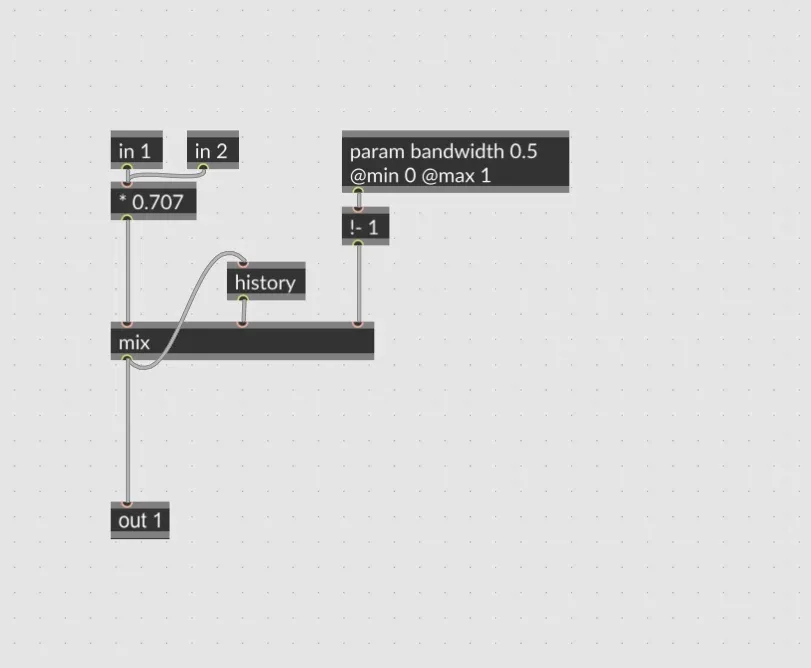
The first part of the Gigaverb gen patch adds the input and multiplies it by 0.707.
This part corresponds to dividing the signal by the root mean square of 2.
Next, mix and history are combined, and a parameter called bandwidth is inserted. This part is a one-pole filter. In this case, it is used as a low-pass filter.
A one-pole filter is represented by the following block diagram. Here, the Z^-1 part is the history operator.
In a one-pole filter, it is used as b0 = 1 - a1.
The mix part plays that role.
If a1 is negative, it acts as a low-pass filter; if positive, it acts as a high-pass filter. The absolute value of a1 must be less than 1.
After passing through the low-pass filter, the signal enters a section called prediffuse.
This is in the form of an all-pass filter.
An all-pass filter is represented by the following block diagram.
Here, it becomes an all-pass filter when b0=aM. In this case, it has a feedback gain of b0=aM=0.75.
The delay time is a parameter connected to roomsize. Regarding the part calculated by expr, if the unit of roomsize is in meters, the output represents the time it takes to travel the distance of roomsize in number of samples.
The following formula is sometimes used for setting the delay time.
340 is the speed of sound, and the sample rate is 1/T. If in1 is d, the expr formula becomes the same as d/cT in the formula below.
If in1 is in meters, this outputs the number of samples. Otherwise, the 0.110732 coefficient applied as a multiplier is likely a coefficient for adjusting parameters. It might be a coefficient corresponding to the room shape, for example. This part is a magic number, but as a whole, we can see that an all-pass filter is at the front stage.
This is a 4-tap delay. It is delayed only 4 times.
Each delay time is determined by multiplying the room size by a coefficient. What comes out of the room size is the number of samples. The delay gain is calculated from revtime and roomsize.
Let's look at the contents of the expr directly under revtime.
pow(10,-60/20)=0.001. This is the part related to the parameter t60. t60 is a parameter related to the audio decay time, etc., and represents the time it takes for the original volume to become 0.001 times its value. The part representing the power of 0.001 is the expr part directly below.
In gigaverb, there are two exprs, but it is easier to understand if they are combined. This is based on the law of exponents
xa×xb=xabx^a×x^b=x^ab
It is easier to understand if you combine them like this.
In summary, it performs the same operation as the following formula.
The number +5 is added to the delay time, but I think this is included for safety so that the delay time does not become 0. 0.41, 0.3, 0.155, etc., are likely coefficients for staggered delay times.
In early, the gain of the initial reflections is adjusted.
The signal output from Tap delays branches and enters the FDN.
The FDN delay time and feedback gain are calculated in the same way as Tap delays. 0.5 is the normalization coefficient for the FDN.
Since there are 4 FDNs
1/4=0.51/ \sqrt4=0.5
This is how it works.
Also, a Low Pass Filter is inserted into each delay line.
This filter is a One Pole filter.
The degree of filtering is adjusted by a parameter called damping.
A parameter called tail is applied to the later stage, where the gain of the late reverberation part is adjusted. Up to this point, the reverb output is monaural.
The signal that has passed through the FDN is sent to the final stage, the Diffusion chains, as a combination of early reflections and late reverberation.
This part is responsible for expressing diffusion and stereo imaging. Each section is equipped with all-pass filters (three in series) x 2 on the left and right, with delay times determined by parameters called room size and spread. The left and right delay times are multiplied by different coefficients to create a difference between the left and right channels. Finally, after being converted to stereo here, the dry parameter determines the d/w gain, resulting in the reverb output.
The above is a rough overview of the contents of Gigaverb.
I was in charge of the venue music for painter Ayaka Hara's solo exhibition "Wavy Garden".
Ayaka Hara Solo Exhibition "Wavy Garden"
Dates: 2023.04.20 (Thu) - 04.24 (Mon)
Time: 13:00 - 18:30 (until 17:00 on the final day)
Venue: gallery hydrangea (Hikifune, Tokyo)
Music: fendoap
Admission free
Details: https://gallery-hydrangea.shopinfo.jp/posts/40905772
Only the silence where no one is present
knows us
Released as a collection of ambient tracks.
Produced entirely with Pure Data; patches are also included.
Produced mainly with Max/MSP; patches are also included.
I sell Max for Live devices.