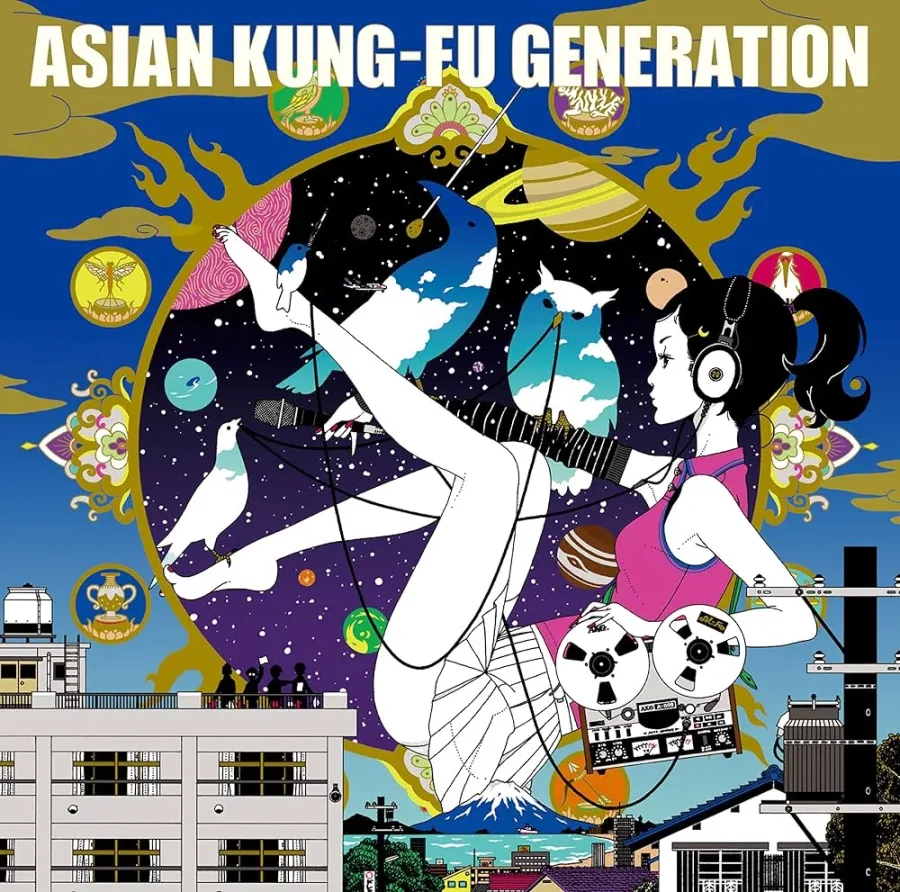
'Sol-fa (2016)' (2016.11.30)
The 2nd album 'Sol-fa', released in 2004, has been talked about as a representative work of AKFG and has been loved as a work with sufficient evaluation and results. It is an album that contains many signature songs and made the name of AKFG widely known. However, this work was completed on a tumultuous schedule after their major debut, as AKFG, having used up their stock of songs, overcame their first tours and festivals.
Masafumi Gotoh (Vo/Gt) seemed to feel a gap between the quality of 'Sol-fa' as a recording and its degree of success. He also mentioned in an interview that he felt strongly depressed during the production of the title track of the previous album 'Wonder Future', but perhaps it was because he had begun to be conscious of the 'end of the band' that could come at any time that he decided he did not want to leave this regret behind. And so, 'Sol-fa (2016)', which re-recorded all the songs from 'Sol-fa', was completed. What does this unusual re-recording album mean?Sol-fa (2016) What does this unusual re-recording album mean?
The Road to Trust
To talk about 'Sol-fa (2016)', it is essential to look back at their career. In this section, I would like to summarize the AKFG psychoanalytic reviews I have written so far.
The debut work 'Hokai Amplifier' is a work that revolves around initial impulses and identity. After a not-so-short period of obscurity, anxiety and expectation are expressed roughly. And the 1st album 'Kimi Tsunagi Five M', while inheriting that impulse, depicts the possibilities that have begun to open up toward the future. It is the period when they began to deliver music to the outside world where unspecified numbers of people exist, beyond the immediate audience at live shows = close relationships.
The 2nd album 'Sol-fa' was created during a period when AKFG was expanding. They were idolized as rock stars, and their desire for approval was drawn out by the desires of others, gradually leading to exhaustion. And in the 3rd album 'Fanclub', they reveal an aggressive side while locking their hearts away. The introspective early period of their activities, which deals with the motif of "Kimi" (You) that indicates their own purity or a trustworthy other, lasts until this work.
After concluding that there was nothing at the bottom of introspection, the 4th album 'World World World' turns their expression outward again. However, unlike 'Kimi Tsunagi~', which was completed within the heart, there was an increase in references to the real society living here and now. In the review, I described the change from 'Kimi Tsunagi~' to 'World~' by likening it to human psychological development using the concepts of the "Imaginary," "Symbolic," and "Real."
After mastering production through sessions that improved the band's skills, they returned to the joy of playing based on Gotoh's demos to create the 5th album 'Surf Bungaku Kamakura', and then the 6th album 'Magic Disk' was born, pursuing the demo -> band production format. In this album, Gotoh released his ego and tried to update AKFG's expression by incorporating things other than band sound.
As a result, production and touring caused friction, leading to a crisis of dissolution, but taking the earthquake as an opportunity, they regained the joy of playing music with others, and the 7th album 'Landmark' was completed. After that, based on what was expected of AKFG and what AKFG sought, they achieved a connection with fundamentalist rock in the 8th album 'Wonder Future'. Thus, AKFG was revived/completed, and the relationship between the four members and their trust in the listeners became solid.
Asian Kung-Fu Generation, heading into their 40s
From 'Hōkai Amplifier' to 'Wonder Future', the works were created while the members were in their early 20s to 40 years old. In terms of the developmental stages proposed by developmental psychologist Erikson, this period is categorized as young adulthood. In young adulthood, people increase intimacy and build relationships by having their identity accepted by others. It is also a time to face society and take on realistic roles and responsibilities.
While strongly seeking connections with others, the anxiety and fear of not being accepted as desired gave birth to 'Fanclub'. After the period of facing society and taking on the responsibilities of an artist reached its peak with 'Magic Disk', 'Landmark' and 'Wonder Future' were born from re-examining the relationships between the members and listeners. Indeed, Asian Kung-Fu Generation's young adulthood is etched into these groups of works.
And in 2016, as Asian Kung-Fu Generation reached their 40s, they entered what Erikson calls middle adulthood. Middle adulthood for humans is considered a period for transmitting professional knowledge and skills to the next generation. For Asian Kung-Fu Generation, who have constantly been hooking up younger artists, one could say this is nothing new, but I do think that respect from succeeding artists has started to be clearly expressed during this period.
As evidence of this, around the time of 'Sol-fa (2016)', there was a succession of projects such as the tribute album 'AKG TRIBUTE' featuring many young bands, and a joint tour project with young bands ('LIVE FOR THE NEXT'). It is said that if one does not take an interest in interacting with the next generation during middle adulthood, one will 'stagnate' and their personality will become rigid, but one could say that Asian Kung-Fu Generation, who constantly intersect with the youth, has reached an ideal middle adulthood in that sense as well.
However, that is precisely why one could say that regret over the big hit 'Sol-fa' remained. The fact that Asian Kung-Fu Generation became a stable band and the influence they have on younger artists became tangible may have been the catalyst for facing what was left undone in their young adulthood. It can be said that 'Sol-fa (2016)' was an inevitable initiation for Asian Kung-Fu Generation as they move forward into a proud middle age.
Boasting an identity
'Sol-fa (2016)' does not have major arrangement changes from the original songs. It is a simple approach of facing 'Sol-fa' with the experience Asian Kung-Fu Generation has gained, such as bringing the songs closer to the versions they have performed live and using the performance and recording techniques they have cultivated. However, this simplicity is an affirmation of Asian Kung-Fu Generation's journey and an expression of a stance that boasts the identity established in their young adulthood.
'Sol-fa', born in the midst of a busy schedule, was an emotionally unstable work crowded with a thirst for approval/anxiety about the status quo and a positive pop sensibility. If one views it as being between the future-oriented 'Kimi Tsunagi' and the claustrophobic 'Fanclub', that 'tearing' of emotions is clear. Positive and negative energies maintained a precarious balance, creating an intense centripetal force, but because of that, Asian Kung-Fu Generation themselves were likely being tossed about by it.
Not changing the arrangements significantly can be said to be a positive attitude toward their past selves. Because they honestly accepted that they had a masterpiece completed during tumultuous days and that the songs included were highly popular with listeners, they were able to take the method of re-recording 'Sol-fa' with good sound and good performances. Although 'Sol-fa (2016)' has a strong aspect of Gotoh's self-realization, it never leaves the members or listeners behind. Here, too, an attitude of 'affirming Asian Kung-Fu Generation' can be glimpsed.
This attitude also gives the songs new expressions. When 'Shindōkaku' is sung after reaching their 40s, the unstoppable impulse for expression feels reliable, and 'Kimi no Machi Made' sounds like a song that straightforwardly sings about a live tour. Songs that sing about 'connections' such as 'My World' and 'Yoru no Mukō' also leave an impression of warm inclusiveness rather than impatience. The messages internalized in the songs are awakened by the re-recording. There is certainly significance in facing their past selves.
The last two songs have new decorations applied, unlike the other songs. 'Mayonaka to Mahiru no Yume' has become more fantastical and calm, and it sounds like they are looking back on the days when they kept writing letters not knowing if they would ever be delivered. And 'Kaigan Dōri', where the strings invite sentimentality, gently wraps around Asian Kung-Fu Generation themselves, who spent those tumultuous days in 2004. This re-recording can be called self-care that transcends time. Including the fact that it was placed at the end of the album, that gentle attitude oozes out.
By completing 'Sol-fa (2016)' and making the 20th-anniversary tour a success, the preparations for the coming middle age were complete. In thinking about the next move for 'Sol-fa', the second in their career, what emerged was power pop, which Asian Kung-Fu Generation views as one of their roots. Unlocking their specialty, they take on the new challenge of 'recording itself' as they once again face the work following 'Sol-fa'.
Next review → 'Hometown' (Scheduled for November update)
#Music #JapaneseMusic #Rock #Band #RockBand #JRock #AnalysisColumn #MusicColumn #Essay #Column #DiscReview #AlbumReview #asiankungfugeneration #AKG #Psychoanalysis #Solfa2016