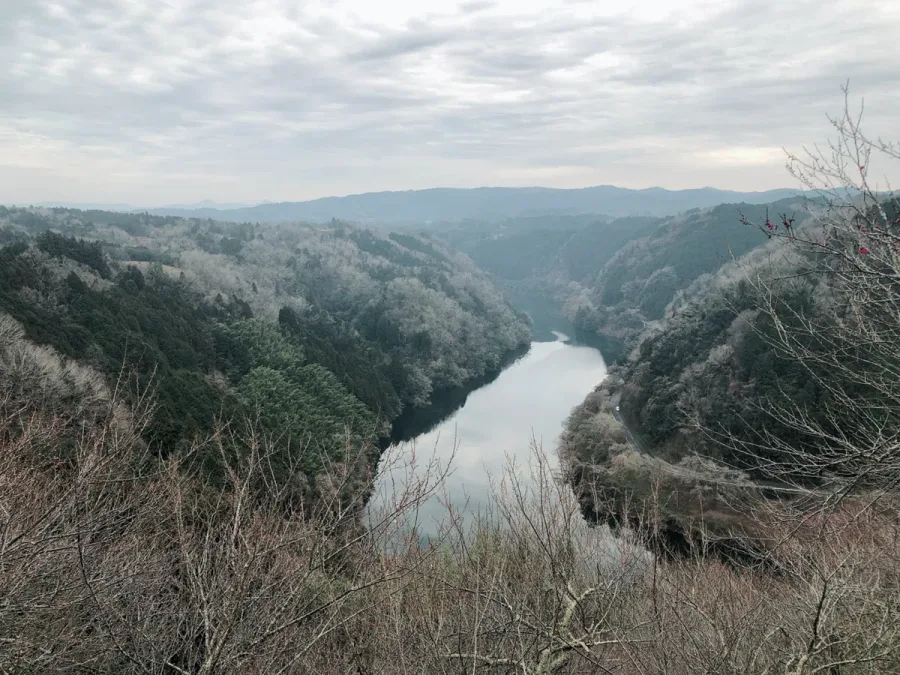
On the day I visited Tsukigase Village in Nara Prefecture, I climbed to the high ground of the plum groves and, welcomed by the scenic beauty of the Nabari River valley, stepped into the quiet townscape. The purpose of my trip was not merely to gaze at the scenery. I wanted to touch the layers of culture rooted in this land. The depth of memory woven by nature and human activity—I wanted to feel that on my skin and receive something that cannot be put into words.
Looking down from the high ground, the Nabari River flowed quietly, carving out a deep valley and holding jade-colored water. Rocks were scattered across the river surface, and the water ran smoothly, weaving between them and creating white splashes in places. Steep rock walls loomed on both banks, with thickets spreading above them. The branches of the winter-withered trees were intricately intertwined, with the deep green of evergreen trees peeking through here and there. The morning light shone in at an angle, casting pale shadows on the rock surfaces and the water.
A thin mist hung in the valley, and the distant mountains appeared to overlap in layers, their outlines blurred. The scene was like a page from a Chinese landscape painting, a fantastical world drawn in shades of ink spreading out before my eyes as reality. The Nabari River was not just a river. It was an existence harboring a spirituality that breathed quietly within the landscape woven by mountains, valleys, and mist. Like a path leading to a fairyland, the river beckoned me into the deep memories of this land.
Along the stone-paved path, long-established shops were scattered, and as I visited places like Tsukigase Zuke Honpo, Kanroubai Fukuda Honten, and Tsukigase Tea Honpo, I found myself drawn into the depth of the local culture.
Not satisfied with just the samples, I picked up and purchased some Tsukigase tea and ubai (smoked plums). Tsukigase tea is a fragrant sencha nurtured by the misty mountain climate, and the fresh, green scent that rose the moment I opened the bag seemed to hold the memories of the land. And then, the ubai. The dark brown plums that the shopkeeper carefully wrapped for me were not just preserved food. They were also medicinal herbs that had supported people's lives since long ago.
Ubai are made by smoking and drying green plums before they are fully ripe. Smoking concentrates the plum's acidity, increases its shelf life, and creates a unique aroma and flavor. Since ancient times, they have been prized as a traditional Chinese medicine, believed to have effects such as regulating the intestines, reducing fever, and suppressing coughs. The fact that these ubai are still made in Tsukigase, Nara, is not merely a continuation of tradition, but is deeply related to the history of Nara as the 'City of Medicine'.
Nara is a land where Japan's oldest medicinal herb culture is rooted. During the Asuka and Nara periods, the 'Ten'yaku-ryo' (Bureau of Medical Affairs) was established at the imperial court, and medicine and pharmacology introduced from the Tang Dynasty were systematized here. Medicinal herbs grew abundantly in the mountains of Yamato, and practitioners of Shugendo collected them and honed the art of healing illnesses. The ubai of Tsukigase are also an extension of that medicinal herb culture. The history of how the local people faced nature and protected their lives with the help of plums still breathes quietly today.
Tracing the history of ubai further, it goes back to China. In China, ubai have been used as medicine since before the Common Era, and their efficacy is recorded in classics such as the 'Shennong Ben Cao Jing' and the 'Compendium of Materia Medica'. In particular, they were prized as medicine to regulate the five internal organs and settle qi, and were used for coughs, diarrhea, and even for mental stabilization. Ubai were not just fruit; they were an existence that symbolized the relationship between nature and humanity.
Looking at the ubai I held in Tsukigase, I felt that the memories of Nara, China, and people's lives were layered within those small fruits. The scent of the smoked plums was somewhat nostalgic and powerful. It was the scent of the activities of people who had accepted the blessings of nature and sustained their lives through wisdom and skill.
I thought I would like to come again. When the plum blossoms in full bloom dye the valley, when the tea plantations welcome new buds, or when the smoke from smoking ubai rises in the mountains. Tsukigase will surely show a different expression each time. And I will listen to the voice of the land once more. In the quiet flow of time.