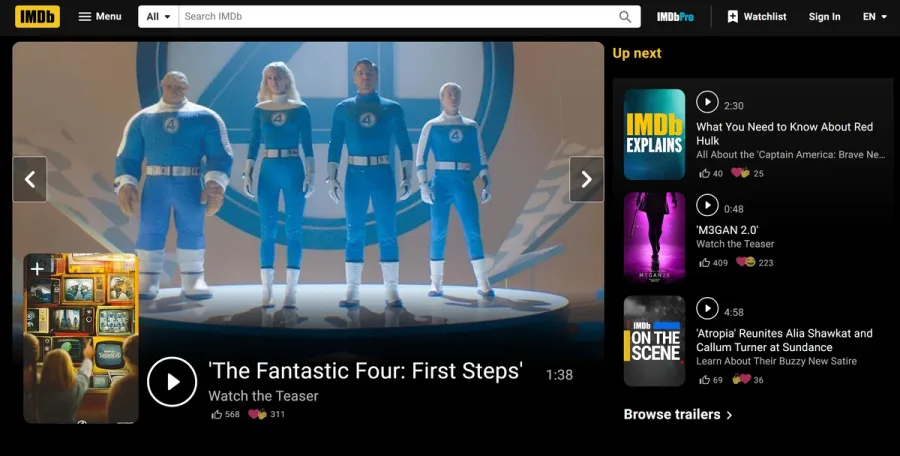
There is an overseas movie and drama review site called IMDb.
It rates almost every video work in existence on a 10-point scale. It covers not only Hollywood but also Japanese movies, anime, and even local programs from countries you've never heard of.
Using this as a reference can help you avoid terrible movies and dramas, saving you time. Although it looks like an English site at first glance, you can search in Japanese.
However, just because a score is high doesn't necessarily mean it's interesting. It's not that it's unreliable, but rather that there are standards for scoring and different ways to view things by genre.
Basically, anything 8 points or higher is treated as a masterpiece.
First, how to interpret the scores. Based on my experience, it feels like this.
Movies and dramas over 8 points are generally masterpieces. They are interesting.
If you are usually busy and don't have much time, using 8 points as a benchmark will save you time in life.
Once you've watched most of those, you can then expand your range to around 7.5 points.
The problem is that the scoring market differs between movies and dramas, and if you only watch high-scoring ones, your genres will become biased.
Scoring standards differ by genre
I said you should watch things with 8 points or more, but in reality, some genres tend to get high scores while others tend to get low scores.
You can probably imagine it, but serious works tend to be higher, while comical works tend to be lower.
Therefore, a movie you remember watching on Friday Road Show won't necessarily have a good score.
High-scoring genres
True stories and biographies
Minority-focused works
Old masterpieces
War
Crime
There are many so-called serious films. It goes without saying, but watching black-and-white masterpieces in this day and age is probably boring, and true stories or biographies are genres that can be sleepy for some people.
Also, films about diversity tend to get high scores. I think you can understand the reason for this.
Of course, there are tons of films that are just serious, so if the score is somewhat high, it means there are interesting elements to it.
Low-scoring genres
Comedy
Romance
Action
Children's
Horror
If anything, nostalgic movies broadcast on terrestrial television are low-scoring genres. Honestly, things that are easy to watch probably don't go over well with people who act like connoisseurs.
So, there are many good things in these genres even if they are around 7 points. Let's lower the bar a little bit.
Dramas tend to get higher scores
Between movies and dramas, dramas tend to get higher scores.
There are only about 5 or 6 movies that can be called historical masterpieces with a score of 9 or higher. On the other hand, there are quite a few dramas.
This is because the evaluation criteria are based on each episode rather than the whole.
Also, documentary programs like Planet Earth get high scores, so it's not just pure dramas that are included.
By the way, Japanese anime and the like are also included in the drama category. The highest-rated one currently is "Fullmetal Alchemist: Brotherhood".
Top 5 movies of all time
The Shawshank Redemption 9.3
The Godfather 9.2
The Dark Knight 9.0
The Godfather Part II 9.0
12 Angry Men 9.0
These are the top 5 movies of all time. Except for 12 Angry Men, you can watch them all with an Amazon Prime subscription.
Watch Amazon Prime
The top-rated dramas are almost all from HBO
Breaking Bad 9.5
Band of Brothers 9.4
Chernobyl 9.3
The Wire 9.3
The Sopranos 9.2
Game of Thrones 9.2
You can watch all of these on Amazon Prime, but you have to pay per episode. Alternatively, you can rent or buy them by the season for several thousand yen.
That's expensive. So, I recommend watching them via a video subscription service.
The issue is the broadcaster; excluding Breaking Bad at number one, all the shows from second to sixth place are on HBO, a premium cable channel. In Japan, U-NEXT is the only place where you can watch HBO content.
Therefore, if you want to watch these historical masterpieces, subscribing to U-NEXT is essentially mandatory.
The difference from Netflix is that the library is extensive, but the price is higher. You don't need to stay subscribed forever, so it's efficient to join and leave as needed—like canceling once you've finished watching what you wanted.
You can check what's available on U-NEXT via their search function, and they also offer a 30-day trial. If you're looking to binge-watch high-rated IMDb titles, you should consider it.