Hello everyone! This is Nemo, a visiting nurse.
The conclusion, from the start
The CURB-65 score is not only a tool for assessing the severity of Community-Acquired Pneumonia (CAP), but if handled differently, it can also serve as vital information for establishing a common understanding among patients, families, doctors, nurses, and caregivers. In particular, among the elements that make up the score, U (Urea: Blood Urea Nitrogen) is a factor that I believe family members and caregivers can proactively influence to prevent the onset of pneumonia through proper hydration and nutritional management.
CURB-65 is a score that helps to easily assess the severity of pneumonia that occurs at home or in facilities, and to determine whether 'treatment at home is possible or if hospitalization is necessary.' Viewed from another perspective, if the score is high in a facility, it can also help in deciding whether a hospital visit is required. It is named after the initials and numbers of the five elements evaluated.
The 5 elements evaluated (1 point each)
To measure the severity of pneumonia, the following five elements are checked:
・C (Confusion: consciousness disorder/disorientation)
Criteria: If there is confusion or problems with recognizing time or place.
・U (Urea: Blood Urea Nitrogen (BUN))
Criteria: If the BUN value in a blood test exceeds 20 mg/dL.
・R (Respiratory Rate: respiratory rate)
Criteria: If the respiratory rate is 30 breaths per minute or more.
・B (Blood Pressure: blood pressure)
Criteria: If the systolic blood pressure (upper) is less than 90 mmHg, or the diastolic blood pressure (lower) is 60 mmHg or less.
・65 (65 years: age)
Criteria: If the patient is 65 years of age or older.
For the 5 items above, add up the points (maximum 5 points) for each that applies.
① If the score is low (0-1 point): The prognosis is very good (mortality rate of about 2% or less). Basically, treatment at an outpatient clinic (at home) can be expected.
② If the score is moderate (2 points): Because there is a risk of a worsening prognosis (mortality rate of about 6-9%), treatment via hospitalization or detailed observation is strongly recommended.
③ If the score is high (3 points or more): The pneumonia is severe, and the prognosis is very likely to be poor (mortality rate of about 15% or more). It is determined that immediate hospitalization and intensive medical intervention, including treatment in an Intensive Care Unit (ICU), are necessary.
The professional criteria for CURB-65 can sometimes be 'difficult to use and hard to share information' for those providing daily care at home or in facilities. Therefore, we consider converting the criteria to be easier to use and visualize according to the situation at home or in facilities, helping to detect abnormalities early.
4. Practical check points for home/facilities (guidelines)・C (Confusion: consciousness disorder)
I believe it is acceptable to mark this if the response to a greeting is strange or extremely weak (e.g., no reaction, a faint 'uh...'), which is a different level than usual.
※ In medical terms, this corresponds to JCS I-1 or higher, or GCS 14-15 or lower, but it can be difficult to evaluate for those who already have difficulty communicating.
・U (Urea: Blood Urea Nitrogen (BUN))
BUN has the characteristic of increasing when dehydrated. Since BUN cannot be measured at home or in facilities, I believe it is acceptable to mark this if urine output is extremely low over 12 hours (around 200-300ml), if the patient is not eating or drinking at all, or if there is vomiting.
・R (Respiratory Rate: respiratory rate)
Originally, this is 30 breaths/min or more, but since a rate of 30 suggests a high possibility of poor systemic condition, it is also useful to consider checking at 20 breaths/min or more as a guideline for early warning.
・B (Blood Pressure: blood pressure)
If there is no blood pressure monitor, or if it cannot be measured accurately due to body movement or contractures, do not force it; focus on accurately grasping other items (consciousness level, respiratory rate). When blood pressure drops, it also appears as facial pallor.
・65 (Age: age)
Since modern Japan is an aging society and many are 65 or older, you can start by assuming this item is basically 1 point. It is important to be aware that as soon as 1 point is added from other items, it immediately becomes '2 points (hospitalization recommended line),' indicating a high-risk state.
CURB-65 is a tool for measuring the severity of pneumonia and does not apply to other diseases such as urinary tract infections or cholecystitis. It is not a panacea, so it is important not to over-rely on it.
The most important information to share, while knowing the limitations of CURB-65, is the perspective of the 'ABCs of emergency care' which are directly linked to life support.
A (Airway): Securing the airway
B (Breathing): Checking and assisting breathing
C (Circulation): Maintaining circulation (blood flow)
This is deeply related to each element of CURB-65. In other words, information based on daily observation, such as 'Are they energetic?' and 'Is their breathing or complexion strange?', is the most important information to share, even with family members who do not know medical terminology.
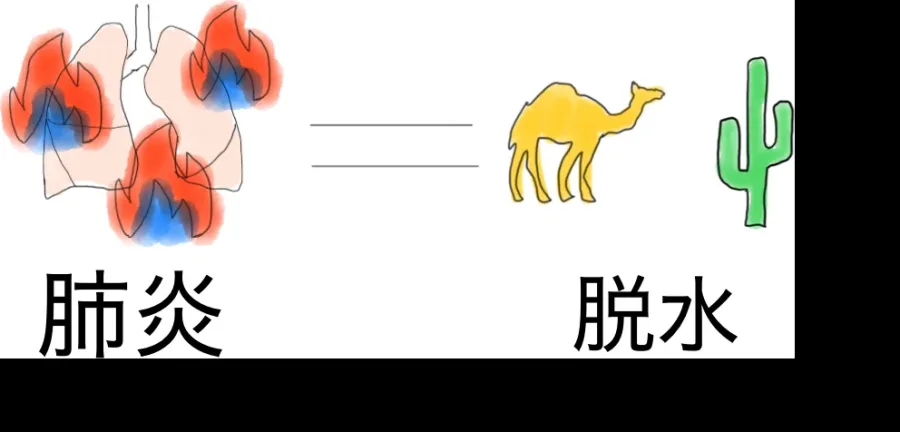
Among the items in CURB-65, the only indicator that family members and caregivers have the potential to control on a daily basis is U (Urea: Blood Urea Nitrogen).
An increase in BUN is caused by dehydration. Therefore, hydration management to prevent dehydration is considered extremely important.
Elderly people are prone to dehydration, and by the time they complain of thirst, dehydration may already be progressing. Since the frequency of dehydration onset is higher in the elderly than in young people, it is suggested that the possibility of pneumonia becoming severe is high. Since CURB-65 can be considered equivalent to 2 points at the time an elderly person feels thirst, it is important to have an intuitive sense of crisis that it is seriously dangerous if they aspirate or catch influenza.
The CURB-65 score, which assesses the severity of pneumonia, can be used not only to evaluate outpatient or inpatient treatment but also as a score for sharing a common understanding of the state of pneumonia. If there is a feeling of pneumonia after vomiting but you cannot visit a hospital for some reason, focusing on avoiding dehydration may be able to slow the progression of pneumonia. Also, when treating pneumonia with oral medication, avoiding dehydration may lead to early recovery.
Thinking for yourself about why SpO2 is not included in the pneumonia severity score might also deepen your understanding of how to look at pneumonia. Personally, I suspect it is because there are many false negatives. Conversely, it might mean that you can sense the presence of pneumonia without being fixated on SpO2.