Prologue
I had intended to buy a Golf GTI.
The MINI John Cooper Works (JCW) possessed a magic strong enough to overturn that intention.
Back when I had a 991.1 Carrera Cabriolet as my primary car, I wanted a front-wheel-drive hot hatch as a secondary car.
The memory of the Golf 2 GTI my mother drove when I was a child remained in my mind, so I rented a Golf 7.5 GTI for two days and drove it around. I had never known another car that eliminated the negatives of front-wheel drive so effectively. The balance was magnificent.
I thought, 'This is the one.'
That was when I encountered a Rebel Green F56 JCW.
It was eight years old with over 50,000km on the odometer. Yet, its condition was surprisingly well-maintained. The deep green body, black roof, and large wheels. The moment I saw it, my feelings for the GTI vanished. It wasn't my reason that reacted, but my body. I believed that when choosing a used car, the individual vehicle matters more than the model.
I had owned several BMWs and trusted them, and the MINI is a hot hatch made by that very BMW. After acquiring it, I installed a Remus exhaust, changed the rear lamps, and tailored it to my own tastes.
I clocked 20,000km in this car.
Hakone, Nagoya, Niigata, Osaka, Fukushima. I am writing down the distances and memories I shared with this car.
When I let it go after two years, I could no longer tolerate the roughness of the 6-speed automatic transmission. I wanted to return to rear-wheel drive; if I looked for reasons, there were many. It is not a car without flaws.
But without this car, neither my current F57 JCW Convertible nor my attachment to the MINI brand would exist. It was that compelling of a hot hatch.
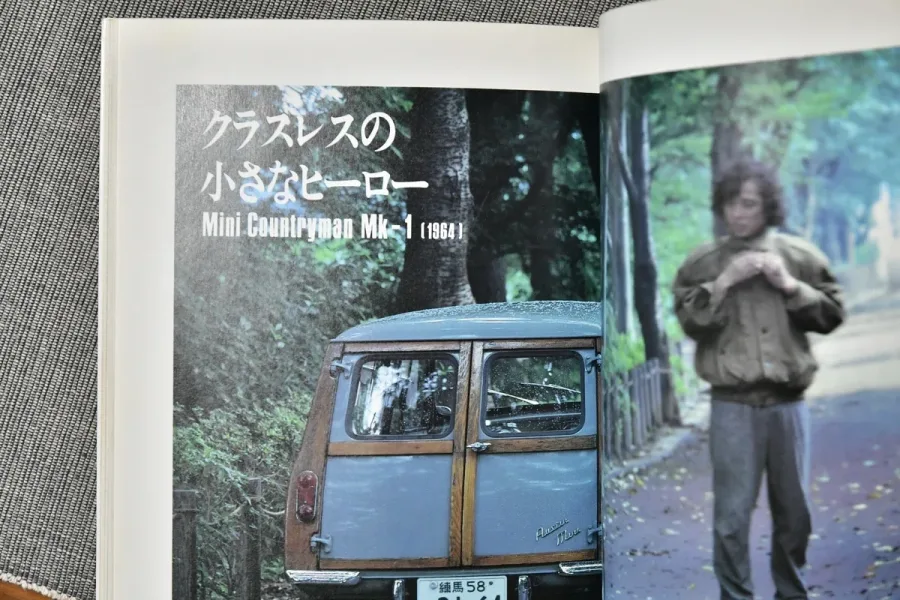
Regarding the essence of the Mini package, mystery writer Soji Shimada wrote this in his 1991 book 'Ecstasy of the Machine.' It is a passage where he recalls the anatomical display of a classic Mini he saw at the Science Museum in London while living in the UK.
Rationality coexists with charm.
This was the answer that the first-generation Mini (1959) designed by Alec Issigonis presented to the world, and after more than half a century, what BMW inherited with the F56 was, in the end, this very point.
That is why the BMW MINI is never front-midship. If they had used a front-midship design—that is, placing the engine behind the front axle and within the space between the front and rear axles—or a design close to it, the driving characteristics, including cornering performance, should have improved; BMW, having continued to build rear-wheel-drive cars, should know this better than anyone.
However, the BMW engineers, who understand that the basis of the Mini is the maximization of the greenhouse, dared to adopt a design that deviated from their own DNA. On top of that, they carried out uncompromising development of driving performance, establishing hot models like the John Cooper Works and Cooper S.
The rear seats of a 3-door hatchback like the F56, while intended for emergency use, actually provide enough space even for someone like me, who is 180cm tall, contrary to appearances. It is a very clever design.
While modernizing with the UKL platform and a transversely mounted BMW modular engine, the F56 JCW firmly inherited the essence of the Mini: 'a mass of rationality that is somehow cute.'
The fact that my body reacted the moment I encountered the Rebel Green F56 was likely due to this continuity of genes.
Chapter 1: B48 2.0L/231ps—The Dynamics of an FF Hot Hatch
The engine of the F56 JCW is the BMW B48 2.0L inline-4 turbo. It has a maximum output of 231ps/5,200-6,000rpm and a maximum torque of 320Nm/1,250-4,800rpm. It combines a single twin-scroll turbo with an electronically controlled wastegate to generate maximum torque flatly from as low as 1,250rpm.
Dividing 231ps and 320Nm by the 1,290kg body weight gives a power-to-weight ratio of 5.58kg/ps. This places it between the 4.98kg/ps of the 981 Boxster 2.7 and the 8.02kg/ps of the F30 320i. Looking only at the numbers, it falls into the category of a 'fast compact car,' but the FF layout gives these numbers a unique experience.
The convertible increases in weight (about 100kg), so the feeling as a hot hatch is somewhat dulled.
When you step on the accelerator, 320Nm of torque concentrates on the two front wheels. At full throttle, the front tires spin for a moment, and the EDLC (Electronic Differential Lock Control) intervenes.
It uses the brakes to simulate an LSD.
Torque steer is transmitted to the body. It is the structural fate of a car where the front wheels handle both drive and steering. The VAQ (electronically controlled, multi-plate clutch differential) of the Golf GTI Performance brilliantly eliminated this negative, but the F56 JCW shows the raw nature of front-wheel drive more honestly.
The handling sensation is murky, a tuning that prioritizes heat over refinement.
A further problem lay in the transmission. The Aisin 6-speed torque converter automatic. This AT is rough in its shifting at low speeds. There is a 'jolt' of impact the moment the gear engages when starting. In traffic or stop-and-go city driving, this shock is repeated.
For someone accustomed to the world's best transmissions, like BMW's ZF 8-speed AT or Porsche's PDK, it was ultimately unacceptable.
While the ZF 8HP45 in the F30 320i was a 'transparent existence,' the F56's 6AT constantly asserts that 'the machine is doing its job.' Even during high-speed cruising, the lock-up engages and disengages with slight accelerator movements between 80-100km/h, transmitting micro-vibrations to the body. However, this is a transmission commonly used by domestic brands like Toyota, Lexus, and Mazda. In other words, it was at the same standard as high-level domestic models of the same period.
The later model (LCI) was switched to an 8-speed AT and improved significantly, but my unit was an early model.
The ACC control was also rough in the early model. The braking when maintaining distance from the car in front was abrupt, which often made passengers uncomfortable.
The engine's character is very good. The rise of torque from low RPMs in the B48 and the pleasant stretch above 4,000rpm. It is a somewhat 'turbo-lag' type of behavior, but its dramatic characteristics are appealing. The bubbling sound with the Remus exhaust installed, releasing a loud 'pop-pop-pop' sound every time the accelerator was lifted, succinctly expressed the car's personality.
The engine and exhaust are top-notch. The AT that transmits that power holds it back. The source of stress is almost entirely concentrated here.
If you are going to get one from now on, an LCI model equipped with the 8AT is definitely the way to go.
Chapter 2: The 2,495mm Wheelbase—The Duality Born from Shortness
The F56 JCW has an overall length of 3,874mm, a width of 1,727mm, and a wheelbase of 2,495mm. For reference, the Golf GTI's wheelbase is 2,620mm, and the Renault Megane RS is 2,669mm. A difference of 120–170mm may seem subtle at first glance, but it has a decisive effect on driving characteristics.
A short wheelbase reduces the yaw moment of inertia. In other words, the car body rotates easily. On winding roads, this becomes a weapon, while on high-speed cruises, it manifests as sensitivity. The F56 JCW embodies the duality of a car's characteristics in an extreme form. Its extremity has much stronger contrast than the previous R56 model.
In the narrow alleys of the city center, the 3,874mm overall length becomes an overwhelming advantage. From Gaien to Aoyama and Kagurazaka, you can move through Tokyo's dense spaces as if swimming. But surprisingly, it is not good at tight turns. The minimum turning radius is 5.4m. The engine layout, which protrudes completely in front of the front axle, the front-heavy structure, and the volume of the full-scale MacPherson strut suspension limit the tire's steering angle and hinder tight turns. The F20's FR layout was easier to maneuver. The windshield design, where traffic lights are hidden at the top of the field of vision, also accumulates as a small stress in the city center.
The body rigidity is at a noteworthy level. The F56 MINI has about 30% more torsional rigidity than its predecessor, the R56, and uses a large amount of high-tensile steel in the UKL platform. In the JCW specification, the subframe mounts are reinforced, and there is almost no sensation of the body twisting during cornering. The solid feel when closing the doors is not that of a compact car. It even feels comparable to a 911. As a result, the rigid response transmitted when going over bumps is comparable to a Porsche sports car. The goodness of the foundation, which I wrote about in the 981 GTS article as 'there is no decoration, so there is no way to fake it,' is also present in the JCW body.
At high-speed cruising, the short wheelbase causes fatigue. The front and rear wheels react almost simultaneously to ruts and undulations in the road surface, causing frequent small lateral shakes. The driver ends up unconsciously making continuous micro-corrections to the steering. Based on 20,000km of experience, the F56 JCW's comfort zone is about 300km. For example, Tokyo to Nagoya or Tokyo to Niigata is the limit of an appropriate distance. Beyond that, the 'luxurious fatigue of a small high-performance car' accumulates in the body. Considering that the 981 GTS's comfort zone was also around 300km, the combination of a compact body and a taut suspension might have similar limits regardless of the car class.
On winding roads, everything is reversed. Hakone Turnpike, Okutama Shuyu Road. The agility in the yaw direction created by the short wheelbase becomes a decisive weapon here. The car body changes direction the moment you turn the steering wheel. The MacPherson strut front and multi-link rear follow the road surface accurately, and the JCW-exclusive dampers quickly settle load transfers. It bites into the road surface as if sinking into the ground while cornering. Since the B48 engine's 320Nm kicks in from 1,250rpm, you can enter acceleration in 3rd or 4th gear at the exit of a corner. The understeer peculiar to FF is mild, the intervention of the electronically controlled differential is appropriate, and the behavior is close to neutral.
The incompleteness felt in the city center and the sensitivity felt at high speeds are all reversed into advantages on winding roads. This reversal is likely the intended way of use envisioned by the designers of the F56 JCW.
Chapter 3: 20,000km of Memories—Days Spent with Rebel Green
What I remember most about my days with the F56 JCW is late-night Hakone.
I return to Gaien after finishing work. I don't feel like going straight home. I grab the JCW key and head to the Shuto Expressway. I climb the Hakone Shindo and drive the Turnpike. The muffler's bubbling sound echoes low on the late-night winding road. Time alone. This was the moment when the dialogue with this car was most intense.
On the steep slopes of the Hakone Shindo, the JCW climbs easily. If you turn the steering wheel, the car body reacts immediately. A sharpness that cannot be tasted in a 911 Cabriolet. The feeling of a light 1,290kg car body running through corners is that of a sports car. A short break at a roadside station. Lake Ashi spreading below and the Rebel Green JCW. The small body is shining in the darkness of the night.
A trip to Nagoya for 'oshikatsu' (supporting my favorite idol), a foliage drive to Niigata, a long-distance expedition to Osaka. The JCW was a car that turned travel into an 'adventure.' It had a small body, but it could carry luggage for two people without any problems. If you fold down the rear seats, it expands even further. The 390L luggage space exceeds the 981 GTS's 280L front and rear combined, and if you fold down the rear seats, it becomes a vast luggage space of over 700L. In terms of practicality, the JCW (MINI 3-door hatch) is superior to a Porsche mid-ship.
The process of tailoring it to my own preferences was also fun. Days spent consulting with Raikou in Yokohama and avis in Ota while proceeding with customization. This is something I didn't do with the F30 or Porsche. The JCW had the joy of 'raising it with my own hands.' Every time I customized it, the distance between me and this car shortened. This is likely the path many MINI owners follow.
While the 911 Cabriolet was a car of 'dignity and weight,' the JCW was a car of 'heat and intimacy.' The two cars lined up in the garage were contrasting in every sense. That contrast made the meaning of having a second car clearer than anything else.
Chapter 4: The Reason for Letting Go, and Moving to the F57
20,000km in two years. After that distance, I let go of the F56 JCW.
The majority of the reason is the 6-speed AT. The jerkiness in the low-speed range, the intermittent lock-up during high-speed cruising, and the rough control of the ACC. These accumulated over 20,000km and eroded daily comfort. I loved the engine. The body rigidity was the best. The driving on winding roads was exciting. But the roughness of the AT accumulated as fatigue during city driving and high-speed cruising, which accounted for 60-70% of daily use.
If it had been the later model with the 8-speed automatic, many of these issues would likely have been resolved. But mine was an early model, and the transmission cannot be swapped.
Next is the harshness of the ride. The way it transmits bumps and vibrations makes many sports cars feel gentle by comparison. Even if I was fine with it, I had to conclude that it was too much for passengers.
Even so, it was well-received by many passengers; they praised its cuteness and the incredibly authentic driving feel, even those who usually drive domestic compact cars or use car-sharing services.
While acknowledging those virtues of the car, I could no longer reconcile them with the stresses of daily life. That is the honest answer.
After letting it go, I went through a BMW before welcoming a later-model F57 JCW Convertible.
The BMW uses a ZF 8-speed torque converter automatic, and the F57 uses an Aisin one, which effectively eliminates the weak points.
The 'heat' of the F56 has been inherited by the F57. The stiffness of the suspension, the FWD torque steer, and the sharpness of the compact body remain. However, the smoothness of the automatic and the fact that the 100kg heavier body shifts the ride comfort slightly toward comfort have fundamentally improved daily usability. It is nothing short of dramatic.
In contrast, the early F56 JCW was not a perfect car. You can't see traffic lights (though that is the same in the F57), the automatic is rough, and the ride is harder than a sports car.
If anything, it was a car where the imperfections stood out. But those imperfections gave this car a personality. It was very impressive and allowed me to spend some fun days with it.
Only the good memories remain, and every place I visited in this car is vivid.
What is a MINI made by BMW? It taught me that first.
Imperfect, a bit stubborn, but overwhelmingly hot. It should be called a classic car.
That was the F56 JCW.
Specs
MINI F56 John Cooper Works (Early Model / 6AT)
Engine: B48 2.0L Inline 4-cylinder DOHC Turbo
Max Output: 231ps / 5,200-6,000rpm Max Torque: 320Nm / 1,250-4,800rpm
Transmission: Aisin 6-speed torque converter AT
Drivetrain: FWD Vehicle Weight: approx. 1,290kg
Length x Width x Height: 3,874 x 1,727 x 1,414mm Wheelbase: 2,495mm 0-
100km/h acceleration: 6.3 seconds
Luggage capacity: 211L (with rear seats in use) / 731L (with rear seats folded)
Main equipment: Brembo 4-piston calipers, JCW-exclusive suspension, Remus muffler (aftermarket)
Dual Garage Tokyo writes from the perspective that 'choosing a car is self-understanding.'
From Porsche, BMW, MINI, VW, Mercedes, and Audi to domestic cars. We delve not only into specs and speed, but also the lingering discomforts and virtues of long-term ownership, the reality of owning a car in the city, and the values that lie behind the act of choosing one.
We update weekly with articles that weave together the history of motorization, primary sources, automotive mechanics, and ownership experiences, as well as things we've discovered while living with cars. What era was that car born in, what philosophy was it built with, and in what kind of life does it shine? Why not spend some time thinking about it with us?
If you found this article interesting, please follow us. We would be happy if you read our next articles, as well as the impressions, owner reviews, and car selection considerations we have written so far.