Watching 'A Confucian Confusion' by Edward Yang again after a long time, I was struck by the fact that, although it is a film set in Taipei in the early 90s, it depicts a world where, despite the apparent narrowing of distances between people, the emotional distance between them expands infinitely—in other words, it seemed to clearly anticipate the society we live in today.
It is an energetic romantic comedy that is urban, talkative, and features male-female relationships that are dizzyingly rearranged. Because it was filmed after the heavy 'A Brighter Summer Day', on the surface, it is extremely light. With modern offices, sophisticated clothing, romantic patterns full of misunderstandings and maneuvering, and plenty of comedic moments, it would be easy to compare it to Japanese trendy dramas made during the same period.
And 'A Confucian Confusion' has often been described as an atypical work in Yang's filmography. However, I don't know the details of why it has been labeled an "atypical work." But I am particularly fond of the atypical works of people considered great directors. For Yasujiro Ozu, it would be 'Twilight in Tokyo', for Woody Allen, it would be 'Interiors', and for David Lynch, it would be 'The Straight Story'. However, compared to those, I don't think 'A Confucian Confusion' deviates that much from Yang's original style. But whether it's a film, a novel, or a painting, atypical works reveal the essence of the creator more than their masterpieces…that is my personal theory.
The setting is Taipei in the midst of rapid economic growth and democratization. Molly (Ni Shu-chun), a woman who runs an advertising agency, is an urban success story who is shrewd in both work and love. Her friend and subordinate, Qi-Qi (Chen Shiang-chyi), is beautiful and loved by everyone, but she is wavering in her relationship with her fiancé, Ming (Wang Wei-ming). Ming is a steady civil servant, but his sincerity is often a hair's breadth away from indecisiveness, and a small crack has formed between the two.
Their friends, lovers, ex-lovers, and business associates come and go, and romance and business, calculation and goodwill, vanity and loneliness are intricately intertwined. Someone's betrayal becomes another's opportunity, and one conversation is consumed as gossip elsewhere. Everyone is sizing everyone else up. Yang depicts how such human relationships fluctuate over a few days (strictly speaking, two and a half days) with a light tempo.
However, that lightness is a mimicry. What Yang is focusing on is, rather, the disconnection that spreads between people who should be connected by friendship or romantic feelings. While everyone is connected to someone, no one can touch the true heart of another, and that connection never moves toward trust or understanding.
───Nevertheless, the characters talk a lot. The conversation continues incessantly and is louder than necessary. Phones never stop ringing, promises are made frequently, rumors spread, and words call for more words. They never really share anything through words. Rather than conveying something, words are used to conceal something. Conversation is not a confession but a way to avoid danger and a technique for self-defense. It seems like they are talking to the other person, but in reality, they are just trying not to undermine their own position or impression. The simple sense of trust of entrusting one's inner thoughts to another is damaged.
Also, everyone talks about themselves with great confidence, but in reality, their words do not even reach themselves. Perhaps they don't understand themselves well, let alone being misunderstood by others.
Car / Elevator / Window Glass
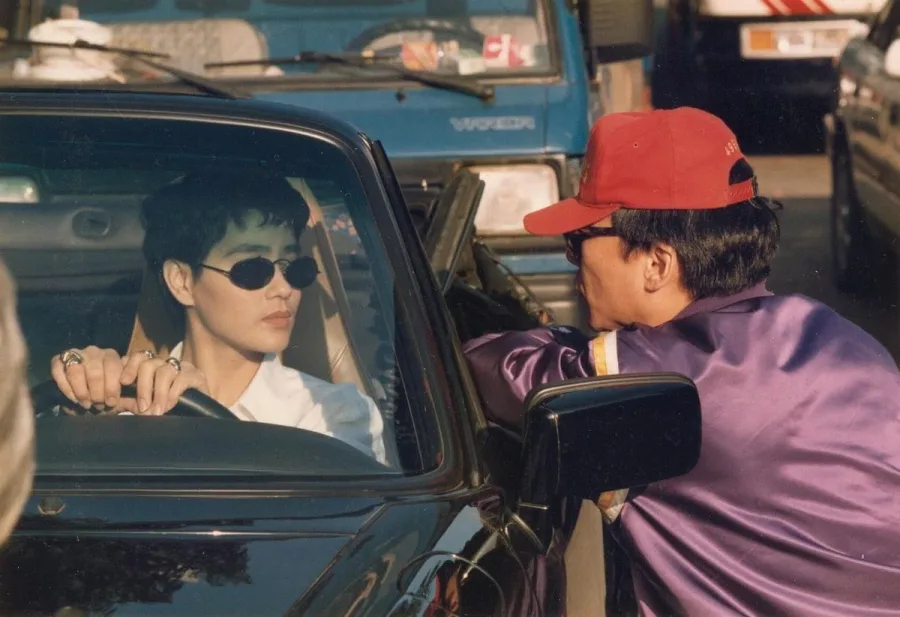
Yang visualizes their instability through the direction of urban space. Particularly impressive are the recurring scenes inside cars. The characters are placed side-by-side at an extremely close distance—the positional relationship of the driver's seat and the passenger seat. However, their gazes are directed forward, and they do not look at each other's faces directly. Although their bodies are close, their gazes do not meet.
The maneuvering between Molly and Larry in the car, and the argument between Qi-Qi and Ming, seem less like words reaching the other person and more like their respective anxieties and frustrations just echoing inside the car. The car is taking them somewhere, but the relationship itself is not moving anywhere. This feeling of "moving but not arriving" is one of the important motifs that runs through 'A Confucian Confusion'.
Similarly, the elevator is also a symbolic space. It appears as a space from which one cannot escape from others who are too close. The physical proximity forced in a narrow box draws out frustration and aggression rather than intimacy. Proximity itself is violence.
Yang uses urban infrastructure like cars and elevators not just as background, but as effectors that amplify quiet violence. The urban space itself defines the nature of their relationships.
What is interesting is that the use of space is never explanatory. Yang does not go out of his way to have characters say propositions like <the city makes people lonely>. Rather, he hints at it cinematically through the arrangement of places like glass, windows, hallways, offices, cars, and elevators.
Also, in shots that capture characters through large window glass, they appear to be in the same space, yet they look as if they are trapped in separate worlds. The open urban landscape visible from the high-rise office also functions not as a symbol of freedom or transparency, but as an unstable place constantly exposed to the gaze of others.
Meanwhile, in scenes where the characters quietly speak their true feelings, the figures are often captured as silhouettes against large windows. With their backs to the light, the figures lose their expressions, becoming nothing more than black outlines and voices. In bright places, they wear the roles of managers, fiancés, lovers, and friends, manipulating words fluently. But the moment their faces disappear, the performance of their roles peels away.
What is being shown is the paradox that truth emerges not through 'being clearly visible,' but rather through 'becoming invisible.' The naive belief that we can get closer to the truth the more information we have does not hold up in the dark. In fact, it is precisely because there is too much information that we lose sight of our true emotions. When expressions vanish and only outlines remain, the raw loneliness finally appears.
Women being watched — Molly and Feng
The message that being stared at intently makes a person unstable is clearly expressed in the contrasting characterizations of the two women, Molly and Feng.
Molly appears on screen as a beautiful, lovely, and universally loved presence, with a hairstyle and makeup reminiscent of Audrey Hepburn in 'Roman Holiday.' While working behind the scenes, Molly is exposed as a model for TV commercials, and beyond her own will, she is reclaimed as the ideal image of a woman demanded by the city.
In contrast, Feng, who wants to make it as an actress, is more active. She attracts powerful men, sometimes toys with them, and even exudes an air of a femme fatale, all while trying to climb to the 'side being watched' at any cost. However, no matter how hard she tries, her dream rarely takes shape. She seems unable to grasp whether she is using the men or being used by them.
That instability is also reflected in how Feng is filmed. For example, in the scene where she sneaks into Birdy's rehearsal space, her view is finely obstructed by the stage sets, and Feng only appears flickering in the narrow, slit-like spaces, never being presented as a continuous image of her whole body.
What is important is that she is not simply hiding here. In other words, Feng is not placed outside the gaze, but is fragmented within it. This way of filming, where she never appears as a stable, full-body image but only as a series of fragmented appearances, implies that while she is heading toward the 'side being watched,' she is an existence that cannot be fixed as a single, complete image.
An interesting twist occurs here. The innocent Molly becomes a woman who becomes an image against her will, while Feng is a woman who wants to be an image but cannot fully become one. This contrast is interesting because, although Molly and Feng are positioned as polar opposites, both ultimately fail to escape the system of 'being watched,' and both become, in different ways, screens that absorb the desires of men.
However, neither woman is fully understood as a human being. Here, too, there is a disconnect between 'being watched' and 'being understood.' Yang is not consuming women as mere symbols, but rather weaving the very mechanism of such symbolization into the arrangement of the characters.
Birdy and the Lost Confucius
A particularly unforgettable detail in the film is the episode of the once-popular writer Birdy (Wang Yemin). Having lost his popular appeal (his main supporters were female college students) and having produced only esoteric novels (all of which were rejected by his sister-in-law Molly, who is his publisher), he despairs of society and sits on a pedestrian bridge, looking down at the flow of cars. Beneath his feet, a massive number of cars are running incessantly. Whether he lives or dies, the city flows as if nothing happened. He alone is suspended above the flow.
Birdy tries to throw himself off, but in the end, he cannot bring himself to do it. What kept him tethered to this world was not a sublime philosophy of art or a sense of ethics, but an unrequited love for Molly. The embers of this miserable emotion pull him back from the world of the dead to the world of the living.
Furthermore, his love drives Birdy to a reckless confession of love; he is rejected by Molly and chases the taxi she is riding in on foot. The moment Molly, feeling sympathetic, shouts to the driver, 'Stop!', he, who was behind the car, crashes into the taxi. Moreover, the visibly dim-witted driver cannot immediately grasp the situation that he has 'hit' a person who was running from behind.
No matter how noble the despair, just like a scandal that fills the pages of a gossip paper, it does not end while remaining serious, but always flips into a strange humor. That is what urban life is. The cruelty and comedy of 'A Confucian Confusion' are condensed into the character of Birdy.
The film's English title, "A Confucian Confusion", is derived from the title of a play-within-a-play written by Birdy. It is a fable about a Confucius reincarnated in the modern age who, unable to convince anyone that he is the real Confucius, chooses death in despair, only to be reincarnated again. It is a somewhat comical setting, but the overall theme is condensed here as well.
What Confucianism once carried was the order of human relationships and the ethics of how to position oneself within social relations. However, in a highly capitalist society, that order has completely collapsed. People can no longer stabilize themselves within human relationships and have no choice but to repeat the unanswerable question of who they are.
Moreover, the troublesome part is that even the words to answer that question are already contaminated by borrowed language, such as that spoken in advertising business. Even when they try to speak about themselves, the words are not their own. Just as Confucius cannot prove he is the real Confucius, they, too, rely so much on borrowed language that they can never prove they are their true selves.
Still, together with others
The existence of the desire to have others recognize that one is a valuable existence or that one is 'real.' In the intimate sphere of reality, they hide their true feelings, while conversely, outside that sphere, they perform excessive self-presentation. And through temporary empathy or approval, they try to confirm their own existence. But such recognition does not last long. What remains is only another unfillable void—in that sense, Edward Yang's 'A Confucian Confusion' is a surprisingly modern work.
Of course, it might be reckless to simply overlay the layer of social media onto a film that depicts the pre-internet era of 1994. However, what is being depicted is precisely the prototype of the sensations we experience daily in the age of social media. Connections have increased, communication has become easier, and the means for self-expression have grown infinitely. Yet, the feeling of being understood only drifts further away. This is because being seen by someone and being understood by someone are entirely different events. Edward Yang saw through this within the urban space even before the internet and social media.
Also, the way humor is handled is likely an important factor. 'A Confucian Confusion' is exceptionally cynical, the dialogue is fast-paced, and the sight of the characters running around in circles is overtly ridiculous. But that humor is not part of the entertainment. Rather, precisely because it makes you laugh, it is hollow and terribly sad.
Like Birdy's pursuit (and collision), they are terribly ridiculous, but it is not someone else's problem at all. Modern people who can only maintain themselves within the gaze of others are—in other words, you and me.
And the place they ultimately arrive at is not overly pessimistic either. Deeply wounded, Qiqi and Ming, at the end of their confusion, let go of their obsession with trying to be someone. There is no great success or dramatic salvation there. They simply accept the lover in front of them as they are. There is a faint hope in that.
What is true happiness for a human being? To understand that, it is not about polishing the self in the mirror, but touching the body temperature of the person next to you that is important.
Having said that, Yang is not unilaterally praising the lost ways of old communities or aesthetics and preaching that we should return to them. In a world where perfect mutual understanding is impossible, he explores the minimum rules for continuing to engage with others nonetheless.
There is love. There is conversation. There is work, friendship, desire, and goodwill. But these do not directly lead to heartwarming relationships between people. Even though we are connected to so many others, we know so little about them. In fact, the more connections increase, the more the impossibility of understanding intensifies. That is likely universal in any society of any era. That is precisely why this film is not only a portrait of 90s Taipei, but also a portrait of ourselves in the 2020s.