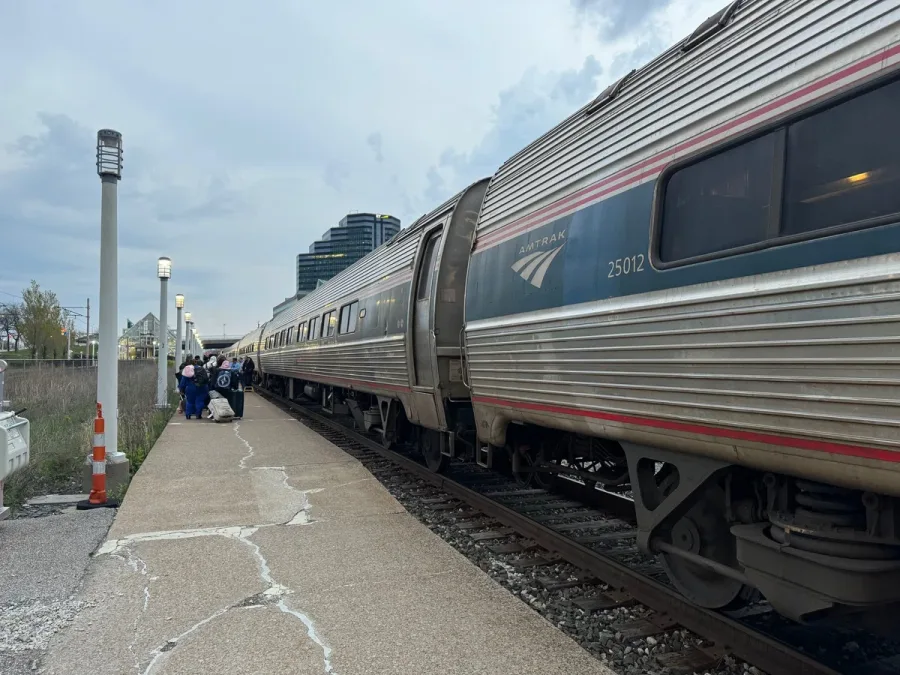
traverse

- Pronunciation, Meaning, Etymology, Example Sentences, and Collocations -
A thorough explanation of Eiken Grade 1 and TOEIC 900 level vocabularyThe word we are covering this time is traverse.
It is often translated as "to cross," but if you learn it only as that, it is difficult to master in actual English. This time, I will thoroughly explain the "core" of this word, which appears widely from travel and nature to academics and IT.
Basic Information
Pronunciation: /trəˈvɜːs/ (verb) / /ˈtrævɜːs/ (noun)
Part of Speech: Transitive verb, noun (countable)
Category: Movement > Crossing > To cross from one side to the other of a wide area or difficult place
Takes an object directly as a transitive verb
✗ traverse across the desert
○ traverse the desert
across is already included in the meaning of the word, so adding it makes it redundant.
The object can be a desert, mountain range, ocean, country, or other wide places that are not easy to cross.
And the subject is not limited to people.
A bridge traverses the river. (A bridge spans the river)
A road traverses the valley. (A road crosses the valley)
It is also characterized by being able to be used for states where a structure extends across a location.
Vocabulary Level Data
CEFR: C1-C2
Zipf Frequency: approx. 3.0
Frequency Rank: approx. 22,000th-28,000th
Corpus Usage Areas: Travel, Nature, Geography, Academics, IT
Register Level: formal to literary
Frequency by Genre:
Travel/Travelogues
Geography/Natural Sciences
Literature
IT/Information Science
Daily Conversation
Original Meaning
Latin transversus (turned across, lying across)
trans- (across, to the other side) + vertere (to turn)
Same etymology as transverse (crossing, lying across)
To turn and cross → to go from one end to the other
Expansion of Meaning
To turn and cross
↓
To cross a wide area from end to end
↓
To traverse difficult terrain
↓
From crossing deserts to traversing mountain slopes, covering topics, and scanning data structures
Not just 'to cross,' but 'to traverse from end to end'
cross (to cross) = to go to the other side (everyday and regardless of distance)
traverse = to pass through a wide and difficult place from end to end
Roads cross, but what you traverse are deserts, continents, and mountain ranges.
✗ She traversed the street to buy coffee. (Exaggerated)
○ The expedition traversed the ice sheet in forty days.
And this sense of passing through the entirety also applies to metaphors. traverse a wide range of topics (to cover a wide range of topics), or in IT, traverse a tree (to follow all nodes in a tree structure)—both refer to passing through every single one.
First, the conclusion
With only the translation 'to traverse/cross,' you cannot see the scale and difficulty or the metaphorical usage of 'to cover/comprehend'.
Core image: A traveler walking all the way to the other side of a desert that stretches to the horizon, leaving footprints—not just crossing to the other shore. They passed through the entire expanse.
This is the essence of traverse.
Remembering with Kanji
Wide-range difficult-place end-to-end crossing; not just crossing, but traversing the entirety
Collocations
Movement/Travel
traverse the desert (cross the desert)
traverse a mountain range (cross a mountain range)
traverse the continent (cross the continent)
traverse difficult terrain (trek across difficult terrain)
Structures
a bridge traverses the river (a bridge spans the river)
a road traverses the valley (a road crosses the valley)
Metaphor/Academic
traverse a wide range of topics (cover a wide range of topics)
traverse centuries (span centuries)
IT
traverse a tree (scan a tree structure)
traverse a list (follow a list in order)
Phrases to learn as a whole
traverse the globe (travel around the world)
traverse the length of... (cross from one end to the other)
a book that traverses three centuries (a book that spans three centuries)