Note: This article contains spoilers for "Sakura no Uta -Dancing Under the Cherry Blossom Forest-" and "Sakura no Toki -Walking Under the Cherry Blossom Forest-" by the game brand Makura. I believe you will definitely enjoy it more if you go in blind, so I would appreciate it if you read this after clearing the games.
Also, this article covers the content up to the point of clearing the main story of "Sakura no Toki -Walking Under the Cherry Blossom Forest-." Therefore, I have not yet read or listened to the novel "Frozen July Sky" or the drama CD "Rin and Shizuku's Mouth to Mouth," which are included as initial bonuses. It would be helpful if you could read this assuming those contents do not exist.
Honestly, the PV might also contain spoilers, but the visuals and music are indescribably well-made, so I recommend watching it if you haven't. To be honest, this PV was what led me to buy this series. The music was so good that I bought the previous work, which led me to clear this work, "Sakura no Toki."
Now, from here on, there will be spoilers. Please be careful.
About each chapter
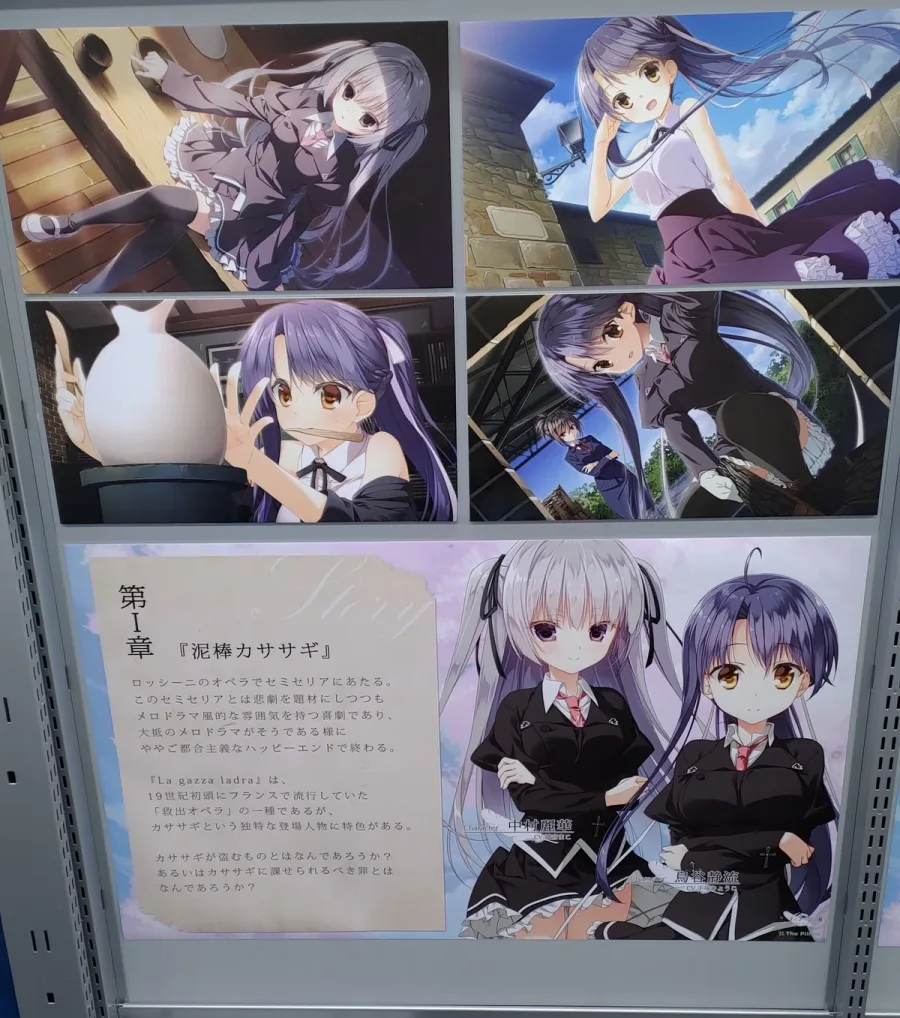
"Sakura no Toki" begins with a bright voice saying "Welcome." Since the trial version had been distributed for over a year before the product version was released, I wondered what kind of story it would be (considering it's a continuation of the previous work, it wouldn't be interesting if it only let you play the beginning), but the structure was convincing once I started playing. It introduced the fact that Naoya, who everyone is curious about, is continuing his daily life as a teacher, and the story focused on Shizuru-san. Chapter I is a fairly independent story, focusing on Shizuru and Reika Nakamura, centered around the snow-viewing magpie vase that also appeared in "Sakura no Uta." It is well-made as a trial version; it is interesting enough even if you only read this part, and for players who have played the previous work, it is designed to introduce the evolved sound and visuals without touching on the main story of "Sakura no Toki" much. In addition, naturally, playing "Sakura no Uta" is essential to enjoy the main story, and it is a clever two-stage trial version that introduces "Sakura no Toki" without spoiling the developments of "Sakura no Uta" too much.
Furthermore, this is quite a good story, and the "hateful" Kenichiro Kusanagi takes all the good parts. He is seriously too cool.
Also, at the time of clearing Chapter I, I thought, "Oh, I see. It's depicting the past of the Nakamura family in a way that doesn't really relate to Chapter II and beyond," but that was not the case at all, and it gets heavily involved in the Toritani route in Chapter III. I was completely dancing in the palm of SCA-ji's hand.
The story from Naoya's perspective starts here. You could say this is the actual start of the main story. The Yumihari Academy Art Club is revived. And the encounter with the new heroine, Kokoro Honma, who appears from this work, is depicted. There is some bustling around with Naoya and the art club members, making it a fairly peaceful story typical of an erotic game. Developments that serve as preparation for future events continue, and after showing the CG used in the PV where they hold hands in front of Kei's "Sunflower," it leads to the opening.
"Toki to Uta," it's the best no matter how many times I listen to it. I want to hear the full version soon.
From here on, choices appear here and there, hinting that the story will branch. Honestly, I was surprised that there are two bad endings (though they might not be strictly bad endings). In the previous work, no matter what you chose, you entered some route, so I wonder if this means that depending on the choice in this work, Naoya becomes a weakling. I wanted to start from the part that seemed least related to the main route, so I played in the order of Toritani route -> Kokoro route.
Toritani's story is like an "if" story that depicts what would happen if you hadn't entered the Toritani route in the previous work, and for the player, it felt like a scenario that felt a tinge of loneliness because the adventure of going to get Yumihari glaze with Naoya was gone.
Also, the development where she doesn't get involved with art directly as an artist, but indirectly as a reporter, and that bears fruit, was good as a reinterpretation. Although there were various reasons, Naoya's classmates do not become romantic interests in "Sakura no Toki," and only Toritani has a route prepared, and on top of that, she has the most CGs, so I think people who like Toritani were in bliss.
The confession scene at the station was also incredibly good, and I was paralyzed by the coolness of Naoya, who was more adult than ever, along with my inner retort of "How much Yumihari glaze are you using to make an engagement ring?!" You will definitely fall in love.
Next is the Kokoro route. At first, she seems to have a wall up even towards Naoya, and it's hard to grasp what kind of character she is until Chapter II, but from around here, her inner self begins to be depicted firmly.
She is a good girl from beginning to end, and when I found out who the person she called her master was, I thought, "So that was it..." and the scene where Nei says "It was Kokoro who killed Kei" was the most shocking scene in this work, partly because I remembered the content written at the end of the previous work.
And the confession scene. Extremely beautiful. That scene where they clash their feelings against the backdrop of the sunset is full of direction that can only be depicted in a visual novel, and it was a scene where the voice actor's acting ability and the beauty of the visuals were at their peak.
I was also nervous when the two of them greeted Reijiro Honma.
And by choosing a different option, it leads to Chapter IV, where Ai-sensei is murdered in the end.
Chapter IVThe first impression of the beginning of Chapter IV, which starts from the moment Kei had the accident, was the thought, "Oh, it has begun." Kei's birth, what happened at that time, the efforts of the principal and Toritani. Kei's growth, his encounter with Kenichiro, his encounter with Naoya, his encounter with Ai. And his encounter with Kokoro, which neither Naoya nor the player knew about. And what did he think on the verge of death?
I don't know how much of Kei's past was thought out at the stage of the previous work, but Chapter IV, which depicts the backbone that was not depicted in "Sakura no Uta" while boasting an extremely high degree of perfection and connects to this work, felt like the biggest highlight of this work.
The end roll flows from top to bottom, even though the scroll direction had been from bottom to top until now. Lyrics of "Toki to Uta" that I didn't know. It was so sad that I couldn't close my open mouth. The direction that makes it feel like sinking to the bottom of despair is the best and the worst.
Chapter VFrom here, the mysterious number "17,186,400" is displayed, and although I didn't understand it well at first, I understood again that it had begun to "tick" time, also because the title is displayed again at the beginning of Chapter V.
Naoya, who was burdened with debt by Hōsai Onda, begins to walk again, but the story is quite heavy.
However, even so, he begins to walk step by step, and the confrontation with Kokoro, Hikawa, Nagayama, and Rin begins.
It feels like a farce with Kawachi-no and Hikawa, and here Akashi and Thomas also appear, but in reality, half of it is a farce by Friedman, and I realize Nagayama's efforts and that Naoya has begun to move as an artist.
There are many points to talk about, such as the scene where Naoya holds a brush in his right hand and the scene where he is given a lap pillow by Ai, but what surprised me was the scene where Naoya gets a voice.
Since I hadn't watched character introduction PVs to avoid spoilers as much as possible, I was quite surprised by the scene where Naoya suddenly gets a voice.
Honestly, there might be negative opinions about this point. However, because of the existence of the line "Kei! I have never, not even for a moment, forgotten you!" where he pours out his thoughts on Kei, I think from the bottom of my heart that "it was good to have a voice." And it leads to the following part, "Go, Hero."
And finally, Naoya Kusanagi's painting is completed.
The end credits begin with the drawing of a swallow that was depicted at the end of Chapter IV and scroll upwards.
Chapter VIThe epilogue, which depicts several years later, begins. I was genuinely happy that they wrote an epilogue, as it wouldn't have been strange for the story of "Sakura no" to have concluded perfectly at this stage.
The final CG, which serves as a counterpart to the ending of "Sakura no Uta".
Although Iru is the child of Naoya and Ai-sensei, her eyes are slightly different from theirs.
From a somewhat meta perspective, normally the character design for Iru would be handled by Kagome-san (who handles Ai) or Moto4-san (who handles Naoya), but they deliberately chose Inukira-san. Although it should have been a scene that felt out of place, it became a final CG featuring characters created by the three people who have worked on this series, and combined with the scene itself, it makes for an extremely moving conclusion.
In addition, a stylish ending was prepared for the credits, using "Sakura no Uta," the main theme of "Sakura no Uta." The graduation ceremony-style staff roll with names scrolling horizontally is, as in the previous work, excellent. Since Chapter VI focused on the aftermath of the characters who appeared in the previous work, the characters who were not depicted were also filled in here, and I felt once again that it had truly come to an end.
Regarding Visuals and Sound
The significantly evolved visuals in this work are also a point that cannot be overlooked. Various ideas regarding "beauty" are expressed in the story, but I think the beauty of the backgrounds and CGs in this work was particularly outstanding. There were already many realistic scenes, but I have the impression that they have been polished even further. I think part of it is that the resolution has become Full HD, but the way the sky (clouds and stars) is drawn and the cherry blossoms blooming at Yumihari Academy have become quite beautiful, and Chapter I in particular had many surprises.
Also, it is definitely a very happy point that the art pieces created by each character were prepared as CGs in this work. The "Snow-viewing Magpie Vase" that appeared in the previous work was beautiful enough to make me stare at it, and the scene where the "Sakurabi Kyousou," which is also the MacGuffin of the work, appears drawn more vividly, made me feel deeply moved. In addition, it should also be evaluated that the art style was clearly divided according to the character, such as Hikawa's paintings (which look 3D?), which give a sense of eeriness.
By preparing these, it is possible to make each scene more impressive, and above all, it creates persuasiveness. After all, the sheer size of Naoya's final painting, which he begins drawing from the start of Chapter V, made me wonder, "What is going to happen from here on?" and it plays a major role in highlighting the climax of this work.
And as for the sound, it is no exaggeration to say that it is the best among the visual novels I have played so far. Starting with vocal tracks like the opening and ending themes, the number of songs and the quality of the background music are extremely high. The music for calm or lonely scenes is particularly wonderful, and I feel it matches the worldview of the entire work very well. Also, songs used in the previous work are adopted within the game, which stirs up emotions significantly.
Personally, perhaps because they are used often in the story, I feel that "4. The Scenery Flickers Hastily" and "26. Outside the Cocoon of Time" match the beautiful CGs and backgrounds of this work very well.
Particularly Good Characters and Slightly Disappointing (Lonely) Points
In evaluating "Sakura no Toki," what cannot be overlooked is the acting ability of the voice actors who play each character.
The acting in emotional scenes, such as shouting lines, was good for:
・Naoya, Kei, Nagayama, Shizuru-san, Reika, Houzai Onda, Kokoro, Nei
Despite about 8 years having passed since the release of the previous work, the ones who showed acting that didn't make you feel that were:
・Kei, Rin, Toriya, Ai, Kenichiro, Principal, Friedman, Suzuna
There were really many good scenes. The point that was particularly good was probably the interaction between Naoya and Kei. Although it is a scene where their voices don't reach each other, that is precisely why the scene where they both put their emotions into it and express their thoughts was good.
Also, when Rin first appeared, her voice had become mature, and I felt lonely, thinking, "Ah, she has changed." However, in the conversation between the two after Naoya finished the painting just before the end, only the line "Yeah, I think it's amazing, Nao-kun" was in the voice tone of the old Rin, and I felt the greatness of the voice actor.
I will also mention a few slightly disappointing points.
If I were to be greedy, I would have liked to see Kokoro's painting, Nagayama's painting, and Rin's painting when they fought at the event hosted by the Moore Foundation at the end in a larger size. However, that scene is a situation where a relative evaluation cannot be made by deciding victory or defeat with paintings, and there are times when it is inconvenient to show the paintings, so I think it couldn't be helped.
Also, while almost everyone was depicted as a good guy in the previous work (although there was Chapter I), I think it was a bit of a waste that Reijiro and Houzai were brought up as villains until the middle of this work. It is amazing that the previous work was able to depict almost all the stories with good guys while having that many characters.
Also, it was lonely that Rina's voice actor changed and that Shizuku's appearance scenes in the main game were quite few. The former was a lonely point that couldn't be helped, especially since I felt a sense of discomfort as soon as she appeared.
Regarding Points I Laughed At or Noticed
Since I cannot paste images here, I will pick up some good CGs and comment on them. I will also summarize points that I was curious about in the work. I hope you read this, laugh, and empathize. I'll keep it loose!
・First, the main visual. At first, I didn't notice it at all, but when I looked at the material collection, I thought, "Is someone on the right?" and when I enlarged it on my PC, Kei was there! I looked forward to it so much and went to the official page many times, but I didn't notice it at all. I was so surprised that I let out a voice.
・The scene where Suzuna and Rurio get on the train. I was thinking about trivial things like, "Why are they standing when the train is empty?" but it was to lead to the scene where Suzuna gets affectionate! I was caught. In the first place, I laughed because Rurio was staring at me from the gap in Suzuna's arm at the CG stage.
・The scene where the new Yumihari Academy Art Club gathers in front of Kei's painting. It was also used in the PV, and it's incredibly good~. And after this, the opening plays, and I get hyped up.
・The scene where I go to the amusement park with Suzuran and confess my feelings. It's beyond words, truly the best. Plus, there are so many facial expressions, and it's even better to see Suzuran, who is usually relatively calm, lose her composure. The CG depicting the two of them as shadows is also great.
・The scene where I walk home with Toritani after the downpour. This is also used in the PV and such, but it is extremely beautiful. Along with this, the scene where we look at the moon and talk at the mansion, and the confession scene at the station are the biggest highlights of the Toritani route. They were all wonderful!
・The scene where Kei watches Kenichiro repair his motorcycle. This is also one of the scenes where Kei gradually opens her heart through Kenichiro, and it was great. This background is used in the game's settings screen, and I personally like this one quite a lot too.
・The scene where Kei and Suzuran sit and draw together. The beauty of the sunset is depicted in the CG to the fullest extent. It is one of the scenes that symbolizes the high quality of the CG in "Sakura no Toki".
・The scene where Kei and young Suzuran watch the osprey. Personally, this might be my favorite CG in the entire game. It's just so good. Kei looks so mature, and if it were possible, I would love to see the interactions between adult Kei and Naoya.
・The scene at the Miyazaki Art School where Naoya sits in Zazen and paints. The intensity when his eyes light up is off the charts. It's so cool! Also, as I mentioned before, the scene where he holds the brush in his right hand is truly cool.
・Finally, about Iru's name. At first, I wondered why it was a name that didn't sound very Japanese, but when I realized it was in alphabetical order (J→K→L→M...) because it comes after Kei (K), I couldn't help but exclaim, "So that's what it is!"
The Significance of "Sakura no Toki -Walking Under the Cherry Blossom Forest-" as a Game
Finally, I will evaluate how "Sakura no Toki -Walking Under the Cherry Blossom Forest-" fared as a game.
Honestly, personally, I feel that the previous work, "Sakura no Uta," had a higher level of perfection, such as in its skillful use of foreshadowing. However, this work adopted a relatively linear structure, significantly evolved in terms of visuals, sound, and direction, and took a longer time to carefully depict "what is happiness" for each character.
The story, which centers on Kei's past that was not depicted in the previous work, could not fail to strike a chord with those who played the previous work, and it was also an extremely painful work to play as it required facing the unchangeable fact of Kei's death.
In fact, it goes without saying that in the reality we live in, it is easier to live by looking away from painful events, just like Naoya at the beginning of the story. But even so, Naoya picks up the brush and confronts them. That figure was moving, and that scene where he "held the brush in his right hand" was the moment that Kei, Rin, Toritani, and not just the other characters, but all the players who played the previous work had been waiting for.
In the previous work, "Sakura no Uta," the final conclusion was about "what is happiness" based on the differences in how one thinks about art. If I were asked "what is happiness?", I wouldn't be able to answer immediately either. However, that scene at Natsume's mansion that you reach after about 40 hours of gameplay. When you hear the conversation between a drunk Naoya and Ai, you realize once again, "That's what happiness is," and "That's what life is." And then, the scene where Naoya and Ai start walking side by side wraps it up beautifully.
On the other hand, I feel that this work, "Sakura no Toki," does not explicitly depict a clear question or a concrete answer to it. This is because the biggest climax of this work is the scene where Naoya puts the final stroke on the burnt painting, and the process (life) leading up to that point holds extremely important meaning. Naoya's efforts, and by extension, the efforts of Ai, Kenichiro, Rin, Shizuku, Toritani, Hikawa, and the rest of the Yumihari Academy Art Club, as well as the principal and Suzuran, complete a single painting and make it bloom. It creates a miracle where cherry blossoms and sunflowers, two flowers that do not bloom in the same season, bloom in splendor.
Of course, this work is fiction, and the player reading the story is not a party involved. But the total of 70 hours spent walking through the perspective of Naoya, the protagonist of this work, creates an irreplaceable emotional experience. By not being objective but by standing close to the story, thinking, and feeling, the beauty called "Sakura no Uta / Sakura no Toki" reaches out to you. Incorporating direction that can only be done in a visual novel and creating an experience that cannot be achieved by other media, "Sakura no Toki -Walking Under the Cherry Blossom Forest-" is undoubtedly a masterpiece.
In Conclusion
I would like to conclude this review by leaving a personal wish. As SCA-ji, the producer of this work who handled the scenario, mentioned on his own note, he introduced that he will release "Sakura no Hibiki" in the future, so I will look forward to that day. Basically, it seems like it will be an append disc-style position that includes routes for the art club members such as Sakurako, Rurio, and Suzuna, as well as Nagayama, who had some meta-dialogue in the main story. (I'm a fan of Kuriyama-kun, so I'm really looking forward to its release!)
Also, the soundtrack. The soundtrack that I want so badly. Even while writing this, I have "Sakura no Toki" running in the background listening to the BGM, that's how much I want it soon. Maybe the summer Comiket? I hope I can buy it~ (Actually, I also want the official visual book, but since some parts are already covered by the first-run bonus, I have a feeling it might not be released, so I won't get my hopes up too much. But I want it! VFB! If it comes out, I'll definitely buy it!)
If you have any comments or opinions regarding the settings in the game, I would be happy if you could leave them. Well then.