1. Introduction
Hello everyone! This is Eigo Manabu-kun. Thank you for always watching my YouTube channel.
Have you ever had the experience of not being convinced even when a native instructor tells you to 'just learn it by feel'? That is only natural. This is because many of them do not understand the filter of Japanese grammar (kokubunpo) that we Japanese speakers possess. In the video I released the other day, '[English Beginners] The Difference Between Be Verbs and Action Verbs,' I emphasized exactly this point, namely the importance of understanding English from the perspective of Japanese grammar. In this special lecture, I will delve deeper into that way of thinking, answer the fundamental 'why?' questions you have head-on, and transform mere knowledge into 'actually usable skills'.
1.2. Why is this difference the 'most important point' in English learning?Why is the difference between 'be verbs' and 'action verbs' emphasized so much? It is because this distinction is the absolute foundation for constructing English sentences.
The mistake that beginners in English learning fall into most easily is inserting an unnecessary be verb between the subject and the action verb. Many academic studies have pointed out this tendency, and the error appears in various forms.
I am play tennis.
She was watched television.
*Tom is play the guitar.
Some of you might have looked at these sentences and thought, 'What is wrong with them?' However, these are serious errors that deviate from the basic logic of English. This is not just a careless mistake, but proof that you are fundamentally confusing the roles of the two verbs.
Mastering this difference is not just about memorizing one grammar rule. It is the first and most important step to understanding the logic behind how English sentences are formed. Unless you overcome this hurdle, no matter how many words or phrases you memorize from here on, you will only be building unstable knowledge like a castle on sand.
1.3. By reading on, you will...Do you ever have the experience of 'knowing the rules vaguely, but when it comes time to speak, I get confused about which one to use...'?
Please rest assured. By reading this lecture to the end, you will not only memorize the rules, but also grasp the first step toward a 'native intuition' that allows you to intuitively judge which verb to use. You no longer need to rely on guessing. You will be able to construct accurate English sentences with confidence.
By reading further, you will acquire skills you can actually use.
--------------------------------------------------------------------------------
2. Main Text
2.1. The Grand Principle: Does it express 'movement' or not?When you are confused about whether to use a be verb or an action verb, there is a simple and powerful first step to return to the basics. It is the perspective of whether the verb expresses a 'concrete movement (action)' or a 'state without movement'. This single question should help resolve most of your confusion.
Key Explanation: Two Groups of Verbs
-
Based on this principle, let's divide English verbs into two main groups.
-
General Verbs: This is a group of verbs that express specific actions or movements . Many can be translated as "to do" in Japanese, and they refer to visible actions or mental activities.
Example: play, run, eat, study
Be-Verbs: These are verbs that do not include specific actions but express a state or existence . They serve to explain "what state the subject (S) is in," "what it is," or "where it is." They correspond to the Japanese meanings of "is/am/are" (state) and "exists/is located" (existence).
-
NG Examples and OK Examples: Mistakes You Must Never Make
Once you understand this basic principle, it becomes clear why the mistakes many beginners make are indeed "mistakes."
NG Example: I am play soccer.
OK Example: I play soccer.
Now that the basic principles are clear, let's look at how this difference affects the actual structure of sentences, especially in the formation of 'negative sentences' and 'interrogative sentences.' Understanding this will dramatically expand your range of expression.
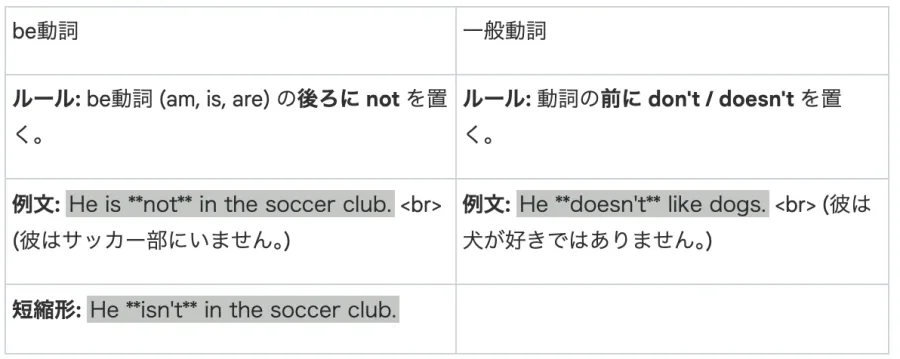
2.2. A Thorough Comparison of Sentence Construction! Rules for 'Negative Sentences' and 'Interrogative Sentences'The decisive difference between be verbs and action verbs lies in the fact that the rules for forming negative sentences (is not...) and interrogative sentences (is it...?) are completely different. It is the key to developing application skills not just to memorize these rules mechanically, but to understand 'why they are different.'
Point Explanation: How to form negative sentences
Point Explanation: How to form interrogative sentences
As you can see, the sentence structure itself is fundamentally different. A be verb performs its grammatical role by changing itself, such as moving to the front of the sentence or adding 'not' after it. On the other hand, it is easy to imagine that an action verb does not move itself, but instead calls in a 'helper (auxiliary verb)' like 'do' or 'does' to help with the work of negation or questioning.
These rules are the very mechanism of English. However, to acquire a deeper native intuition, you need to look at the 'nature' of the verbs themselves.
2.3. Getting Closer to Native Intuition: The Concept of 'Stative Verbs'This is the core part of this lecture. I will share a very important point that many Japanese learners fundamentally misunderstand. When many learners hear the word 'verb,' they are unconsciously drawn to the kanji character '動' (move) and think of it as 'movement.' However, to understand the true classification in English, you first need to reset this way of thinking.
In fact, the rules we have seen so far—whether it is 'movement' or 'state,' and the 'difference in how to form negative and interrogative sentences'—all come from this more essential classification of 'Action Verbs' and 'Stative Verbs'. The true distinction in English is not a simple binary opposition of 'be verb or action verb.' The key to unlocking everything is the perspective of whether 'the verb describes dynamic actions involving change or continuity' or whether it describes 'static states such as emotions, perception, or possession.'
Point Explanation: The true classification of verbs
-
English verbs can be organized as follows.
-
Verbs
-
Stative Verbs: Verbs that express states, emotions, possession, perception, etc. Because they describe mental states or situations, they generally cannot be used in the progressive form (-ing).
Examples: be verbs (am, is, are), like, know, want, have (possession), believe
-
Action/Dynamic Verbs: Verbs that express physical or mental 'actions.' Since actions have a beginning and an end and the process can be described, they can be used in the progressive form (-ing).
Examples: run, study, eat, play, think
-
-
NG examples and OK examples: The rule for the progressive form '-ing'
-
The most important rule in this classification is that "stative verbs are not used in the progressive form." This is because the state of "knowing" is not an action currently in progress.
-
NG: I am knowing the answer.
OK: I know the answer.
-
NG: She is wanting a new phone.
OK: She wants a new phone.
-
NG: I am liking chocolate ice cream.
OK: I like chocolate ice cream.
-
This rule seems clear, but in reality, some verbs can cross this boundary. Next, let's look at those advanced cases.
2.4. Advanced Level: The "Two Faces" of a Single VerbIn English, there are special verbs that can play the role of both stative and action verbs. The meaning of these verbs changes depending on which role they are used in. If you can understand and properly use these nuances, your English will become more natural and expressive.
Point Explanation: Verbs that Change Meaning Between 'State' and 'Action'
Let's check the 'two faces' of representative verbs in the table below.
As you can see, even the same word can be used in completely different ways depending on the context. Once you can make this distinction, you are no longer a beginner.
Now, let's test your skills with the following practice problems to see if you have truly mastered what you've learned so far!
3. Practice Part (Test + Answers)
3.1. Comprehension Check TestProblem 1 (Rearrangement): Rearrange the following words to complete the correct English sentence. ( he / does / sports / like / ? )
Problem 2 (Multiple Choice): Choose the most appropriate word to fill in the ( ). She ( is / does / am ) not a student.
Problem 3 (Error Correction): Correct the error in the following sentence. I am know him very well.
Problem 4 (English Composition): Translate the following Japanese sentence into English. 'She is making lunch now.'
-
Answer: Does he like sports?
Explanation: 'like' is an action verb. For interrogative sentences with action verbs, place 'Do' or 'Does' at the beginning of the sentence, following the word order 'Does + subject + base form of the verb'.
-
Answer: is
Explanation: Since this is a sentence expressing a 'state' meaning 'She is a student', we use a be-verb. Because the subject is 'She', we choose the be-verb 'is'. Since it is a negative sentence, it becomes 'is not'.
-
Answer: I know him very well.
Explanation: 'Know' is a 'stative verb' that expresses thought or perception. As a general rule, stative verbs cannot be used in the progressive form (am knowing).
-
Answer: She is making lunch now.
Explanation: Since it expresses an 'action' currently in progress—'is making right now'—we use the progressive form (be-verb + verb-ing). The be-verb becomes 'is' to match the subject 'She', and 'make' becomes 'making'.
④ Summary
4.1. What We Learned TodayThe core points I wanted to convey in this special lecture can be summarized in the following three points.
Understand English verbs through the essential classification of 'action verbs' and 'stative verbs'.
The differences in how to form negative and interrogative sentences arise from these differences in verb properties.
You cannot use a be-verb and the base form of an action verb in the same sentence simultaneously. It is important to understand combinations that follow the rules, such as the progressive form.
Thank you very much for reading until the end. I hope that through this article, it has been conveyed, even if just a little, that the difference between 'be-verbs' and 'action verbs' is not merely a matter of rote memorization, but the logic that forms the foundation of the English language.
Please try to be conscious of what you learned today in your English studies starting tomorrow. Even if it feels awkward at first, through repeated practice, it will surely become second nature. Of course, do not be afraid of making mistakes. Mistakes are the best proof that you are challenging yourself with something new.
If you have any questions or things you would like to know more about, please let me know in the comments section. Your feedback provides great hints for creating the next video or article.
See you in the next lesson!