[Note] This article is full of spoilers.
Introduction
Hello.
Just recently on March 24th, Resident Evil 4 Remake was released, and Leon is out there making waves in the world. However, I personally am obsessed with the eighth numbered title in the Resident Evil series, Resident Evil Village, which I bought during last year's Christmas Steam sale and finished playing in February. My whole life is basically running a lap behind, so I'm just grateful I was able to get hooked on something, and I'll just keep going at my own pace. This article is one part of that process.
One of the charms of Resident Evil Village is that the personalities of the four lords, who are your enemies, are reflected in their respective living areas. The architecture, worthy of the name Resident Evil, richly implies a history that is never explicitly put into words.
In Castle Dimitrescu, luxurious and sensual furnishings are placed everywhere, and in the atelier, she has self-portraits painted on canvases that reach the ceiling, showing no lack of vanity or display of wealth.
Since the setting is that Dimitrescu herself is not from the village and was given the old castle after adapting to the Cadou, it is charming to see her constantly stooping to avoid door frames designed for average-sized humans. That gesture might indicate that for her, this castle is not a place that "truly belongs to her," but rather a base for "illegitimately acquired power."
In Moreau's living area, the water mill and the dam lake, the buildings themselves barely function. Power lines for managing the sluice gates run over the abandoned, barnacle-covered houses that once stood there, but maintenance doesn't seem to have been done properly; the crank for operation breaks, and once you restore it, dangerous high-voltage sparks fly everywhere. The way the buildings are decaying everywhere, and even his own clinic, which he seems to have used even after adapting to the Cadou, is flooded, is painful to see, as it reminds one of the process by which his movements on land became increasingly difficult.
I get the impression that Heisenberg's Factory grew by following the textbook cycle of manufacturing: investing profits into equipment, and using that equipment to generate more profits. The entrance is a garage where you'd keep farm equipment, and thinking that this is where he started up, I am impressed by his management skills. However, the footing is bad, the cords are left crawling on the ground instead of being covered, and the handrails are wobbly, making me want to shout, "Workers' compensation is fair game!" He has no intention of taking care of his employees. It's a map where you'd rather have a helmet than a gun.
However, in this article, I will write about the second mid-boss in the game, Donna Beneviento's home, "House Beneviento". House Beneviento is a stage that places weight on psychological horror, and it is highly praised as the "scariest in Resident Evil history," having planted trauma in many players. However, I have been captivated by this building. Even looking at the building area alone, the Beneviento house is less than one-eighth the size of Castle Dimitrescu, but the objects placed in the map, from the spools of thread to the fireplace and the way the walls are peeling, make you feel a delicate story and history, radiating an intense charm.
House Beneviento seems to be alive, with every move of the people who spent time here soaked into it. Wherever I look, memories blow in like a storm, and I am enchanted. Even though what I see are imaginary still lifes set up in a virtual space, countless non-existent memories are awakened in my heart as I look at the silent items. The game creators who made this map are truly wonderful.
The owner, Donna, only speaks two words in the game, and the number of lines for her energetic partner Angie is by no means large. If you want to know them, I think their house speaks more eloquently of their character than they do themselves.
This article is a memorandum of my attempt to understand the mysterious characters, Donna Beneviento and Angie, even a little, through exploring House Beneviento. Speculations that have little to do with the architecture are written in the article below.
It's almost like a collection of impressions, but I would like to add updates or citations if I discover anything new, come up with hypotheses, or find other people's interpretations that open my eyes, using this article as a pivot.
As of March 29th, when I posted this, I have cleared the story twice, and I have bought the DLC "Shadows of Rose" but haven't played it yet. I will add more if I make new discoveries in the future. Also, I would be very happy if I could get opinions from other players like, "Isn't there this kind of interpretation too?"
Above all, everything I'm writing about here is just one player's perspective, so I would appreciate it if you could just think of it as "there's that way of thinking too."
Also, the specs of the PC I own are not that high, so the screenshots don't bring out the full potential of the game, but please forgive me.
There is a very big constraint when talking about House Beneviento.
When you defeat Donna, the source of the hallucinations, you can no longer open the door leading to the elevator. Even if you wake up from the hallucinations, the only thing you can check while sober is the green area shown in the figure below. It is unclear whether the other red areas, such as the hallways and rooms themselves, even truly existed. The reason the mystery of House Beneviento is wide and deep is that these red areas occupy most of the map.
To make it easier to proceed with the story, in this article, I will call the green area that Ethan can check even after waking up from the hallucinations the "Real Area," and the other red areas that can only be entered while under the influence of the hallucinations the "Hallucination Area."
Also, the map that can be viewed within the Resident Evil Village game is not made with north at the top. Considering the movement of the sun and the names "West Village" and "East Village," it seems that the top of the map is south. I don't know if the upward arrow of the compass-shaped icon that appears as a cursor on the map points exactly south, but in this article, I will proceed with the assumption that the direction corresponding to the top edge of the map is true south.
In this article, we will go through the rooms of House Beneviento in order. The first part will cover the first and second floors, and the second part will cover the basement floor.
If I can think of hypotheses for questions I have, I have listed them, but for every question, there are potential strong hypotheses such as "Hypothesis 0-1: There is no particular reason," "Hypothesis 0-2: It was just adjusted for the convenience of game progression," and "Hypothesis 0-3: Everything is a hallucination that Ethan saw, and it doesn't exist." However, that would be the end of it, so I will refrain from noting this Hypothesis 0 one by one.
First Floor Edition
First of all, the location is absolutely insane. The sight of a massive waterfall roaring behind an old-fashioned mansion is surreal and cool. While I catch my breath, I also feel a bit put off, thinking, 'It's crazy to build a house in a place like this.' It's not upstream, it's not downstream, it's right next to it!! There is no sense of worldly concerns like wanting to secure water for daily life or using a water wheel as a power source; it is an unconventional, dope construction.
I thought, 'It's like Kegon Falls, you could commit suicide here more easily than going to a convenience store,' but the artwork captions available after clearing the game say:
It is written as follows.
It's a terrifying backstory, but in other words, it's highly likely that Donna's parents in the main story did not commit suicide, which makes me feel a little relieved. This location is a remnant of the initial setting.
The Beneviento house is an aged property, but electricity and water are properly installed. It is thought to have been built in the generation of Donna's grandparents or great-grandparents, and I am quite moved by the impression of a house built by someone with very good taste and who was very strange.
I have never actually been there, but looking at this scenery reminds me of Nageire-do in Tottori Prefecture. It is a building derived from mountain worship and Shugendo, and it is a hall built with concise brilliance as if it were clinging to a cliff.
Such architecture is called 'kake-zukuri' (hanging structure), and Kiyomizu-dera is a prime example, but personally, I feel a similar atmosphere in the exterior of the Beneviento house. It is a place where I would like to see what the landscape looks like in seasons other than winter.
When people encounter scenery that particularly moves their hearts while walking through terrain created by nature, they feel divinity or awe there and have made it a sacred place in various forms. There must be an ancestor of Donna who stood on the cliff overlooking the waterfall, was fascinated by the severity of the land, and decided, 'I will definitely build a house here and live here!!!' I have to say it's a good idea.
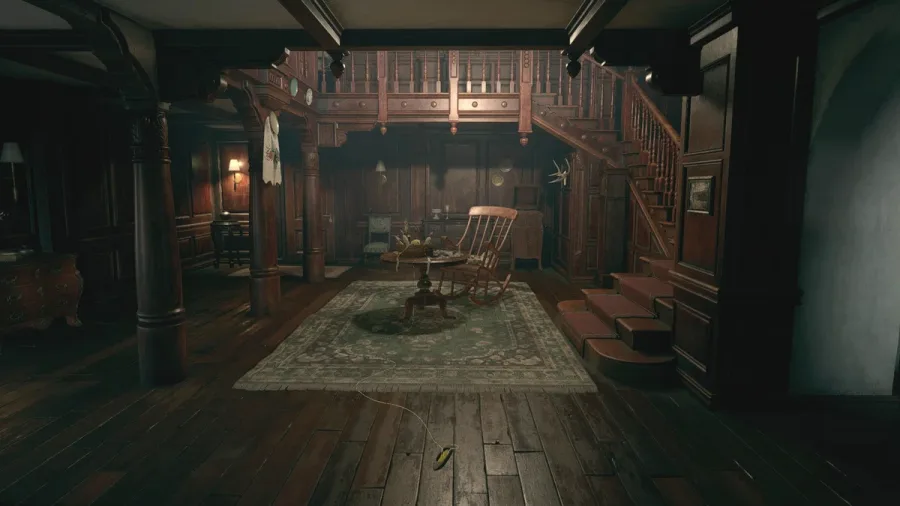
The entrance hall, which is an atrium to the second floor, is filled with a calm sense of daily life, as if the presence of someone who was just sewing remains. With the atrium structure, the shadows created by the eaves-like upper floor passage, and the wooden pillars supporting the passage, it is a wonderful structure that is rich in three-dimensionality and ingenuity, even though it is by no means large.
There is a grandfather clock next to the stairs. Although it makes a ticking sound, the pendulum is not moving, and the time indicated by the hands does not seem to be accurate. It is thought to be placed monumentally as a memento of the family.
There are only two other clocks I could find in the Beneviento house, one in the doll workshop and one on the chest of drawers in the basement corridor, but the times they indicate are actually inconsistent.
Ethan's forced march to rescue Rose is on an incredibly tight schedule,
Before dawn: Arrival at the village -> Morning: Dimitrescu Castle -> Morning: Beneviento House -> Afternoon: Moreau's Lake -> Evening: Heisenberg's Factory
He is smashing the bosses with demonic speed. Ethan is the scariest one.
Considering the timing of the visit to the Beneviento house, the time indicated by the clocks in the basement corridor and the doll workshop seems appropriate, but isn't it highly likely that Donna and the others in this house do not live with 'time' in mind in the first place?
An objective standard like time is necessary when making appointments with others, such as meeting people or being hired to work within working hours. Therefore, conversely, for Donna, who lives isolated from others except for Angie, accurate time does not mean much, and such a feeling may be reflected in the deviation of the clocks. I guess she lives a life of quietly making dolls alone, managing the house and garden, playing with Angie, and sleeping when she gets sleepy... I envy her.
◇ Changes after the hallucination is lifted
19 dolls appear.
Behind a cardboard box and a basket full of apples, and past a box with enamel work, you can see a wine press. The enamel box is an object also seen at Castle Dimitrescu and at the Duke's shop.
Hypothesis 1. They used to make homemade wine, but due to the deaths of family members and servants, they lack the manpower, and it is now covered in dust. The barrels on the porch are a remnant of that. The bottles on the dining table are stock made previously.
Hypothesis 2. Lady Dimitrescu forced it on them, saying, 'You should try making wine too,' but they don't want to do such hard labor, yet it would be bad to throw it away, so they have tucked it away.
At House Beneviento, I often see this cardboard box containing fabric with a small blue floral pattern, which can be seen behind the apples in the screenshot above on the right. I have taken to calling this cardboard box the 'homely cardboard box,' but it is an object found not only at House Beneviento but also at the Duke's shop, inside the gardener's house, and on the porch of Leonardo's house. Furthermore, this 'homely cardboard box' is scattered around the Heisenberg factory as well. It is quite a mismatch for the rugged and desolate factory space, but I cannot gauge if it is placed there to hint at something.
On the other hand, there are extremely few cardboard boxes in Castle Dimitrescu. Even in spaces where decoration is not prioritized, such as the kitchen or the dungeon, it is mostly wooden crates and barrels that are rolling around.
It is possible that bringing cardboard boxes into Castle Dimitrescu is a taboo that invites death. Since cardboard boxes are modern and domestic objects, they might be a 'no' according to the aesthetic sense of Dimitrescu, who colors her ancient castle with Rococo tastes. I can smile imagining Lady Dimitrescu pointing at a discarded cardboard box and snapping, 'Who left this here!? Don't ruin the aesthetics of my castle!!'
The cardboard boxes in Resident Evil Village are truly the best. I am captivated by the design of this cardboard box, where the parts that tore when someone tried to carry heavy items in it have been forcibly stuck back together with duct tape. I am enchanted by the subtle realism of the various parts being folded along the corrugated structure inside the cardboard. People who can create things like this in 3D are seriously cool!!
Pots and groceries are hung as if to surround a cute ceiling light, and large baskets containing berries and apples are placed around. It has more of a dining room atmosphere than a living room. There are two empty teacups on the table in the foreground, which makes one think that Donna and Angie were having tea here. The antique ceramic bottle looks like something used to hold alcohol. Is Donna a drinker? It is doubtful whether Angie needs oral ingestion, but when I think that this whole house is the stage for their make-believe play and that they must have had a small, close-knit life, I feel overwhelmed. A corner on the southwest side is like a small reception booth, and there are two teacups here as well. It would be convenient if there were a door connecting the storage room and the living room, but there is no such thing.
There is one doll on the bookshelf next to the door leading to the hallway. Dolls are offered everywhere along the path from the crossroads to Claudia's grave and in the garden, but this is the only doll you encounter from the moment you enter House Beneviento until you reach the doll workshop.
◇ Changes After the Hallucination is Lifted
Dolls appear in this room literally packed into every corner. In addition to the one on the bookshelf that had already shown its face, 29 new dolls appear in the dining booth, and 14 appear in the reception booth. A total of 44 dolls—it is packed tight.
Also, a very concerning change occurs in the closet of the reception booth.
Under the influence of the hallucination, this closet contains a circular can (no label) that seems to contain a video film, and a rectangular can of about the same size. However, when you open this closet after the hallucination is lifted, doll shoes, fabric, and hair are scattered even on the floor at your feet. It is black hair. Is it Donna's...?
Changes also occur in the closet of the guest room, which I will mention later, but I feel that this one, where a different object was visible under the influence of the hallucination, implies a more serious situation. The sight of shoes and hair scattered in this place, far from the workshop, is very ominous.
This is a hallway covered in old-fashioned floral wallpaper. This area already belongs to the "hallucination realm," and after Ethan defeats Donna and returns to his senses, both the door accessible from the living room and the door accessible from the hallway before the entrance hall become locked. During the "hide-and-seek" boss fight, this hallway is a traversable stage, so it is a bit of a mystery why it was specifically sealed off. I would think that the elevator stopping would be enough...
Wondering about this, I looked at the floor plan and became suspicious that there might have been another room at the southern end of the first floor, or that it had become unrecognizable along with the door due to the hallucinations. It's intriguing, isn't it?
House Beneviento has a very well-maintained interior, but the areas with wallpaper are quite damaged. The damage to the walls stands out all the more because the small items are so well cared for.
Hypothesis 1. Replacing wallpaper is a major task that requires moving furniture, so the introverted and lonely Donna and her companions cannot repair it.
Hypothesis 2. They intentionally left it unchanged to preserve the colors and patterns chosen by their family in the past as a memory.
It is not a room, but since it is located between the first and second floors and is a very impressive object, I will dedicate one section to the "Portrait."
This portrait is likely the first thing that gives you a vivid shock upon entering House Beneviento. It is here that the player first learns of Donna's "true face." While I was captivated by her refinement, at the same time, many questions arose—"Who painted this?" "With what thoughts was it painted?" "Why is it displayed?"—making me feel unsettled.
After clearing the Beneviento house, learning through the gardener's diary that Donna suffered from social anxiety, lost her family, and lived in lonely circumstances makes the impression of this painting even more mysterious and fascinating. This faint but certain smile! Who on earth could have drawn out this smile? Who on earth could have watched her long enough to leave this smile behind as a painting?
◇What is Donna's true face in the first place?
Donna's "true" face is visible for only a fleeting moment in the game, literally just after defeating her and until her body crumbles away. There, the player can see that the right half of her face is eroded by a grotesque parasite, yet she still possesses refined features that clearly show she is the same person as the woman in the portrait.
Meanwhile, thinking I might be able to solve some mystery, I changed the display language to English and looked at the document files, and found this description.
It says that Lady Donna had "the scar across her face" from long ago, enough to be the cause of her social anxiety!! Why is such an important fact not written in the Japanese file? If new facts are hidden in the vast number of other languages I cannot read, my head will spin. I'm trembling.
However, looking at Donna's dead face after reading this description, I can indeed confirm what appears to be an old scar running from the bridge of her nose to her left cheek and neck (the area indicated in blue on the front-facing drawing). This scar, which crosses her face, matches the expression "across" in the English diary. Since I cannot determine the type of scar, I looked up "scar" in the dictionary, and it seems this word can refer to any kind of scar, including "wound" (cuts or gunshot wounds), "burn," and "sore" (inflammation, swelling, or sores). Personally, it looks like a scar from a strong chemical, but this alone is not enough to infer the cause of the wound.
On the other hand, a new, bright red wound runs vertically down the left half of her face (the area indicated in pink on the front-facing drawing). At first glance, it looks like blood from her head is dripping down, but it appears to be a concave crack. It is possible that the Cadou caused a laceration on her skin, or, as terrifying as it is to think about, it is possible that a deranged Ethan slashed her face with scissors (though these scissors are also likely a hallucination, so perhaps claws?).
I am also curious about the color of her eyes. They are much paler than in the portrait, but perhaps she lost that color as her body tissue crystallized after suffering a fatal wound.
Thinking about the old scar, the mystery of the portrait deepens even further. Why is the old scar not depicted in the portrait? I peeked into the English files to solve the mystery, but this is the result. It's like quicksand.
Hypothesis 1. Painted by her father or mother on their deathbed.
◎Since Donna, who has social anxiety, is showing her true face and even smiling, I think it is highly likely that a family member painted it. Since she is wearing mourning clothes as an adult, it was likely painted after one of her parents passed away. Since they are a family of craftsmen, it would not be strange for them to have artistic skills. Painting Donna and Angie together might have been a parental gesture to make them aware that these two are independent entities, and to keep Donna from losing her sense of self as an individual. If it is a posthumous work filled with parental love, it makes sense that Donna, who seems to have less vanity than Dimitrescu, would hang her portrait in a prominent place.
However, the fact that the old scar on her face is not depicted is a bit puzzling. If it were a loving relative, wouldn't they try to prove through the painting that she is beautiful even with a scar on her face?
Hypothesis 1-1. Donna requested that it not be painted
Hypothesis 1-2. The facial scar was caused by her parents' carelessness, and they felt guilty
Hypothesis 1-3. Her parents were trapped in narrow-minded ideas about beauty and painted their daughter's "ideal self"
Hypothesis 2. Commissioned a painter with no blood relation
×Even if she were sullen, I cannot imagine Donna showing this expression to a total stranger.
I cannot agree with the possibility that there is a painter close enough to see her smile... because I would go crazy with jealousy (personal bias). If there were such a person, I think there should be some trace of them in the game, but there are no such documents or objects.
Hypothesis 3. Painted it herself
○I think this is surprisingly plausible. The person in the painting, who has no scars, wears a gentle smile, and is standing next to Angie, might be Donna's ideal self. This hypothesis would have been the most compelling if the mirror on the bedroom dresser mentioned later had a cloth over it, but the mirror is exposed.
By the way, the stairs where the portrait is hanging have proper carpet holders (the things that hold the carpet down so it doesn't slip or bunch up and make your footing dangerous), but the stairs in the luxurious hall of Castle Dimitrescu do not. Sister Dimitrescu, I don't think you should be cutting corners on safety like this...
◇Changes after the hallucination is lifted
A total of five dolls appear: four on the landing of the stairs and one in front of the guest room.
Second Floor
◆Guest RoomThe moment you enter, it is a beautiful room that makes you think, "I want to live here!!" It doesn't have that polished, glossy look you might see in a home design magazine, but it has a charm that could be described as a wabi-sabi beauty. It feels like 60% structure and 40% scenery. The unadorned, aged white walls, reminiscent of a monastery cell, are highlighted by the light streaming in from the large window, creating a refreshing sense of clarity that lifts the spirit.
What captivated me most in this room was the old quilt rug at the foot of the small desk.
Actually, I didn't even notice this quilt rug on my first playthrough; I walked right past it. After clearing the story on my first run, I loaded my House Beneviento save data and was re-exploring this building that had so captured my heart when I finally discovered this soot-stained, yet somehow adorable pattern. The pale colors, the lovely fabric and pattern, the calculated placement of the motifs! House Beneviento is filled with countless poignant still-life objects that evoke memories and history, but the rush of memories I felt when I saw this rug was exceptional. I remember being overcome by a heart-wrenching affection at first sight, a feeling bordering on delirium.
This is a space for a child. With its pink and light blue butterflies, flowers, and hearts, it is a space prepared for a child. The House Beneviento that the player sees is only the "current" House Beneviento, where a lonely woman lives with her dolls. But looking at this rug, I can imagine that there was once a young girl in this house, and that there was someone who specifically chose the furniture for her. I am not so young that I don't understand how precious such remnants connecting the present to the past are.
It was only after seeing this rug that I felt I finally understood why I am so obsessed with this building. The entire house seems to be telling me that there is a clear difference between "something being completely ruined and lost" and "the traces of something having been ruined and lost remaining."
To the game developers who placed this rug here, thank you.
There is a railing on the other side of the window. It is a bit too narrow to be called a balcony.
Looking at it from outside the building, this is how it appears. It isn't very high, but since it looks like it might have been added later, perhaps the parents installed it to prevent falls when they decided to make this room a child's room.
At first glance, this guest room seems ascetic and inorganic, but it feels filled with quiet affection.
◇Changes after the hallucination is lifted
15 dolls appear. The inside of the closet at the foot of the bed, which appeared empty while under the influence of the hallucination, now contains scattered doll parts after the hallucination is lifted.
Wooden crates are stacked up, preventing the door from being opened.
Hypothesis 1.Since the guest room may have been Donna's childhood room, this room located opposite it belongs to Claudia.
The child's room is preserved as it was to mourn her death.
Hypothesis 2.Conversely, the guest room was Claudia's former room, and this area contains Donna's old room. It was sealed off as a private area.
A desk with books and a plaster bust blocks the way. You can barely see a cream-colored door on the left. You can see a hallway extending to the right.
Hypothesis 1.The door on the left leads to the tower visible from the outside.
Hypothesis 2.Since there are no toilets or bathrooms in the explorable area of House Beneviento, such rooms belong here.
Hypothesis 3.From the exterior, it looks like there is another floor above this one (an attic?). There are stairs or a ladder leading there.
Hypothesis 4.From the exterior, it looks like the elevator continues to the second floor. Since the elevator belongs to the hallucination area, Ethan could not perceive that he could go to the second floor.
Changes after the hallucination is lifted in the "real realm"
After finishing the game of tag with the baby and returning to the first floor by elevator, the effects of the hallucination intensify, and dolls are scattered everywhere on the screen, which is now suffering from chromatic aberration. Entering the living room marks the start of a game of "hide-and-seek." Where did these dolls come from?
Hypothesis 1.Just like shoving messy personal belongings into a closet when unexpected guests arrive, she was embarrassed by the clutter and used hallucinations to cover it up.
Hypothesis 2.She deployed the dolls as an ambush force to attack whenever necessary, camouflaging them with hallucinations.
Hypothesis 3.She placed them while Ethan was in the basement to attack him during "hide-and-seek."
△Isn't Donna a bit too busy for that?
During "hide-and-seek," some of the dolls appear in their normal state, while others have red eyes. It seems only these red-eyed dolls contribute to the eerie atmosphere by rattling their heads during the game. While all the dolls visible after the hallucination is lifted are standing upright, the red-eyed dolls seem capable of taking irregular postures, such as sitting or lying on their sides.
Hypothesis 1.The red eyes are dolls that have already been infused with Donna's Cadou, while the normal ones have not. Donna can only control the red-eyed ones.
△When you have a large number of dolls and only some move in special ways, this is a natural conclusion, but questions remain.
What I want to focus on is the fact that the red-eyed dolls deployed during "hide-and-seek" do not remain as motionless husks (like Angie) after the hallucination is lifted. When the hallucination vanishes, the red-eyed ones disappear along with their forms.
Hypothesis 2.All dolls that behave aggressively are hallucinations.
○I think this hypothesis can answer the question raised by Hypothesis 1.
Regardless, I am genuinely impressed by Donna's skill in creating such a vast number of dolls. There are over 60 dolls just in the mansion that can be confirmed after the hallucination is lifted, and if you count the ones in the hidden room accessible from the basement study and the ones placed in the graveyard, the number is truly enormous.
Comparing this to the estimated time of her Cadou compatibility, even though she has become ageless, Donna's actual age is likely at most around 30. I have nothing but respect for the concentration and consistency (perhaps a form of obsession) she has as a craftsperson to keep creating this many dolls at such a young age.
(To be continued in Part 2: The Basement Floor)
Update/Edit History
2023.04.10
Based on the movement of the sun and the names of the village locations, I realized that the map viewable in-game does not have north at the top, so I added a note about directions to the legend. I replaced the floor plan image with one that has south at the top.
Added a description of the dolls present from the start in the living room section. Added "◇Changes after the hallucination is lifted" to the entrance hall, living room, portrait, and guest room sections. Accordingly, the order of sentences in the guest room section has been revised.
Also added the section "Changes after the hallucination is lifted in the 'real realm'."
Postscript: I drew a manga
I drew a manga. Please read it!
I believe that fan works are basically love letters to existing characters, but this manga is dedicated to Donna, Angie, and Heisenberg, as well as to the architecture of House Beneviento. It was my first time drawing a manga driven by love for a building, but it was a wonderful experience.
Thank you, Capcom! Thank you, House Beneviento!!!
HOUSE BENEVIENTO FOREVER!!!!!!!!