Introduction
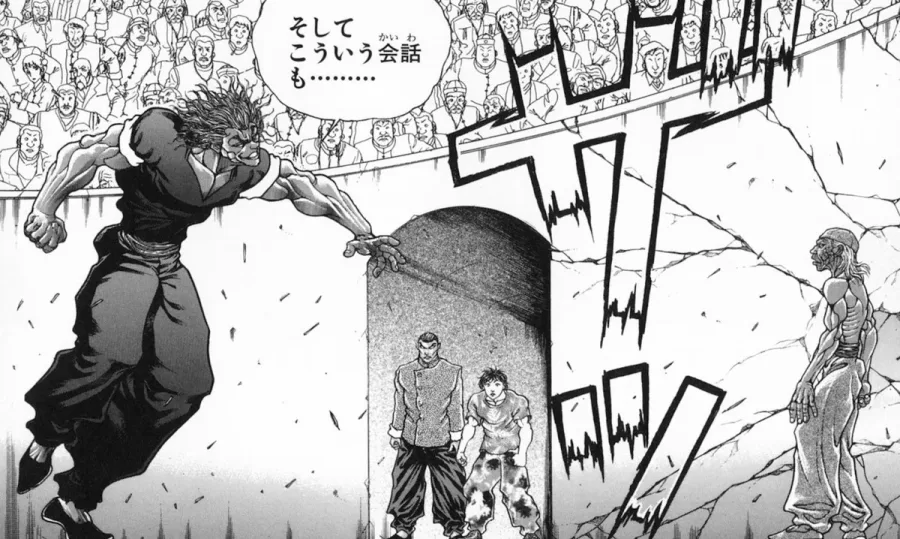
In the fourth part of the Baki series, 'Baki-Dou', when Izou Motobe defeated the clone Musashi, every long-time fan must have been shocked and thought... 'That Motobe!?' Or perhaps some were suspicious, wondering, 'Was Izou Motobe really at this level all along!?' After all, the legendary demon fist Retsu Kaioh had been defeated and killed. There is no way anyone thought, 'What's wrong with Motobe being strong?' That victory had that much impact. In the traditional Baki series, Izou Motobe was categorized as a 'weak character.' He was given the title of 'The World's Strongest Commentator' by readers for his work as a commentator during the Maximum Tournament, and because he became abnormally strong when in a park, he was called 'The Strongest Creature in the Park.' However, most people likely held the impression that this was just a joke and that he was still weak regardless of those quirks. At the very least, that was the author's perception at the time. I thought, 'Maybe he's about as strong as Kosho Shinogi at best.'
However, looking back on it now, Motobe's victory against the clone Musashi can be seen as inevitable. It is closely related to the inflation of combat power among the story's characters. In this article, I would like to record the reasons for this while incorporating my analysis.
What are the conditions for a strong or weak character in the Baki world?
There is a rule for 'strong guys' in Baki. That is, they have extremely few monologues during battle. 'Not talking incessantly or whining during a fight' functions as almost the only rule that separates strong characters from weak ones. Those who lose usually develop long monologues. Or, even if they were pushing the fight until then, they lose after a monologue is inserted.
As the saying goes, 'a barking dog never bites,' and in the Baki world, the weaker the character, the more they think about this and that. They devise strategies and reveal their inner feelings. To be an excellent 'stepping stone,' they explain in their hearts or out loud what kind of hellish experiences they have been through, what kind of training they have done, and how superior their techniques are. In extreme cases, they belittle their opponents to appeal their own superiority to the readers beyond the opponent. And after talking incessantly about their 'sure-fire' tactics, they are miserably knocked out.
In the Baki world, 'strong guys don't think.' All that exists is the character trait of 'fighting to win.' They know well that anyone who cannot enter the battlefield with just their own body will become a fallen corpse.
Weak guys monologue, strong guys don't talk much and let their fists do the talking. The character who embodies this rule is likely the strongest character in the series and the world's only true master of brute force, Yujiro Hanma. I will quote his impressive statement from the end of the third part.
'When strength goes too far, it steals away your dreams. When strength goes too far, it steals the light from your life.'
I didn't understand it well when I read it in real-time, but now I think this monologue is poignant. Yujiro is lonely, and because he is the strongest, he has no inner self. In short, he has nothing other than the character of 'being the strongest.' Occasionally he shows off Udunde or explains the Poison Hand, but since Yujiro acquires these without effort, they are no different from mere knowledge. Because he can obtain anything with just his fists, there is no conflict. Because there is no conflict, his humanity does not grow. It sounds good to call it 'natural and effortless' or 'selfless,' but being the strongest is a shallow existence, nothing more than a character with skin-deep depth. Yujiro is aware of this.
The uniqueness of the character Izou Motobe
How about Izou Motobe, then? He has the unofficial title of 'The World's Strongest Commentator.' So, what is commentary and what is a commentator in the Baki world?
Commentary in a typical fighting manga is about teaching (the reader) about the techniques used or the psychological state during a match. You explain how amazing or difficult that technique is and convince the reader what a great fighter that person is. However, in the Baki world, one more element is added here.That is the role of 'spokesperson for strong characters.' Because 'the strong don't think,' they remain silent at critical moments. Therefore, someone must provide an explanation for the sake of the manga. However, if you force them to monologue, they immediately fall into the category of the weak. The role of a 'commentator' in the Baki world is to take on that burden and keep the strong characters strong.
Paradoxically, the formula 'Commentator = Spokesperson for strong characters = Weakling' is established.
From Part 1. Motobe blushing after being praised by a playboy.He is so talkative that you wouldn't think he had just been miserably defeated by Kinryuzan.
The 'Total Motobe-ization' that began with the 'Pickle Arc' of Part 3
If I were to draw a line in the Baki series, I think it would be from the 'Pickle Arc.' It could be from the Mohamed Alai Jr. Arc or the Biscuit Oliva Arc, but I think it starts with the appearance of Pickle in terms of the fact that the power of existing characters no longer worked.
In Part 3, Pickle, the upright primitive man thawed from ice, defeated everyone who had been considered a 'strong character' up to that point with his primitive body. He ate one of Retsu Kaioh's legs, tore off one arm of Katsumi Orochi who had mastered the new Mach Punch, and treated the great Jack Hanma, who trained 30 hours a day, as preserved food. If you can't surpass him in physicality, techniques don't work, and tactics are meaningless, then the business of those who had been treated as 'strong characters' is ruined. The characters up to that point were forced to change their paths and began to reveal their inner feelings more than necessary. Doppo and Shibukawa enjoyed secret street fights against amateurs and spoke openly about their uncontrollable fighting instincts, while Retsu Kaioh switched to boxing and engaged in psychological warfare in fights against boxers. Even Kaoru Hanayama was working hard (along with Retsu) as an unaccustomed commentator during the Baki vs. Pickle fight.
So, what did Izou Motobe accomplish in the third part, 'Hanma Baki'? Actually, he did almost nothing. That is to be expected; as the inflation of the power balance occurred due to the appearance of Pickle and 'strong characters' were weakened one after another, they began to reveal their inner feelings that they had kept hidden, and they also took the initiative to perform the commentary that should have been handled by 'weak characters' like Motobe. No matter how you think about it, it is better for the manga if Kaoru Hanayama or Retsu Kaioh explains things rather than Motobe. The charisma they have as characters is different from Motobe's. Once it came to this, there was no room for him to appear. It's like a large supermarket that has everything opening right next to a local shopping street. His business is ruined.In other words, former strong characters and popular characters began to dabble in commentary and monologues to find their place in the Baki world... It is the arrival of the 'Total Motobe Era.'Original vs. Clone
The fourth part of Baki, 'Baki-Dou,' began in a format roughly similar to the Pickle arc. A clone of Miyamoto Musashi is created by the psychopathicbillionaire Mitsunari Tokugawa, and the flow follows a pattern where he eventually slips out of Tokugawa's control, dispatches existing characters in preliminary battles, and leads to the main event: vs. Baki.
The pyramid of strength in the series is the Hanma faction of Yujiro and Baki > Clone Musashi > Pickle > existing characters, so it is hopeless for any existing character to defeat Musashi no matter what they do. Doppo Orochi was toyed with, Retsu Kaioh died, and countless others lost their will to fight from air slashes that didn't even connect... Even Pickle, who boasted exceptional strength in the third part, bowed to Musashi. The old characters can no longer play a leading role. They have no choice but to put up a good fight as mere stepping stones or stand on the sidelines providing commentary.
And so, I believe the appearance of Izou Motobe here is extremely natural. If characters who were once strong are swallowed by the wave of power creep and become weak, it is understandable that Izou Motobe would step forward as their representative. If the old characters are all becoming 'Motobe-fied,' then it makes sense that the 'true Izou Motobe, the head temple of all Izou Motobes,' would butt in to strike a blow against these unreasonable new characters.
In other words, the original Izou Motobe who confronted Clone Musashi was carrying the resentment of all the weakened (Motobe-fied) characters, and that is precisely why Motobe's victory would provide some relief to readers who have had to watch their favorite characters look so pathetic.
Aside: Mimicry and Silence
Explaining things through monologues is a condition of a weak character, but there are cases where strong characters mimic weak ones.
Representative examples would be Kaku Kaioh and Clone Musashi. Kaku Kaioh talked quite a bit when landing his Shaori punch on Yujiro, but that was to intentionally make him underestimate him so he would take the punch.
Also, Clone Musashi is one of the most talkative characters among the strong. Because he was born 400 years ago, he doesn't know modern fighting styles well. To learn them, he intentionally makes remarks like a stepping stone to draw out techniques from his opponents. There is also the aspect of provoking the opponent to make them let their guard down. If the enemy gets angry, loses their composure, and charges in randomly, it is easier to deal with them. Using this method, Musashi made Baki throw a jab and baited Doppo Orochi into a flying kick. He tried it on Retsu Kaioh too, but it failed because his signature line was widely known.
Both of these individuals have various techniques and tactical drawers. Perhaps their eloquence is one of them. Intentionally playing the weakling to make the enemy let their guard down. Since both are quite elderly characters, this is truly a fighting style befitting a combat expert.
Also, in the Baki series, there is a depiction where one of the parties in a conversation goes silent. Not when listening to someone else, but during a normal conversation. Applying the logic of this article, I think it is an attempt to maintain a superior power balance during the conversation by intentionally shutting down speech and not revealing one's feelings. It could also be said that by staying silent and letting the other person talk on and on, one is 'insisting on their own selfishness' by wanting to hear more of what the other person has to say.