Hello, this is Ken-Dragon!! In this post, I would like to write about the comfort and other aspects of the Astrox 88D Pro, a racket I love to use! The 88D Pro is personally one of my favorite rackets, so I want to write this with all my heart!!
Other review articles and videos are likely made by skilled advanced players or professionals, but I think their sensations are quite different from those of someone like me who just plays badminton as a hobby. So, if you are looking for a review from an average person like me, please be sure to read this!!
1. About the Astrox 88D Pro
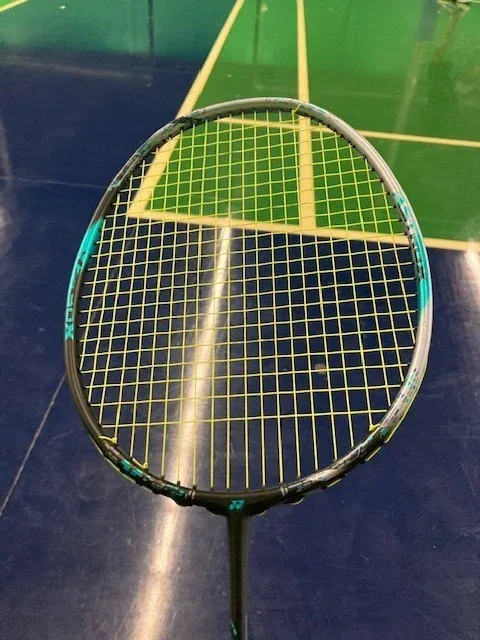
First, I will explain the overview of the racket.
The head balance of a racket refers to whether it is head-heavy, even-balanced, or head-light.
The 88D I am introducing this time is part of the Yonex Astrox series, so it is head-heavy. This means that the weight of the racket is located at the racket head. In other words, using a head-heavy racket makes smashes sink, allows you to hit powerful shots due to centrifugal force, and makes it easier to hit shots. To use a hammer as an analogy, a hammer has a weight at the end, which makes it easy to drive a nail. Similarly, when the racket head is heavy, rotational force increases, making it easier to hit powerful shots. However, at the same time, just like with a hammer, if you don't have the muscle strength, you might hurt your shoulder, get swung around by the racket, or be late on your swing. Therefore, it is recommended for those who have a certain amount of muscle strength. By the way, the Astrox 88D is more head-light than the 100ZZ and 99 Pro, and more head-heavy than the 77 Pro and 88S. In terms of head weight, it is
a racket positioned around the middle of the Astrox series.
The specs are as follows.
3U4, 3U5, 3U6, 4U5, 4U6
3U: 20-28 lbs
4U: 21-29 lbs
Regarding the numbers and letters above, the first characters 3U and 4U represent the weight of the racket.
Conversely, the number at the end represents the grip size. Number 4 is the thickest, and number 6 is the thinnest.
Racket Weight
The Astrox 88D Pro comes in two weight types: 3U and 4U. The 3U is heavier, at about 85-90g. On the other hand, the 4U is lighter, at about 80-85g. I recommend the 4U first. However, if you are confident in your muscle strength, using the 3U will allow you to hit even more powerful shots.
Grip Size
There are four grip sizes in total: 4, 5, and 6. Number 4 is the thickest, and in the case of the 88D, it is a grip size only available for the 3U. It is suitable for aggressive players or those with large hands. Number 5 is the middle, which is the so-called standard grip size and the most commonly used one. Number 6 is the thinnest, and since it is sized for easy control and grip changes, it is recommended for players who have many fast-paced rallies.
String Tension
For the Astrox 88D Pro, a tension of 20-28 lbs is recommended for the 4U racket, and 21-29 lbs is recommended for the 3U. Poundage refers to how tightly the strings—the part that plays the role of making contact between the racket and the shuttlecock—are strung on the racket. The tighter you string it, the narrower the sweet spot (the position on the racket where the shuttle hits and flies well) becomes, but if you can hit it well, your control and power will increase. Conversely, if it is lower, below 25 lbs, the sweet spot becomes wider, but control becomes vague and you won't get as much power.
I personally recommend 25-27 lbs, but you should try changing the tension according to your own preferences.
Shaft Stiffness
The shaft is stiff. It feels softer than the Astrox 100ZZ and stiffer than the 99 Pro. However, the head is lighter than the 99, so it is easier to handle. It is a racket that you will likely find easy to handle in fast-paced rallies because you won't be late on your swing.
Recommended Strings
As for recommended strings, according to the official Yonex website, Exbolt 68 is for hard hitters, and Aerobite is for control players. By the way, I use Exbolt 65 and Aerobite.
The technologies adopted in the Astrox 88D Pro are as follows.
High Modulus Carbon, CFR, Tungsten, High Modulus Carbon, 2G-Namd FLEX FORCE, Ultra PE Fiber, New Built-in T-Joint
Furthermore, a technology called the Rotational Generator System is also adopted, which distributes weight to the grip, shaft, and head of the racket, increasing rotational force. A Power Assist Bumper is adopted at the top of the frame, which increases the weight of the frame while reducing air resistance.
The Astrox 88D Pro is also the first racket to adopt 2G-Namd FLEX FORCE, which is characterized by quick flexing and recovery.
The Astrox 88 is a racket mainly made for doubles, and it is divided into two types: the 88S and the 88D. The 88S is a control-oriented racket for the front court, designed to defend the front in doubles. On the other hand, the 88D is a racket for the back court whose role is to smash repeatedly from the back in doubles. In other words, it is an aggressive racket that can also handle fast-paced play.
The one I am introducing this time is the Pro version, but like other Yonex rackets, it is divided into four series: Play, Game, Tour, and Pro. For beginners, Play or Game are recommended. For intermediate to advanced players, Tour or Pro are recommended.
2. Impressions of using the racket
Now, I would like to write about the good points, bad points, and my impressions for each shot.
By the way, for the 88D Pro I am using, I use the 4U5 weight, and I have it strung with Aerobite at 27 pounds. There was a time when I had it strung with Exbolt at 28 pounds.
First is the drive. What I thought while hitting with it is that the shuttle has good extension. It feels like the shuttle runs, gets gripped, and flies to the back. The hitting feel is soft, and it feels more like pushing than repelling. It feels like the time the shuttle is in contact with the racket is slightly longer than with other rackets. However, it is not that the repulsion is completely gone; on the contrary, because it is soft, it feels like it repels firmly. I have my strings at 27 pounds, and when they were freshly strung, the feel was rather hard, but as I got used to it, the softness I mentioned earlier also emerged. I received the impression that it repels softly and the shuttle has good extension.
ClearFor the clear, it feels like I can hit it firmly. I think the hitting feel is harder than the Astrox 99 Pro. If anything, I feel the hitting feel is closer to the 77 Pro. However, the head weight, shaft stiffness, and power quality are quite different from the 77, so perhaps that is where the difference comes from. As I mentioned earlier, it feels like it grips the shuttle and then repels it with force. The sound is also very good, and it feels great to hit clears. The chewy, repelling hitting feel is impressive. It also feels like it flies far with ease.
DropAs for the drop, it is easy to hit because it is a racket that is very easy to control. The balance between the shaft stiffness and head weight is good, and because it is head-heavy, it feels like I can use the head weight to hit drops. Cuts are also easy to hit. You can especially realize this when using Aerobite.
SmashFor the smash, when you hit it squarely, it feels like you can hit it comfortably while it repels. This also makes the shuttle run well. The 99 Pro might have a longer contact time with the shuttle, allowing you to hit a heavy smash rather than a fast one, but the 88D Pro feels like you can really hammer it in. It also generates speed. If you can make the most of the 88D Pro's characteristic chewy hitting feel, it seems possible to hit heavy smashes as well.
LobWhat was most impressive about using the 88D is that lobs are quite easy to hit. When using the 100ZZ or the Nanoflare series, there are times when lobbing is a bit difficult, but the 88D Pro, as I mentioned earlier, makes the shuttle run well, and it feels like you can release it while it repels. The 99 Pro is also famous as a racket that is very easy to lob with, but the 88D does not have as much shuttle-holding capability as the 99 Pro, and since it inevitably repels, it feels like you can hit fast shots. Above all, the shuttle extension is good, so fast attack lobs are very easy to hit.
In front of the netControl in front of the net is also easy. However, compared to the 99 Pro or 88S Pro, it might be slightly inferior because it repels. Even so, I think it is no problem for those with technique, and using Aerobite makes the hitting feel harder, making it quite easy to hit.
ReceiveSmash receives are also quite easy. It feels like you can hit while controlling, from receives that drop in front of the net to drive receives and high returns. Since the 88D Pro is a racket for doubles and is also quite strong in fast-paced play, I think you can especially realize its greatness in receives during fast exchanges, such as push receives. Since it also generates speed, I think you can perform racket work that won't be pushed back by the opponent's fast shots.
PushBecause it is strong in fast-paced play, pushes were also quite easy. Like the receives, it generates speed and doesn't get pushed back by the opponent, so it was quite easy to hit.
ProsThe pros are as follows
You can hit fast shots
You can hit powerful shots
It is easy to hit angled continuous smashes
It is flexible but has excellent repulsion
The shuttle travels well
The contact time between the shuttle and the racket is slightly longer
It is well-balanced due to the shaft stiffness and head weight
It is a lightweight racket that is easy to handle even in fast-paced rallies
It gives the impression of being able to hit long distances with ease
Recommended for singles players who engage in fast rallies and for doubles backcourt players
The cons are as follows
Since it is a light racket, it is not suitable for those who prefer heavier rackets
There are other rackets that offer better control at the net
Not recommended for doubles frontcourt players or singles players who prioritize net play
In conclusion, personally, the Astrox 88D Pro feels similar to the 77 Pro, but with a slightly heavier head, a stiffer shaft, and above all, the impression that you can hit more powerful shots. It feels like it sits somewhere between the 77 Pro and the 100ZZ. Rather than a racket that just snaps, it feels like the shuttle travels well and it has a rich, powerful snap. The time the shuttle stays in contact with the racket is also slightly longer compared to other rackets, perhaps similar to the 99 Pro? However, it doesn't hold the shuttle as well as the 99, but it has more power than the 77 Pro. Compared to the 100ZZ, the 88D Pro seems usable in faster exchanges, and its ease of use is definitely superior. However, in terms of control, the 100ZZ might be better. Still, personally, I feel the 88D Pro produces more power than the 100ZZ.
This is just my personal impression, but the 88D Pro feels like it can hit speedy and powerful shots. The hitting feel is on the softer side, with a rich sensation that snaps the shuttle deep, but it doesn't feel as soft as the 99 Pro.
3. Comparison with Other Rackets
I just explained it while comparing it to other rackets, but I would like to explain in more detail who this racket is especially recommended for.
If we are talking about rackets other than the 88 series, the 77 Pro is arguably the most similar. The 88S Pro is indeed the most similar, but the 88S has a better shuttle hold and the impression that the shuttle doesn't extend as far. In other words, its power and snap are slightly inferior. Personally, I think it feels like a 77 Pro with a stiffer shaft, improved snap, and a heavier head. However, it has more power than the 77 Pro, and it also has a slight sensation of "catching" the shuttle like the 99 Pro. Compared to the 100ZZ, the 88D Pro has a lighter head and I think it snaps better. The shaft also feels stiffer on the 100.
Therefore, it is recommended for those who want a racket that is lighter and snaps better than the 99 Pro, those looking for a racket with a stiffer shaft, heavier head, and more power than the 77 Pro, and those looking for a racket with a slightly lighter head and better snap than the 100ZZ.
Starting with dissimilar rackets, there are the Nanoflare and Arcsaber series. The Nanoflare in particular is head-light, so I don't think the 88D Pro is suitable for those who like head-light rackets like the Nanoflare. However, I think it feels lighter in the head compared to other Astrox series rackets, so in that sense, it might be good. Since the 88D Pro has a heavier head than the Arcsaber series, I also get the impression that force is transmitted to the shuttle better, so in that respect, I think it is also different from the Arcsaber series.
I think it is the optimal racket for those who are looking for a racket that is head-heavy but light, easy to handle, and also makes it easy to hit various shots. Above all, the Astrox 88D Pro is a racket that can hit strong shots more easily compared to other rackets, and since the entire racket is well-balanced, it is actually a racket that anyone can handle.
4. Recommended Strings
Personally, I highly recommend the Exbolt 65. This is because when you use Exbolt, you can really feel the snap. Furthermore, Exbolt is characterized by a soft hitting feel, and I think it is the string that can best utilize the performance of the Astrox 88D Pro.
For players who prioritize control, Aerobite is definitely the way to go. The weight of the smash and the flight of the clear might be slightly inferior compared to Exbolt, and I think the sweet spot might be just a little smaller, but I think you can get quite a lot of control for shots like drops, cuts, nets, and half-smashes. The hitting feel is on the harder side, and I think you can get even more control if you string it at a higher tension.
5. Summary
In summary, the Astrox 88D Pro is one of the quite easy-to-handle rackets, and above all, I had the impression that the shuttle extends well. I think it is a racket that anyone can handle because the shaft stiffness and head weight are well-balanced overall.
Especially because the shuttle travels well, it is easy to hit shots from above, and it is also easy to hit attack lobs and drives from below. You could say it is a racket that can give you a significant advantage in doubles attacks. Of course, it can also be used in singles, and although it might be slightly inferior in terms of control, if you cover that with technique, you could call it a perfect racket.
As for the shuttle hold, it is not as good as the 99 Pro, but it still has a rich hitting feel without having to sacrifice the snap like the 88S. It feels like it richly catches and snaps the shuttle. Anyway, it feels like the shuttle travels well and you can hit powerful shots. You can also hit continuous smashes, and the smashes feel like they sink. I think it has become a racket that can be used in faster exchanges than the previous 88D Pro model, so I personally highly recommend it.
Besides doubles players, I think it is a racket that can also be used in singles, so it is definitely worth keeping one in your racket bag.
That was my personal review of the Astrox 88D Pro. If you thought this article was even a little bit helpful, please give it a high rating, follow, comment, and share!!
See you next time!!
Astrox 88D Pro
Recommended for beginners to intermediate players, these are the Astrox 88D Tour and Game, which maintain the performance of the Astrox 88D Pro while being designed to be even easier for beginners to handle!!
Astrox 88D Tour
Astrox 88D Game