The Technology of the "Roads (Cables)" Connecting Data and Computers
Our world is built upon data that continues to increase every day. Between the CPU and memory that process that data and the storage (HDD or SSD) that permanently saves it, there exists a "road" for transporting information, namely the storage connection interface. This interface is an inconspicuous yet extremely important foundational technology that determines the performance, scalability, cost, and management of computer systems.
Even with USB-B and C, the specifications for the top and bottom of the port change, and the thickness of the cables differs.
This "road" was never a single path. From the era of thick, unwieldy parallel cables to thin, high-speed serial cables. From being merely directly attached to servers (DAS) to resources shared over a network (SAN/NAS). And to the foundation of cloud services and container technology that make physical existence imperceptible. Storage connection technology has repeatedly undergone dramatic evolution and paradigm shifts in response to the explosive increase in data volume, the relentless demand for faster access, and changes in the very way computers are used.
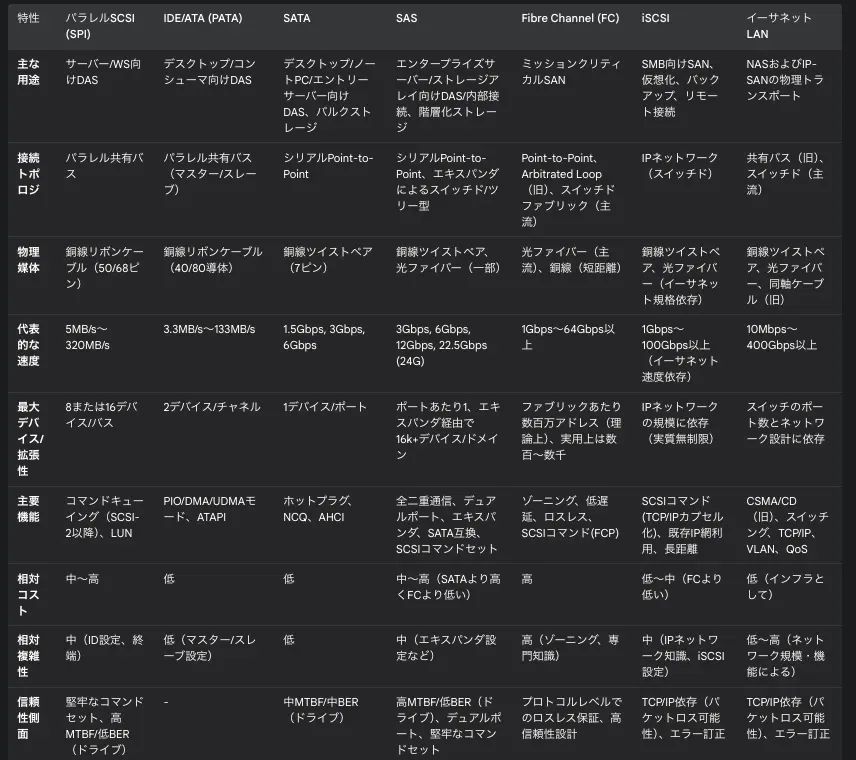
In this article, we will trace the history of the evolution of major storage connection technologies such as Parallel SCSI, IDE/ATA (PATA), SATA, SAS, Fibre Channel (FC), iSCSI, and the Ethernet LAN that supports them. We will not only explain the technical specifications but also explore the depths of the storage connection world by weaving in the "story" of why each technology was born, what challenges it tried to solve, and what philosophies and trial-and-error processes led to its current form, as well as the transition of how OSs and applications have handled storage. Through this story, I hope you will feel the drama of the dynamic evolution behind the technology we use every day.
1. The Era of Parallel Interfaces: The Foundation Built by SCSI and IDE/ATA (Up to the Early 2000s)
In the era when computers became personal and servers began to support corporate activities, the protagonist of storage connection was the "parallel" transmission method. This method, which bundles multiple signal lines to send data simultaneously, was the most direct means of increasing speed at the technical level of the time. Representing this era are SCSI for enterprise and IDE/ATA for desktop.
1.1 Parallel SCSI (SPI): The Reliable Right-Hand Man for Servers/Workstations[Product and Technical Background] The origin of Parallel SCSI (SCSI Parallel Interface, SPI) lies in SASI (Shugart Associates System Interface), conceived by Larry Boucher and others at Shugart Associates in the late 1970s. His idea was a "bus for controlling general-purpose drives with an 8-bit MPU," aiming to standardize drive-specific control. In the process of being standardized by ANSI (American National Standards Institute), this evolved into SCSI (Small Computer System Interface) (1986, SCSI-1). Although initially intended for "Small Computers," its high performance and scalability quickly established it as the standard interface in the server and workstation market.
[Philosophy and Trial-and-Error] The core philosophy of SCSI was "treating peripheral devices as equal nodes (initiators or targets) connected to a bus." This made it possible to connect multiple devices (HDDs, tape drives, scanners, etc.) to a single host adapter (HBA) and manage them efficiently. Each device on the bus was identified by a SCSI ID, and the concept of LUN (Logical Unit Number), which allows multiple logical units (disks, etc.) within a single target, was introduced early on, providing high scalability. During the standardization process, the committee was divided over whether to include, for example, a parity line for error checking, but ultimately, the robustness essential for enterprise use was prioritized. Also, the difficulty of physical handling was a characteristic of Parallel SCSI, such as the need for termination (terminating resistors) to maintain signal quality, issues with cable length and noise immunity due to differences in signaling methods (SE/HVD/LVD), and the complexity of ID settings (later automated with SCAM).
[Performance and Market] SCSI achieved higher speeds with each revision of the standard, evolving from SCSI-1 (5MB/s) to Fast SCSI (10MB/s), Wide SCSI (20MB/s), Ultra SCSI, Ultra2 SCSI (introduction of LVD), Ultra160, and finally to Ultra320 SCSI (320MB/s). In particular, the command queuing function introduced in SCSI-2 provided a decisive advantage in efficiently processing multiple I/O requests in multi-tasking server environments. Due to these performance and features, Parallel SCSI reigned as the de facto standard in the enterprise market for nearly 20 years.
1.2 IDE/ATA (PATA): The Unsung Hero of Desktop PC Popularization[Product and Technical Background] Meanwhile, the standard that boasted an overwhelming share in the desktop PC market was IDE (Integrated Drive Electronics) / ATA (AT Attachment), later called PATA (Parallel ATA) to distinguish it. In the mid-1980s, Western Digital, Compaq, CDC, and others cooperated to incorporate disk controller functions into the drive itself, with the goal of simplifying the host adapter and reducing costs. It was standardized as ATA in 1994.
[Philosophy and Trial-and-Error] The philosophy of PATA was "simplicity and low cost." By incorporating the controller into the drive, the interface on the motherboard side (often onboard) could be simple, significantly lowering the cost of the entire system. The connection method was also simple, with up to two drives per cable (channel) with master/slave role settings. However, this simplicity came at a price. Early ATA had a strict limit of 528MB on the connectable drive capacity, but this was resolved by the introduction of EIDE standards and LBA (Logical Block Addressing)* in ATA-2. Also, an extended standard called ATAPI (ATA Packet Interface) was formulated to connect devices other than HDDs (CD-ROMs, etc.). Transfer modes also evolved from the CPU-intensive PIO mode to DMA, and then to the high-speed Ultra DMA (UDMA), finally reaching UDMA/133 (133MB/s). Due to signal quality issues, an 80-conductor cable with increased ground lines became mandatory for high-speed modes, but even then, the cable length was short, at a maximum of about 46cm, which sometimes made routing inside the chassis difficult.
[Performance and Market] The greatest achievement of PATA was that it brought HDDs to home PCs through its overwhelming cost-performance. However, it had many disadvantages compared to SCSI in terms of performance. True simultaneous access was impossible with the shared bus of the master/slave configuration, and there was also the issue where the speed of the entire channel was throttled when a slow device was connected. Performance degradation during multitasking was also significant, and command queuing did not become widely adopted. As a result, a clear market segmentation was formed, with PATA becoming the standard for the desktop/consumer market and SCSI becoming the standard for the server/enterprise market.
1.3 Common Limits of Parallel Interfaces: The Emergence of a "Wall"Although parallel SCSI and PATA achieved great success in their respective markets, they hit a common physical limit in the early 2000s.
Performance Plateau: As operating frequencies increased, signal quality issues became more severe. Ultra320 SCSI (320MB/s) and UDMA/133 (133MB/s) became the practical upper limits.
Physical Constraints: Wide and stiff ribbon cables obstructed airflow within the chassis, reducing cooling efficiency. Additionally, poor manageability and connection length limitations were also issues.
-
Signal Quality Issues:
Crosstalk: Noise caused by electromagnetic interference between adjacent signal lines.
Skew: The time difference in the arrival of bits on multiple signal lines. Higher speeds make the tolerance extremely small.
Reflection: Disturbance of signal waveforms due to impedance mismatch.
Attempting to achieve further speed increases with parallel methods while overcoming these physical limits became unrealistic both technically and economically. This is where the transition to "serial transmission", which fundamentally changes the signaling method, comes in. Serial transmission had the advantages of being able to operate at much higher frequencies instead of sending data one bit at a time, being less susceptible to noise and skew, and using thin, easy-to-handle cables.
2. The Serial Revolution and Networking: Toward an Era of Connection Diversification (2000s–)
Following the limits of parallel interfaces, storage connection technology shifted significantly toward serial methods. At the same time, the need to share and manage data over networks increased, and network storage technology also developed significantly.
2.1 SATA: The Shift from PATA as the Desktop Mainstay[Product and Technical Background] SATA (Serial ATA) was announced in 2000 as the successor to PATA and spread rapidly starting around 2003. The goal was to solve the issues of PATA, such as performance, cables, and the lack of hot-plug support.
[Technical Progress and Design Philosophy]
Serial Transmission: Adopted serial transmission using high-speed differential signaling.
Point-to-point: Each device connects one-to-one to a host port. The concepts of master/slave and bus sharing are eliminated, making it simple and less prone to performance degradation.
Higher speeds: Evolved to SATA I (1.5Gbps), SATA II (3Gbps), and SATA III (6Gbps) (Gbps is bits/second, effective speed in MB/s is about 1/10). 6Gbps is the practical upper limit.
Cable improvements: Adopted thin and flexible 7-pin data cables (up to 1m) and 15-pin power cables. Improved airflow and simplified wiring.
New features: Hot-plugging (insertion/removal while power is ON) and NCQ (Native Command Queuing, improved random access performance) are supported (when AHCI mode is enabled).
Software compatibility: Maintained compatibility with the ATA command set, facilitating migration at the OS/driver level. PATA-SATA bridge chips were also utilized in the early stages to achieve a smooth market transition.
[Market Impact] Due to performance improvements, ease of handling, and low cost, SATA quickly replaced PATA and became the standard interface for desktop and laptop PCs. It is also widely adopted in entry-level servers and NAS.
2.2 SAS: Serial SCSI for Enterprise[Product and Technical Background] SAS (Serial Attached SCSI) appeared around 2003 as the successor to parallel SCSI. It aimed to solve the speed, scalability, and cabling issues of parallel SCSI while inheriting its robust SCSI command set and enterprise-grade features.
[Technical Features and Design Philosophy]
Serial, point-to-point: Basic structure similar to SATA.
High-speed transfer: Supports speeds equal to or greater than SATA (3, 6, 12, 22.5(24G) Gbps) and full-duplex communication.
Scalability: SAS expanders (switches) allow many devices to be connected from a single port (tree/mesh configuration).
High Reliability: Dual-port ensures redundant paths, with more advanced error detection and recovery functions. SAS drives themselves are also designed for high reliability (high MTBF/low BER).
SATA Compatibility: SAS controllers/backplanes can connect and control SATA drives (the reverse is not possible). This is strategically important.
[Relationship between the market and SATA] SAS has become the standard interface for enterprise servers and storage arrays that require high performance and high reliability. Due to SATA compatibility, a major advantage is the ability to easily build tiered storage that mixes SAS drives for performance-oriented tiers and inexpensive SATA/NL-SAS drives for capacity-oriented tiers, allowing for optimized cost performance. Without this compatibility, the market might have been fragmented, and it became the key to SAS adoption.
2.3 Fibre Channel (FC): Dedicated lines for high-performance, high-reliability SANs[Product and technical background] Fibre Channel (FC) is a high-speed serial network technology that emerged in the 1990s, primarily for building SANs (Storage Area Networks). It was developed to overcome the distance and scalability limitations of parallel SCSI. "Fabric" connections using FC switches are the mainstream.
[Design philosophy and features] FC was designed specifically for storage communication. It prioritizes low latency, high throughput, and lossless data transfer over general-purpose networks (Ethernet).
High performance and high reliability: Speeds have increased from 1Gbps to over 64Gbps. Extremely high performance and reliability are achieved through dedicated hardware (HBA, switches) and robust protocols.
Scalability and long distance: A large number of devices can be connected via switched fabric. Long-distance (km-scale) connections are also possible using optical fiber.
SAN functions: Native support for functions required for enterprise SANs, such as zoning (access control).
[Market and trade-offs] Due to its high performance and high reliability, it has long held a dominant position in the high-end SAN market for mission-critical core systems, large-scale databases, and HPC. However, there is a trade-off in that it is high-cost because it requires dedicated hardware and requires specialized knowledge for installation and management.
2.4 iSCSI: Democratization of SANs via IP networks[Product and Technical Background] iSCSI (Internet SCSI) was proposed by IBM and Cisco around 1998 and standardized by the IETF in 2003-2004.It encapsulates SCSI commands in TCP/IP packets and is a technology for transferring them over existing Ethernet (IP) networks.
[Design Philosophy and Features] The philosophy of iSCSI is 'lowering costs and simplifying SANs by utilizing existing IP infrastructure.'
Cost Efficiency: Dedicated HBAs and switches like those for FC are not required. Inexpensive standard NICs and LAN switches can be used.
Ease of Management: Can be managed using the IP network knowledge and tools that many IT professionals are accustomed to.
Distance: Because it is based on IP networks, there are theoretically few distance limitations, making it suitable for use over WANs (such as remote replication).
[Trade-offs and Market] Due to overhead from TCP/IP encapsulation, CPU load, and dependence on network quality, performance (especially latency) may be inferior to FC (this can be mitigated with dedicated HBAs or TOE). However, due to its overwhelming cost efficiency and ease of implementation, it has become widely adopted in areas where cost is a critical factor, such as SANs for small to medium-sized businesses (SMBs), departmental storage, development/test environments, and backup targets, contributing to the 'democratization' of SAN technology.
2.5 Ethernet LAN: The Ubiquitous Foundation Connecting Everything[History and Evolution] Invented in the 1970s at Xerox PARC by Robert Metcalfe and others. It evolved from the initial shared coaxial cable bus (CSMA/CD) to a dedicated bandwidth star topology using twisted-pair cables and switches. It achieved phenomenal speed increases from 10 Mbps to over 100 Gbps, becoming the de facto standard for LANs. This collision avoidance and speed enhancement through switching was essential for the practical application of iSCSI and high-performance NAS.
[Role in Storage] Although Ethernet itself is not dedicated to storage, it has become the foundation for modern storage in the following ways.
NAS (Network Attached Storage): The communication foundation for file sharing protocols such as NFS and SMB/CIFS.
IP-SAN (iSCSI): The communication foundation for block storage access via the iSCSI protocol.
The ubiquity, low cost, standardization, and continuous speed increases of Ethernet support the widespread adoption and development of network storage as a whole.
3. Evolution of Storage Usage: Interaction with Connectivity Technologies
The evolution of storage connectivity technology has been closely linked to the evolution of the methodology of 'how' OSs and applications use storage. What connectivity technology made possible and the demands from the application side influenced each other, creating today's diverse usage patterns.
3.1 From Simple Mounting to Shared Disks (DAS → SAN/NAS)Early Days (Up to the early 1990s): Primarily DAS (Direct Attached Storage). The standard approach was to use the file system provided by the OS (such as UFS, FAT, ext2, NTFS, etc.) to format internal server disks or directly attached disks, and then mount them to specific directories (e.g., /usr, D:). This was a simple and intuitive abstraction based on the philosophy of Ken Thompson and other UNIX developers that “everything is a file.”
Rising Demand for HA (Late 1990s): In mission-critical systems, single-server failures became unacceptable, leading to the emergence of shared-disk clustering. Technologies like IBM HACMP, MSCS, and Veritas Cluster Server provided mechanisms (failover) where two or more nodes shared the same storage (LUN) connection (primarily via FC-SAN) to take over processing in the event of a failure. In this scenario, exclusive control (fencing) became critical to prevent data corruption, making locking mechanisms like SCSI-3 Persistent Reservation (PR) essential. The OS either assumed “no simultaneous mounting” or relied on cluster file systems like Veritas CFS to manage locking between nodes.
Background (1990s–2000s): Engineers of high-performance databases (such as Oracle and Informix), notably Jim Gray (Tandem/Microsoft), believed that the caching and journaling processes inherent in OS file systems were an overhead that hindered performance for the database's own optimized I/O control.
RAW Device Usage: They promoted the use of “RAW devices,” where block devices (e.g., /dev/rdiskX) were placed directly under database management without going through a file system. By having the database itself fully control physical block placement, cache management, mirroring, and recovery, they aimed to eliminate file system layer latency and maximize performance.
Rise and Fall: While this method became a staple for “experts” in specific high-performance DB environments, it gradually declined due to operational complexity, such as the difficulty of managing and backing up data with standard OS tools. It was superseded by the improved performance of file systems themselves (ext3/4, XFS, ZFS, etc.) and the emergence of “logical volume layers that can be used like RAW devices but are easier to manage,” such as Oracle ASM. Today, it is not mainstream except for special use cases. However, the philosophy that “applications can control storage more intelligently than the OS” continues to influence later technologies.
The Impact of Server Virtualization (2000s–): VMware (Mendel Rosenblum et al.) announced ESX Server and VMFS (Virtual Machine File System). By storing virtual disk files (VMDK) for each VM on physical LUNs, it provided advanced features like thin provisioning, snapshots, and cloning on a per-file basis. Administrators no longer needed to be aware of physical storage details (such as which RAID group was used) and could manage virtual disks based on capacity and policy. Storage connectivity utilized FC, iSCSI, NFS, and others.
The advent of cloud storage (2006–): AWS (Jeff Bezos, Andy Jassy, et al.) launched EBS (Elastic Block Store) and S3 (Simple Storage Service). This triggered a paradigm shift where "storage is not a physical box, but a service accessed via API." Users could instantly provision the required capacity of block storage (EBS) or object storage (S3) via a web console or API call, with availability and redundancy becoming the responsibility of the cloud provider. From the OS perspective, EBS appears as a standard block device, but its reality is a large-scale distributed storage system where the physical configuration is completely abstracted. Connection is via a network (Internet/dedicated line) using various internal protocols.
Demands of the container era (late 2010s–): With the widespread adoption of Docker and Kubernetes, application deployment cycles have accelerated, creating a need for more dynamic and portable storage management.
CSI (Container Storage Interface): A standard interface developed primarily by the Kubernetes community (Google, RedHat, etc.). By simply having the application (Pod) declare the required storage type (performance class), capacity, and access mode (e.g., ReadWriteOnce) in a YAML file or similar, the Kubernetes control plane automatically provisions the corresponding storage volume and mounts it to the container via the CSI plugin.
Underlying philosophy: Application developers no longer need to be aware of whether the underlying storage is SAN or NAS, or which vendor's product it is, making it possible to "use the required storage on-demand." Software-Defined Storage (SDS) such as Ceph (RBD), GlusterFS, and Longhorn, as well as storage services from various cloud providers, are utilized through CSI, driving further abstraction and servitization of storage.
In this way, the evolution of storage connectivity technology and the evolution of how storage is used by OSs and applications have progressed while mutually stimulating the direction of "liberation from physical constraints," "pursuit of performance and reliability," and "abstraction and automation of management."
4. The Next Wave: NVMe and Storage Fabrics
Currently, and for the future of storage connectivity, the biggest trend is the NVMe (Non-Volatile Memory Express) protocol, designed to maximize the performance of flash memory (SSD), and NVMe over Fabrics (NVMe-oF), which utilizes it over a network.
NVMe: While traditional SATA/SAS interfaces were based on protocols from the HDD era (ATA/SCSI commands), NVMe is a more efficient protocol that leverages the low latency and high parallelism of flash memory. Physically, it is directly connected to the PCI Express (PCIe) bus close to the CPU, achieving significant performance improvements.
NVMe-oF: A technology that extends the high performance of NVMe over a network. It transfers NVMe commands over various fabrics (network technologies). Key examples include NVMe/RoCE, which uses RDMA over Ethernet, NVMe/TCP using TCP/IP, and NVMe/FC using Fibre Channel. This is expected to be the next-generation high-performance network storage connection, replacing traditional iSCSI and FC.
This is the latest example of how changes in the characteristics of storage media itself (HDD to SSD) have spurred innovation in connection interfaces and protocols. It symbolizes the trend in storage technology shifting from "disk-centric" to "memory-centric."
5. Conclusion: Perspectives on the Future Learned from the Evolution of Connectivity Technology
In this article, we have provided an overview of the evolution of storage connectivity technology and its surroundings as a "story," from the dawn of parallel SCSI and PATA, through the era of serialization and networking via SATA, SAS, FC, iSCSI, and Ethernet, to the transition in how storage is used by OSs and applications, and finally to the latest trend of NVMe/NVMe-oF.
Key drivers of evolution:
Demands for performance: Faster throughput, lower latency.
Overcoming physical limitations: Limits of parallel transmission to serialization, limits of HDD to NVMe.
Pursuit of cost efficiency: Proliferation of PATA/SATA, cost reduction of SAN via iSCSI.
Data sharing and improved manageability: Transition from DAS to SAN/NAS.
Abstraction and automation: Virtualization (VMFS), cloud APIs (EBS/S3), containers (CSI).
Lessons from history:
Technology does not exist in isolation: Connectivity technology develops while interacting with the evolution of the entire ecosystem, including CPUs, memory, storage media, OS, applications, and network technology.
Understanding trade-offs: There is no single perfect technology that satisfies all requirements for performance, cost, reliability, scalability, and manageability; trade-offs always exist. The 'quirks' and 'conventions' of each technology are the result of those choices.
The importance of knowing 'why': By understanding the challenges behind the emergence of each technology, the philosophy of the developers, and the market reaction (the drama of 'products,' 'people,' and 'markets'), one cultivates the ability to discern the essence and applicability of a technology.
The pros and cons of abstraction: While abstraction through virtualization, cloud, and containers has dramatically simplified management, it also hides the complexity of the underlying technology. Understanding what is happening inside that 'black box,' and what consistency models and redundancy are provided, becomes crucial for troubleshooting, advanced optimization, and evaluating SLAs.
The world of storage connectivity is entering a new era of transformation with the emergence of new technologies such as NVMe-oF and CXL (Compute Express Link). Learning from the past and maintaining a perspective of 'what problem is this trying to solve' for each technology will serve as a reliable compass for navigating these rapidly changing times and making future technology choices.