I've heard rumors about this tool for a while.
A tool that resurrects dead websites as desktop apps has so many potential use cases that it's practically a SaaS killer.
The link is at the very bottom.
1. Overview: Redefining the Web Experience with Pake
In modern computing, web browsers function as de facto operating systems, but they simultaneously suffer from structural issues like "tab proliferation" and "uncontrolled resource consumption."
Pake redefines this chaotic web experience by converting any webpage into an independent desktop app with a single command.
The essential strategic value of Pake lies in its ability to go beyond simple browser bookmarks and "elevate" specific web services into dedicated professional tools.
This open-source project, which has garnered over 53,400 stars on GitHub, is fully compatible with macOS, Windows, and Linux.
Its greatest feature is its simplicity: it allows you to convert a specific URL into a package that behaves like a native app, without requiring complex environment setup, either via CLI or online builds using GitHub Actions.
The structural change brought about by this "one-command app conversion" dramatically reduces the user's cognitive load.
Extracting specific functions from the massive framework of a general-purpose browser to build a task-specific "dedicated space" shifts the way we interact with the web from "passive browsing" to "active utilization."
Technically supporting this paradigm shift is an extreme level of efficiency that surpasses existing frameworks.
2. Performance: Extreme Efficiency Realized by Rust and Tauri
As software development matures, users are beginning to strictly evaluate not just functionality, but also "resource efficiency."
In the current landscape where bloated applications occupy memory and degrade overall system performance, software "lightness" is no longer just an added value, but a powerful competitive advantage in itself.
Pake has embodied this extreme efficiency by adopting a modern technology stack consisting of Rust and Tauri.
The size of a package generated by Pake is, astonishingly, kept to around 5MB. This is a dramatic figure compared to traditional JavaScript-based desktop frameworks.
Because it inherits Rust's type safety and strict memory management, memory usage is kept extremely low, enabling instantaneous startup speeds.
The adoption of Rust and Tauri goes beyond mere improvements in operating speed.
Efficient resource management at a low level not only ensures system stability but also extends laptop battery life by reducing CPU load, ultimately contributing to the physical longevity of the hardware.
Technical sophistication is directly linked to practical user experience and sustainability, and these overwhelming performance metrics draw a definitive line between it and existing technologies.
3. Performance Comparison with Other Models: A New Standard Breaking Through Electron's Limits
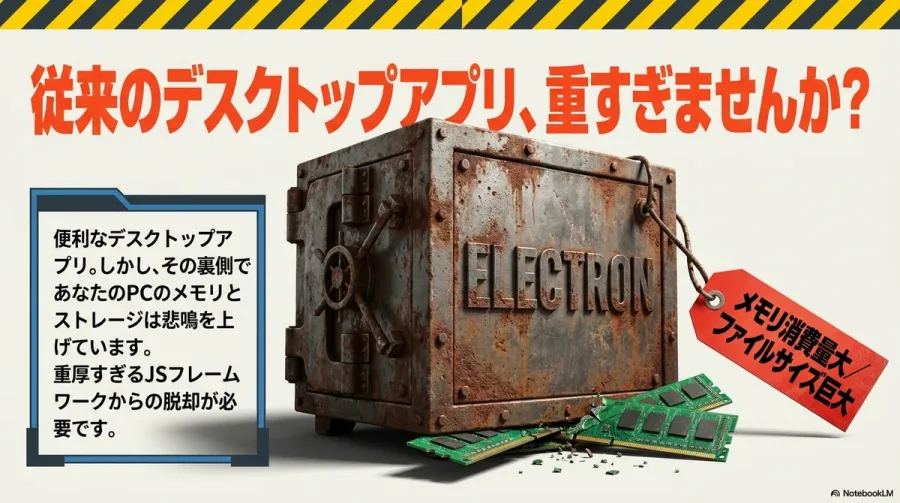
While Electron, the de facto standard for desktop app development, democratized development using web technologies, it has always been burdened by the fatal issue of runtime bloat.
Pake presents a new standard by rethinking the structural limitations that Electron faced.
Pake's superiority is summarized by the fact that it is approximately 20 times smaller than existing Electron-based apps.
This dramatic difference is driven by a difference in architecture.
While Electron bundles a heavy Chromium engine with every single app, Pake (Tauri) dynamically utilizes the 'System Native Webview' provided by the OS.
This eliminates resource waste caused by engine duplication, achieving a tiny package size of just a few megabytes.
The impact of this miniaturization is multifaceted.
First, in a world where modern apps often occupy gigabytes of storage, Pake apps barely put any pressure on storage resources.
This means easier distribution and faster downloads, lowering the psychological and physical hurdles for end-users to adopt them to the absolute minimum.
This approach, which eliminates resource waste, minimizes machine load and serves as a powerful answer to environmental and economic concerns by slowing down hardware replacement cycles.
4. Problems Solved: Liberation from Browser Constraints
Modern knowledge workers have their concentration eroded daily by 'tab fatigue,' the struggle to find a target page among countless tabs in a browser.
Excessive reliance on browsers always carries risks, such as interruptions from notifications on other sites or the accidental closing of tabs.
Pake fundamentally resolves these issues by separating and isolating websites from the 'general-purpose container' that is the browser.
By introducing Pake, specific web services sit in the OS dock or taskbar as independent icons, functioning just like dedicated native apps.
What is important here is not just that the windows are separated, but that an operating system equivalent to native apps is provided.
Rapid URL copying: Instantly retrieve the current page URL with 'Cmd + L (Ctrl + L)'.
Cache management: Clear cache and restart with 'Cmd + Shift + Backspace (Ctrl + Shift + Del)'.
Visual immersion: 'Immersive windows' without URL bars, title bar drag-and-drop movement on macOS, and page navigation via gestures.
Detaching tools from the browser and giving them dedicated shortcuts and a native feel facilitates a psychological shift in context.
This transformation into an "independent entity" is the key to guiding users toward deep work.
5. Usage and Installation: From Beginners to Professionals
Pake is designed with multi-layered usage paths so that users of all technical skill levels can benefit.
For Beginners: "Popular Packages" such as WeRead, Twitter, Grok, DeepSeek, ChatGPT, Gemini, and YouTube Music are available and can be downloaded immediately without any build process. Note that "Mole for Mac," created by the author, is not a Pake feature but a cleanup app intended to support development.
For Developers: Packaging can be done with a single command using the CLI tool. While an environment with Rust >=1.85 and Node >=22 is recommended, even if you lack a local environment, you can use "GitHub Actions" cloud builds to generate the app online and receive the artifacts.
-
For Advanced Users:
Incognito Mode: Building a privacy-focused browsing environment.
Container Communication: More advanced integration between the app and the system.
Customization: Removing ad elements or fine-tuning styles via CSS.
Even more important is the licensing structure.
The Pake core is released under GPL-3.0, but what is particularly noteworthy is the existence of the "Pake Output Exception."
This legally guarantees that applications generated using Pake become the user's own property, free to be used and distributed.
This transparency and guarantee of rights create a sense of security for business use.
6. Conclusion: The Future of Applications Opened Up by Pake
Pake is a platform that expands the possibilities of the Web by integrating the three elements of "lightweight, fast, and simple" through the technical decision to utilize system-native web views.
It is nothing less than a sophisticated answer from a technology architect to the ever-bloating modern software landscape.
The widespread adoption of Pake will have a long-term, structural impact on future SaaS usage and individual productivity.
Users no longer need to wait for vendors to release heavy, dedicated apps; they can generate lightweight, optimized tools for themselves.
This trend of "autonomous application generation" has the power to optimize individual workflows at the OS level.
Turning your favorite websites into your own sharpened, dedicated tools.
I often find myself imagining what kind of use cases this will create.
For example, a performance comparison table. I turned that into one of my tools. It's not just about being able to see it online anytime.
You can get a single-page database with sorting functionality right away.
With just one command.
To me, it looks like the number of entry points for materials that LLMs can handle has increased.
That is all for this story.
Thank you so much for reading until the end this time as well~~~✌️
I use this as an indicator of what kind of content is helpful to others.
If you found this even slightly useful, I would be happy if you could "Like" or "Follow" me.✨✨
If I post too much, I might end up looking like an annoying bot.
I am considering just studying the tools that get fewer likes and not posting about them.