FOODSCAPE Magazine | Roman Food Culture Research Report
When those who know food hear the name Testaccio in Rome, they first think of the "Mattatoio" (slaughterhouse). From the end of the 19th century through the 20th century, this facility handled all of Rome's meat processing, transforming Testaccio into Rome's largest working-class neighborhood. As a culinary byproduct, the slaughterhouse gave birth to the cooking philosophy of "quinto quarto" (the fifth quarter)—the very soul of Roman cuisine, which laborers who could not afford noble cuts of meat elevated through wisdom and time, using offal, tails, heads, and more.
The restaurant that connects that memory to the present day is located at 97 Via di Monte Testaccio. Flavio Al Velavevodetto.
"Velavevodetto"—a name that means "I told you so" (Ve l'avevo detto) in the Roman dialect—was inherited from the previous owner. Due to the superstitious customs of the restaurant industry, only the name has lived on through the ages.
The restaurant's most distinctive feature lies in its physical foundation. Deep inside the building, visible through large glass panels, is Monte dei Cocci (Mount of Potsherds)—a 35-meter-high hill formed by the accumulation of amphorae (terracotta jars) fragments used to transport olive oil during the two centuries of Ancient Rome. Its porous strata retain moisture while circulating air, functioning as natural air conditioning even in the height of summer.
The restaurant is literally built upon the waste of Ancient Rome. Interpreted in the context of gastronomy, this resonates perfectly with the philosophy of "circulation and regeneration" inherent to the location of Testaccio—the philosophy of the quinto quarto, which transforms what was meant to be discarded into something of value.
Two declarations inscribed on the menu
When you sit down and open the menu, two "declarations" catch your eye before the dishes themselves.
The first is a long explanation of "why it is Matriciana and not Amatriciana." It is a quiet rebuttal from the Roman side to the city of Amatrice obtaining EU STG certification in 2020 and protecting "Amatriciana" as a geographical indication. The menu argues: the origin of this dish is uncertain. Both Rome and Amatrice have claimed it as "their own" for centuries. Tomatoes were added in the 18th century, after the Neapolitans spread them throughout Italy. According to the Roman theory, it was born when the shepherds of Amatrice stayed in Rome during their winter grazing, and Roman ingredients and techniques fused together. In any case, the restaurant's answer is clear: "Noi semo de Roma (We are Romans). That is why we call it Matriciana here.."
The second is a list of "things we do not serve at this restaurant."
Spaghetti con le polpette (spaghetti with meatballs)
Fettuccine Alfredo
Fettuccine alla Bolognese
Cappuccino
These are all dishes that spread around the world as "Italian food" for tourists, or the habit of having a cappuccino after a meal—things that do not fit the original Roman and Italian food culture. The list is not a prohibition of dishes, but a declaration of culture. A quiet, yet unwavering message: "If you are going to eat here, eat Roman food." Against the wave of tourism, the menu itself acts as a breakwater.
The Testaccio table
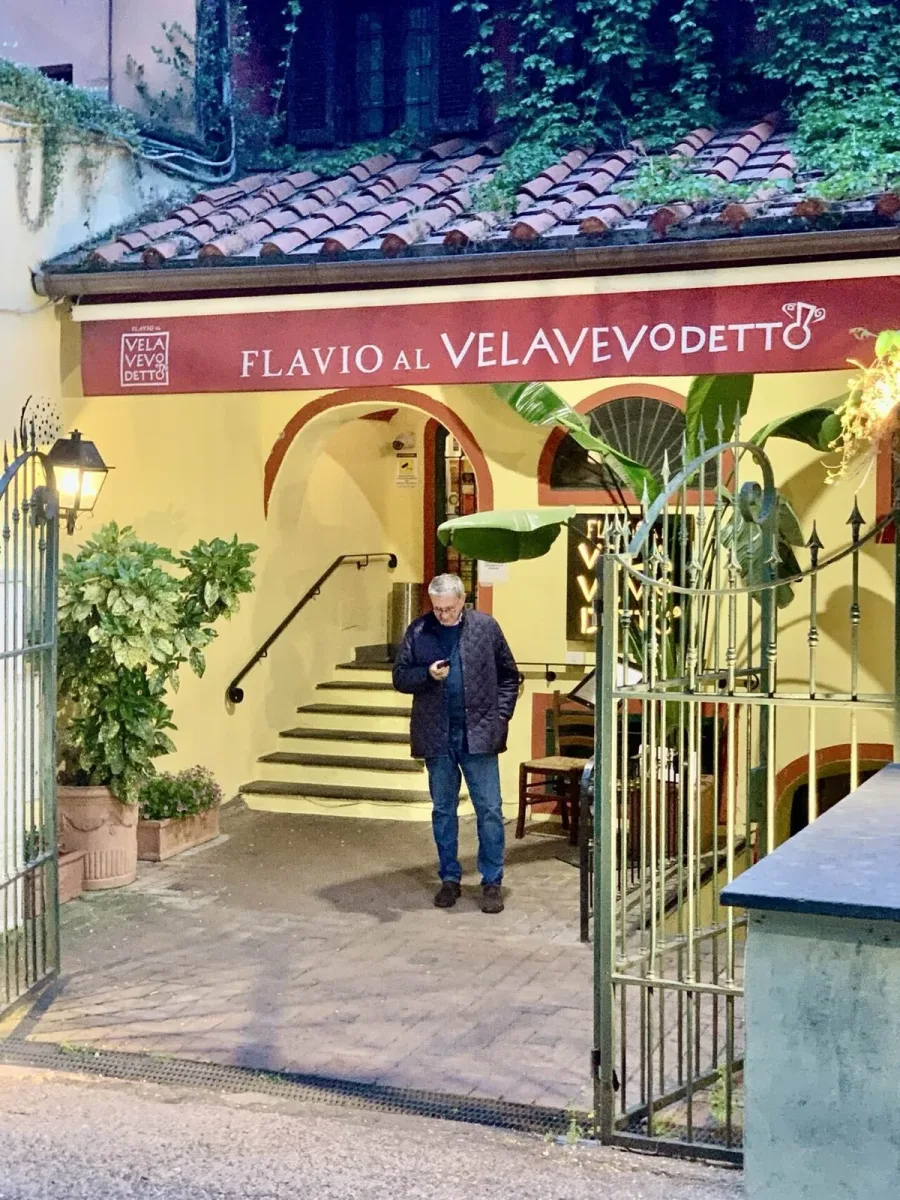
The entrance at dusk. The neon sign for VELAVEVODEITO glows against the terracotta-colored exterior walls. The restaurant name is repeated on the parasols of the terrace seating. Not as a decorative display, but like an imprint of the place.
The wine chosen was Casale della Ioria / Cesanese del Piglio D.O.C.G.—100% Cesanese, a variety native to the Lazio region. It is a full-bodied wine with an indigenous wildness, a bottle that pairs well with the powerful dishes about to be brought to the table.
Contorno—The Philosophy of Roman Vegetables
This evening, the first things to leave an impression were not the pasta or the meat, but three vegetable dishes.
Sautéed chicory with garlic and chili. Bitter, with the heat of olive oil and chili drawing out the aroma. This is the cheapest vegetable in the Roman market, and at the same time, the most philosophical—a culture that appreciates bitterness is proof of a mature palate that does not rely on sweetness.
Zucchini alla Scapece (sautéed with mint). A crispy surface and a vibrant aroma. In the osterias of the Testaccio neighborhood, mint functions not as a herb, but as a structural element. It cuts through the fat, lightens the aftertaste, and acts as a bridge to the next bite.
And the Carciofo alla Romana (Roman-style artichoke)—the most memorable dish of the night.
Lying on the plate with its stem intact, it is almost sculptural. Braised in olive oil, mint, and garlic, the outer leaves of the artichoke are soft and tender, while the dense umami is concentrated toward the center. There are two ways to prepare artichokes in Rome—the Jewish style (alla giudia), which is deep-fried to make the outside crispy, and the Roman style (alla romana), which is braised in oil to bring out the tenderness of the inside. The latter is a dish of time. A dish that refuses to be rushed. The very sense of time inherent in Testaccio's food culture is right here.
Why did this dish leave such an impression? It is likely because it showed me the 'perfect form of the season.' April is the peak season for Roman artichokes. This is likely the result of the perfect timing that can only be encountered in this season, when the local variety called 'Ciaccolaro' floods the market, combined with the restaurant's direct access to the source (their own farm is in Cerveteri).
Primo—The Two Poles of Roman Pasta
I ordered all the pasta dishes this evening as mezzo primo (half portions). It was an instinctive decision by a reporter wanting to try multiple flavors, and this restaurant was happy to accommodate.
Tonnarelli Cacio e Pepe. The milky white sauce clings to the grooves of the tonnarelli. A complex world made of only three ingredients, where the saltiness and umami of the pecorino and the kick of the black pepper become a trinity. Flavio De Maio once mastered this dish at the prestigious 'Felice a Testaccio.' This is that direct lineage of flavor.
Rigatoni al Sugo di Coda (oxtail ragu). A rich sauce that penetrates even inside the tubes of the rigatoni. This is pasta that utilizes the top layer of Coda alla Vaccinara—a dish of circulation where the secondo and primo are born from the same stew. As the 'what we don't serve' list on the menu indicates, there is no place for fettuccine bolognese here. There is only food made with Roman ingredients and Roman time.
Secondo—Two Dishes of Quinto Quarto
Polpette di Bollito (fried meatballs made from boiled meat). The leftovers from the previous day's bollito are shaped into balls and fried. Crispy on the outside, moist on the inside. A dish that expresses the Roman food philosophy of 'a Roma non se butta niente' (in Rome, nothing is thrown away) in its simplest form. Here is the real 'polpette,' the polar opposite of the 'spaghetti con le polpette' rejected on the menu.
And the Coda alla Vaccinara (Roman-style oxtail stew). A stalk of celery is submerged in a sea of deep brown sauce. The meat around the bone melts away, and the sauce has a complex sweetness and depth created by the long simmering of tomatoes, celery, pine nuts, and raisins. It takes at least three hours to make this—a dish that is the literal consumption of 'the meaning of taking time'.
Dolce—Tiramisu al Bicchiere
Finish with a tiramisu in a glass. Three layers of espresso, mascarpone, and chocolate sauce. After trying it, I understood why regulars say this restaurant's tiramisu is a "must-eat." It is neither too light nor too heavy, and the bitterness of the coffee cleanses the palate at the end.
Also, if you order a cappuccino here, it won't come. It says so on the menu. Ending the night with an espresso after a meal is the Roman way.
What Flavio Al Velavevodetto Protects
For three people, including bread, three vegetable dishes, three pasta dishes (half portions), two main courses, dessert, and wine, it was 129.50 euros (approx. 43 euros/person). For a place that has caught the attention of the Michelin Guide and was praised by Slow Food founder Carlo Petrini as "one of my favorite restaurants in Rome," the price is surprisingly reasonable.
Honestly, it exceeded my expectations.
Famous restaurants often have the pitfall of "reputation preceding quality." However, this place did not have that. Every dish had a reason for its existence, backed by the history of the Testaccio area, the philosophy of quinto quarto, and the timeline of the seasons.
And the two declarations written on the menu—the "reason why we call it Amatriciana" and the list of "what we do not serve"—are not just empty talk. This is culinary self-definition. Amidst the waves of tourism and globalization, by articulating "who we are, what we protect, and what we refuse," this restaurant has established its reason for being.
From the perspective of gastronomy research, Flavio Al Velavevodetto is not just a "delicious restaurant." It is a rare food culture institution that preserves and practices the region's culinary memory in real-time, while actively expressing it through words and attitude. In a Rome where the philosophy of quinto quarto, born from the workers of the slaughterhouse, is fading under the waves of tourism and gourmet trends, this restaurant continues to keep that light burning.
If you come to Testaccio, you should start here. That's why I told you—Velavevodetto.
Reporting and text: Editor-in-Chief of FOODSCAPE Magazine, April 13, 2026, in Testaccio, Rome
Flavio Al Velavevodetto Via di Monte Testaccio 97/99, Roma (Testaccio district) Tel: 06.57.44.194 Hours: Lunch/Dinner Estimated budget: 40-45 euros/person (including wine)