This is a table of contents as long as a receipt.
Introduction
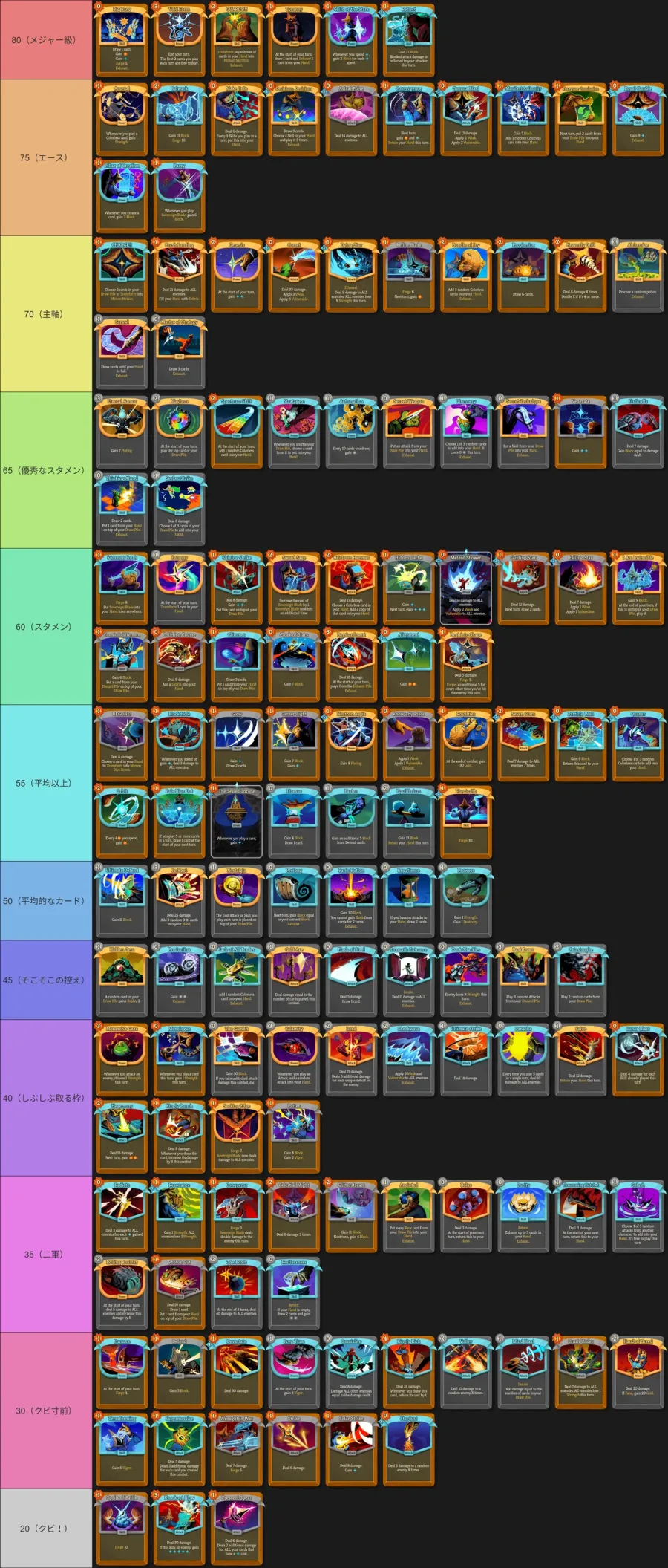
The meta has changed so much in the last two months that I felt it was impossible to continue writing based on the tier list I created at launch so I rewrote it from scratch.
The following is my previous article.
Because I was so slow to summarize the tier list I made into a note you might be able to glimpse me struggling to choose my words while evaluating the cards in the text. That said, since I had already evaluated most of the cards by then, I will focus here on why these evaluations are the way they are, rather than on individual card descriptions. After all, if it's too long, you'll get bored. I realized that it's hard to write if you don't do it with momentum.
As of the time of writing, I have recorded a 74% win rate at A10 so I am confident that the content is worth reading. Please read until the end if you'd like.
Tier List
The tier list for the current meta is as follows.
Here, I assume that cards two grades apart have roughly a one-standard-deviation difference in power.
If the grades are one apart: Approximately 64% chance to pick the higher-ranked card
If the grades are two apart: Approximately 76% chance to pick the higher-ranked card
If the grades are three apart: Approximately 86% chance to pick the higher-ranked card
If the grades are four apart: Approximately 92% chance to pick the higher-ranked card
Please understand that there is a difference in card power to that extent.
In particular, consider cases where you pick a card three or more grades lower as an 'emergency evacuation' when your deck is about to collapse.
By the way, it used to look like this before.
The changes can be broadly categorized into the following three points.
The evaluation of Sovereign-type cards has improved significantly
The evaluation of Mana (blue star) cards has stabilized
It has become less necessary to rely on colorless cards
The images are overwhelmingly beautiful!!!!!!
I hope you keep this in mind while reading. Regarding the images for each card, they are cited from slaytabase.
Grade 80 (Major League)
These six cards are powerful enough to define an archetype on their own. Just like the "Mana archetype" or "Forge archetype," these six cards possess the power to justify calling your deck a "Big Bang archetype" or a "Star Child archetype".
Big BangThe premier card that can do anything.
The development after playing it is incredibly strong, and just by playing it at the start of the game, you get
6 cards in hand
4 energy
4 mana
A Sovereign card that deals 15 damage with 2 energy retention added to your hand
You can start the game from this state, and its strength is that it can serve as a starting point for any deck.
Also, the action of generating a Sovereign while increasing energy by 1 is extremely powerful. Playing the generated Sovereign is effectively equivalent to playing a 15-damage attack with Retain for 1 energy.
In addition, if upgraded, it becomes a 15-damage attack with Innate and Retain for 1 energy, and furthermore, the initial hand pressure typical of Innate can be ignored thanks to Big Bang's "+1 Draw."
I think its strength, which no other card has, is that it can act as simple early-game firepower in addition to solidifying block and hoarding resources.
Void FormWhile it is somewhat difficult to get through, once you do, it is a powerful card that will generate value no matter what.
Its main job is often cheating mana costs, but it is also powerful in that it can cheat Sovereign costs, status effect costs, and mana resource costs. Since there is never a situation where you have "nothing you want to cheat," it has almost no downsides and is extremely powerful.
GUARDS!!!You want to heavily compress your deck
You need block in an emergency
The appeal is that it can be used strongly in either case. You might think it's a card whose role changes between the early and late game, but it is also attractive because it can generate 36 (48) block just by turning 4 cards in your hand into tokens, allowing it to fulfill its role as an emergency button from start to finish.
Not only does it have many cards that synergize well with it on its own, but because this card itself can handle compression, it is very versatile in that it can act as both a combo finisher and a bridge for combos.
TyrannyA demon of consistency that has high compression ability, the ability to pull key cards, and can also handle the junk thrown by enemies.
Most cards like this are only "strong if you can play them," but since Tyranny is granted Innate upon upgrade, you can reliably execute the aforementioned moves, leaving no holes.
It is designed to thoroughly eliminate gaps, weaknesses, and downsides, and despite this being a game with strong randomness, it is very pleasing that "you won't be betrayed even if you build your deck assuming the existence of Tyranny."
The fact that Regent can significantly reduce the number of 'enemies you must care about' is powerful. It is especially sufficient as a reason for adoption just to reduce matches where you struggle against enemies that put junk in your deck while attacking such as Phantoms, Mechanites, or Experiments.
Child of StarsIt is a vital presence in decks that primarily utilize Mana. It bridges the unstable turns between consuming Mana and recharging it by generating block.
In the first place, getting 4 (6) block from Falling Star is strong. Applying Weak without consuming energy, combined with 6 block, is sufficient for damage mitigation, and it can be used effectively even in decks that do not focus on Mana.
Ultimately, what it does is 'carry over block via Mana resources and release the accumulated block at your preferred timing,' so there is little waste. Especially in the late game, it can be used like a card that can release 6 (9) block from Awe at any time, making it easy to incorporate without wasting your starting cards.
It can also stand strong against Doormakers who force compression and Queens who inflict Vulnerable, making it practically an essential piece of infrastructure.
ReflectIt is a rare card that allows you to shut down enemies from start to finish just by repeatedly playing it..
Although 3 Mana is heavy, since you are provided with 3 Mana by your starting relic, there is no problem playing it even if it comes into your hand on the first turn.
In addition, 3 Mana is supplied from Awe after upgrading, so theoretically, you can aim for a total shutdown just by compressing your deck. Of course, it won't work 100% of the time just by doing that, but it works about 70% of the time.
It is a key card with no complaints, as simply leaning into a 'repeatedly play Reflect' build naturally increases the stability and power of your deck.
Because it has good synergy with the starting card Awe, it is possible to perform feats like repeatedly playing only Reflect, even if you aren't focusing on Mana. It truly possesses an intense power that transcends various builds.
SummaryAs I mentioned at the beginning, this rank tier consists of cards that will reward you if you build a deck around them. They are not only high in individual performance but can also be used more effectively by adding support.
Beginners should first focus on these 6 cards and try building while thinking about 'what should I do to use this card effectively?' Through that process of trial and error, you will naturally be able to build strong decks and, consequently, start winning.
Grade 75 (Ace)
These are cards that can serve as key cards for a specific archetype.
To put it simply, it's a card that is "faster than Demon Form, more reliable than Demon Form, deals more Strength than Demon Form, and is lighter than Demon Form."
There are three major strengths. First is the breadth of its synergy. Since it is enhanced by card generation in general, it benefits not only Colorless builds but also Mana, Debris, and even Sovereign builds. Additionally, since you can increase Strength through card generation via potions, combined with the advantages mentioned later, it is powerful because it is hard to lose your role even if your hand is bad.
It is blessed with not only generation but also output destinations; if you have spare Energy, there is Heavenly Drill, and if you have spare Mana, there is Seven Stars. It possesses a wide variety of finishers.
The second point is that it is incredibly light. It costs only 1 Energy to use, and it is very grateful that it gains Innate when upgraded. When building a deck around this card, regarding the setup to place the Armory, the draw sources to draw the Armory quickly, in other words, the resource consumption until you reach the Armory, you can ignore all of that, so it is unlikely to cause situations where you are struggling just to play your cards.
Also, fundamentally, the fact that Strength increases by about 5 can be interpreted as having an effect of roughly double damage. In other words, even if you haven't thought deeply about synergies, as long as you have cards that can generate, it will provide more than enough benefits. Combined with the reasons mentioned later, the fact that it functions solely with generation types also contributes to its lightness.
And the third point is that it is very fast. Unlike Demon Form, this card's scaling speed does not depend on the number of turns, but on the number of times you play generation-type cards, in short, it depends on the speed at which you cycle through your deck.
To use the Armory effectively, it is powerful to cycle through your deck as fast as possible. To cycle through the deck quickly, it is best to avoid casting Shield as much as possible and annihilate the small fry, and the Armory can indirectly assist with that. In other words, the more powerful the deck becomes, the more powerful the Armory becomes, and the powerful Armory further trains the deck—the self-cycle of mutual symbiosis that exceeds expanded reproduction is likely its unique advantage.
Overall, not only do you not have to set up turns for waiting or enduring for one or two turns, but the power to assist in acting immediately is extremely strong compared to similar cards. Given that Strength increases sufficiently even without thinking much about synergies, as long as you have some decent forging cards and cards like Collision Course, I have given it this evaluation.
BulwarkAn irregular reflection.
The high performance of being able to shut out opponents if you can theoretically keep playing Bulwark is attractive. Although it is one turn slower compared to Reflection, the Sovereign Blade that remains later functions as both simple firepower and a trump card, making the startup very easy.
One card I pick almost first in the early game.
Make It SoA convenient Attack that triggers under simple conditions. It is specialized in stabilizing deck tempo above all else. In the early game, it can deal damage after Awe or Defense, reducing situations where you are purely on the defensive. And from the mid-game onwards, when you can spam skills, if you have this one card, you don't need to take AOE attacks, allowing you to deal damage with great flexibility.
Also, not only when it is in the discard pile or deck, but even if it is exhausted, it returns to your hand is one of its charms. In the late game, it acts like an infinite resource card, and even if it is exhausted by the effects of Spectrum Knight or Door Maker, it can stubbornly carve out damage, allowing you to avoid situations where you lack damage output.
Like the Armory, it is a card that easily strengthens the deck while also acting even more strongly in a strong deck, so its charm is that it is easy to include without much downside.
Decisions, DecisionsThere are several cards in Regent that fall into the play to wincategory, but this is one of the top-tier cards among them.
Setting aside mana accumulation, you don't need to prepare any special support cards for it, so the fact that it can function as a deck just by specializing in playing DD is powerful. Regardless of synergy, it embodies the idea that any card is strong if you play it three times.
Astral PulseCrazy AoE performance
-
You can clear Act 1 to early Act 2 with this
Just by combining it with Star Child, you can deal 14 total damage + 6 block for 0 energy
You can clear Act 1 just by playing Pulse
The 3-mana cost is also great, and it's possible to generate 9 block with Star Child while attacking
It's powerful against all enemies that Regent struggles with, so you'll want to add it if you see it.
It's one of the strongest commons even across all characters; I don't know why it isn't an uncommon.
A small Big Bang. Regent in the current meta has high draw power, and it's easy to play by continuing to play 1-2 Convergences every turn to avoid the risk of hand accidents while scaling, so this card has greatly increased in value compared to before.
If the hand you are retaining is strong, it is of course powerful. Even if it is weak, if you have additional energy and mana, you can usually make minimal moves.
And once you manage to reach a shuffle, the next turn's hand (draw pile) is guaranteed to be a strong one containing Convergence, so the appeal is that even if you draw a bad hand, it leads to a strong play.
In short, the strength of Convergence is that it makes it easy to avoid the losing condition of "the deck's cycle stopping because weak cards are mixed into the discard pile."
Gamma BlastAn irregular cost Uppercut.
In addition to a powerful effect that works well in any build, the fact that you can consider it a pseudo 1-energy (prepaid) card just by upgrading Awe also increases the evaluation of this card.
The combo of repeatedly playing Falling Star and Gamma Blast to keep applying Weak and Frail to enemies is simple yet powerful.
Considering that it doesn't consume energy,
can easily increase Sovereign's damage output, and can deal damage while also mitigating incoming damage, I imagine many people just pick up one copy as a default. It's similar to Wall. You could call it a type of infrastructure.
The appeal lies in its ability to scale until the late game if you keep playing it. Compared to cards with similar effects, this is the only card that can solidify block while generating colorless cards.
Actually, this block value is quite high, and even if you have a bad draw, the high level of self-sufficiency that allows you to at least solidify your guard and aim for another challenge is powerful. Regardless of the deck's direction, it's a card you can just pick up early on.
Foregone ConclusionA card specialized for building small loops. Since it can search without being interfered with by draw, if you have a deck that lines up many powers, it is easy to secure your opening moves and follow-ups, and it has excellent cycling performance.
The fact that this card exists is a strength because it excels at avoidingthe risk of including mediocre mana resources like Radiance or Solar Strikeandbuilding a thick, wasteful, and weak deck pointlessly.
It is true that you should aim to build a deck that functions without this cardbut ifyou can build a functioning deck just by including this cardthen that is good enough.
Royal GambleA powerful card that can increase your mana by 4 with a single play.
Fundamentally speaking, mana resources are just cards slightly better than Curses, aside from the fact that they give you mana, so you should try to run your deck with as few as possible. To run with a small number, it is absolutely necessary to generate a lot of mana from a single card, and from that perspective, Gamble, which can generate 4 mana from one card, is the most efficient mana resource.
In addition, if you upgrade it, it gains Retain. As I repeat, mana resources are essentially Curses, so having them retained in your hand is quite powerful in itself.
Furthermore, because it gains Retain, playing Awe to secure 5 mana and then playing Gamble to secure 9 mana becomes guaranteed, so you will never have trouble with mana.
Even without thinking too hard, if you realize thatby including this card you don't need to include 3 or 4 other mana resourcesits strength becomes obvious.
Seven Stars: 7 mana
Reflection: 3 Mana
Resonance: 3 Mana
Gamma Blast: 3 Mana
Falling Star: 2 Mana
Compared to these 5 cards that all have high mana costs,
Royal Gamble x2: 4x2 = 8 Mana
Hidden Treasure: 4 Mana
Awe+: 3 Mana
Shining Strike: 2 Mana
Gather: 1 Mana
I was able to cover the costs with these 6 mana resources and win with a deck of only 24 cards. If you were to replace Royal Gamble with other cards, you would need to include about 2 to 3 additional mana resources to gain 4 mana.
And since typical mana resources gain mana in exchange for energy, you would need even more cards to fill the gaps. As a result, you would end up building a larger deck, which would be slower and weaker.
Actions that grant mana without consuming energy are just that powerful.
Pillar of CreationAn armory that has become more reliable in exchange for losing Innate.
The amount of block generated is simply too high; it is also strong that Embodiment effectively becomes 12 block and Rampart effectively becomes 17 block.
If you combine it with Spectrum Shift to gain 4 block and 1 colorless card every turn, it reaches the power level of a boss relic.
Not only that, it becomes a terrifying card that thins your deck while generating 8 block with CHARGE!! or generates 16 block while playing 4 colorless cards with Joy.
Card generation shares the risk of having a non-negligible gap in your play turn in exchange for the reward of being able to inflate your resources indefinitely.
The fact that they "share a common weakness" conversely means that if you have one Pillar, you can handle everything, and in fact, it has synergy with more cards than you might imagine. Generating 4 block when creating a Sovereign Blade is also very welcome, even if it is subtle.
Because of Star Child, this card is often underestimated for various reasons, but the reason Star Child generates a lot of block is because it requires two things: mana resources and mana cost.
Pillar has advantages that Star Child lacks in that it can generate block on its own without forcing mana consumption. This card's opportunities to shine have increased dramatically due to the buffs to Sovereign and Joy.
You can take advantage of the fact that the timing and amount of block generated by Star Child and Pillar differ.
If you need a large amount of shield, use Star Child to stack block all at once
If you want to save up mana, use Pillar to avoid resource depletion
The movement is extremely powerful, and I believe that mixing one Star Child and one Pillar is currently the most stable build for winning.
It also has good synergy with Parry, which I will discuss later, and it has become the backbone that supports the current Regent.
In addition, it eliminates block cards like Star Mantle and Particle Barrier that make you poorer the more you use them, so mana becomes easier to save. As a result, you can fight with a more compact deck.
As mentioned in the Royal Gamble section, mana resources are essentially curses, and cards that don't function without curses can also be said to be essentially cursed cards.
Star Mantle and Particle Barrier are truly the leaders of cursed cards and are cards described as 'strong, but they shouldn't be. A deck where these are strong is a weak deck'. Pillar of Creation can treat those two cards that only provide shield as 'weak, unnecessary cards.' If I write 'a Star Mantle that doesn't clog your hand, requires no mana, and isn't affected by Vulnerable,' that should be enough to convey how powerful it is.
ParryIt is a hybrid of Star Child and Pillar of Creation.
The amount of block it generates is just too much. It goes without saying that it is strong in a Forge build, and because the 14 block you can use as insurance is so powerful, it is a card that is well worth including in other builds as well.
Star Child (Mana build)
Parry (Forge build)
Pillar of Creation (Colorless build)
—these three cards are in a league of their own in terms of strength because they have low dependence on the draw required to generate block.
If you can pick up at least one by the first half of Act 2, it will become dramatically more stable.
As a difference from Star Child and Pillar, since Sovereign is powerful as a simple source of damage in the early game, you can easily clear Act 1 just by incorporating appropriate Forge cards and Parry is a point worth mentioning.
This is the single card that has seen the most improvement in evaluation and performance since release.
At launch, it required a powerful Forge card beforehand and, on top of that, one had to consider the effort of placing a Parry as well. After repeated restrictions like these, it was a card used only in very limited builds.
As a result of the buffs to Forge-related cards in general and the significant buff to Parry, the initial evaluation has been reversed and overturned to the point where one considers including a decent Forge card just to utilize Parry.
It is a power card so good that you might even Forge for its sake, and it has made such an impact that it has raised the evaluation of other Forge cards by about two tiers on average, successfully wiping out the trend that 'Forge builds are weak'—a truly memorable card.
SummaryAs an aside, the reason the continuation of the previous note stopped coming out is because of this Parry.
Now that it has been buffed this much, the strategy of 'swinging Sovereign while waiting for Parry to build up' becomes extremely powerful from the early to late game.
It has reached the point where Forge builds have transformed into something powerful enough to win on their own, and I felt that continuing to write while maintaining the stance that it is just 'an extra for Big Bang and Ramparts' would be dishonest, so I decided to rewrite it.
To give you an idea of how powerful Forge builds are, they are strong enough to win A10 even if your only mana resources are Awe+ and Big Bang.
The attack method for this deck is to double Sovereign with Pen Nib and strike, and the defensive means are Parry and Star Child.
If a card that 'can generate block while attacking' is Parry, then a card that 'can stack block as high as you want if you feel like it' is Pillar of Creation. Use them according to their roles.
By the way, the card that 'can generate block while attacking and stack block as high as you want if you feel like it' is Star Child. It really is a cut above the rest.
Grade 70 (Main Axis)
It's not like you win just because you have this card, but there are many situations where you feel this card is necessary. I will introduce them in groups from here on.
It is a small armory, and if you draw it in the first or second turn, it is often stronger than the armory itself.
The bombs you receive are extremely powerful; by successfully combining Falling Stars and bombs, and whittling down enemies with Weakness, you can consistently clear encounters.
You should treat it as a Power card in practice.
Although there are many factors to be careful about, it is one of the best AoE cards in the entire game.
Since most mobs will die if you use it twice, the downside doesn't really affect you that much.
Combined with Pillar of Creation, it can become a card that ends the game.
It gives the impression of a sharper Pulse.
By paying 2 energy, you no longer have to worry about mana resources.
While the setup cost is heavy, the fact that the return is powerful from early on is attractive.
Being able to play Awe at the start of the turn is, in itself, a move worth 2 energy.
Its existence is great; you could say its strength lies in the fact that having it reduces your mental resource load.
(A card you tend to pick less as you get better at winning.)
Though it has a high cost, it's an excellent card that can wipe out most mobs. It's especially strong in Act 2.
Particularly strong in Act 2, this card fully benefits from being a Rare.
Dying StarDespite its heavy cost, it's a rare card that can shut down many attacks. It works well in multi-enemy encounters where they deal large amounts of damage at once.
The Ethereal aspect is a bit troublesome, but I personally feel the benefit of 'it disappearing on its own in games where I don't use it' is greater. It's best to build your deck while stalling with Dying Star.
Refine BladeOne of the cards that was significantly buffed after the update.
The ability to generate high Forge values on its own and energy carryover have excellent synergy.
Refine + 2 energy for block
Sovereign (19-23 damage) + 2 energy for block
Refine + 2 energy for block
......
In this way, maintaining block while building up damage output, this tempo-based playstyle is extremely powerful throughout the entire game.
Also, it has great synergy with Falling Star, and by playing Refine at the right time,
Falling Star (8 damage)
Sovereign (19 x 1.5 = 28 damage including Weakness modifier)
By combining these two to deal a total of 36 damage, it is possible to output stable damage throughout the early and mid-game.
An energy carry-over card that is strong when played repeatedly
Forge 9, which guarantees a win if played repeatedly
combined with the fact that even with a thin deck, it is easy to deal 36 damage is, I believe, the strength of this card.
For Neow, which requires many cards to be used effectively, a 36-damage output completed with just a common and a starter is extremely cost-effective.
Also, easing the burden when playing Sovereign by utilizing energy carry-over, or its cleverness and versatility in connecting to other combos are also advantages.
It generally has good synergy with Orbit as well; by spending 1 energy to carry over 1 energy, you can advance the Orbit count by 2 on its own, further mitigating the burden when using Sovereign.
Bundle of JoyConsidering you can get 3 cards from the highly versatile colorless pool, it is quite powerful.
A card that becomes stronger the higher your understanding of the game is, so it is great that it is worth exploring.
ProphesizeCompared to the above, it is a card that embodies isn't it strong if you can just draw 6 cards carelessly...?.
Since I have never seen anyone else say this card is strong, I think either I am too strong, or the world is wrong.
It is probably often evaluated as a draw source by the public, but a draw source that consumes 2 energy is weak.
The strength of this card lies in the fact that just by including one, it becomes easier to trigger a shuffle at the desired timing, in other words, it functions as a (pseudo) mass-compression card.
If you look at the remainder of your deck and it clearly looks weak, playing Prophesize allows you to cancel out the turn that would have been weak.
By holding many subtle cards in your hand, you can easily manage weak and strong cards separately, which is the strength of this card. If your hand is already strong, you shouldn't need to play it.
In terms of supporting the repetition of strong actions, Prophesize works powerfully.
It's like a milder version of the Necrobinder's Eidolon. While it also holds the title of the weakest, I don't think it's actually the weakest.
Heavenly DrillIf you pull it off, you win.
The 94 (128) damage combined with Falling Star is attractive.
If you use potions, relics, and other tricks, you can aim for this from the early game.
If you have potions, you can manage.
The strategy of using potions to conveniently play Alchemize every match is simple yet powerful.
The high difficulty of obtaining it is a downside.
It's essentially Scry with Exhaust, but at a lower cost.
It has the intense power to turn the tide even in slightly disadvantageous situations.
Its performance against bosses is even higher than in the previous game, and the ability to aim for a quick kill is another attractive point.
Because energy is unstable, it's a card that's harder to just play blindly compared to the previous game.
Roughly powerful 3-draw
It appears often so I don't buy it much, but it has powerful performance that is worth buying if you see it
Since this card doesn't do anything on its own, it is best used as an insurance policy
It's as usable as Alchemy fixed to an Acceleration Potion, and it's roughly powerful
It's a good thing that there are many cards that feel stronger than this one
Grade 65 (Excellent Regulars)
Eternal ArmorWith a Plating value this high, it's definitely worth playing
Playing it reduces the burden related to blocking, allowing for more aggressive play
As a result, the game ends before the armor rots, creating a virtuous cycle
The average number of turns played per combat is about 4 to 6 turns, and if upgraded, it is basically stronger than Sai (7 block per turn)
It's roughly powerful, and it's powerful but rough
Even without specifically setting it up, the fact that there are many cards you want to cheat out from the start is also appealing
Be careful, as there are some terrible cards like Void or Calamity
If you build around colorless cards, the number of duds increases, but it's on that perfect line where you hesitate whether to buy it or not
High-end Hello World
A card whose evaluation has risen significantly in the last two months
Since it picks from cards of Uncommon rarity or higher, it ends up being a good hit more often than not
It is also nice that cards from archetypes that don't synergize, such as Mana or Sovereign, do not appear
You need to solidify your guard on your own for 2-3 turns after placing it is required
(Especially in the early game) It is recommended to buy it just in case, but that is not very good
It is not a card to add when you have nothing, but a card to add when you are slowly starting to lose
A Power that lets you search for any card you like when reshuffling
It was extremely strong against Doormaker, but it was removed
The action of being able to bring any card you want after seeing your hand is actually strong
Since it stops functioning if it sinks to the bottom of the deck, treat it only as insurance
It gives the impression of a Strategist that has been made milder but is capable of long battles
Be careful, as it basically provides no benefit on the turn it is used
Almost the same as Stratagem
Roughly speaking, it is fine if it returns 3 energy over 2 turns
The benefit on the turn it is set is weak, and the benefit is not direct
Like Arsenal, the fact that it is a system where decks that can wake up Automation early receive the strongest benefits is powerful
It's not exactly a game-changer, but it's good because it's easy to incorporate naturally.
A solid, standard search card.
Since Regent clearly needs attacks at specific times for cards like Sovereign or Comet, it's slightly better than Technique.
Although it's highly random, the ability to cheat out high-mana cards or powers is appealing.
Regent often plays many powers to scale, so it's nice that cards you've cheated out are relatively unlikely to become dead weight.
At the end of the day, it's random, so you still need a solid deck foundation.
It's best to think of it as a high-variance Big Bang.
Since many of Regent's skills act as lubricants, its relative importance is lower.
Of course, it's nice to have, and it's great if you can get it for free.
A card whose evaluation has risen significantly over the past two months.
The 1 energy to 3 mana conversion after upgrading is exceptional, and just pairing it with Hidden Treasure solves most mana issues.
Rather than gaining 1-2 mana with Radiance or Solast, it's better to use Venerate early.
It also strongly stabilizes the use of Falling Star, so you want to upgrade Venerate early regardless of your build.
The significance of being able to easily incorporate 3-mana cards is greater than you might imagine.
Cost-effective Dash
For characters with Falling Star, it is simply a Dash that costs 1 less energy
It is strong and easy to handle, but be careful that it does not lead to damage output itself
It is easier to work with if you treat it strictly as a cost-effective block card
It has good synergy with the Necromancer, who often requires combos of two or more cards
The disappearance of its arch-nemesis, the Doormaker, is also a tailwind
The fact that it is the only card of this type for hand adjustment that does not consume energy is also a plus
It is inherently stronger than Pommel Strike
Just being able to pull Falling Star, Awe, Strike, or Defend at the right time makes things easy
The format of searching for one card of your choice from three is a perfect match for the Necromancer
The fact that it leaves the two unwanted cards in the deck is also very welcome
Note that it is not looking at the top three cards of the deck
You might not be able to draw the same card even if you play a draw effect afterward
Grade 60 (Regulars)
Members who feel like regular starters.
Summon ForthIt has become relatively powerful due to the buffs to Parry and Sword Saint
In modern StS, you win if you can swing Sovereign enough so search cards are also highly valued.
Note that this is only powerful when "Sovereign is the main axis."
Its standalone performance is inferior to Polish and not much different from Loot.
If you only need it about once per deck cycle, it is better to wait patiently.
If there is a possibility of swinging Sovereign three or more times then you should include it.
One of those cards that "pays off if you use it enough."
Irregular Tyranny
It's not weak, but surprisingly there aren't many good targets to swap it for.
There aren't many situations where you can do much with 4 cards in hand, and it tends to lead to a gambling-like setup.
It is best to combine it with things that can increase your hand at the start of the turn, such as Tyranny, Retain, and Pave.
I've said a lot, but in Act 1, it's quite casually strong.
You get 2 mana for 1 energy.
If it spans 2 turns, it effectively becomes 4 mana.
There are no other particular strengths, so you should include it when you are short about 4 mana.
It's nothing more than a degraded version of Royal Gamble, and while its theoretical value is the lowest, it is sometimes necessary.
Since it just looks like a degraded version of Awe anyway, the evaluation will likely drop even further by next year.
A card that can double-strike (dual-wield after the update)
Honestly, in terms of feel, it's exactly the same as Limit Break
So it's reasonably strong, but I feel like you need at least two of Rampart, Parry, or Polish
It's extremely powerful if you have a card that can generate Forge early or a card that can eliminate openings
Before the update, it meant increasing the cost of Sovereign by 1 instead of double-striking—a level of weakness that made no sense
Combined with Sword Saint + Forge, who would be happy with 6 (5) energy reserved for about 40 damage? I wonder if they thought...
It was often introduced as the whipping boy for the theory that Sovereign is the weakest
The overwhelming mediocrity of using two cards to create an inferior version of Bury (Uncommon) or Reap (Common) is famous for giving us, who were full of excitement for the new year, fresh laughter and shock
(At the time of release, I was in despair at the sheer difference in character power)
Heirloom HammerThere is no time to play around with things like duplicating Sovereign for dual-wielding!
A card used to duplicate powerful Ancient cards like Aurora Flame or Phantasm
It's also possible to use it as an insurance policy by duplicating Sovereign, but only if you have Parry
One of those cards that is "strong if used well"
Although it is niche, since the existence of a "game where Aurora, Phantasm, and Parry never show up" is rare, it gets a decent rating for now
A mana resource that does nothing but generate a lot of mana
Better than many cards that 'don't do nothing, but do almost nothing, and don't provide much mana supply either'
The ideal form is to alternate with Awe+, and mana supply is sufficiently possible even without upgrading Hidden Assets
The ability to allocate upgrade rights elsewhere is also a strength that sets it apart from other mana resources
Although niche, it has high self-sufficiency
Regarding the priority of mana resources
Awe+
Royal Gamble+
Hidden Assets or Genesis (regardless of upgrade status)
Light Concentration+
Radiance+
Light Concentration
Awe
Radiance
Royal Gamble
I believe the ranking follows this order.
Especially regarding Gamble, it is weak if not upgraded, so I believe the ideal form is to fill the gap with 1 or 2 mana resources.
In that sense, I believe Hidden Assets is rated relatively highly because it is easy to fill the gap with just one card.
Meteor ShowerIt's casually strong and too powerful
It's just that they 'cannot become a core component' due to acquisition difficulty, but their power when lined up side-by-side is among the best.
It is also excellent against Centipedes, Mini-Louse, and Knights, which Regents struggle with.
A draw engine for the mid-to-late game.
It's not very strong when put into decks that rely on Mana as their core.
If anything, it's a strong card to include in decks that use only Falling Star as their main focus.
Since it allows for easy scaling when put into decks that have leftover Mana, I pick it up reasonably often.
The fragility of its draw cycle is a clear weakness, but it is excellent as a supporter for Forge-based builds.
Another high point is that with Star Child, it becomes a cost-effective card that outputs '13 damage, 6 block, 3 draw' for 1 Energy.
The entirety of the Regent.
0 Energy (1 Energy prepaid) for 8 damage, 1 Weak, and 1 Vulnerable is enough to break through the early game.
Let's fight by making the most of it.
If you can make good use of your starting cards, that is the most eco-friendly and strongest form of deck compression.
Simply put, the block value is high.
It's often considered weak because the effect is hard to use, but it's actually strong even if you just play it normally.
Regarding the criticism that 'I would use it if it weren't a Rare,' I agree completely...
A card that you use if you have it, and it pays off when you do.
Another card that you use if you have it, and it pays off when you do.
Recommended if you have a high dependency on specific cards.
In other words, a card generally picked to support the early to mid-game.
You want to avoid taking it if possible, but there are many runs where you have no other realistic choice.
It doesn't have good synergy with Invisibility because relying on Invisibility won't necessarily help you win.
A card that lets you choose between '1 Energy for 9 damage' and '0 Energy for 9 damage plus 1 junk'.
Ultimately, what it boils down to is a 1-Energy attack that can be paid for later, so it feels similar to '0 Energy, 1 Mana, 9 damage'.
That said, since it doesn't actually consume mana, it has good synergy with Falling Star.
It's a card I often pick when I'm struggling in the early game, partly because it doesn't leave much of a mess behind.
Among Necromancer cards, it's a rare attack that can be played casually and has low commitment.
A card to pick up in the mid to late game.
It has high draw power and allows you to adjust your deck by placing cards on top.
However, since you can also do that with Guiding Star, it's not exactly a unique strength.
The strength of this card lies in the ability to discard weak hands by timing it with a shuffle.
Thinking of it this way, the effect of placing a card on top of the deck can be seen as an effect to save strong cards in your hand.
In other words, just like the illustration, it is possible to operate it in a way that cycles strong cards.
Regarding Prophecy and Glimmer, everyone else says they are weak so I am at the cutting edge
A Collision Orbit that can provide block
It's strong, but essentially a block card that you pay about 0.3 energy for in advance
If I'm struggling in the early game, I'll take one, but I might hold off if I have Rampart Reflection
Note that it is not much different from Deflect
It is strictly a card for providing consistent block, so you will need other block cards for big attacks
The fact that it has synergy with Star Child is quite good
Strong in a casual way
In Act 1, I think it's easy to use even without specific exhaust elements
If you have Pael's Eye, it has the potential to break the game
There are relatively many cards that synergize with it, making it a fun card to use
Note that transforming is not exhausting, so they don't have good synergy
In particular, its compatibility with Charge! is not very good; they compete for energy, and since you can deal damage with Minion Bomb, Bombardment becomes less necessary
Strong in decks that cycle through cards
In decks that don't focus on Mana (especially Colorless-focused), it is extremely powerful because you can use up the increased resources
Conversely, if you are Mana-focused, since almost all cards have a Mana cost set instead of energy it doesn't really have much meaning
Note that 3 mana is heavy, and since there are powerful cards like Reflex Gambler, you need to pick with that in mind.
It goes without saying that it has good synergy with Prophecy.
The key is how many high-quality draw sources you can pull.
In about 40% of situations, it is an inferior version of Polish.
If you can output about 10 Forge in the early game, it serves as a simple damage source.
From the mid-to-late game onwards, its strength lies in its ability to act as a scaling card by increasing hit counts or by being played every turn to expect about 20 Forge per turn.
Either way, it is a compromise, and superior versions certainly exist.
However, it is convenient because it is a card that can maintain some kind of role from the early to late game.
Among the specialized Forge-axis cards, it has quite straightforward performance.
If I had to ask for more, I would have wanted the multi-hit types to be stronger...
Grade 55 (Above Average)
Even if you collect only these, you won't win, but they are cards that work in your favor in most cases.
BEGONE!A card that uses 1 energy to deal damage and compress your deck.
Since the bullet is a cantrip, its selling point is that it is hard to lose tempo when compressing.
However, since it consumes 1 energy and 2 cards from your hand to deal only 6 damage, the turn you play it is weak.
In addition, BEGONE! itself tends to become a dead card in your hand.
Unlike 'Charge!', which can compress two cards at once, it lacks compression performance and scaling.
However, it has the benefit of being able to remove unnecessary cards from your hand and is strong against status effects.
An AoE that deals damage every time you perform a mana-related action.
The conditions are relatively loose, the damage output is decent, and it has the strength of not being affected by Weak.
However, it is ultimately a card that doesn't function unless your deck is cycling well, so it's hard to make it work in the early game.
In addition, since AoE is needed near the start of combat, drawing it early is necessary.
Since Star Child Pillar Specif (Parry) exists at the same cost tier, it often gets cut to prioritize that instead.
It is a strong card with potential, but since it can basically only deal chip damage, it is currently a bit of a jack-of-all-trades, master of none.
The combo with Sealed Throne is strong enough to break the game.
If you see a Vantom (or occasionally a Bloodline), it's a card you might pick up even in the early game.
Overall, it is mainly used in the mid-to-late game as a combo piece added after your mana base has stabilized.
It's a really mediocre card in the early game.
If unupgraded, it's painful because it essentially consumes energy without doing anything.
It is, of course, strong in the late game when you have room for upgrades.
Thanks to the additional draw, it can form a cycle structure that repeatedly plays mana resources.
Personally, I don't like having too many mana resources just as much as I dislike 'not having mana,' so I don't want to add it thoughtlessly.
It is the most well-rounded single-copy addition for the mid-to-late game.
It might be best to think of it as a common version of Gather Light.
I think Brilliance is the easiest to slot in when you are short on mana in the late game.
It is designed so that you might hesitate a bit on the first copy, but can pick up subsequent copies easily.
Unlike Brilliance, this has decent block value, making it easier to pick up from the early game.
Since it cannot win on its own and does not expand your board state, I prefer not to touch it in the late game.
It is also painful that it only provides 1 mana even after upgrading.
In other words, it requires other mana resources.
The strength lies in the fact that it can form a flow to upgrade Awe early on to avoid damage in the early game.
The issue of "only providing 1 mana" is greatly mitigated if you have Awe+, so they synergize well.
Subjectively, I think it is slightly stronger than Brilliance.
That said, you still want to keep your deck size small, right?
It is designed so that you can pick up the first copy easily, but will hesitate on the second copy onwards.
A power card that is relatively suited for the early game.
One of the big reasons to upgrade Awe early.
As I mentioned with Immortal Armor, in this game,a single combat ends in 4-5 turns on average
If you can set it up, it's stronger than Sai (the tank relic that gives 7 block every turn)
It's often said to have mediocre values, but the numbers are actually quite high
Its biggest weakness is that its role easily overlaps with Star Child
You can play Aegis before Star Child, or Star Child before Aegis, so honestly, they don't overlap that much
However, because block tends to overflow,Aegis is relatively harder to use and more likely to be cut
The difficulty of obtaining it is a negative, but I don't think it's as weak as the general consensus suggests
Especially since many current bosses force long-term combat,making it hard to waste
Since boss damage is high, the block generated from Star Child -> Aegis won't go to waste either
A card that feels like it should have existed but didn't
It's a card that can turn Strikes into Falling Stars card
And it's also a card that can turn Falling Stars into Uppercuts as well
It goes without saying at this point that 0-energy Weak is extremely valuable
The brilliance of it being 0-energy shines through; it's a simply powerful and excellent card
Having 1 or 2 of these is very welcome
A card that gradually gets stronger outside of combat
From the mid-game onwards, when block starts to stabilize, the effect becomes nearly equivalent to gaining one relic per shop visit, making it extremely powerful
It is somewhat weak in the early game, and the burden of playing it is also significant.
It is often weak in mana-focused decks, which tend to have many powers they want to play.
Also, in colorless-focused decks centered on Spectrum Shift, it is difficult to secure the energy to spare for Loyalty, so it cannot be used very effectively.
In decks that are not focused on that, it can generally be used powerfully.
Sovereign-focused decks have few powers they want to play, and in addition to that, the existence of Parry, which guarantees 10 (14) block just by playing one card, makes it easy to fill gaps, so it has excellent synergy.
Also, in generation-focused decks, since the costs for generation-type cards are light at 0 or 1 energy, it is easy to create timing to set it up, so it also has good synergy here.
It looks like it could be used in any archetype, but it is weak in decks that are overly dependent on powers or that go all-in on resources.
Otherwise, it shows its true value in decks that look toward long battles (meaning they can scale the longer the turn lasts).
The cost is too heavy. It is.
It is the strongest as AoE.
It can deal solid damage not only to mobs but also to bosses.
I cannot forgive that it is affected by Weak.
I gave feedback saying 'Please make it 7x11=77 damage after upgrade,' but there is no sign of it being reflected.
Looking at it with a deduction method, it is a 7-point card, but looking at it with an addition method, it is about a 77-point card.
If you have a way to boost Strength with relics or potions, it becomes a card that can fight until the end game.
It has particularly good synergy with Door Maker, and thanks to the compression, it was able to become a very powerful card.
Since this character has many cards with terrible Strength/Vigor output, it is particularly difficult to handle.
The Seven-Star Sword obtained from an Attack Potion is one of the best hits across all characters.
It works surprisingly well if you use it with the intention of going all-in, so I don't think it's that weak.
Fundamentally, it is a 1-energy block that can be paid for in advance.
There are blocks with better cost-performance than this.
Although it has combo elements, taking it for other reasons often leads the game in a negative direction.
I don't play in a way that cuts down on mana resources and creates excessive surplus mana, so I don't rate this card very highly as it is "wasteful and doesn't lead to development."
However, it is strong when combined with Throne or Star Child, and I would take it if I see a combo.
When you have Star Child, if you take this, you tend to have enough block regardless of Particle Wall...
With the weakening of Ramparts and Reflection, the opportunities to touch it might increase slightly.
For almost the same reasons as Particle Wall, my evaluation is relatively low.
Being able to choose one from three and take what you like is strong.
However, combining Quasar with mana resources consumes two cards.
In other words, you must be careful that it is actually a 1:2 trade.
It's a card that gives the impression of Spectrum Shift turned into a skill.
If you hit a good one, it's stronger than Shift.
If there are only mediocre cards, the two-card consumption cannot be ignored, and Shift is more powerful.
It's not bad, but I often feel it's just a card meant to add some flavor to the game.
Since you break even if you use two and get one decent hit, it's actually pretty decent.
Personally, I think this is the single card that best represents a Grade 55.
In any case, it's a card for the early game when you need a hit, and a nice guy that can carry you relatively far into the late game.
It blends slightly into any deck, but with stricter loyalty requirements.
While it has interesting elements, at the end of the day, it's close to having an energy relic.
The feeling of invincibility when you have two of them out is amazing, but that's true for other powers as well.
Conversely, the strength lies in the fact that by operating it alongside other powerful powers, you can artificially create a 'double-stacked' state.
Placing two Star Children is obviously strong, but being able to play mana-consuming cards (mana resources) one extra time, possesses a similar level of strength.
Like Loyalty, it shines brightest in a Sovereign build where high-performance individual powers are the core.
It's only artificial, but because it can act as a multiplier for powers you've already set,
Slowly but surely strong draw.
Lower priority because it is weaker than strong powers
Running out of mana at the start is quite heavy
Strong, but a card that carries a fairly reasonable risk
I think it is very strong if you have a clear way to spend your manaas well
A decent block card
I'd like to buy it if I can, but card removal is usually prioritized
Just when I thought the incompatible Door Maker was gone, the incompatible Hourglass was added
Extremely strong but hard to obtain
Basically, you want it by the first half of Act 2, so the lack of opportunities is a major negative
The potential is truly high
As usual, there are other strong cards in the 1-cost power slot so it tends to be left out
A generally strong block card
Be careful, as spending 2 energy on this outside of mana-focused builds is surprisingly heavy
A cheat factor and the strongest card once you commit to it
Weak in 90% of situations, but strong against elites and bosses specifically
(Though there are cards like Hunter Killer) Since the difficulty in this game is skewed toward elites and bosses, it can be evaluated to a certain extent
Grade 50 (Average)
These are cards that are valuable because they are better than starters, or perhaps general-purpose picks.
Since for some reason only colorless cards are left, this is effectively a category that makes you a little happy when you get it from a gacha.
Solidly defensive
Consistently strong throughout Acts 1-3
Note that there are no synergies to utilize this card, so it can only be played as a standalone
I think this is a classic example of how helpful it is when a role is clearly defined
A sharp Quasar
Or rather, a sharp Gift
Not bad among cards you play to kill time
A top-tier card that is quite strong but one I don't want to buy myself
It's usable because it makes it easier to play cards with loop elements like Prophecy, Aggregation, or Polishing
The problem is that returning it to the top of the deck is mandatory, making it cumbersome to operate
The difficulty lies in the fact that abundant draw is required to make it work positively
Personally, I think whether or not you can treat Nostalgia as a winning pull is the key to a colorless-focused build
That is also why the evaluations for Guiding Star, Prophecy, and Shimmer are high
Nice to have
Can do without
It's nice to have, and it has good synergy with Star Child and Pillar
but you don't really need it
If you optimize, Star Child + Mantle is usually better, and this tends to get in the way
Not bad, but only a card you're happy to see in your opening hand
It obviously has poor synergy with Sovereign, and it's not a card that can pull mana when you're short on it
It only draws two cards, and since it's not guaranteed, it easily becomes a curse
The upgrade scaling is too small
Since the character has many excellent powers, you rarely take this
It provides a significant benefit regardless of the deck so it's very powerful when the early game pool is weak
Grade 45 (Decent Reserve)
Continuing with colorless cards.
The difference from before is that there are very few opportunities to buy them. Please understand this as the level of happiness when they appear from a gacha.
The benefits are too slow, too roundabout, and highly inconsistent
I used it because it was free, but there are many situations where it's better to remove a Strike than to pay a high price for this
Even if you buy it, it's hard to use consistently and tends to get in the way
It has no advantages over Star Cycle
Only worth considering if you have something like 'Draw 1 card every 4 cards played'
Relatively happy to receive it, but it's a bit difficult to replicate consistently
A backup that might create a slim chance of winning in a losing game
Can pad the count for generation-based effects
Scaling is too slow to be useful against anything other than Act 3 bosses
However, it is also a card that can break otherwise hopeless situations
It's a pretty good pull when it comes out of a Colorless Potion you're forced to use
Cantrip attack
It's fine that it's inferior to Execute...
But I can't shake the feeling that Collision Course or Falling Star would be better
It serves as a meta for Vantom and doesn't get in the way much, so I buy it on rare occasions
It has terrible synergy with Entmancer and Hunter Killer, so it's surprisingly high-risk
Innate is not needed!!!
It's not bad, but in the end, there are no enemies that die from this alone, and you need separate AoE
A card that is acceptable as long as you use it for free
What you need to win is not cost-effective single-hit cards, but cards with finishing power
It hits sometimes, but Star Child is better
I'm happy to get it for free, and it pairs well with Pillar of Creation to solidify defense
Buy it if you are facing enemies like Vantom that are tough even with power-based shields
It is true that it is stronger than Defend, but if it's just a card that is slightly better than Defend, Defend is fine
Trash
Toy
Dirty spam card
But it has very high explosive power
A card that is only happy to take when you get it for free
Trash
Toy
Dirty spam card
But it has extremely high explosive potential
A card that is only worth taking if you get it for free
If it were designed to play the top two cards of your deck, it would be rated a bit betterthan it is
Grade 40 (The 'take only if you have to' tier)
Cards I try to avoid taking as much as possible.
There are fine distinctions even within this tier;I often feel like I don't want to touch any card weaker than Volleyat all.
Monarch's GazeA card that makes a fool of people
Of course, there is not even a 1% chance I would pick this
It's only decent and easy to use if you can cheat it out with a Power Potion
If you are very generous, it's the same astreating all attacks as Star Childrenin effect
In other words, its theoretical value is incredibly low
It's one of the debts Necromancer carries, as it won't be patched because it's unnecessarily strong in multiplayer
It looks like it has high theoretical value, but it's basically worse than Flex
Even so, it's a rare Strength card for Necromancer, so I use it while crying
I can at least give it credit for the fact that incorporating Monologue into a small loop improves your finishing power
A card just for skilled players to show off by using it in a 'skilled' way
It's essentially like setting your HP to 1 and gaining Intangible, so the risk is quite heavy.
It's subtly 50 block is mediocre and you can't survive against Knights or Queens even with this.
I don't understand what it's trying to say.
It's interesting that it can increase attack density, but it's not interesting when you consider that the density of cards like Comet decreases.
Against the Door Maker, it's extremely powerful because it effectively stops the function of the Exhaust debuff.
Even against the Eternal Hourglass, it's quite powerful because it makes it easier to aim for a quick finish, and you can fill your hand with attacks to partially weaken the Decay debuff's function.
It's unclear in all other board states.
In theory, it should be strong even if it comes early in Act 1, but I haven't been able to verify that yet.
Sovereign is fine.
Even in other archetypes, it's mediocre because it consumes the energy needed for resource recovery.
The reason for applying Weak and Frail is, in a sense, to make all attack/block cards stronger, so if Rend only makes itself stronger, you won't be able to keep up later.
It's relatively effective against Act 3 Elites.
There's little time to play it.
About 70% of the time, Falling Star and Thy are better.
What Regent needs is a win condition or finishing power; while a global debuff is nice, you can't follow up after playing it.
Since it tends to have poor synergy with the Insect Bloodline, Centipede, and Fabric Knight, I take it occasionally even though I feel it's heavy.
It looks like an ultimate, but it doesn't deal that much damage.
It's not bad, but in most cases, you're better off training a Sovereign.
The fact that it's hard to combine with Falling Star feels a bit underwhelming.
It's excellent because it's easy to slot in and strong when you feel like you're lacking firepower.
The Underground Waterway has many troublesome enemies like Vantom, as well as Biardnis and Stone Statues, so it's worth adopting as a meta choice.
It's especially great that you can deal with Stone Statues effectively from the early game.
Black Star is fine.
Despite being a nice AoE for the early game, it's hard to activate early on, and it's easy to get flustered before and after setting it up.
It gives the impression of being specialized for centipedes.
It's generally strong, but that's about it.
You often want to spend energy on actions that gain mana, spend mana, or play powers, so even if you can retain it, it tends to become a mediocre card.
It's quite nice when it comes out of a Spectrum Shift.
Since it's straightforward and excellent in Act 1, I feel like it would have been a bit different if it were an Uncommon...
Va
Strength/Vigor builds are (excluding Armory) seriously weak on the charging side, so they are disadvantaged.
The one that probably has the best synergy is the mana build.
The downside is that it doesn't have enough specs to justify wasting mana on this card.
Only if you have Sealed Throne, there is room to use this as late-game damage.
Please replace it withDelay.
This character doesn't have enough leeway to actively use a 2-energy card that doesn't provide block.
I understand what it's trying to do, but the numbers are just mediocre.
The fact that it's painfully weak when you get it from a potion is also a major drawback and frustrating.
While you can certainly expect high damage, in terms of effort and consistency, you're better off with Forge.
It's quite strong against the Kin, so I might include it if I have absolutely nothing else.
A Pulse that costs 3 energy instead of 3 mana.
Because the Forge value is too stingy, it tends to become a heavy and sluggish AoE even if you only include this.
Since not every enemy requires an AoE attack, I don't see the point in wasting a precious power slot on this.
When you have Polish (not Rampart), the Forge value becomes decent, so I use it on rare occasions.
The cost-performance is good.
The fact that 2 (3) Vitality is as weak as an ink stain is a major negative.
Essentially just 1 energy for 8 (10) block + 3 damage is what it is
It's smarter to rely on Star Child or Pillars for block rather than depending on cards like this
Combined with Strike, it's essentially 2 energy for 8 block + 9 damage, so it's really just average
Well, Parry is fine for this...
Grade 35 (Second String)
Cards that start bringing you closer to defeat once you take them
RadiateStrong if drawn early in the game (essentially 9+ AoE damage)
It's amazing if you pull off some combo
What I look for in AoE isn't explosive power when things go right, but consistent clearing ability
A card that makes you want to scream, so weak that I can't even understand what's resonating
The only reason it's not at the very bottom is that there are cards I wouldn't take even over this
It looks strong in multiplayer, but -1 Strength is too little, and the fact that the debuff side gets +2 Strength doesn't mesh well
Might as well lock it to multiplayer and make it 'All players get +2 Strength, all enemies get -1 Strength'
It's true that if you play this many times you can solve everything, but that's it
I heard you can put up some big numbers with it
Sword Saint is fine, logically speaking.
Costs 1 energy, doubles damage to the target enemy only (Upgraded 3).
Polishing (Upgraded 9) is fine, logically speaking.
Since you only get serious when playing it from a difficult choice, it might be interesting to include as a niche pick.
It makes me sad to think that something like this is filling up the uncommon slots.
One of the weaker counters to Vantom.
I realized that the strength of Vantom lies in making you take cards like this with no future, distorting your draft.
It's simply heavy, and the carry-over block is too mediocre, often leading to a purely defensive playstyle.
It's decent when viewed in isolation, but the bar set by Reflective Rampart is too high.
Maybe it would have been welcomed if it were on Silent.
Being born into a class without Footwork or Parry is just bad luck.
You usually only end up taking about 3 to 5 rare cards per game.
Even if you're told you can pull out all the rares... well...
It usually ends up being a high-cost secret.
While the ability to pull out powers is appealing, the fact that it costs 1 energy is painful.
Especially since even if you pull out an Ethereal card, you can't play it, which is a huge downside.
I'd like to see it buffed so that the upgraded version is the default, or upgrading it makes it cost 0 energy.
A card you just get automatically
Forms a synergy with the Armory if you try hard enough
It's not the card's fault, but a deck that relies on Purify is already doomed, right?
It looks like it could combo with Emergency Landing, but it doesn't really work that way
It looks impressive, but it's just a self-inflicted problem
Seriously, just remove it at the shop
Against Soulfish or Eternal Hourglass, it's quite powerful
Especially against the Hourglass, it has plenty of targets to exhaust and won't rot in your hand
Be aware that it can be a hindrance in many situations
Consider buying it if you're worried about the long game
A card that somehow comes back
For the class that isn't Necrobinder, this card is mediocre
In the first place, you don't really struggle with attacks outside of the early game
There aren't many attacks stronger than Gunbar, are there?
Rolling trash
This game usually ends in around 5 turns.
People tend to say it's strong, but it's just a losing move.
It doesn't generate any advantage either before or after upgrading.
Especially before upgrading, it reduces your hand size, so it's just as much of a disadvantage as a Strike.
Don't forget that if this trash weren't there, you could have drawn one more card.
If you think it's useful because you can put it back on top of your deck, you've been fooled.
Build your deck so that things like this don't have to act as AoE.Do your best.
A curse that triggers its effect about 3 times out of 100.
Even this is better than other curses because it has Retain.
Grade 30
It's on the fence as to whether it's a card you'd never use until you die.
An Infinite Blades that costs 2 energy and lacks Innate.
The scaling is insultingly slow.
It tends to get in the way of Falling Star.
Well, it's better than nothing, right?
I've included it in the tier list just to set a baseline below Defend.
Too heavy and lacks finishing power.
30 damage before upgrade is not a number for a card that understands reality.
40 damage after upgrade is not a number for a card that understands reality.
It's better to apply Weak and then throw a Sovereign... (lol)
Blast Furnace number two.
A card that I feel might have had a chance if it weren't colorless.
AoE that specializes only in Phantom Bugs is tough.
It looks like it says something amazing, but Pulse is fine.
Strong against Vantom.
The fact that it's weakest during the most important early game is the worst part.
Random!?!?
Why not just use Drill?
I want to play it for 2 energy or more, but then it just becomes better to use Sovereign.
Since it consumes energy during the setup, it's hard to commit to unless the return is as big as Drill.
Go home!!!
It's a mystery what kind of forces were at work to keep it in the game.
It tried to pack in 'lightweight attack, AoE, and global debuff' all at once, and ended up being mediocre.
It's slightly weak in every aspect, so there's never a reason to include it.
A loyalty card that is hard to obtain, has a heavy cost, and is terrible to use.
Since it can basically only be obtained in shops, the cost-performance is incomprehensibly bad.
How are you supposed to make a profit on this...
A botched forging mechanic.
I think it's genuinely weak because even when you're handed this, you have no idea what to do with it.
I'll turn a blind eye to everything else, just please give it 1 draw.
Even though it's trying reasonably hard, the damage output just doesn't scale at all.
I wish they had made this a 5+4xn rapid-fire format instead.
I wanted it to pair with Armory and output cosmic levels of damage.
It's not that bad in terms of synergy with Eternal Hourglass.
It feels great when it comes out of Calamity.
You're underestimating the upgrade scaling after UG, aren't you?
A card that exists solely to throw the Sovereign you just crafted.
It's not even about sacrificing block, and yet its contribution to damage is lackluster.
However, it's still strong in Act 1.
The 9 forge value after UG is reasonably high, so it's not the worst thing to pick up early on.
A garnish for Falling Star.
Everything from here on is worse than Strike.
It performs better than Strike, but I simply don't want to pick up a Strike-like card again.
It's for when you're desperate for mana, and if you do take it, you need to be strict with your build.
It's slightly impressive only in that it generates 2 mana after being upgraded.
Honestly, I don't think going for a mana build just to take this is strong.
If this is all you have, Regent is strong enough that you should consider fighting with a different strategy.
Trash card
The mana efficiency is impossibly bad.
However, dying with leftover resources is the absolute worst.
Since it at least forces you to dump all your resources, it barely avoids being fired.
It is a very sinful card in the sense that it has spawned countless trash decks due to the narrative that 'actually, high-level players value Stardust.'
Grade 20 (Fired!)
I won't use this until I die.
Oversized garbage
A 2-draw that is neither poison nor medicine combined with a pathetic 5-forge!
As a result, it transformed into a card specialized in wasting 1 energy.
This card itself has no immediate effect and no future; it is irredeemably trash.
Therefore, if you are going to include this card for the purpose of drawing 2 cards, you should leave the space empty instead of including this card.
I truly cannot understand at all how it ended up with these stats after being adjusted.
People say it's basically like Backflip, but I think that's actually slander.
It looks like it wants you to spam it, but it can't scale—that's just not okay...
It makes no sense
The turn you use this card, I don't think you can place all the Star Child Pillar shifts so it's really trash
Actually, 5 mana isn't enough, or rather, it's easier to aim for Comet after playing Awe and Brilliance
Even though the strength of mana is that it's a carry-over resource, it ignores all those advantages
It's weak, half-baked in every way, and boring; everything from its purpose to how to use it is a mystery
It won't get strong unless you put in a lot of mana cards
If you make it strong, many cards stronger than this like Gambler will increase
In other words, it's a hindrance either way
The end
Even if you manage to make it strong, the frequency of playing it decreases as the deck grows, so the benefits are thin
It's a card that, by its structure, has no intention of ever becoming strong, so it's troublesome
I'm really glad the starter wasn't Crescent Spear
It won't get strong unless you include cards better than this (meaning everything else) to strengthen the deck, a crazily designed card
It requires way too much babysitting
Conclusion
How was it?
Organizing my thoughts while writing this article helped me improve my gameplay, so it was a great opportunity.
I brought up this topic at the beginning.
With these changes,I believe Necro has become an interesting character that can win from anywhere. The changes to the Forge axis, in particular, are remarkable,
Early game: Easily dealing damage with Sovereign Blade, while picking for Act 2 and beyond
Mid game: Shifting toward mixing in other axes or extending the Forge
Late game: Hunting convenient mobs or acting as a finisher
I am happy that I can now fight while shifting between various routes like these.
It's sort of likethe job systems found in RPGs, isn't it? Even though the cards (tools) are the same, the combat style changes drastically depending on how you use them, which is fascinating.
So, I'll leave it here for now.
The next topic is undecided, but I'm thinking of summarizing how to win with A10 Necro. Since writing on note is very difficult, I might summarize it in a video instead.
Regarding opinions or requests like "I want to know more about this," I would appreciate it if you could share your feedback via the note comment function or on X (formerly Twitter) (@taking0000).
Also,please like, upvote, reply, comment, RT, and share the link. It motivates me.It feels lonely and like a flop without reactions so I really am counting on you.It's the most painful thing when a note I spent time writing gets no response seriously.
The sooner the response, the sooner the follow-up will come. See you later.
I finally managed to summarize a character evaluation in one go...