The word "hunky" has several meanings and nuances depending on the context and era. I have organized the etymology, meanings, and usage I researched below.
1. Meanings in modern dictionaries
In Merriam-Webster, hunky (adjective) is sometimes used to refer to an "attractive and muscular man." (Merriam-Webster Dictionary)
Collins Dictionary similarly lists "hunky" with the meaning that a man is "muscular and attractive." (Collins Dictionary)
However, these meanings are slang usages from the 20th century onwards, and may differ slightly from the meaning used during Dick's era (mid-to-late 19th century).
2. "Hunky" as 19th-century/old slang
Considering the historical context of this work ("Ragged Dick"), "It's hunky" is likely used as a colloquial or juvenile expression of praise or affirmation, meaning "great," "all right," or "good." In fact, Green's Dictionary of Slang lists the following meanings:
In other words, in the language of a boy, "It's hunky" likely carries the nuance of a light compliment, such as "That's great," "That's good," or "That's well done."
3. Etymology, derivative meanings, and notes on opposing meanings
hunk (noun) exists. There is a theory that it originally meant "a large chunk or piece" and has been in use since around 1813. (Etymological Dictionary)
There is also a theory that "hunky" derived from this to take on a slang meaning of "something good," "something nice," or "something complete." In fact, there are etymological explanations that relate it to the Dutch word "honk" (meaning "home" or "base" in children's games). (Wordorigins.org)
-
Additionally, "hunky" has a separate history of being used as a derogatory ethnic slur. There are records that in the early 20th century, "hunkies / hunky" was a slur used in parts of the United States to refer to Hungarians or Eastern European immigrants (Poles, Slavs, etc.). (Green's Dictionary of Slang)
This usage carried discriminatory connotations referring to a "physical or ethnic lower class," and depending on the context, it can contain a discriminatory nuance. (LitCharts)
However, it is unlikely that it is used as an ethnic slur in this scene of "Ragged Dick"; it is more natural to view it as an affirmative term in the colloquial language of a boy.
4. Summary of key points and interpretation within the work
"Hunky" likely held the meaning of "good," "feeling fine," or "excellent" in the slang of that era.
While it has meanings like "attractive" or "muscular man" in modern times, or as a discriminatory slur, these change depending on the context and era in which they are used.
In the context of "Ragged Dick," it is reasonable to interpret that the boy Johnny was eating steak and wanted to say "delicious" or "it tastes good."
*Is it still used with the same meaning today?*
That is a very good question.
To give you the conclusion—
No, it is hardly used today in the sense of "It's hunky" (meaning "it's good" or "it's excellent") as it was back then.
However, the word itself remains in modern English, but it has changed to a completely different meaning.
️1️⃣ Meaning in the 19th century (the era of "Ragged Dick")
This was boyish slang at the time, and it was a light, affirmative expression close to
"It's cool." / "It's all good." / "It's fine." in today's terms.
Alger himself noted in the work that "it is not in the dictionary, but a boy would understand it," which shows how much this word was
colloquial (street slang) of the time..
2️⃣ Changes since the 20th century
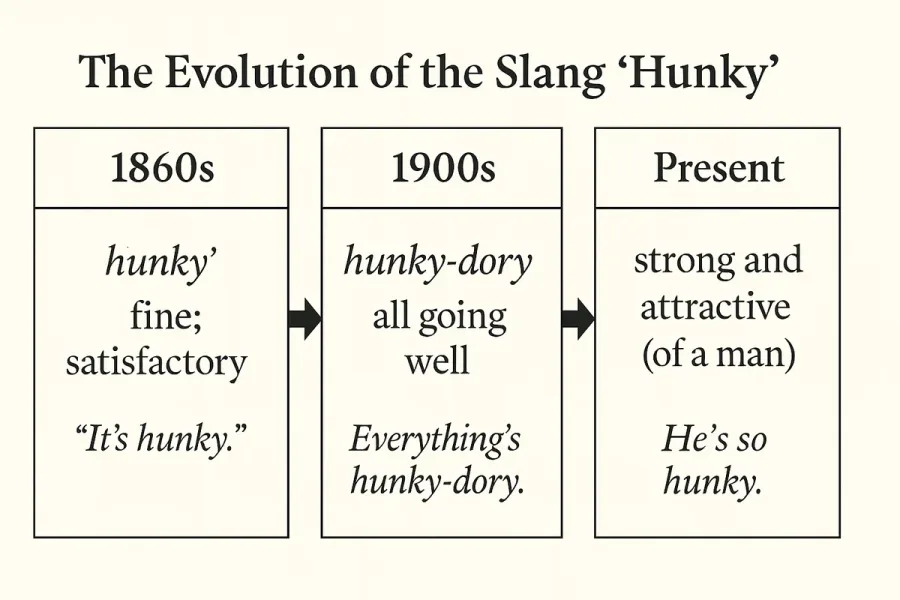
Entering the 1900s, the expression "hunky-dory" became common. The meaning is "everything is going well" or "no problem."
This is the last remnant of "hunky" retaining the meaning of "OK" or "satisfied."
This form is still understood by middle-aged people and older in English-speaking countries, but few people use it in daily conversation, and it has a somewhat old-fashioned or humorous ring to it.
3️⃣ Modern "hunky"
Currently (in the 21st century), it is used with a completely different meaning.
In other words, it is an adjective referring to "a muscular and attractive man." This meaning became established in the film and magazine culture of the 1940s and 1950s.
Summary
Era Meaning Example 1860s "Good," "Excellent," "Going well" "It's hunky." 1900s "Everything is going well" "Everything's hunky-dory." Modern "Muscular and attractive (man)" "He's hunky."
In other words,
it is natural to paraphrase the "hunky" in "Ragged Dick" as "cool / nice / fine" today.