TUG and SPPB are commonly used when checking the physical function of elderly individuals.
Since both evaluate standing up, walking, and balance,
“Which one is better for assessing fall risk?”
“If I measure TUG, is it unnecessary to do SPPB?”
“What is the difference, after all?”
You may find yourself wondering these things.
To clarify the differences first,
However,
“TUG is an evaluation that looks at movement”
“SPPB is an evaluation that looks at muscle strength”
It cannot be completely divided like that.
TUG results are also influenced by muscle strength, balance, walking speed, pain, and anxiety.
SPPB also includes actual movements such as standing and walking.
What is different is the way of capturing physical function and movement.
It is not about which one is superior,
You choose the evaluation from this point.
1. TUG is an evaluation that looks at a "series of movements"
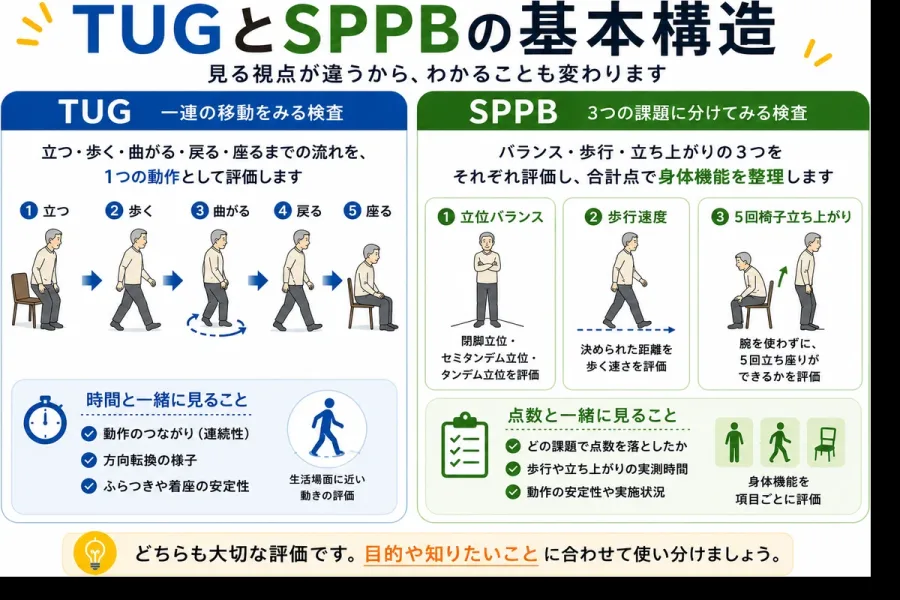
TUG is an abbreviation for the Timed Up and Go Test.
Generally, it starts from a seated position in a chair.
Stand up from the chair
Walk 3 meters
Turn around
Return to the chair
Sit down again
The time taken for this sequence of movements is measured.
The TUG was reported in 1991 as a method for quantitatively evaluating the basic mobility of frail elderly people. The original study examined 60 elderly people referred to a geriatric day hospital [1].
Observing the movement patterns along with the time
The main numerical value obtained from a standard TUG is the total time from start to sitting down.
However, when I observe a TUG, I do not just stop at the number of seconds.
For example,
Are they unsteady immediately after standing up?
Do their feet stop when starting to walk?
Are their steps small and shuffling when turning?
Are they operating their cane or walker safely?
Do they sit down into the chair with too much force?
I also check these types of movements.
Even with the same 12 seconds, the way of moving is not necessarily the same.
The things to look at next will differ between someone who took a long time to stand up and someone who was cautious when turning.
With TUG,
The TUG time alone does not reveal the cause.
Just because a TUG test took a long time,
you cannot immediately conclude
that the person is
“weak in muscle strength” or “prone to falling.”
Behind the time taken,
muscle strength or balance,
joint movement or pain,
fear of falling,
handling of a cane or walker,
or moving while checking for safety,
there are multiple possibilities.
The TUG result is not the cause itself, but material for considering where to look in more detail next.
The measurement method, reference values, and how to observe movements for TUG are organized in detail in this article.
▶ What is the TUG test? How to perform it and interpret the results | Do not judge fall risk by time alone
2. SPPB is an evaluation that "looks at three separate tasks"
SPPB stands for Short Physical Performance Battery.
Physical function, focusing on the lower limbs, is assessed through the following three tasks.
1. Standing balance
Check if the person can maintain a standing position while changing foot placement.
Side-by-side stand
Semi-tandem stand
Tandem stand
2. Gait speed
Measure the time taken to walk a set distance at a normal pace.
3. Five-times chair stand
With arms crossed over the chest, measure the time taken to stand up from a chair five consecutive times.
Basically, each of the three tasks is scored from 0 to 4, for a total score of 0 to 12.
SPPB was developed as a method to objectively evaluate lower limb function in the elderly, and the original study examined over 5,000 elderly people aged 71 and older [2].
Looking at which task had a low score
With SPPB, you can check not only the total score but also the results for
balance items
gait speed
chair stand
separately.
For example, even with the same score of 8,
a person with a low score on balance items
People with low walking speed scores
People who took a long time to stand up from a chair
Then, the content to check next is different.
Even with SPPB, you cannot determine the cause
Even if the score for standing up from a chair is low, muscle strength is not necessarily the only cause.
Foot position, the movement of shifting the body forward, pain, joint movement, balance, and chair height also have an impact.
The same applies when walking speed is slow.
Various backgrounds can be considered, such as stride length, pain, endurance, and caution.
SPPB is also not a test that provides an answer, but rather material to consider what to check next.
The implementation method and scoring for SPPB are summarized in this article.
▶ How to perform SPPB and score criteria | Includes evaluation forms for clinical use
3. What is the difference between TUG and SPPB?
The differences between TUG and SPPB are summarized as follows.
Comparison perspective TUG SPPB Evaluation form Series of movements 3 tasks Main content Standing, walking, turning, returning, sitting Balance, walking, standing up Main results Total time Score for each item and total score What is easy to see Connection of movements, direction change, sitting Which task had a low score Points to note Cause cannot be determined by time alone Cause cannot be determined by score alone
What to be careful about here is
to completely separate them.
TUG results are also influenced by muscle strength, balance, and walking speed.
SPPB also includes movements such as walking and standing up.
Both are influenced by similar physical functions, but
TUG is viewed as a continuous movement
SPPB is organized by dividing it into three tasks
These are the differences.
4. Choose based on what you want to know
When choosing an evaluation, before looking at the test name, consider
.
Use TUG if you want to observe the flow of movement or turning
For example,
staggering immediately after standing up
feet stopping when starting to walk
becoming unstable when turning
unable to approach the chair well
using too much momentum when sitting down
wanting to observe movement including the use of a cane or walker
are such cases.
In TUG, the actions of standing, walking, turning, returning, and sitting are continuous.
Therefore, it becomes easier to check the connection between movements, which is difficult to see through individual actions alone.
Use SPPB if you want to observe the three tasks separately
For example,
Can they maintain a standing posture?
What is their usual walking speed?
Can they repeat standing up?
In which items was the score low?
I want to organize physical functions by item.
This is the case.
With SPPB, you can evaluate balance, walking, and standing up separately.
If information is insufficient, combine both.
You do not necessarily have to decide on just one, either TUG or SPPB.
For example,
There are cases like this.
Instability that was difficult to see in tasks requiring a fixed posture becomes visible in TUG, which involves moving while changing direction.
Conversely,
There are also cases like this.
Even if a series of movements can be performed, by looking at walking and standing up separately, you may find areas that you want to check further.
Do not try to know everything with one evaluation,
is important.
5. Which is better for assessing fall risk?
When considering fall prevention,
you might wonder, "Which is better at identifying people who will fall, TUG or SPPB?"
that is a concern.
To give you the conclusion first,
In a study that followed community-dwelling adults aged 75 and older for one year, neither TUG nor SPPB was able to sufficiently distinguish those who subsequently fell.
However, this is the result for one specific target group and cannot be applied directly to all elderly people [3].
This does not mean that TUG or SPPB are useless.
With TUG, you can observe how they move, and with SPPB, you can organize the status of their balance, walking, and standing up.
However, in addition to physical function, falls are also influenced by:
past falls
medication effects
drop in blood pressure when standing up
vision and hearing
cognitive function
feet and footwear
home environment
moving at night
fear of falling
Daily activities
and other factors are involved.
The World Falls Guidelines, an international guideline for fall prevention, also recommends that for older adults at high risk of falling, a multifaceted assessment including physical, cognitive, psychological, and environmental factors, in addition to fall history and gait/balance, should be conducted [4].
A fast TUG time does not guarantee safety.
A perfect SPPB score does not mean one will not fall.
Conversely, a poor result does not mean one will definitely fall.
None of these can be stated definitively.
Test results should be used as one piece of evidence to consider the factors leading to falls.
The 13.5-second benchmark for TUG is explained in detail in this article.
▶ Is 13.5 seconds on the TUG a danger line? The origin of the reference value and how to view fall risk
6. Even for the same person, different evaluations reveal different things
Let's consider a hypothetical case here.
Mr. A, 78 years old
Mr. A has recently started feeling anxious when going out.
He can walk indoors, but
crowded places,
changing directions,
and sitting in a chair
are situations where he says he feels "a little scared."
Mr. A's wish is to
is what it means.
What was revealed by TUG
The total time for TUG was 14.2 seconds.
However, looking at the movements rather than just the time,
there was unsteadiness during the turn
there was momentum when sitting down in the chair
were observed.
From the TUG, it is considered better to look closely at the turning and sitting-down phases.
What was revealed by SPPB
In the SPPB,
performed 3 standing balance positions
gait speed: 0.6 m/sec
5-time chair stand: 15.8 seconds
were the results.
Rather than determining the cause based solely on these figures, we will next examine the results of the gait speed and chair stand in detail.
Things to check next
Physical functionmuscle strength
joint range of motion
Presence or absence of pain
Movement of shifting the center of gravity forward
How the feet are moved
Method of changing body orientation
Behavior in crowds
Situations involving going out or shopping
Home environment and travel routes
Intensity of anxiety
Movements or places being avoided
Whether the range of activity has narrowed
At this point,
we do not immediately decide on "strength training because it took time to stand up"
or "balance training because there was unsteadiness during a turn."
We do not make such decisions immediately.
We consider the necessary support by combining test results, movements, daily life situations, and the individual's goals.
By combining TUG and SPPB,
we can identify which movements cause instability
Which tasks are showing difficulty
What to check next
It becomes easier to organize.
7. Supplementary note for professionals | Do not record only scores and seconds
Both TUG and SPPB allow you to record results as numbers.
However, if you only record the numbers, when you look back at them later,
"Why was this the result?"
will become unclear.
What to record for TUG
Total time
Chair height and shape
Use of canes or walkers
Walking speed instructions
Parts that took time
Number of steps for turning
Unsteadiness
How they sat down
Anxiety felt by the individual
What to record for SPPB
Scores for each item
Total score
Walking distance
Measured walking time
Measured time for 5 chair stands
Reason for inability to perform
Pain or fatigue
Use of assistive devices
Observation of movement
When comparing with previous results, keep measurement conditions such as the chair, walking distance, assistive devices, and speed instructions as consistent as possible.
SPPB is an evaluation with supported reliability and validity.
On the other hand, for people with very high or very low physical function, scores may cluster near the upper or lower limits, making it difficult to capture small changes.
A 2024 systematic review also reported that while SPPB is a valid evaluation, its sensitivity to change has limitations [5].
Therefore, when monitoring progress, it is important to record not only the total score but also the measured times for walking and standing up, as well as observations of movement.
Do not end the evaluation results with just
but also
record that as well.
8. Summary | Decide what you want to know before choosing an evaluation
Here is a summary of the content covered.
TUG looks at the sequence of movement from standing up to sitting down
SPPB looks at balance, walking, and standing up by dividing them into three tasks
TUG is also influenced by muscle strength, balance, and walking speed
SPPB also includes actual movements
Neither can identify the cause based on numbers alone
TUG is easy to use when you want to observe the flow of movement and turning
SPPB is easy to use when you want to organize and separate the three tasks
If information is insufficient, combine both
Do not determine fall risk based on a single test alone
Connect evaluation results to daily life difficulties and support
Whether to use TUG or SPPB.
The answer is not determined by the name of the test.
First, consider:
"What is the person struggling with?"
"Which movement do you want to examine in detail?"
"What do you want to use the results for?"
Think about these.
The goal is not to perform the evaluation.
Where is the person struggling, what should be checked next, and what kind of support will it lead to?
We use TUG and SPPB to think through to that point.
Recommended reading
Basic TUG procedures and how to observe movement
▶ What is the TUG test? How to perform it and interpret results | Don't judge fall risk by seconds alone
For those who want to know more about the 13.5-second TUG benchmark
▶ Is 13.5 seconds on the TUG a danger line? Origin of the reference value and how to interpret fall risk
For those who want to check SPPB methods and scoring
▶ SPPB procedures and score criteria | Includes clinical evaluation forms
For those looking for articles on long-term care prevention and movement analysis by purpose
▶ For beginners | A guide to articles for families concerned about a parent's movement and young rehabilitation professionals unsure about evaluations
References and materials
Podsiadlo D, Richardson S. The Timed “Up & Go”: A Test of Basic Functional Mobility for Frail Elderly Persons. Journal of the American Geriatrics Society. 1991;39(2):142–148.
Guralnik JM, Simonsick EM, Ferrucci L, et al. A Short Physical Performance Battery Assessing Lower Extremity Function: Association With Self-Reported Disability and Prediction of Mortality and Nursing Home Admission. Journal of Gerontology. 1994;49(2):M85–M94.
Pettersson B, Nordin E, Ramnemark A, Lundin-Olsson L. Neither Timed Up and Go Test nor Short Physical Performance Battery Predict Future Falls Among Independent Adults Aged 75 Years or Older Living in the Community. Journal of Frailty, Sarcopenia and Falls. 2020;5(2):24–30.
Montero-Odasso M, van der Velde N, Martin FC, et al. World Guidelines for Falls Prevention and Management for Older Adults: A Global Initiative. Age and Ageing. 2022;51(9):afac205.
Kameniar K, Mackintosh S, Van Kessel G, Kumar S. The Psychometric Properties of the Short Physical Performance Battery to Assess Physical Performance in Older Adults: A Systematic Review. Journal of Geriatric Physical Therapy. 2024;47(1):43–54.
National Institute on Aging. Short Physical Performance Battery (SPPB).