Diavolo, the final boss of JoJo's Bizarre Adventure Part 5: Golden Wind. Regarding his Stand ability, King Crimson, there was a lively discussion on Twitter recently about his powers, so I'm writing down a memo about a theory I proposed previously: "Isn't King Crimson's ability tied to the theme of fatalism in the series?".
I should clarify that this is just a theory from a fan—a 'wouldn't it make sense if we interpreted it this way?' kind of thing—and it's not official canon. Don't go explaining it on YouTube like you're an expert! You'll embarrass yourself!
For this verification, I used the digital version (monochrome) as the base text. Since this is based on the paperback edition, there are differences in volume numbers compared to the Jump Comics edition. Please be aware of this.
An ability that is just hard to understand
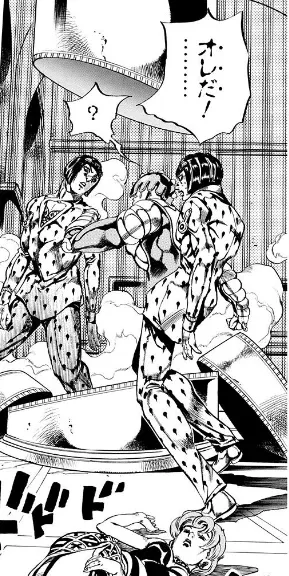
King Crimson's ability is just complex and hard to understand. It includes mysterious visual effects, and it even has a sub-ability called Epitaph.
For what it's worth, the Stand introduction in the JoJo's Bizarre Adventure paperback edition says:
It is introduced this way, and if interpreted literally, it's like, "You can skip time. However, only you can move during that time.".
What makes it different from time-stopping like The World is that the opponent still moves during the skipped time. However, they have no consciousness, so they move exactly as they had intended to move beforehand. You can choose whether or not to interfere with the world in that state.
Judging by the movements in the work, it behaves in a way that doesn't contradict this interpretation... but how did he take Trish out of the elevator during his first appearance?
What's going on with the 'Was that me behind the pillar?' part? If you ask me that, I'm genuinely stumped. Perhaps this is the reason why King Crimson's ability is so confusing... or rather, "Seriously, what is this?
The fact that this effect of touching one's future self never appears again is also a source of confusion. Much like the setting where Gold Experience's 'punches cause sensory overload,' maybe the author just decided, 'I'm done with this effect,' and stopped using it...
Now, here is the main point. I think that 99% of why King Crimson's ability is hard to understand lies in the visual effects during its first appearance, but let's set that aside.
I think it makes sense if we view this ability as one linked to the theme of fatalism in the series, so please let me write about it.
Is it an ability to escape from 'fate'?
Could the essence of King Crimson's ability be that it is an "ability to escape from 'fate'"?
That is the theory I have been proposing for several years now.
The basis for this is the existence of the epilogue, 'Sleeping Slaves'.
This epilogue has a very unique structure; after the boss, Diavolo, is defeated, a prequel is suddenly inserted. Yes, the timeline suddenly jumps back. Why did Araki-sensei choose such an irregular structure?
I suspect that, judging by interviews and such, Araki-sensei had quite a lot on his mind regarding fatalism during the serialization of Part 5, and I think he included this episode as a central theme to summarize the entire part.
There is an ability in this chapter called "Rolling Stones." It is an ability that "appears before those destined to die and manifests their death in the form of a sculpture." If one accepts their fate, they can meet their end peacefully. In the story, it is shown that even if you try to change fate by destroying the stone, it cannot be changed.
Yes, in other words, "fate" exists in the world of Part 5. Bucciarati was destined to die, and he could not avoid it. Even if he could change the path leading to death (making it a peaceful one), he could not avoid death itself. Bucciarati was fated to die even before he met Giorno.
However, the Boss is the only one who can outmaneuver this "fate."
When King Crimson first appears, the Boss makes this statement.
He also says this to Doppio.
He states it like this: "Fate" is predetermined. Once a vision has appeared, it cannot be changed. However, the Boss can "erase" that moment.
What form would Rolling Stones take if it appeared before the Boss? I suspect it would take some form. But the Boss can see that moment with Epitaph (his precognition ability), and he can make it as if it never happened.
In the world of Part 5, which is governed by fate, he is the only one who can be free from it. I believe that is the true essence of King Crimson's ability.
You might think, "But isn't that just running away from fate?" However, I believe that is the essence of Diavolo. Diavolo is fundamentally a small-time villain, isn't he? He basically hides in the shadows and spends his time running away from his own past.
Araki-sensei has said something to the effect of, "It is most terrifying when a weak person directs their weakness toward others," so in that sense, Diavolo has a pettiness of character befitting a final boss.
From here on is pure speculation, but perhaps the Boss's original ability was just Epitaph. It was an ability that could only see fate, but just as Yoshikage Kira awakened to a new ability when cornered, perhaps he awakened to the ability to make that fate never have happened.
And if you consider that his original personality and ability were consumed by an evil personality, like a parasitic twin, it makes sense.
However, Diavolo, who had been running away from fate, is finally brought to justice by Giorno. Ironically, because he ran away from the fate of death, the Boss is trapped in an infinite hell where he "will never reach the truth of death." Depending on how you look at it, it could even appear as if fate itself sent Giorno as an execution machine.
Is Bucciarati's life "useless"?
There is a concept called fatalism. It is the idea that everything in this world is predetermined. Therefore, no matter what humans do, what happens in the end cannot be changed.
Fatalism is closely related to religious discourse, and arguments such as "If it is already decided who will go to heaven, isn't it all a waste to perform good deeds, maintain faith, or put in effort? have been actively debated in both the West and the East. I would like those interested to look into it, but from the perspective of this fatalism, the Boss and Giorno's group are at opposite poles.
The Boss speaks of a result-oriented mindset, saying, "Since the results are all predetermined, no matter how hard you try, it is meaningless."
“It is only the ‘results’! In this world, only the ‘results’ remain!”
“Only the ‘results’ remain. Everything in between has been erased.”
For the Boss, what matters is the result. Much like DIO, he believes that the process and methods do not matter at all.
However, Araki-sensei rejects that value system. As seen in the words of Abbacchio's fellow police officer.
As we can see from the ability of Rolling Stones, Bucciarati's death was determined before the story even began. And that cannot be changed. But is that life ‘useless’?
No, that's wrong. It's not ‘useless’ at all. I believe that is Araki-sensei's answer.
Bucciarati, Abbacchio, and Narancia all lost their lives. However, their actions and their will influenced Giorno and the others.
We will die someday. That much is certain. So, isn't it important what we can do before we die? And that will and those actions will not perish. They will be passed on to someone else.
I think that is the very theme of JoJo's Bizarre Adventure: Golden Wind.
Finally, let us part ways with Araki-sensei's afterword and the final lines from 'Epilogue: Sleeping Slaves'.
“We are slaves to fate.” “But let us pray that they are ‘sleeping slaves’.” “That by waking up... they are ‘sleeping slaves’ who will carve out something meaningful...”