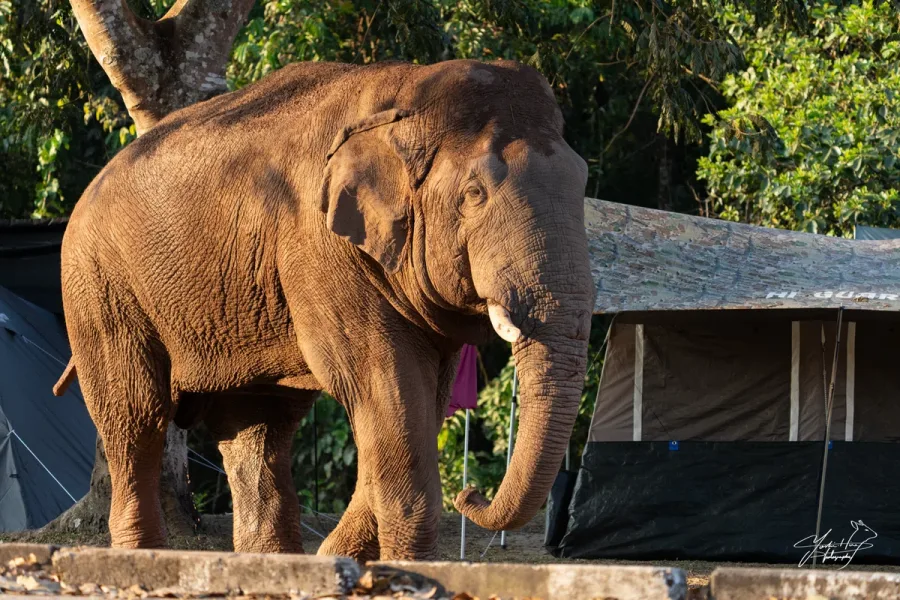
In the evening, he was right next to the tent at the campsite, having finished his meal.
The setting sun bathed his massive body, which stood about 3 meters tall and weighed several tons.
The elephant slowly passed right by the tourists and left the campsite.
In February 2026, at the peak of the dry season, I visited Khao Yai National Park in Thailand in search of wild mammals and birds.
The male elephant I met there prompted me to reconsider the meaning of encountering wild animals in their natural environment.
Encounters with wild animals do not end with just the thrill.
Sometimes, they are experiences that reveal the problems existing between humans and wildlife.
In this article, using the male elephant I met in Khao Yai as a starting point and based on stories I heard from my local guide, Noi, I would like to think about the distance between wild elephants and humans.
Wild animals encountered in Khao Yai
In February, at the peak of the dry season, I visited Khao Yai National Park in Thailand in search of wild animals and birds.
During my stay, I encountered deer, porcupines, civets, pig-tailed macaques, gibbons, and Asian elephants.
Among them, the presence of the Asian elephants was overwhelming.
They are not always deep in the jungle.
Sometimes, they reveal their massive bodies around the campsite or on the main roads within the national park.
Asian elephants appearing on the road
When an elephant appears, many tourists gather.
At first glance, the scene is somewhat similar to the atmosphere when people gather in Japan to see a rare wild bird.
However, the crucial difference is that the subject is a large mammal weighing several tons.
If attacked by an elephant nearly 3 meters tall, neither people nor cars would stand a chance.
In the vicinity of the national park, personal injury accidents have actually occurred.
A few days before I visited Khao Yai, there were reports of an accident near the national park, and I felt a unique sense of tension at the site.
*News article https://newsclip.be/thai-news/thai-local/33538
Even if humans feel "accustomed" or "it seems okay," the elephant's mood is unpredictable.
If you misjudge the distance and approach carelessly, a moment of awe can turn into a serious accident.
At the scene, national park rangers were using megaphones to call out to tourists.
People who had parked their cars around the elephant hurriedly moved them.
What I felt there was not just a "beautiful encounter with wildlife."
The thrill from their overwhelming power and the awe from their slowly moving massive bodies.
These two things existed in the same place at the same time.
The elephant I met, Pa Duan Wanalee
The name of the elephant I met is Pa Duan Wanalee.
He is a 40- to 50-year-old male elephant, standing about 3.2 meters tall.
The origin of his name is that the tip of his tail is missing and shortened.
Pa Duan Wanalee once led a herd in Khao Yai.
However, he was driven out of the herd after he turned 40.
This is also a part of the natural way of life for male elephants.
Asian elephant herds are matriarchal societies centered on females and their young. When males grow up, they leave the herd and live alone or in loose association with other males.
According to Noi, who works as a local guide, Pa Duan Wanalee is in musth.
Musth is a temporary, rut-like state seen in male elephants, where testosterone levels rise sharply and behavior changes significantly. During this period, male elephants may change their range in search of females and are more prone to aggression than usual.
It is quite possible that he was appearing in front of people because he was looking for a herd of females.
When I met him, it also looked as if he had been forced to come out to a visible place to bathe or eat.
Elephants that are no longer afraid of people and cars
It is said that the elephants in Khao Yai are no longer as afraid of people and cars as they used to be.
Of course, approaching humans is not an objective for the elephants themselves.
・ Forest fragmentation.
・ Farmland encroaching on elephant habitats (watering holes and feeding grounds).
・ Roads crossing elephant migration routes.
・ Human food and crops becoming attractive bait for elephants.
・ Tourists getting too close.
As a result of these overlapping factors, some individuals emerge into tourist areas and onto roads.
From the human perspective, it looks like "elephants have come out near people."
But from the elephant's perspective, human roads and tourist facilities have been built in places they originally used.
Before Khao Yai was designated as Thailand's first national park in 1962, there were settlements of villagers who had moved from the lowlands on the Nakhon Nayok side, and they practiced traditional slash-and-burn agriculture, hunting, and gathering of forest products.
At that time, wild elephants lived as "primitive wild animals living in natural habitats" in grasslands and open forests created by slash-and-burn agriculture.
They lived avoiding human eyes, and it is said that they did not appear on roads or interact with tourists at close range as they do now.
Conflict between humans and wild elephants
When people think of Thailand, many might think of "elephant riding."
However, what I saw this time was not elephants used by humans, but wild elephants living right next to human society.
In recent years, the conflict between humans and wild elephants has become a major issue in Khao Yai National Park.
Incursions into farmland, crop damage, contact on roads and in tourist areas, and personal injury accidents.
The boundary between the forest and human life is not as clear as it appears on a map.
As clashes with elephants increase, measures such as managing food resources within the forest, installing protective fences, and driving elephants away are being implemented.
National parks, related organizations, and local residents are discussing the problem, but it is said that reaching a conclusion is not easy.
Already in the northern part of Khao Yai National Park, the original natural environment is being lost due to human activities such as noise and lighting.
Finally, I would like to record Noi's words.
"Humans destroyed the forest. And the elephants lived in that forest. So, when thinking about today's problems, what is important is who was the first to intrude."
"In the future, human intrusion into forests and wildlife habitats will become even more serious."
Acknowledgments
Finally, I would like to thank Noi, whom I met at a cafeteria in Khao Yai and who taught me various things.
The information I obtained from Noi, who works as a local guide and in conservation activities, brought a local perspective to this article.
I am also sincerely grateful for keeping in touch even after I returned home.
I also thank my two travel companions who joined me on the expedition to Thailand. Thank you very much.
The commotion of losing my passport and having to stay behind in Thailand when returning home is now a nostalgic memory.
︎ Click here for local guide Noi's Facebook!
︎ I am posting the wild animals I encountered on Instagram!