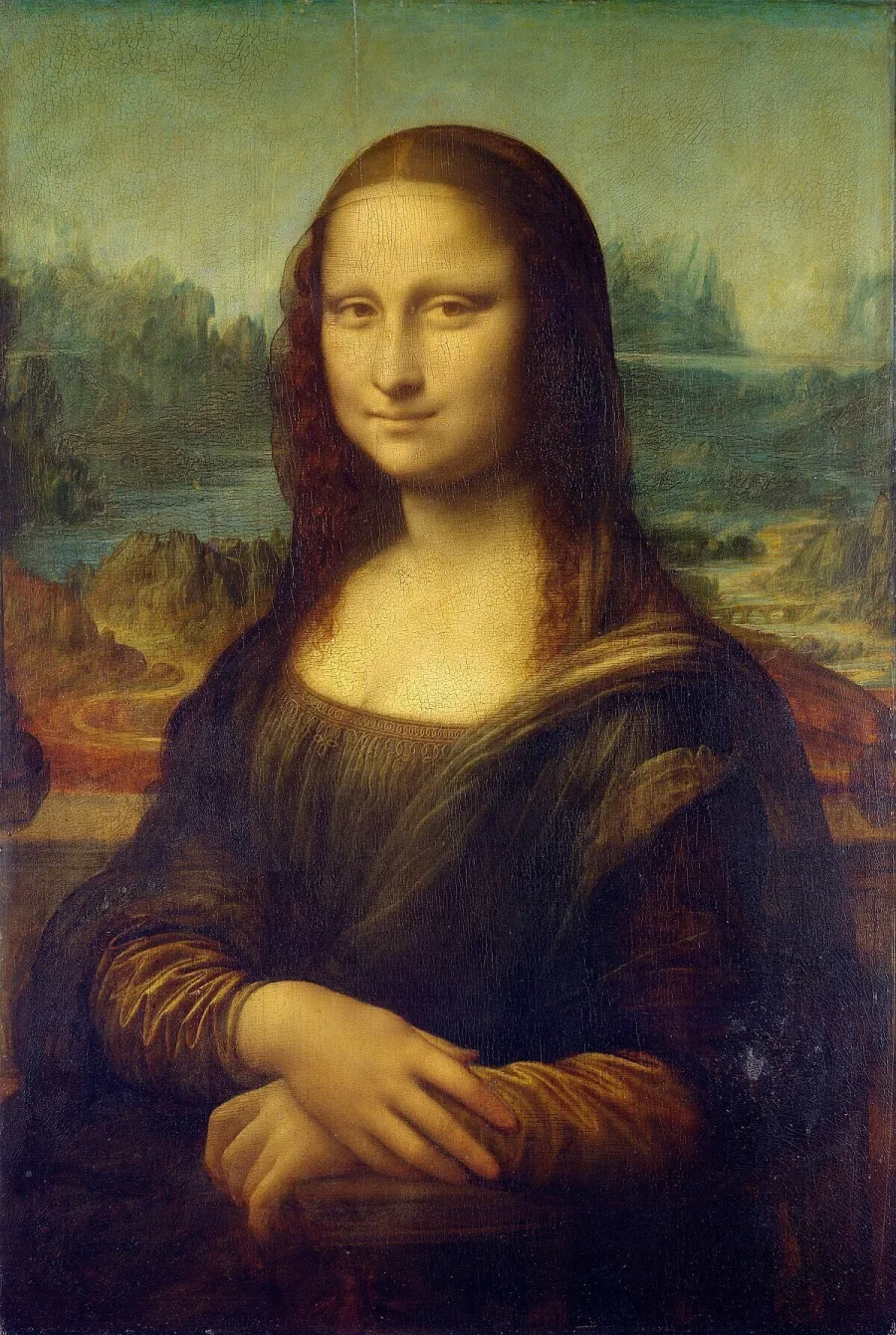
Did you know that there were actually two versions of the famous Mona Lisa painted?
First of all, it is a fact that there is a painting at the Prado Museum that looks exactly like the real Mona Lisa at the Louvre.
The Prado version was not seen by the public very often and even had its background painted over in black for a time, so as a result, it is in much better condition than the so-called "original" Louvre version; it is more vivid, and the background and eyebrows can be observed in greater detail.
With that in mind, what exactly is the Prado version?
In short, while there is no proof that da Vinci painted it, scientific analysis shows that the process of sketching and correction matches perfectly, so there is little doubt that it was painted at the same time in the same workshop, either by the artist himself or by his students working in parallel.
And this is where it gets really interesting.
Quoting from Goro Yamada's YouTube (【The world's greatest masterpiece! Facts you didn't know】Actually, there were two Mona Lisas! Does she have eyelashes and eyebrows? What was the terrifying intention of the super-genius who painted multiple Mona Lisas?【Leonardo da Vinci】).
Believe it or not, the two are offset by 5cm, and they might have been painted in 3D!
If that's the case, it's human nature to want to try it out.
So, I made a quick one.
I hope you'll give it a try.
It seriously looks 3D!!!
Since the Louvre version (the original) had faded, I processed it into black and white. This way, you can really see it in 3D. Or rather, I couldn't see it in 3D when it was in color.
Well, strictly speaking, perhaps there was a limit to the realism of hand-painting, as there are many parts that look slightly blurry, but the 3D effect is certainly well done. The transparency of the person in the foreground and the distant landscape is exactly like a 3D stereogram. The nose even appears to pop out.
For the record, I also read the literature cited on Wikipedia that refutes this. That said, since I cannot read French, I will transcribe here the English version obtained via machine translation. (Unfortunately, I do not yet trust machine translations from French to Japanese very much.)
According to this, the basis for the refutation is written as "when examined in detail, there are inconsistencies as a stereoscopic image." However, it is impossible to judge whether this inconsistency arises from the limitations of the technique of hand-drawing and sketching, or whether it arises because it was not intended for stereoscopic vision from the beginning.
Therefore, I think it is quite possible that he seriously aimed to create a stereoscopic image.
Well, if I were to grasp his other creative activities during this period, my opinion might change again. If there are absolutely no other works besides this Mona Lisa where he attempted a stereogram, I might think it is a hypothesis that is hard to believe.
(End)