Success of the world's first electronic television experiment: Hamamatsu's passion, the cultivation of the Victor VHS development team, and the technology management (MOT) that became the foundation of Japan as a video-producing nation
"I want to create something that will become the eyes and ears of humanity. Mechanical gears cannot keep up. By using the flight of electrons, we can deliver the world exactly as it is into the living room."
On December 25, 1926, in a dimly lit laboratory at Hamamatsu Higher Technical School, the katakana character 'I' appeared faintly in green on a cathode-ray tube. It was the moment the world's first electronic television reception was achieved. The person who accomplished this feat was Kenjiro Takayanagi, known as the 'Father of Japanese Television.' Takayanagi's greatness lies not only in successfully creating the world's most advanced electronic television in a laboratory. After the war, as the head of technology at JVC (Victor Company of Japan), he acted as a breakwater for the 'nameless engineers' such as Shizuo Takano, who developed the home video (VHS) that would later become the world standard, and led Japan to become the world's leading video electronics powerhouse. This article unravels the legacy of Kenjiro Takayanagi's indomitable research and development and technology management.
"Drawing pictures with the light of electrons." In the 1920s, while the rest of the world was obsessed with mechanical television research that was an extension of the phonograph, a young engineer in the regional city of Hamamatsu, Japan, was looking at the roots of physical laws. That was Kenjiro Takayanagi. Takayanagi's life is filled with greatness not only as a brilliant scientific achievement of the world's first electronic reception, but also as a 'master of technology management (MOT)' who nurtured young engineers at JVC after the war and created the world's largest consumer electronics market, the home video (VHS). Herein lies the essence of leadership that keeps the fire of long-term research and development burning and protects engineers from short-term performance pressure.
---
2. Introduction: Historical Background and Overview of the Person
Born in 1899 in Hamana District, Shizuoka Prefecture. After graduating from the Electrical Engineering Department of Tokyo Higher Technical School (now Tokyo Institute of Technology) and working as a teacher, he was appointed as a professor at the newly established Hamamatsu Higher Technical School (now Shizuoka University Faculty of Engineering) in 1924. He began his television research through self-study.
On December 25, 1926, in a dimly lit laboratory at Hamamatsu Higher Technical School, the katakana character 'I' appeared faintly in green on a cathode-ray tube. It was the moment the world's first electronic television reception was achieved. The person who accomplished this feat was Kenjiro Takayanagi, known as the 'Father of Japanese Television.' Takayanagi's greatness lies not only in successfully creating the world's most advanced electronic television in a laboratory. After the war, as the head of technology at JVC, he acted as a breakwater for the 'nameless engineers' such as Shizuo Takano, who developed the home video (VHS) that would later become the world standard, and led Japan to become the world's leading video electronics powerhouse. This article unravels the legacy of Kenjiro Takayanagi's indomitable research and development and technology management.
"Drawing pictures with the light of electrons." In the 1920s, while the rest of the world was obsessed with mechanical television research that was an extension of the phonograph, a young engineer in the regional city of Hamamatsu, Japan, was looking at the roots of physical laws. That was Kenjiro Takayanagi. Takayanagi's life is filled with greatness not only as a brilliant scientific achievement of the world's first electronic reception, but also as a 'master of technology management (MOT)' who nurtured young engineers at JVC after the war and created the world's largest consumer electronics market, the home video (VHS). Herein lies the essence of leadership that keeps the fire of long-term research and development burning and protects engineers from short-term performance pressure.
---
3. Origin and Tenacity: Insights and Development Stories that Created Breakthroughs
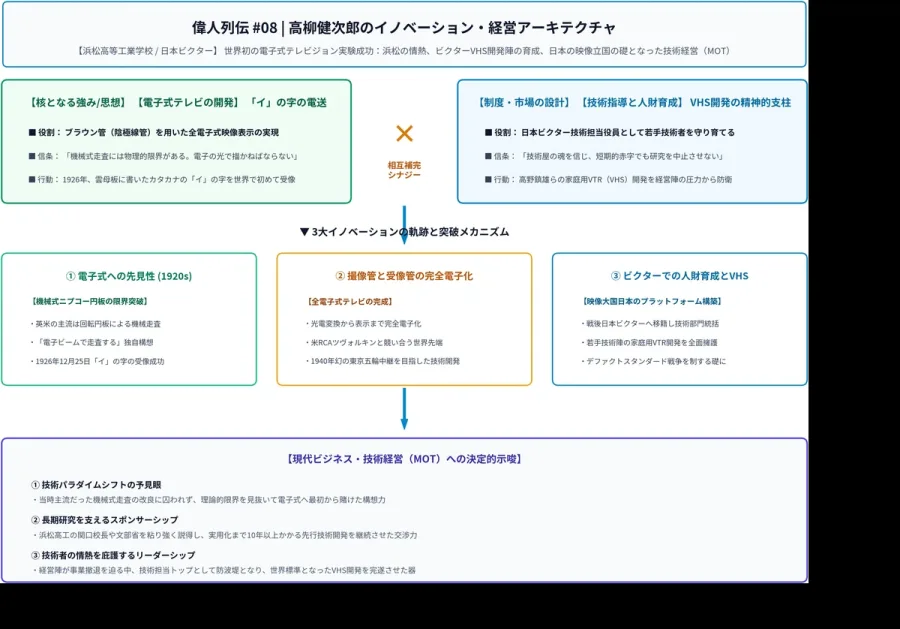
① Foresight for Electronic Systems (1920s)In the 1920s, television research in the West was dominated by mechanical scanning using a rotating metal plate with small holes called a 'Nipkow disk.' However, Takayanagi coolly saw that there were physical limits to the rotation speed and inertia of machines, and that it was impossible to send high-definition images as moving pictures. 'Unless we use an electron beam (cathode-ray tube) with almost zero mass to scan light, a true television will not be realized.' While mocked by surrounding scholars as 'science fiction,' he continued his lonely battle, blowing his own vacuum tubes and soldering circuits.
② Full Electronization of Camera Tubes and Picture TubesAfter the successful reception of the character 'I' in 1926, Takayanagi pushed forward to complete an all-electronic television that also electronized the imaging side (camera). In 1930, he received a royal viewing by Emperor Showa, and in 1936, he joined the NHK Technical Research Laboratories to lead the 1940 Tokyo Olympics television broadcast project. Although he faced the tragedy of the Olympics being canceled due to the war and his research being interrupted, the ultra-high frequency and electron beam control technologies and human resources cultivated at this time became the unshakable foundation of Japan's post-war electronics industry.
In 1924, when Takayanagi began his television research, all he had were a vacuum pump, a few glass tubes, and a poor-quality power supply. The foreign-made cathode-ray tubes of the time were for oscilloscopes, and the brightness of the fluorescent screen was extremely low, making it impossible to display images. Takayanagi held the burner himself to blow the glass, ground zinc sulfide powder to use as a phosphor in a mortar to apply it, and made his own grid electrodes for the electron gun. On December 25, 1926, the moment the katakana character 'I' appeared as a still image in green light on the fluorescent screen of the picture tube, Takayanagi's whole body trembled. He chose the character 'I' because it is the first in the traditional Japanese Iroha order, and the combination of a straight line and a stroke was optimal for verifying the resolution of the electron beam's scanning lines. This small character of light was the first cry of the television civilization that would later cover the world.
③ Human Resource Development at JVC and VHSAfter the war, Takayanagi was invited to JVC, where he guided the technical team as Senior Managing Director and General Manager of the Technology Headquarters. In the early 1970s, when JVC was struggling with poor business performance, there was strong pressure from headquarters to 'dissolve the loss-making VTR development department.' However, Takayanagi saw the tenacity of field leaders like Shizuo Takano, who wanted to 'create a small video recorder that anyone could use to record television programs at home,' and stood as a shield for the research team, telling management, 'If you stop this research, I will quit too.' Under this protection, 'VHS' was born, which became the world's de facto standard.
---
4. Management Philosophy and Leadership: Conviction and Organizational Theory
[Development of Electronic Television] Transmission of the Character 'I'Identifying Fundamental Physical Limits: Choosing a technological architecture that will be a future winner by thinking from the roots of physical laws, rather than through incremental technological extensions.
[Technical Guidance and Human Resource Development] The Spiritual Pillar of VHS DevelopmentTechnology Transfer and Human Resource Development: An educator's spirit that does not cling to one's own achievements, but generously pours accumulated technical philosophy and passion into the next generation of engineers.
Defending the 'Sanctuary of Engineers' in VHS Development: In the 1970s, when Victor Company of Japan (JVC) fell into a management crisis, the parent company and management strongly pushed for the dissolution of the VTR business, which had been consistently in the red. Takayanagi, who was a senior managing director at the time, was convinced of the significance of the home video development being pushed by division manager Shizuo Takano and others, and declared at a management meeting, 'If you want to stop the video research, you must fire me first.' It was because of this protection from Takayanagi that the team was able to continue the development of 'VHS' in secret, which later led to a major turnaround that won the format war against Sony's Betamax and secured the global standard.
Passing the Baton to Successors and Organizational DesignA Management Breakwater Protecting Passion: The responsibility and sense of mission of a technical management executive to protect the seeds of future mega-hits (exploratory organizations) from the short-term performance pressures of large corporations.
---
5. Lessons for the Modern Era and Implications for Management of Technology (MOT)
① Foresight in Technological Paradigm Shifts: The conceptual power to look past the improvements of the then-mainstream mechanical scanning, identify the theoretical limits, and bet on electronic systems from the start.
② Sponsorship Supporting Long-term Research: The negotiation skills to persistently persuade Principal Sekiguchi of Hamamatsu Technical College and the Ministry of Education to continue pioneering technology development that would take over 10 years to commercialize.
③ Leadership Protecting the Passion of Engineers: The capacity to act as a breakwater as the top technical executive while management pushed for business withdrawal, ultimately completing the development of the VHS that became the global standard.
---
6. Related Q&A and Deep Dive into Famous Quotes
Q. Why did you choose the katakana character 'I' for the first experiment?
A. It is the first character in the 'Iroha' poem, the traditional Japanese character arrangement, and its simple shape of a straight line and a stroke was the most suitable for verifying resolution and the accuracy of electronic scanning.
'Engineers must have dreams. The tenacity to never give up on those dreams and to hold on until they are realized is what creates miracles.'
— Kenjiro Takayanagi
---
7. References and Major Chronology
1899 Born in Hamana District, Shizuoka Prefecture
1921 Graduated from the Department of Electrical Engineering, Tokyo Higher Technical School (now Tokyo Institute of Technology)
1924 Appointed Assistant Professor at Hamamatsu Higher Technical School and began television research
1926 Achieved the world's first transmission and reception of the character 'I' using a cathode-ray tube
1930 Demonstrated television experiments to Emperor Showa
1937 Concurrently served at the NHK Technical Research Laboratories and led the development of television broadcasting for the Olympic Games
1946 Joined Victor Company of Japan (JVC) and was appointed as a Director
1955 Led the start of color television broadcasting in Japan, including the development of color picture tubes
1976 Announced the VHS video format and provided technical support for its global standardization
1981 Awarded the Order of Culture
1990 Passed away at the age of 91
© 2026 Innovation & Leadership Archive. All rights reserved.
#Innovation #Inventor #KenjiroTakayanagi #FatherOfTelevision #ElectronicTechnology #JVC #VHS #TechnologyManagement #MOT #RDManagement