Hello, I am Umaki.
In this article, I will summarize one of the hottest themes in the world of AI data centers right now: 17 US stocks related to silicon photonics (AI optical communication) As the demand for generative AI computing explodes, alongside the GPUs themselves, "how to transport data faster" has become the new main battlefield. The answer is silicon photonics, which replaces electrical copper wiring with light.
In March 2026, the news that Nvidia invested a total of $4 billion in optical component giants Lumentum and Coherent was an event that symbolized this trend. The market immediately recognized that "light is the next bottleneck for AI," and related stocks have risen significantly across the board. In this article, I will organize and introduce them into five tiers, ranging from major blue-chip stocks to high-purity speculative small-cap stocks.
Below is the table of contents.
Why is capital flooding into "silicon photonics" right now?
In generative AI training and inference, tens of thousands of GPUs are bundled together to act as one massive computer. At this time, the volume of communication connecting GPUs to GPUs, servers to servers, and racks to racks is increasing exponentially. Even if the computation is fast, if the data transfer cannot keep up, the expensive GPUs will sit idle waiting for communication.
However, limits have begun to appear in conventional copper wiring (electrical signals). As speeds increase, power consumption and heat generation swell, and the distance over which signals can be sent shortens. The industry calls this the copper wall. As long as the scale of AI continues to expand, this wall was a challenge that would inevitably be encountered at some point.
That is where silicon photonics, which uses light for wiring, has jumped into the spotlight. Light can transport large volumes of data over long distances with low power consumption. It first became popular as pluggable optical modules (optical transceivers), and is now evolving into CPO (Co-Packaged Optics), which bundles optical engines right next to switches and GPUs.
What was symbolic was the move by Nvidia mentioned earlier. In March 2026, they invested $2 billion each in Lumentum and Coherent, for a total of $4 billion, and even signed multi-year purchase agreements. The king of GPUs went out and secured the optical supply chain itself. This made the view that "light determines the growth of AI infrastructure" definitive.
The generational shift in data transmission speeds is also accelerating. Climbing the ladder from 800G to 1.6T and then to 3.2T, companies showcased 3.2T and 6.4T prototypes at the industry event OFC in 2026. According to research firm forecasts, the optical transceiver market will expand to a scale of approximately $29 billion, and silicon photonics is considered the center of that growth. The entire data center network market is also expected to expand from approximately $45.8 billion in 2025 to approximately $103 billion by 2030.
What I want to emphasize here is that this trend is not a temporary fad, but a structural change born from physical constraints. Electrical signals hit an unavoidable wall where heat generation and power loss increase the faster you try to make them go. As long as AI models continue to grow, the role of light as a means to overcome that wall will surely increase. That is precisely why even Nvidia, which is supposed to be in the position of buying optical components, has stepped into investing in optical technology itself.
As a result, optical-related stocks have literally climbed parabolically over the past year. While this is a powerful tailwind, it is also a double-edged sword of risk, with high valuations that have already priced in significant expectations. I will delve deeper into this in the risk section later.
What is silicon photonics in the first place?
In a nutshell, silicon photonics is a technology that integrates communication circuits using light onto a semiconductor (silicon) chip. Its greatest strength lies in the ability to mass-produce optical components all at once using semiconductor production lines.
Breaking down the contents a little, it consists of components such as modulators that convert electrical signals into light, photodetectors that convert light back into electricity, lasers that serve as the source of light, and waveguides that are the paths for light. By packing these into a single chip, it is possible to achieve small size, low power consumption, and large capacity simultaneously.
Applications are expanding in stages. First, it is becoming popular as pluggable optical transceivers, and next, CPO, which bundles optical engines into the packages of switches and GPUs, is starting to emerge. The big picture is that in the future, it will head toward optical I/O that connects chip to chip directly with light. For readers to make investment decisions, it should be enough to grasp the keywords around CPO, 1.6T, coherent light, and laser light sources.
I will add just a little more. The currently mainstream optical transceivers are pluggable components that are inserted into switches later. In contrast, CPO is a method that bundles the part that converts light and electricity right next to the switch or GPU, and it is expected to reduce power consumption even further.
On the other hand, an intermediate solution called LPO (Linear Pluggable Optics) has emerged, which reduces power consumption while retaining the ease of use of transceivers, so it remains fluid which approach will become the mainstream. From an investment perspective, it is often easier to interpret companies involved in multiple approaches rather than betting everything on a single one.
In this article, I have categorized the related stocks into the following five tiers. From top to bottom, they are: the core of AI infrastructure, major optical components and transceivers, AI connectivity and next-generation interconnects, small-to-mid-cap companies with high silicon photonics purity, and the large-scale infrastructure supporting the foundation. Please read on while keeping their respective positions in mind.
The 3 Core Stocks Driving the 'Opticalization' of AI Data Centers
First, we look at the large-cap stocks that are at the epicenter of this theme. We will cover three companies that generate the demand for optics itself and lead the standards.
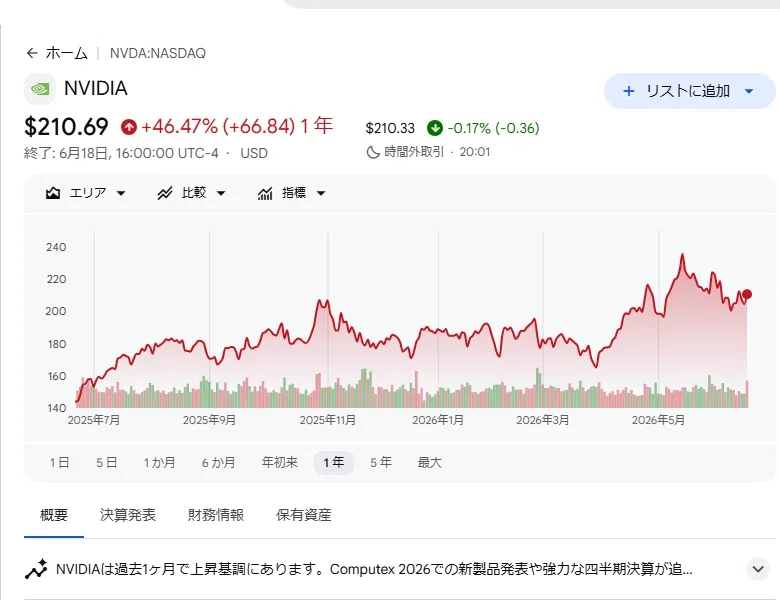
1. NVIDIA (NVDA)Stock Price $210.69 (1Y +46%) / Market Cap ~$5.1 Trillion / P/E Ratio 32x / P/B Ratio 26x / Dividend Yield ―
The absolute king of AI semiconductors, this company generates the ultimate demand for the silicon photonics theme. The more NVIDIA GPUs are sold, the more optical components are needed to connect them. In other words, NVIDIA stands at the root of all optical-related stocks.
What is noteworthy is that they have stepped from being a 'user' of optics to a 'designer.' They have introduced a line of switch products with built-in CPO and have begun to lead the trend of bundling optical engines into network equipment themselves. Furthermore, in March 2026, they invested a total of $4 billion in Lumentum and Coherent, clearly setting out a strategy to secure the optical supply chain.
The one-year stock price increase of +46% looks calm compared to the specialized optical stocks mentioned later. However, the sheer scale of a $5 trillion market cap company achieving this growth rate is impressive. If you are to hold only one core stock for this theme, this is the one to consider first.
2. Broadcom (AVGO)Stock Price $411.35 (1Y +65%) / Market Cap ~$1.96 Trillion / P/E Ratio 68x / P/B Ratio 22x / Dividend Yield ―
A giant with a dual engine of custom semiconductors for AI and network switches for data centers. In the context of silicon photonics, it is positioned as the leader in deploying CPO on a large scale from the switch side.
The company's latest switch generation, Tomahawk 6, is seen as the foundation for the full-scale adoption of CPO by bundling 800G and 1.6T optical solutions. Because they control the switches that handle massive amounts of data next to the GPUs, they are in a position to capture the full benefits of opticalization.
The stock price has been steady, up +65% over the past year. As one of the two pillars of AI infrastructure alongside NVIDIA, it can be considered a stock that is easy to place at the core of a portfolio. The valuation is high at a P/E ratio of 68x, so that is something to keep in mind.
3. Marvell Technology (MRVL)Stock Price $310.58 (1Y +323%) / Market Cap ~$271.7 Billion / P/E Ratio 107x / P/B Ratio 15x / Dividend Yield ―
A company that has established a leading position in both custom silicon and 1.6T optical DSPs, which are the brains of optical transceivers. They are truly a key player in opticalization, responsible for the signal processing required when converting data to light.
Symbolic of this was the acquisition of Celestial AI (approx. $3.25 billion), which was completed in February 2026. The company's Photonic Fabric is considered a technology that delivers optical data not just to the 'edge' of the processor, but to any location on the die, and is seen as a move looking beyond CPO. The fact that NVIDIA's top leadership praised it has also been a tailwind.
The stock price is up +323% in one year, an outstanding growth rate for a large-cap stock. Given the high expectations, the P/E ratio is at a high level of 107x, so caution is required as the stock price is predicated on continued growth.
5 Major Stocks in Optical Components and Optical Transceivers
From here on, we look at the major companies that actually manufacture and supply optical components, modules, and systems. This list includes companies backed by NVIDIA and the industry's top favorites.
④ Coherent (COHR)Stock Price $389.57 (1Y +380%) / Market Cap ~$76.2B / P/E Ratio 185x / P/B Ratio 7.1x / Dividend Yield ―
Formerly II-VI, this company has rebranded and is a top-tier player in terms of comprehensive optical component capabilities. Its strength lies in vertical integration, ranging from the InP lasers that serve as the foundation for light, to silicon photonics modulators, and finished transceivers.
The current business environment is extremely strong. Orders for data centers continue to exceed shipments by more than four times, and it is reported that production capacity for its flagship InP lasers is fully booked through 2027. At OFC 2026, it even demonstrated a 6.4T-class silicon photonics CPO system. The $2 billion investment from NVIDIA serves as proof of its technical prowess.
The stock price has risen significantly by +380% in one year. On the other hand, the P/E ratio is quite high at 185x, reflecting an valuation that assumes continued strong performance growth. Because it is a favorite, this is a stock for which you want to choose your entry timing carefully.
⑤ Lumentum (LITE)Stock Price $850.00 (1Y +848%) / Market Cap ~$66.1B / P/E Ratio 149x / P/B Ratio ― / Dividend Yield ―
A major player in lasers and optical components, and one of the companies backed by NVIDIA. As a leading supplier of laser light sources essential for CPO, it is at the forefront of the optical transition wave.
In March 2026, a major turning point occurred when it received a $2 billion investment and a multi-year purchase agreement from NVIDIA. Expectations for earnings growth have surged as it captures demand for light sources for AI data centers. It is also moving to increase supply capacity and is building a production system within the United States.
The stock price rose +848% in one year, recording the highest growth rate among these 17 stocks. Conversely, it is also the stock that has priced in the most expectations. Price movements are volatile, and declines can be significant during adjustment phases, so careful attention to position sizing is necessary.
⑥ Ciena (CIEN)Stock Price $428.22 (1Y +475%) / Market Cap ~$60.6B / P/E Ratio 142x / P/B Ratio 21x / Dividend Yield ―
A world-leading company in long-distance, high-capacity optical communication systems. It is particularly strong in advanced transmission technology called coherent optics, and is capturing demand for DCI (Data Center Interconnect) that connects data centers to each other.
Its flagship WaveLogic 6 is considered the industry's only solution capable of achieving 1.6Tb/s on a single wavelength, and it is growing strongly against the backdrop of a surge in network demand driven by AI. A key feature is that it controls not only the GPU clusters themselves but also the major arteries connecting locations.
The stock price surged +475% in one year. It is attractive because it has a stable business foundation as a systems company while also benefiting significantly from the tailwinds of AI optical communication. However, with a P/E ratio of 142x, the valuation is high, and one must remain aware of the potential for overheating.
⑦ Fabrinet (FN)Stock Price $573.76 (1Y +116%) / Market Cap ~$20.6B / P/E Ratio 49x / P/B Ratio 8.9x / Dividend Yield ―
A company with large-scale production capacity that is almost unique in the world for contract manufacturing of optical modules. It manufactures optical products for Lumentum, Cisco, and NVIDIA behind the scenes, essentially taking on the manufacturing for the entire optical boom.
Recent quarterly revenue reached a record high of $1.13 billion. Its strength lies in its position as a so-called pickaxe seller, where orders increase as the optical transition progresses, without needing to bet on a specific winner. It is an investment destination similar to the idea that the most reliable way to make money during a gold rush is to sell pickaxes.
The stock price is up 116% over the past year, a relatively calm rate of increase among the top-tier group. The P/E ratio is also at 49x, which remains a realistic level compared to other specialized optical stocks. This is likely a company suitable for those who want to ride the theme while avoiding excessive overheating.
⑧ Applied Optoelectronics (AAOI)Stock Price $161.85 (1Y +590%) / Market Cap Approx. $13 billion / P/E Ratio 34x / P/B Ratio 12x / Dividend Yield ―
This is a leading emerging company specializing in optical transceivers. Although it had a period of sluggish growth, it has captured the demand for high-speed transceivers for AI data centers, leading to a dramatic turnaround in its business performance.
It has begun mass shipments of 800G products and is reported to have secured orders exceeding $200 million for 1.6T products. Customers include major cloud operators such as Amazon, Oracle, and Microsoft, placing the company in a position to directly benefit from hyperscaler capital expenditures. Sales for data centers have grown significantly compared to the same period last year.
The stock price has risen explosively by 590% over the past year. As a mid-cap stock with a market capitalization of around $13 billion, the price movement is quite volatile. While there is significant room for growth, it is important to understand that the stock price is easily swayed by fluctuations in orders.
3 Key Players in AI Connectivity and Next-Generation Interconnects
These companies are responsible for connection technologies that move data at high speeds, including not only optics but also DSPs, retimers, and cables that connect copper and optics. They hold a position in the inconspicuous but critical parts of AI infrastructure.
⑨ Credo Technology (CRDO)Stock Price $271.83 (1Y +218%) / Market Cap Approx. $50.7 billion / P/E Ratio 108x / P/B Ratio 24x / Dividend Yield ―
A company specializing in high-speed connectivity, it originally made a name for itself with AEC (Active Electrical Cables). It has increased its presence with products that efficiently connect short distances within server racks using copper.
In recent years, it has been actively stepping into the optical domain. It is expanding its business by looking at both copper and optics, deploying the Cardinal family of 1.6T optical DSPs and 800G ZeroFlap optical transceivers. Having acquired the optical company DustPhotonics, it expects $500 million in optical-related sales in fiscal year 2027.
The stock price has risen strongly by 218% over the past year. Its flexibility in capturing the transition from copper to optics is highly regarded. Since the P/E ratio is at a high level of 108x, this is a stock to watch while assessing the sustainability of its growth.
⑩ Astera Labs (ALAB)Stock Price $417.07 (1Y +348%) / Market Cap Approx. $71.5 billion / P/E Ratio 282x / P/B Ratio 48x / Dividend Yield ―
An emerging company specializing in connectivity that resolves data bottlenecks occurring inside servers and racks. It plays a role in unlocking the performance of AI servers with retimers and smart cables for standards such as PCIe and CXL.
Its new product, the Scorpio X-Series, is a fabric switch for AI scale-up that supports 320 lanes and has already begun shipping. In October 2025, it acquired aiXscale Photonics, laying the groundwork for the optical field. It is capturing the explosive demand for connectivity solutions for AI infrastructure.
The stock price has surged by 348% over the past year. On the other hand, its P/E ratio is 282x, the highest level among these 17 stocks. Because extreme growth expectations are priced in, it is particularly important to be aware that the stock price will be heavily influenced by whether earnings continue to outperform.
⑪ MACOM Technology (MTSI)Stock Price $391.41 (1Y +186%) / Market Cap Approx. $29.9 billion / P/E Ratio 166x / P/B Ratio 22x / Dividend Yield ―
This company has strengths in radio frequency (RF) and analog semiconductors, and also handles lasers and drivers for optical communications. It supplies essential, albeit low-profile, components that are indispensable for making optical systems work.
In the most recent quarter, revenue for data centers reached a record high of $85.8 million. The company raised its growth outlook for the data center business to 35-40% and emphasized the tailwinds from new architectures such as 1.6T optics and LPO (Linear Pluggable Optics).
The stock price has performed steadily, up 186% over the past year. Among optical components, its strong expertise in specific areas like lasers and analog is attractive. With a high P/E ratio of 166x, this is a company to consider while monitoring the sustainability of demand.
Three Small-to-Mid-Cap Stocks with High Silicon Photonics Purity
From here on, we look at high-purity small-to-mid-cap stocks where almost the entire business is directly linked to silicon photonics. While the potential for returns is large, the risks are also significantly higher. Please view these with the premise of keeping them as only a portion of your portfolio if you choose to invest.
⑫ POET Technologies (POET)Stock Price $12.15 (1Y +201%) / Market Cap ~$2.1 billion / P/E Ratio ― (Loss-making) / P/B Ratio 8.7x / Dividend Yield ―
This is a small company aiming to make optical engines cheaper and smaller using a proprietary platform called an optical interposer. By consolidating multiple components onto a single base, it seeks to realize high-density optical connections.
The business continues to make progress. It received an initial $50 million order from Lumilens, which has developed into a framework with the potential to exceed $500 million over five years. It also raised $400 million in capital to prepare for mass production. On the other hand, the stock price recently dropped nearly 20% in a short period following an order cancellation related to Marvell.
The stock price rose 201% in a year, but it is a small-cap stock with a market capitalization of $2.1 billion and is still in the loss-making stage. Price movements are extremely volatile and can swing significantly on a single piece of news. It is realistic to treat this as a speculative position and only invest a small amount.
⑬ Lightwave Logic (LWLG)Stock Price $9.78 (1Y +702%) / Market Cap ~$1.5 billion / P/E Ratio ― (Loss-making) / P/B Ratio 18x / Dividend Yield ―
This is a specialized company that has developed unique polymer materials used in modulators that convert electricity into light. Its proprietary materials, which enable high-speed, low-power modulation, have begun to attract attention as infrastructure components for the AI era.
A turning point was the partnership with Tower Semiconductor announced in March 2026. The agreement involves integrating polymer modulators exceeding 110GHz into the company's PH18 silicon photonics platform, and the stock price surged over 40% on the day of the announcement. It is in the process of transitioning from a company that develops materials to one that supplies core components for AI infrastructure.
The stock price has risen sharply by 702% in a year, but it is a sub-$10, loss-making micro-cap stock. Full-scale mass production and monetization are still ahead, and it falls into the most speculative category among these 17 stocks. It must be handled with caution, understanding that it is a stock where expectations are running ahead of reality.
⑭ Tower Semiconductor (TSEM)Stock Price $286.74 (1Y +626%) / Market Cap ~$34.1 billion / P/E Ratio 133x / P/B Ratio 11x / Dividend Yield ―
This is a foundry specializing in the contract manufacturing of silicon photonics. Many optical semiconductor manufacturers outsource production to Tower rather than owning their own factories. It is an unsung hero that benefits regardless of whose optical chips are selling.
Centered on its PH18 silicon photonics manufacturing platform, it partners with many companies, including Lightwave Logic mentioned earlier. Its strength lies in the ability to invest in the broader trend of optical conversion itself, rather than betting on a specific product hit. Driven by expanding demand for AI data centers, its performance is also growing.
The stock price has risen significantly by 626% in a year. Due to the nature of the foundry business, it benefits as capital investment across the entire industry increases. While the P/E ratio is high at 133x, it is worth considering as a company that covers the foundation of the theme.
3 Large-Cap Infrastructure Stocks Supporting the Foundation
Finally, these are large-cap stocks that, while not pure-play silicon photonics companies, hold the foundation that supports the wave of optical transformation. Their price movements are relatively calm, and they can be expected to play a role in enhancing the stability of your portfolio.
15. Corning (GLW)Stock Price $194.92 (1Y +287%) / Market Cap ~$167.8 billion / P/E Ratio 99x / P/B Ratio 15x / Dividend Yield ―
A global leader in optical fiber and a comprehensive glass and materials technology company. If silicon photonics is about what happens inside the chip, Corning supplies the "lines" that connect data centers.
In AI data centers, the demand for optical fiber to connect servers and switches is surging. Corning is a direct beneficiary of this cabling demand, and its optical communications division, long seen as a mature business, has transformed back into a growth driver. The fact that it holds multiple businesses, such as glass for smartphones, also contributes to its stability.
The stock price has risen strongly by +287% in one year. Because it holds the physical foundation of infrastructure rather than chips, it is less susceptible to the wins and losses of individual technologies. It can be said that this is a stock that allows you to capture the base of the theme with more peace of mind.
16. TSMC (Taiwan Semiconductor / TSM)Stock Price $462.12 (1Y +121%) / Market Cap ~$2.40 trillion / P/E Ratio 40x / P/B Ratio ― / Dividend Yield ―
The world's largest semiconductor foundry and the heart of AI semiconductor manufacturing. In the context of silicon photonics, it plays a role in supporting the mass production of CPO through a technology called COUPE, which is a packaging foundation for optical chips.
Most AI chips from Nvidia and Broadcom are also manufactured by TSMC. As optical transformation progresses, the importance of the advanced packaging that makes it possible increases, and TSMC's presence grows as well. Rather than being at the center of the theme, it is in a position to quietly support the entire foundation.
The stock price has performed steadily, up +121% in one year. Not only can it capture the entire growth of AI semiconductors, but the progress of optical transformation also acts as a tailwind. With a P/E ratio of 40x, it cannot be said to be excessively high considering its scale and profitability, and it is a strong candidate as a company that holds the core of AI infrastructure.
17. Cisco Systems (CSCO)Stock Price $119.54 (1Y +80%) / Market Cap ~$471.2 billion / P/E Ratio 40x / P/B Ratio 9.6x / Dividend Yield 1.4%
A giant in network equipment that has long supported the communication infrastructure of companies and data centers. It has deep ties to silicon photonics, and it owns Luxtera, a silicon photonics company it acquired in the past, and Acacia, which specializes in coherent optics.
Against the backdrop of expanding demand for AI networks, Cisco, which was once seen as a mature company, is being re-evaluated. The trigger for this reassessment is the fact that it is strengthening products for AI data centers by combining optical technology with network equipment. Among these 17 stocks, it is also one of the few that pays a solid dividend.
The stock price is up +80% in one year, the most modest growth rate on this list. Although it lacks flashiness, it has a stable earnings base and dividends. For those concerned about the volatility of optical-related stocks, it is a company that is easy to incorporate as an anchor for a portfolio.
Investment Perspective: How to Combine Core, Growth, and Speculative Stocks
We have looked at 17 stocks so far, but it is not realistic to buy them all in the same way. This is because the level of risk varies greatly from stock to stock. Here are some tips on how to assemble your portfolio.
The first is a barbell strategy that covers both ends. Specifically, the following allocation can be considered.
As a foundation, focus on diversified large-cap stocks such as Nvidia, Broadcom, TSMC, Cisco, and Corning.
For growth potential, add a small amount of high-purity small-to-mid-cap stocks like POET, Lightwave Logic, and AAOI.
This combination allows you to maintain a sense of stability while also capturing explosive potential if things go well.
The second point is the pick-and-shovel strategy. It is not easy to pick individual winners. Therefore, it is effective to focus on the supporting players that benefit regardless of who wins, such as Fabrinet (contract manufacturing) or Tower Semiconductor (foundry).
The third point is timing your purchases. The 17 stocks in this list have seen annual gains of several hundred percent. Since they have already priced in high expectations, if you are entering now, it is safer to avoid lump-sum investing and instead adopt a stance of buying on dips in installments.
The fourth point is capital allocation and time horizon. In a theme with such high volatility, it is forbidden to invest a large amount of money that would affect your daily life all at once. The basic approach is to decide in advance what percentage of your total assets to allocate to this theme, and then allocate more to the core large-cap stocks and less to the speculative small-cap stocks.
Also, it is important to accept that AI infrastructure investment is a long-term theme that will continue for several years, and not to get too caught up in short-term fluctuations.
Risks that cannot be overlooked
Finally, I will summarize the risks that you must be aware of when investing in this theme. The higher the growth rate of a theme, the more intense the potential decline tends to be.
The main risks are as follows:
️ High Valuation: In a world where a P/E ratio of over 100x is common, if expectations are dashed, the decline will be significant.
️ AI Capital Expenditure Cycle: If investment by major cloud providers enters a plateau, optical demand will also slow down.
️ Technology and Standards Competition: The winning path could shift between CPO, LPO, pluggables, etc.
️ Customer Concentration: High dependence on a small number of hyperscalers means that fluctuations in orders directly impact performance.
️ Dilution and Losses in Small-to-Mid-Cap Stocks: Stock dilution due to capital increases or prolonged losses may occur.
️ Currency Exchange: When evaluating in Japanese Yen, you will be affected by movements in US interest rates and the USD/JPY exchange rate.
In particular, the high valuation mentioned first is something to take very seriously. A P/E ratio of 100x roughly means you are paying 100 years' worth of current annual profits in advance.
This can be justified if growth continues as expected, but even a slight slowdown in growth can cause the stock price to adjust significantly. In fact, even if the earnings figures themselves are good, these stocks can drop 10-20% in a single day just because they failed to meet the market's overly high expectations. You should assume that the same level of downside risk lies behind the high growth rate.
Especially as seen when POET dropped sharply in the short term due to the cancellation of Marvell-related orders, small-cap stocks can fluctuate wildly based on a single piece of news. While it is attractive to ride the momentum of a theme, it is most important not to invest an amount that exceeds your own risk tolerance.
Summary
Silicon photonics is the new bottleneck solver that physically supports the growth of AI data centers. As symbolized by Nvidia's $4 billion investment, the shift toward optical technology is no longer a passing trend but is becoming a structural change.
On the other hand, many related stocks have already risen by several hundred percent in a year, and bullish expectations are heavily priced into their stock values. That is why it is important to focus on major blue-chip stocks, keep speculative small-cap stocks to a minimum, and maintain a stance of being mindful of buying on dips. I hope this article serves as a foundation for your stock research.
Finally, I would like to introduce two books to help you understand this theme more deeply.
The first book is by Chris Miller, which depicts the struggle for hegemony between nations over semiconductors, "Chip War: The Fight for the World's Most Critical Technology". It is a book that allows you to understand at once the history and geopolitics of why semiconductors have become the most important issue for every country. It is useful for grasping the broader context of why the entire AI infrastructure, including silicon photonics, is attracting such massive amounts of money and national strategy.
The second book is by Tapazo, "The Super Easy US Stock Investment Technique to Increase Your Money". This book is for those who want to first solidify the foundation of their US stock investments before chasing trending theme stocks like the ones discussed here.
It gently organizes the mindset for increasing assets over the long term and how to utilize ETFs, helping you create a "core" to combine with high-stimulation individual growth stocks.
That concludes the 17 US stocks related to silicon photonics. Thank you for reading until the end.