The biggest difference between a straight perm and hair straightening is the 'presence or absence of heat treatment'.
A straight perm is performed using only chemicals and is characterized by a natural finish, while hair straightening uses chemicals plus heat treatment from an iron to make even strong curly hair semi-permanently straight.
What you will learn in this article
5 differences between straight perms and hair straightening (procedure, price, finish, duration, damage)
How to choose the right one for your hair type and check points
Points to note to avoid failure and post-treatment care methods
Are you struggling with questions like, 'When I consulted the salon, I couldn't decide between a straight perm and hair straightening...' or 'It seems like the price and effects are different, but what exactly is the difference?'
In fact, although these two treatments seem similar, they are completely different. Making the wrong choice can lead to not only failing to achieve your ideal finish but also the risk of hair damage and additional costs.
In this article, based on the insights of an active hairdresser who handles over 500 curly-haired clients a year, we will thoroughly explain the differences between straight perms and hair straightening. We will provide specific criteria so you can choose the treatment that suits your hair type and wishes.
[Author Introduction] Michihiro Morikoshi
Representative Director, SENJYU Co., Ltd. / Supervisor, SENJYU Professional Team
16 years of experience as a hairdresser. Debuted as a stylist at age 24 while at GARDEN, achieving 3.5 million yen in sales in the first month (a new Japanese record at the time).
As a specialist in perms, hair straightening, and hair quality improvement, I face the hair of over 5,000 clients annually. Currently expanding stores nationwide.
What is a straight perm? Let's understand the basic mechanism
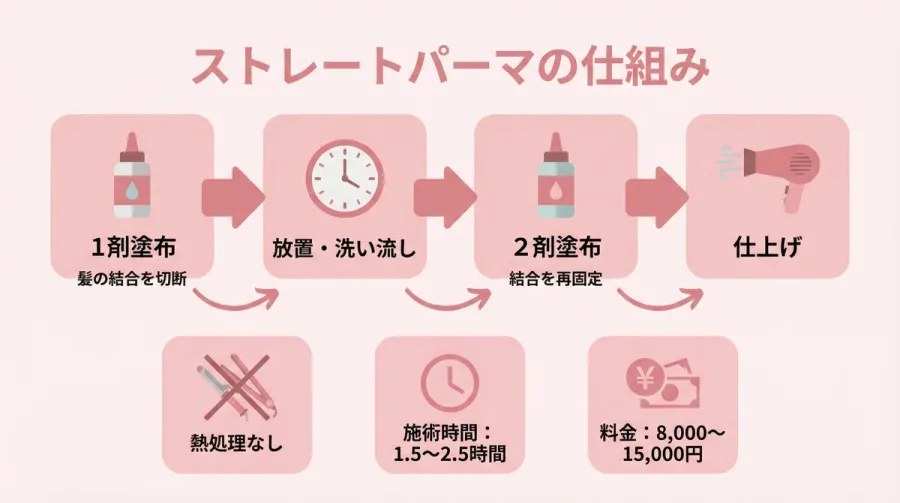
A straight perm is a treatment that uses only two types of chemicals to straighten hair.
It was originally developed as a technique to return permed hair to its original straight state.
Straight perm procedure processThe straight perm procedure proceeds in the following flow.
1st agent application: Apply chemicals that temporarily break the protein bonds of the hair
Leave on/Rinse: After leaving it for a certain amount of time, rinse off the chemicals
2nd agent application: Apply chemicals that fix the hair bonds again in a straight state
Finish: After shampooing and conditioning, use a hair dryer to
dry and complete
Because it does not use heat treatment (an iron), it is characterized by relatively less damage to the hair. The treatment time is about 1.5 to 2.5 hours, which is shorter than hair straightening.
Benefits of a straight permA straight perm has the following benefits:
Natural finish: It does not become too flat and retains a moderate amount of volume.
Less damage: Because no heat is applied, it is less stressful on the hair than hair straightening.
Lower cost: It costs about 8,000 to 15,000 yen, which is about half the price of hair straightening.
Soft texture: It results in a natural and soft touch.
On the other hand, there are also the following disadvantages:
Not suitable for strong curly hair: The chemicals alone cannot completely straighten strong, frizzy hair.
Short duration: The effect fades in about 1 to 3 months.
Limited effect: It only reduces volume and does not result in perfectly straight hair.
A straight perm can be said to be a treatment suitable for those who want to calm down light curly hair or remove a perm.
What is hair straightening? Let's understand the basic mechanism.
Hair straightening is a treatment that uses heat treatment from a hair iron in addition to chemicals to strongly fix the bonds of the hair.
It is known as the most effective treatment method that can make even the strongest curly hair straight.
Hair straightening treatment processThe hair straightening treatment proceeds in the following flow:
Application of the first agent: Applying chemicals that break the bonds of the hair.
Waiting and rinsing: After leaving it for a certain amount of time, the chemicals are rinsed off.
Dry: Dry the hair
Straight iron: Straighten the hair while taking fine slices with a high-temperature (160-180 degrees) iron
Second agent application: Apply a chemical that fixes the hair's bonds in a straight state
Finishing: After shampooing and conditioning, perform the final drying
Because it changes the hair structure using both chemicals and heat, it provides a more powerful effect than a straight perm. The treatment time is longer, taking about 3 to 4 hours.
Benefits of hair straighteningHair straightening has the following benefits:
Straightens strong curly hair: Even frizzy hair and strong waves can be made completely straight
Semi-permanent effect: Once treated, the hair remains straight semi-permanently
Adds shine: The iron treatment smooths the hair surface, resulting in a beautiful shine
Peace of mind even in the rainy season: Hair is less likely to frizz on humid days
Easier styling: Significantly reduces the time spent on daily hair styling
On the other hand, there are also the following disadvantages:
High damage: Both chemicals and heat place a burden on the hair
High cost: About 15,000 to 25,000 yen, which is about twice the price of a straight perm
Long treatment time: Takes about 3 to 4 hours * Cannot get a perm: It becomes difficult to get a perm after hair straightening
Not suitable for bleached hair: It may not be possible to perform the treatment on damaged hair
Hair straightening is a treatment suitable for those who want to "thoroughly straighten strong curly hair" or "maintain straight hair for a long period."
A thorough comparison of the differences between a straight perm and hair straightening from 5 perspectives
We will compare the differences between a straight perm and hair straightening in detail from the following five perspectives.
Difference 1: Treatment Content [The presence or absence of heat treatment is the biggest difference]The biggest difference is whether or not heat treatment using a straight iron is performed.
A straight perm changes the shape of the hair using only chemicals, whereas hair straightening involves softening the hair with chemicals, then straightening it with a high-temperature iron and fixing it in that state.
Whether or not this heat treatment is performed creates a significant difference in the strength and durability of the finish.
Difference 2: Price and Treatment TimeHair straightening costs about twice as much and takes about twice as long.
Because hair straightening includes a heat treatment process, it requires more skill and time. Also, since long hair surcharges may be added depending on the length of your hair, please check in advance.
Difference 3: Texture of the FinishA straight perm results in a natural softness, while hair straightening results in a glossy, straight finish.
Straight perm finish:
Natural and soft texture
Retains a moderate amount of volume
Some waves may remain
Does not become too flat
Hair straightening finish:
Glossy and straight
Volume is reduced
Waves are completely straightened
Uniform straightness to the ends of the hair
If you prefer a natural finish, a straight perm is suitable; if you want perfectly straight hair, hair straightening is the way to go.
Difference 4: DurationA straight perm lasts for 1 to 3 months, while hair straightening is semi-permanent.
Duration of a straight perm:
Gradually returns to its original state in about 1 to 3 months
Individual differences exist depending on hair length and quality
Requires regular maintenance
Duration of hair straightening:
The treated area remains straight semi-permanently
Newly grown roots remain curly
Root touch-ups are required every 3 to 6 months
Since hair straightening keeps the treated area straight semi-permanently, it can be said to be cost-effective in the long run.
Difference 5: Damage to hairHair straightening causes more damage.
Hair straightening uses high-temperature irons in addition to chemicals, which puts a greater burden on the hair. In the case of bleached or highly damaged hair, it is safer to avoid hair straightening.
However, new technologies that reduce damage, such as "acidic hair straightening," have recently appeared.
Which one should you choose? How to choose and check points that suit you
It is important to choose according to your hair type and desired finish.
Let's judge using the following check points.
People who are suited for a straight permA straight perm is recommended for those who fit the following criteria.
Hair type/condition:
Have light wavy or curly hair
Have a perm and want to remove it
Want to slightly reduce hair volume
Have damage from bleaching or coloring
Desired finish:
Want a natural, soft straight hairstyle
Do not want it to look too flat
Want to maintain a natural texture
Hair straightening is recommended for those who fit the following criteria.
Hair type/condition:
Have strong curly or frizzy hair
Hair tends to spread out due to humidity
Spend a lot of time styling every morning
Have healthy hair (not bleached or highly damaged)
Desired finish:
Want completely straight hair
Want hair with a glossy shine
I want to completely straighten my hair
Summary: Achieve Your Ideal Straight Hair with the Treatment That Suits You
Let's summarize the differences between straight perms and hair straightening once more.
5 Differences:
Treatment Content: The presence or absence of heat treatment is the biggest difference
Price: Straight Perm 8,000–15,000 yen vs. Hair Straightening 15,000–25,000 yen
Finish: Natural softness vs. Glossy and straight
Duration: 1–3 months vs. Semi-permanent
Damage: Moderate vs. Significant
Basics of Choosing:
Light waves/desire for a natural finish → Straight Perm
Strong waves/desire for perfectly straight hair → Hair Straightening
The most important thing is to choose the treatment that suits your hair type and needs, and to consult with a trusted hairdresser.
To get your ideal straight hair, start with a free consultationIf you are wondering, "I want to know which one is right for my hair" or "I want to see the actual results before deciding," we recommend starting with a free salon consultation.
An experienced hairdresser will assess your hair type and propose the optimal plan based on your past treatment history and lifestyle. Get your ideal straight hair and enjoy your daily hair care.
Frequently Asked Questions (FAQ)
Q1. Are over-the-counter straight perm products effective?We recommend professional treatment because the risk of failure is high. With over-the-counter straight perm products, it is difficult to select the right chemicals for your hair type and damage level, and it is also hard to judge the processing time. An experienced hairdresser will choose the best chemicals and treatment method for your hair.
Q2. Can men also get straight perms or hair straightening?Yes, it is also effective for men's wavy hair. Straight perms and hair straightening are effective for men's wavy or frizzy hair as well. However, for short hair, the roots tend to become noticeable as the hair grows, so maintenance every 2–3 months is usually required.
Q3. Is it possible to have a partial treatment just for the bangs?Yes, it is possible. The price is generally around 3,000 to 8,000 yen. You can have the treatment applied only to specific areas that concern you, such as your bangs or around your face. Partial treatment allows you to resolve frizz in specific areas while minimizing the burden on your entire head of hair.
Q4. Can I have a color treatment at the same time?Basically, it is recommended to do them on separate days. You should avoid having a straight perm or hair straightening and coloring done at the same time, as the burden on your hair is too great. By waiting 1 to 2 weeks after the treatment before coloring, you can minimize damage.
Q5. How often should I visit the salon?The guideline is every 3 to 4 months for a straight perm and every 3 to 6 months for hair straightening. Since the effects of a straight perm fade in 1 to 3 months, maintenance every 3 to 4 months is recommended. Hair straightening has a semi-permanent effect, but it is best to get a retouch every 3 to 6 months when you start to notice the frizz in the newly grown roots.