Good evening, everyone! Now that we've entered November, it feels like the end of the year is suddenly approaching. Once Halloween is over, it's straight into Christmas. I'm a writer who feels half excited and half a bit melancholy.
It's getting quite cold in the mornings and evenings, so please take care of your health!
Now, to the main topic!
Today, I'm going to explain the "space elevator"!
The reason is that the space elevator concept announced by Obayashi Corporation in 2012 included a plan that "if construction could begin in 2025, operations would start in 2050." And now it is 2026. It's just the right time to be curious about the "reality check."
So, I did some research.
Even if you think, "That's just something from anime or sci-fi, right?", please give this a read!
What is a space elevator?
A "train to space" that climbs a cable to reach the stars!
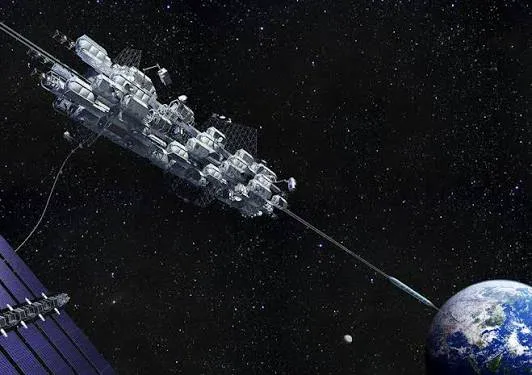
A space elevator is a system that transports people and cargo to space by extending a cable from the ground to space and having a vehicle called a "climber" ascend that cable.
Instead of burning fuel and launching all at once like a rocket, it's imagined as a train slowly ascending to space along a rail.
The key point is the "geostationary orbit" located around the middle of the cable. As introduced in a previous article, in a geostationary orbit at an altitude of about 36,000 km, satellites rotate at the same speed as the Earth's rotation, so they appear stationary when viewed from the ground. The space elevator uses this geostationary orbit as a center, extending cables simultaneously toward the ground and toward space to maintain balance.
In Obayashi Corporation's concept, the total length of the cable is a staggering 96,000 km. That's long enough to circle the Earth more than twice (too long, right? haha).
A weight called a "counterweight" is placed at the very top to keep the entire cable taut.
Simply put, a space elevator is a "vehicle that climbs an incredibly long thread tied to the Earth"! (If you can remember just this, you've got it perfect!)
Why is the space elevator attracting attention? Escaping the "fuel-carrying journey" of rockets
Now, here you might think, "If we have rockets, why bother with an elevator?"
The keyword is "transport efficiency."
According to a paper from Obayashi Corporation's research institute, the payload (the cargo you want to carry) accounts for less than 5% of the total weight of current rockets. In other words, most of a rocket's weight is fuel and the vehicle itself, with only a small fraction being cargo. On the other hand, a space elevator is expected to have a transport efficiency close to 100%.
In a previous article, I introduced the idea of reusing rockets to lower launch costs, but the space elevator is an even more advanced idea of "not using rockets at all." If it becomes a reality, delivering artificial satellites to space and humans traveling to space might take a completely different form than it does today.
Obayashi Corporation's 2050 Concept: A "Station to Space" Designed by a General Contractor
The company seriously conceptualizing a space elevator in Japan is the general contractor (major construction company) Obayashi Corporation. In 2012, they announced a concrete construction concept in their public relations magazine "Kikan Obayashi" No. 53, "Tower."
In the concept, they first build ground departure and arrival ports, "Earth Ports," on the equator, divided between land and sea. The sea portion is a facility with a diameter of about 400m, planned to be connected to the land portion by an undersea tunnel.
Along the cable, several "stations" are lined up. At an altitude of 23,750 km, there is a "Low Earth Orbit Satellite Launch Gate" to send artificial satellites transported from Earth into space, and other concepts include a "Lunar Gravity Center" and a "Mars Gravity Center" where one can experience the same gravity as the Moon or Mars. And the largest station is the "Geostationary Orbit Station" located in geostationary orbit. In the Obayashi Corporation research report, it is assumed that it will take 7 days to travel from the ground to this geostationary orbit station.
It's truly a "route map to space"!
Of course, they aren't just drawing up concepts. Obayashi Corporation has been cooperating with Shizuoka University and others to conduct experiments by placing carbon nanotube threads, the material for the cable, outside the Japanese Experiment Module "Kibo" of the ISS (International Space Station) to check if they deteriorate in space. In the first experiment from 2015 to 2017, damage believed to be caused by atomic oxygen (oxygen particles that damage cables) was found, and a second experiment has been underway since 2019 using improved materials.
By the way, just the other day (October 30th), astronauts performed an extravehicular activity on the ISS to install new solar batteries. Space elevator material testing is only possible thanks to the active ISS.
Barriers to Realization and the Future: The Three Mountains of Materials, Debris, and Radiation
Reading this far, it sounds like a dream, but there are still major barriers to realization.
The biggest one is the cable material. The candidate, carbon nanotubes, is a light and strong material said to have about 20 times the tensile strength of steel. However, according to the Obayashi Corporation research report, the cable strength required for the concept is 150 GPa (gigapascals, a unit of how much pulling force it can withstand). Current carbon fiber developments are around 10 GPa, a roughly 15-fold difference. Furthermore, according to reports, the length of carbon nanotubes that can be produced now is only about 10 to several tens of centimeters. Since we need 96,000 km, the scale is completely different...
There are many other challenges. Regarding space debris, it is estimated that there is a risk of collision with the cable once every 10 days for objects under 10 cm in diameter, and once every 100 days for objects over 10 cm. Also, to protect passengers from radiation during the 7-day journey to the geostationary orbit station, covering it with aluminum would require 18 tons just for the climber's outer wall, and using electromagnetic shielding would require 1.12 GW of power, both of which are considered unrealistic.
Obayashi Corporation's representatives also reportedly say, "The more we do, the more difficult it gets," and "The reality is orders of magnitude away from the ideal."
Even so, I feel that this research has great significance. Strong and light materials, processing technology that doesn't deteriorate in space, technology to avoid debris... these are all things that will be useful in other space businesses and ground industries even if the space elevator is never completed. By setting an outrageous goal of "building an elevator to space," research into these technologies is being driven forward. I think that is where the business value of this concept lies.
That is why, now that the "2025 construction start" has passed, I want to keep an eye on what kind of outlook Obayashi Corporation will show from here on out!
To summarize one last time, a space elevator is a "system that connects the ground and space with a cable and travels to space like a train"!
Although it is still at the dream stage, I feel that the technology born in the process of chasing that dream is filled with an exciting future.
Thank you for reading this far!
See you in the next article!
References
・Obayashi Corporation "Space Elevator Construction Concept | Obayashi Corporation PR Magazine 'Kikan Obayashi'" (Kikan Obayashi No. 53 "Tower," published in 2012) https://www.obayashi.co.jp/kikan_obayashi/detail/kikan_53_idea.html
・Obayashi Corporation Technical Research Institute Report No. 85 "Efforts toward Technical Challenges of Space Elevators" (2021) https://www.obayashi.co.jp/technology/shoho/085/2021_085_01.pdf
・Obayashi Corporation "Conducted Second Space Experiment for Space Elevator Cable Materials" (June 11, 2020) https://www.obayashi.co.jp/news/detail/news20200611_1.html