September 30, 2026
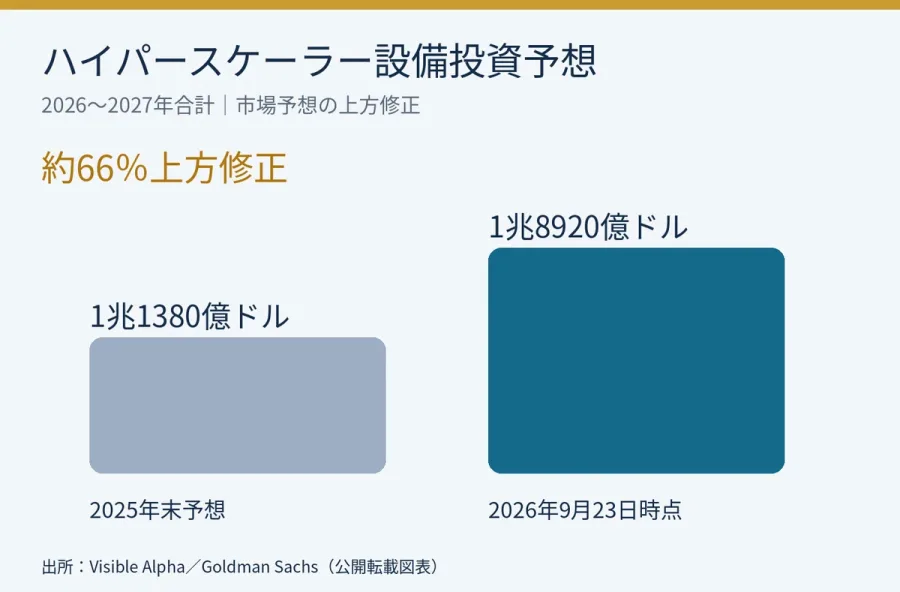
Capital expenditure forecasts for the five major US tech companies (hyperscalers) are ballooning on a scale that completely shatters the market expectations from the beginning of the year. According to market forecast data compiled by Goldman Sachs, the capital expenditure forecast for the two-year period of 2026–2027 has been revised upward from $1.138 trillion as of the end of 2025 to $1.892 trillion (approximately 302.72 trillion yen) as of September 23.
The "Three Perspectives" Uncovered in This ArticleThe Main Drivers of the 120 Trillion Yen Increase and Where the Funds Are Going: Visualizing the breakdown of how investment is concentrating on the three companies that own Google Cloud, AWS, and Azure.
The Trap of "Buying IT Stocks" and True Investment Opportunities: Explaining why the winning opportunities lie not with the hyperscalers themselves, which are under the pressure of depreciation costs, but with niche infrastructure companies on the supply side (power, cooling, optical communications).
Judgment Criteria for Identifying 2027 Earnings Growth: Presenting a framework that links each company's data center expansion plans with the order and delivery schedules of supply companies to lead to high-conviction stock selection.
For those who want to grasp the ripple effects of massive Capex and the conditions for winners concretely, rather than ending with superficial news about the "continuation of the AI boom," please read this article.
The amount added in just nine months is $754 billion (approximately 120.64 trillion yen). This does not mean the investment amount for the single year of 2027, but that the "market forecast for the two-year period" has jumped by 66%. To break through the physical limits of AI demand, the investment scale for the entire AI infrastructure—not just servers and semiconductors, but also power, cooling, and optical communications—is being fundamentally re-evaluated.
◆ Alphabet Revises 2-Year Capital Expenditure Forecast to DoubleHyperscalers are companies that operate massive data center clusters. The companies covered in this compilation are the five firms: (GOOGL) Alphabet, (AMZN) Amazon, (MSFT) Microsoft, (META) Meta Platforms, and (ORCL) Oracle. The capital expenditure forecasts are not the companies' own plans, but the aggregated values of analyst forecasts.
The total forecast for 2026–2027 was revised upward by approximately 100% for Alphabet, from $253 billion to $507 billion, and by approximately 68% for Amazon, from $301 billion to $505 billion. Microsoft was raised by approximately 64% from $227 billion to $373 billion, Meta by approximately 45% from $230 billion to $333 billion, and Oracle by approximately 38% from $126 billion to $174 billion.
The increase for the three companies—Alphabet, Amazon, and Microsoft—totals $608 billion, accounting for approximately 80% of the total. The increases are concentrated in the three companies that operate Google Cloud, AWS, and Azure. In the cloud business, which provides AI computing power to enterprises, the expansion of servers and data centers is directly linked to the expansion of sales capacity.
◆ Hyperscaler Capital Expenditure Forecasted at $1.2 Trillion in 2027In an official article published by Goldman, it is forecasted that hyperscaler capital expenditure will expand from $800 billion in 2026 to $1.2 trillion (approximately 192 trillion yen) in 2027. This is a single-year forecast by the firm's analysts and differs from the aforementioned two-year total market forecast. This represents a 50% increase year-over-year, with an increase of $400 billion (approximately 64 trillion yen).
Capital expenditure also includes regular cloud equipment, and not all of it is for AI. Nevertheless, the expansion in investment scale supports demand for GPUs, dedicated AI semiconductors, memory, and network equipment. Goldman points out that the spending by major IT companies is rippling out to the profits of industrial and utility companies in addition to semiconductors and hardware.
◆ AI Data Center Investment Supports Orders for Power, Cooling, and Optical CommunicationsTo operate large quantities of high-performance AI semiconductors, it is necessary to enhance power supply and cooling capacity, as well as increase communication speeds between servers. Data center expansion entails orders for power equipment, cooling facilities, and optical communication components. The purchase amount of semiconductors alone cannot capture the full extent of demand expansion driven by AI infrastructure investment.
◆Conclusion: 3 Conditions to Identify the 'Winners' in the 2027 AI Infrastructure MarketThe massive 64 trillion yen increase in investment (a 50% year-on-year increase) projected for 2027 is not merely a conceptual forecast, but guaranteed cash flowing into the sites of 'equipment procurement' and 'infrastructure construction'.
As major IT companies grapple with the burden of depreciation, the true 'monetization phase' will be captured by infrastructure suppliers capable of converting this 64 trillion yen into orders. The specific approach to identifying winners in the stock market moving forward can be summarized in the following three points.
Data center construction start dates and supplier order timing
Verification of backlog digestion speed in power grids, liquid cooling, and optical communications sectors
Expansion trends in operating profit margins (marginal profit) for suppliers accompanying facility expansion
The phase of abstract debate over 'whether there is AI demand' is over. By linking the expansion plans of the top three cloud providers with the actual delivery timing of the infrastructure supply chain, the 'true earnings transformation stocks' of 2027 will come into focus.
In future issues, we will continue to track the ripple effects of this 120 trillion yen wave, tracking and analyzing specific niche top stocks related to power, cooling, and optical communications, as well as order trends. If you want to capture structural changes in the market without missing out, please follow our account and wait for the next update.
Follow here
◆Main Sources
Goldman Sachs: 2027 Capital Expenditure Forecast and Impact on Corporate Earnings
Goldman Sachs: Estimates of Global AI Investment and Definition of Capital Expenditure
◆Recommended Reading
Which products beyond semiconductors will benefit from increased investment? This article covers companies related to power, cooling, optical communications, and passive components.
20 AI Data Center Related Stocks: Power, Cooling, Optical Communications, and Passive Components Expanding Beyond GPUs
This article covers the impact of increasing power consumption and the shift to 800V on the power-related businesses of Japanese companies.
This article does not recommend the buying or selling of individual stocks. It summarizes stock price drivers and market perspectives based on publicly available information. Please make investment decisions at your own risk.