At 2:00 AM on Sunday the 27th of this month, New Zealand clocks will move forward by one hour.
In New Zealand, daylight saving time begins every year on the last Sunday of September. This year, it is Sunday, September 27. Whether you are traveling, staying on a working holiday, or keeping in touch with family in Japan, it is helpful to know that the time difference will change.
Table of Contents
⏰ When does New Zealand daylight saving start this year?
On Sunday, September 27, what time do the clocks change and how?
🇯🇵 How does the time difference with Japan change?
When does daylight saving end?
What should travelers and residents be aware of?
Why does New Zealand have daylight saving time?
✅ Summary
⏰ When does New Zealand daylight saving start this year?
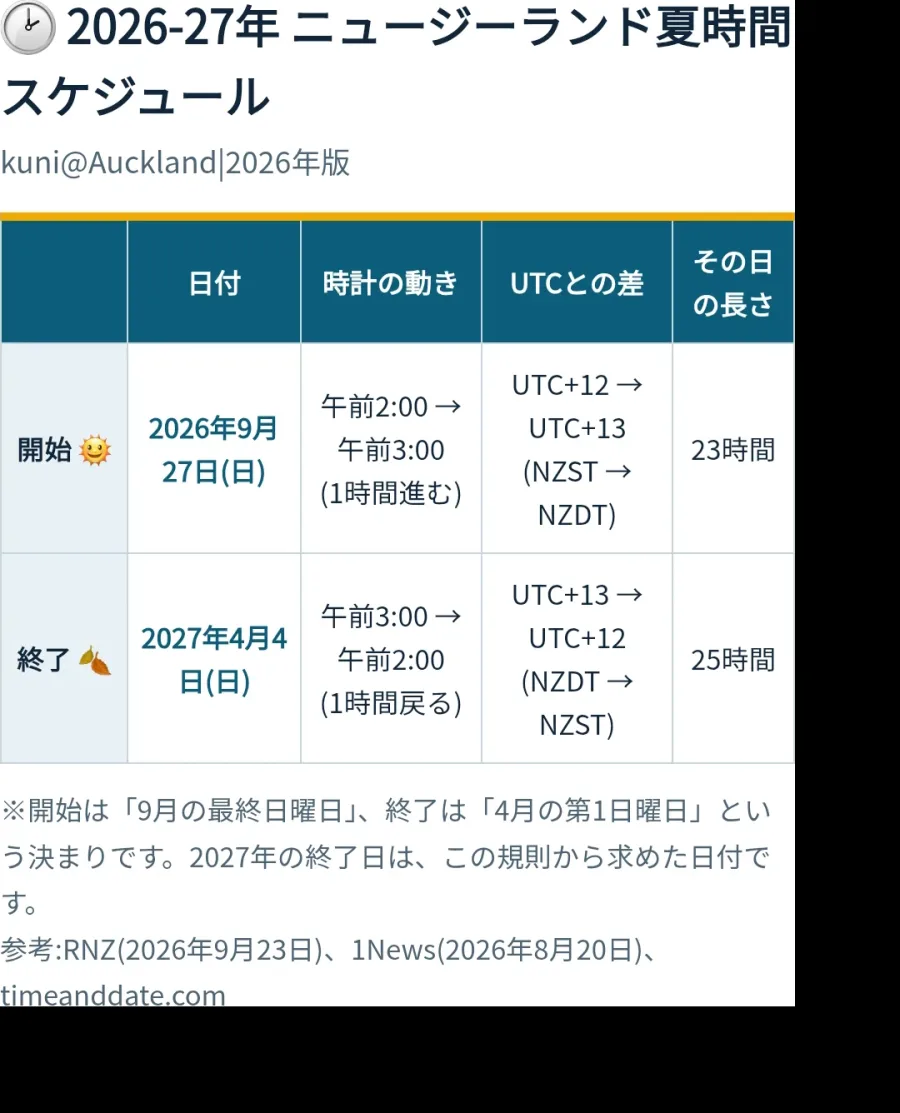
Conclusion: In 2026, it begins at 2:00 AM on Sunday, September 27.
New Zealand daylight saving time is set to begin on the "last Sunday of September" and end on the "first Sunday of April." This year, the last Sunday of September falls on the 27th. This applies nationwide, and Auckland will also switch on the same day.
Key point: This year's start date is Sunday, September 27. You won't get confused if you remember it as the "last Sunday of September" every year.
On Sunday, September 27, what time do the clocks change and how?
Conclusion: The moment it hits 2:00 AM, it jumps to 3:00 AM.
Because the 2:00 AM hour will not exist, September 27 will only have 23 hours. The time will change from New Zealand Standard Time (NZST, UTC+12) to New Zealand Daylight Time (NZDT, UTC+13).
As a result, the morning will feel one hour darker, and the evening will stay bright for one hour longer. RNZ notes that this allows for more time for evening exercise and barbecues.
Key point: On Sunday morning, you will feel like you "lost an hour." In exchange, sunset in the evening will be one hour later.
🇯🇵 How does the time difference with Japan change?
Conclusion: The time difference with Japan will increase from 3 hours to 4 hours.
Japan does not have daylight saving time. Since only New Zealand moves forward by one hour, NZ time will be "Japan time + 4 hours." For example, noon in Japan is 4:00 PM in NZ.
For calls to family or online meetings, this one-hour shift makes it easy to get the meeting time wrong. Please be especially careful in the few days immediately after the switch.
Key point: From September 27 until spring of the following year, calculate the time difference as "4 hours."
When does daylight saving end?
Conclusion: It is expected to end at 3:00 AM on Sunday, April 4, 2027.
The end occurs at 3:00 AM on the "first Sunday of April," and clocks are set back to 2:00 AM. The first Sunday of April 2027 is the 4th. This day will have 25 hours, giving you an extra hour of sleep.
Note that this year (2026), it ended on Sunday, April 5. Daylight saving time lasts for about 6 months.
Key point: The daylight saving period is from Sunday, September 27, to the first Sunday of April the following year. Since the end date is calculated based on a rule, it is best to double-check it just before it happens.
What should travelers and residents be careful about?
Conclusion: Be careful with "morning plans" and "manual clocks" on the day of the switch.
Smartphones and PCs will switch automatically. On the other hand, cars, ovens, and wristwatches need to be manually advanced by one hour. If you have a flight or transfer scheduled for early Sunday morning, please be sure to check using the new time.
I also do airport transfers, and I feel that misreading the time is the biggest source of trouble. You can prevent this just by checking the night before.
Key point: You can rest easy if you review your "clocks, alarms, and schedule" the night before.
Why does New Zealand have daylight saving time?
Conclusion: It started with a proposal from a scientist who had a hobby of collecting insects.
According to 1News, New Zealand first implemented daylight saving time in 1927. It is said that entomologist George Hudson proposed it because he wanted more time to collect insects after work. It was later discontinued, then revived during the energy crisis of the 1970s.
The period has been extended several times, and the current dates have been in place since 2007.
Key point: Daylight saving time is a system that has been around for 100 years, and the current schedule has not changed since 2007.
✅ Summary
Sunday, September 27, 2:00 AM → 3:00 AM. The time difference with Japan will become 4 hours.
Start: Clocks move forward 1 hour at 2:00 AM on Sunday, September 27, 2026
Time Difference: The difference with Japan changes from 3 hours to 4 hours
End: Clocks move back 1 hour at 3:00 AM on the first Sunday of April 2027 (April 4)
Note: Check car clocks, alarm clocks, and plans for early Sunday morning the day before
At this time of year when the seasons change, you can enjoy the evening scenery for much longer. Please enjoy summer in Auckland.
Click here for a short video
https://youtu.be/ggyV9ni7FhM
Reference Information
RNZ "Daylight saving 2026" (September 23, 2026)
1News "How long is it until we change our clocks for daylight saving?" (August 20, 2026)
timeanddate.com "Daylight Saving Time Changes 2026 in Auckland, New Zealand"
🇳🇿 I share information, activities, and real-life experiences in New Zealand.
If you are interested, please check here!
https://lit.link/kuni-nz